What does a logistics agent do?
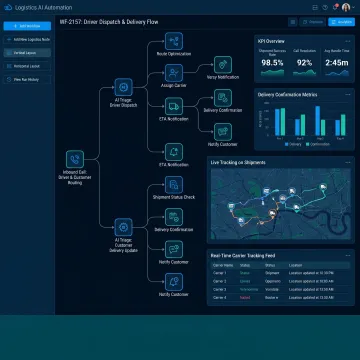
A logistics agent coordinates communication and tasks related to moving goods efficiently. That can include shipment updates, dispatch coordination, appointment scheduling, issue escalation, customer communication, and recordkeeping. An AI voice agent supports these functions by handling repetitive calls, collecting information, routing conversations, and syncing outcomes into existing systems so human teams can focus on exceptions and higher-value decisions.
Is there an AI for logistics?
Yes, AI is increasingly used in logistics for routing, forecasting, tracking, customer communication, and workflow automation. Dograh AI applies voice automation to logistics operations by handling calls for shipment status, scheduling, support, and follow-ups. This helps reduce manual call volume, improve response speed, and maintain consistent communication across customers, drivers, carriers, and internal teams.
How can an AI voice agent help logistics operations?
An AI voice agent can automate routine conversations such as shipment status checks, appointment confirmations, dispatch updates, missed-call recovery, and support triage. It can answer calls 24/7, capture structured information, route urgent issues, and trigger downstream workflows. For logistics teams, that means fewer repetitive calls for staff, faster handling times, and more consistent communication during busy operational periods.
Can the voice agent integrate with our CRM or logistics tools?
Yes. Dograh AI supports deep CRM and tool integrations — including n8n, WhatsApp, SMS, email, Calendly, and many others. With MCP support now shipped, connecting to internal systems and tools is significantly faster, and agent platforms can spin up logistics voice workflows directly. Dograh also supports pre-call data fetch, pulling fresh shipment details or customer records from your CRM before each call so agents have the right context from the first second. Call data, notes, and outcomes sync automatically, keeping logistics records accurate and actionable.
Is Dograh AI suitable for regulated or security-sensitive environments?
Yes. Because Dograh AI is open-source and self-hostable, data never leaves your own infrastructure — eliminating the need for vendor compliance processing such as HIPAA, GDPR, SOC 2, or CCPA certifications entirely. This makes procurement simpler and go-live faster, and is a particularly strong fit for data-sensitive industries and geographies. Teams can choose between cloud hosting, self-hosted open-source, or a fully managed private-cloud deployment — where Dograh builds the agent, deploys the entire infrastructure within your own cloud environment, and manages orchestration, upgrades, and reliability on your behalf.
How quickly can a logistics voice agent be deployed?
Deployment speed depends on workflow complexity, integrations, and script requirements, but Dograh AI is built for rapid setup with a working bot deployable in under 2 minutes. Teams can use the no-code visual workflow builder, prebuilt flows, and expert consultation to accelerate implementation. Dograh can also build and deploy voice agents end-to-end — including integrations with your CRM, calendar, automation tools, and other internal systems.
Can the system handle multilingual logistics conversations?
Yes. Dograh AI supports multilingual voice agents across 70+ languages using leading speech-to-text and text-to-speech providers, as well as speech-to-speech models like Gemini Flash Live that enable lower-latency, real-time voice interactions. This is useful for logistics environments where customers, drivers, vendors, or partners may prefer different languages. Multilingual support helps improve clarity, reduce friction in routine calls, and create more accessible communication across distributed operations and diverse service regions.
How do you test voice agents before they go live?
Dograh AI includes automatic QA and post-call analysis tooling — covering sentiment, miscommunication detection, activity detection, and strict adherence checks. Teams can also use AI testing personas to simulate realistic customer scenarios, test scripts, routing logic, and edge cases before launch. This helps refine performance, improve dependability, and reduce manual QA effort — especially valuable for high-volume logistics workflows.