Bland AI and Synthflow come up constantly in these evaluations. But they're not competing for the same buyer. One is an API-first platform built for engineering teams running high-volume outbound campaigns. The other is a no-code builder designed for faster deployment without developer involvement. Picking the wrong one wastes budget, delays launches, and creates technical debt that's painful to unwind.
This comparison covers pricing, deployment, reliability, integration depth, and the compliance trade-offs neither platform advertises prominently.
Key Takeaways
- Bland AI is API-first and developer-heavy — expect significant setup time even for basic call flows
- Synthflow is a no-code drag-and-drop builder built for SMBs and agencies that need fast deployment
- Bland's per-minute rates start at $0.11–$0.14/min; Synthflow's PAYG model typically runs $0.15–$0.24/min
- Both platforms are closed-source and cloud-hosted — your data lives on their infrastructure, not yours
- For data sovereignty, self-hosting, or regulated industries, an open-source alternative like Dograh AI is worth considering
Bland AI vs. Synthflow: Quick Comparison
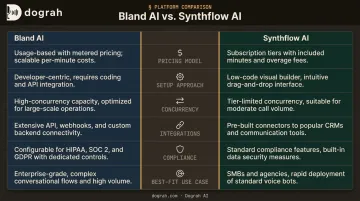
| Dimension | Bland AI | Synthflow AI |
|---|---|---|
| Pricing model | $0.14/min (Start), $0.12/min + $299/mo (Build), $0.11/min + $499/mo (Scale) | PAYG: $0.15–$0.24/min depending on components; Enterprise custom |
| Free start | 2 free credits, no card required | Free to build/test; charges begin at deployment |
| Concurrency | 10 (Start) / 50 (Build) / 100 (Scale) | 5 default; +$20/mo per additional unit |
| Setup approach | API-first — requires cURL, Python, or JavaScript | No-code drag-and-drop visual builder |
| Integrations | Twilio, Zapier, Custom API, webhooks | HubSpot, Salesforce, GoHighLevel, Cal.com, Zapier, Make, ElevenLabs, Twilio, Telnyx, RingCentral, 200+ total |
| Compliance | SOC 2 Type I & II, HIPAA-eligible (BAA), GDPR, PCI DSS | ISO 27001:2022, SOC 2, PCI DSS v4.0.1, HIPAA, GDPR |
| Data hosting | Cloud by default; Enterprise On-prem/VPC option | Managed cloud SaaS; Enterprise on-premise/geo-based hosting |
| Customer support | Limited — primarily async, user-reported unresponsiveness | Async support; user-reported reliability and response issues |
| Best-fit use case | Developer-led enterprise outbound at scale | Non-technical teams, SMBs, agencies needing fast deployment |
One shared limitation applies to both: Both platforms are closed-source. Without an Enterprise contract, your call data, agent configurations, and transcripts live on their infrastructure — not yours. For healthcare, finance, legal, and GDPR-regulated businesses, that's a procurement blocker, not just a preference.
What Is Bland AI?
Bland AI is a developer-first phone calling platform built for enterprises automating inbound and outbound calls through a programmable API. The positioning is explicit — their own docs call it an "API-first platform" — and that shapes every aspect of the product experience.
Technical Capabilities
The platform's strengths are well-suited for engineering teams:
- Voice cloning — create custom voices from audio samples via API
- Conversational Pathways — node-based call flows with Webhook, Knowledge Base, Transfer Call, and End Call nodes
- Custom Tools — mid-call API actions that let agents interact with any web API, update CRMs, or schedule appointments during a live call
- Twilio integration — bring-your-own Twilio numbers with hand-off back to Twilio Studio Flow
- Zapier integration — triggered by post-call webhooks, routes transcript data and outcomes downstream
Pricing
| Plan | Per-minute | Platform fee | Concurrency | Calls/day |
|---|---|---|---|---|
| Start | $0.14/min | $0 | 10 | 100 |
| Build | $0.12/min | $299/mo | 50 | 2,000 |
| Scale | $0.11/min | $499/mo | 100 | 5,000 |
| Enterprise | Custom | Custom | Custom | Custom |
All plans include LLM, STT, and TTS — no provider pass-throughs. Call transfers cost an additional $0.03–$0.05/min depending on tier (free with bring-your-own Twilio).
Bland AI Strengths
- Handles high call volume: 100 concurrent calls on the Scale tier supports enterprises dispatching thousands of calls daily
- Precise conversation logic: Custom Tools, Pathway nodes, and direct API access let engineering teams control every branch without platform constraints
- Bundled pricing: LLM, STT, and TTS are included — no hidden provider markups
Bland AI Limitations
The platform's developer-first design creates real barriers for anyone without a dedicated engineering team. Basic call flows require JavaScript, Python, or cURL — there's no visual builder for non-technical iteration.
Reddit users in the r/AI_Agents community have described the company as "mind blowingly unresponsive" and reported that knowledge bases were wiped overnight without warning.
Voice quality is a separate concern. Independent testing found Bland's voice sounded "bot-like," with long pauses causing most calls to drop within 20–30 seconds. For a platform built around high-volume outbound calling, that's an operational risk worth pricing in before you commit.
What Is Synthflow AI?
Synthflow is a no-code AI voice agent platform founded in Berlin in 2023. It raised a $20M Series A in June 2025, bringing total funding to $30M, and had processed over 45 million calls by mid-2025 according to TechCrunch. The product targets non-technical teams and agencies that need voice agents live quickly — without waiting on developer availability.
Technical Capabilities
- No-code drag-and-drop builder — visual interface for building conversation flows
- Voice integration — ElevenLabs for voice enhancement and cloning
- 200+ integrations — HubSpot, Salesforce, GoHighLevel, Cal.com, Zapier, Make, Freshworks, Zendesk, Telnyx, RingCentral, Vonage, WhatsApp
- Multilingual support across multiple languages
- Pre-built templates for common use cases
- Compliance certifications: ISO 27001:2022, SOC 2, PCI DSS v4.0.1, HIPAA, GDPR
Pricing
Synthflow has moved away from fixed subscription tiers toward a component-based PAYG model:
| Component | Cost |
|---|---|
| Voice Engine | $0.09/min |
| GPT-4.1 mini | +$0.02/min |
| GPT-4.1 | +$0.05/min |
| Synthflow-managed Twilio | +$0.02/min |
| Performance Routing | +$0.04/min |
| Global Low Latency Edge | +$0.04/min |
| Phone number | $1.50/month |
| Extra concurrency unit | $20/month |
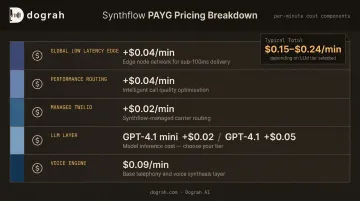
Default concurrency is 5 — meaningfully lower than Bland's baseline offerings. A typical PAYG setup lands between $0.15–$0.24/min once LLM and telephony are added.
Synthflow Strengths
- Fastest path to deployment: Non-technical teams can build and launch a working agent without any developer involvement — practical for SMBs and agencies without a dedicated engineering team
- Integration depth: 200+ out-of-the-box integrations eliminate the custom webhook work that Bland's setup typically requires
- Compliance certifications: ISO 27001, SOC 2, HIPAA, and GDPR coverage reduces procurement friction for mid-market buyers
Synthflow Limitations
User complaints cluster around a few recurring themes:
- Pricing surprises: Trustpilot reviewers have reported "bait-and-switch" pricing, charges after cancellation, and key features locked behind expensive enterprise tiers
- Account management friction: G2 users flagged no way to close an account from the dashboard
- Off-script brittleness: Agents reportedly struggle when conversations deviate from expected flows
The deeper issue is structural. Synthflow is a closed, managed SaaS platform, so your call data, agent configurations, and conversation history all sit on Synthflow's infrastructure. Compliance certifications cover security practices within their environment. They don't give you data ownership or portability.
Bland AI vs. Synthflow: Which Is the Better Fit?
These two platforms target different buyers with different priorities. They're not really competing for the same customer.
Here's how to decide which one fits your situation:
Situational Decision Guide
Choose Bland AI if:
- Your team has dedicated engineering resources comfortable with APIs
- You need maximum customization of conversation logic through custom tools and pathway nodes
- You're running high-volume outbound campaigns where per-minute cost efficiency matters at scale
- Speed of setup is less important than control over call behavior
Choose Synthflow if:
- You're a non-technical team or agency that needs voice agents live quickly
- HubSpot, GoHighLevel, or Cal.com integrations are core to your workflow
- You can accept a closed-platform trade-off for faster iteration cycles
- Call volume stays manageable enough that PAYG costs don't spike unpredictably
Neither platform is a good fit if:
- Your business handles sensitive data in healthcare, finance, legal, or GDPR-regulated industries
- You need self-hosting, data residency control, or audit trails you fully own
- You want to connect locally hosted LLMs, STT, or TTS models without vendor lock-in
- Budget predictability at scale matters — both platforms have cost structures that can surprise you
If any of those last four points apply to your situation, an open-source, self-hostable platform like Dograh AI is worth a closer look — it's built specifically for teams that need data sovereignty and flexibility without vendor lock-in.
What If Neither Fits? The Case for an Open-Source Alternative
The limitation both platforms share isn't a support complaint or a UI shortcoming — it's architectural. They're closed, cloud-hosted, and you have no ownership over the infrastructure that processes your call data. For healthcare providers, fintech companies, legal firms, and any business operating under GDPR, this isn't a minor trade-off. It's a procurement blocker.
HHS HIPAA guidance is clear: any cloud service provider that creates, receives, maintains, or transmits ePHI is a business associate — even if it only stores encrypted data. That means every platform in your vendor chain handling voice data needs a signed BAA and ongoing compliance monitoring.
Self-hosting removes the platform vendor from that chain entirely.
Dograh AI: Open-Source, Self-Hostable Voice Agent Platform
Dograh AI was built to close this gap. It's an open-source, self-hostable voice AI platform — a visual workflow builder (think n8n, but for voice agents) available under a BSD 2-Clause license on GitHub.
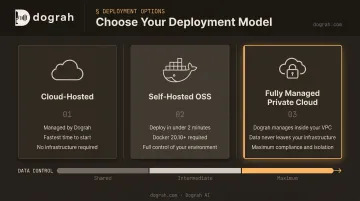
Three deployment options:
- Cloud-hosted — managed by Dograh, fastest to start
- Self-hosted OSS — deploy via Docker in under 2 minutes; Docker 20.10+ is the only prerequisite
- Fully managed private cloud — Dograh deploys and manages your entire voice agent infrastructure inside your own VPC; your data never leaves
Those deployment choices unlock capabilities that closed platforms can't match:
- Locally hosted models — connect Llama, Qwen, Whisper, Canary, Kokoro, Coqui, or Chatterbox directly, removing vendor dependency at the model layer
- Speech-to-Speech orchestration — using Gemini Flash Live and OpenAI GPT-Realtime-2, cutting end-to-end latency roughly in half versus traditional STT-LLM-TTS pipelines
- Hybrid pre-recorded + TTS — mix real human voice clips with TTS fallback in the same cloned voice, cutting costs up to 3× and delivering 2× better outbound conversions
- MCP support — agent platforms like Claude Code, OpenCode, and Codex can build and configure voice agents on Dograh directly
For regulated industries, the procurement impact is direct. When sensitive data never leaves your infrastructure, you're no longer processing it through a third-party vendor. Fewer vendors touching PHI or PII means fewer BAAs to negotiate, simpler internal security reviews, and faster go-live timelines.
Conclusion
The decision comes down to your team's profile:
- Bland AI fits engineering-heavy enterprises that prioritize API control and can absorb reliability risk at scale
- Synthflow fits business teams that need no-code setup and rich integrations, and can live with opaque billing in exchange for faster deployment
For organizations where data sovereignty, self-hosted deployment, or open-source auditability are non-negotiable, the comparison needs to go further. Dograh AI was built precisely for that use case — open-source under BSD 2-Clause, self-hostable via Docker, and available as a fully managed private-cloud deployment so your data never leaves your own infrastructure. If either closed platform leaves gaps your team can't work around, it's worth evaluating.
Frequently Asked Questions
Is Bland AI suitable for outbound calling campaigns?
Bland AI is built for high-volume outbound calling and supports up to 100 concurrent calls on the Scale plan. However, it requires developer setup even for basic flows, and user-reported issues with long pauses and dropped calls are worth testing against your specific use case before committing.
Does Synthflow AI support HIPAA and GDPR compliance?
Synthflow holds ISO 27001, SOC 2, PCI DSS, HIPAA, and GDPR certifications. That said, compliance certifications are not the same as data sovereignty — your call data and agent configurations still reside on Synthflow's managed cloud infrastructure, which matters for organizations requiring full data residency control.
Which platform is easier to set up for non-technical teams?
Synthflow is clearly more accessible. Its no-code drag-and-drop builder lets non-technical teams deploy working agents without any code. Bland AI requires JavaScript, Python, or cURL knowledge even for basic call flows.
How do Bland AI and Synthflow compare on pricing?
Bland AI runs $0.11–$0.14/min (all-in) with platform fees on paid tiers. Synthflow's PAYG model typically lands at $0.15–$0.24/min once LLM and telephony costs are included. Both diverge from advertised rates once volume, concurrency, and add-ons are factored in.
Can I self-host Bland AI or Synthflow?
Neither platform offers self-hosting at standard tiers — both treat on-prem and VPC deployment as Enterprise-only options. For organizations with strict data residency requirements, that means an enterprise negotiation, not a standard feature.
What's a good alternative if I need data sovereignty or open-source flexibility?
Dograh AI fits this use case directly. It's an open-source, self-hostable voice agent platform (BSD 2-Clause license) deployable via Docker in minutes, with fully managed private cloud options that keep your data within your own infrastructure. It connects locally hosted LLMs, STT, and TTS models with no vendor lock-in.