Introduction
Banking customers don't wait anymore. They expect instant answers at midnight, seamless handoffs between channels, and resolution on the first contact — every time. Traditional contact center models, built around human agents and rigid IVR menus, are cracking under that pressure.
The problem runs deeper than staffing costs. Banks are simultaneously facing tighter compliance scrutiny and rising cost-per-contact figures. According to McKinsey, 57% of customer-care leaders expect call volumes to keep climbing — and at one leading European bank, roughly half of all inbound calls were purely transactional queries that AI could handle.
Meanwhile, Gartner reports that 85% of customer service leaders planned to explore or pilot conversational AI in 2025. For banks, deployment is no longer the debate. The harder decision is choosing which vendor to trust with regulated customer data.
This guide profiles six leading AI consultants and platforms for banking customer service — assessed on how they handle regulated data, support voice and chat channels, and deliver measurable results in production.
Key Takeaways
- AI consultants for banking automate customer service, cut contact center costs, and maintain compliance — without sacrificing experience quality
- Voice AI and conversational AI are the fastest-growing deployment categories in banking customer service
- Top vendors bring banking-specific domain knowledge, compliance readiness, and proven deployments
- Key selection criteria: data sovereignty, deployment flexibility, multilingual support, and measurable ROI
- This list covers Dograh AI, IBM watsonx, Neurons Lab, NICE, Cognigy, Synechron, boost.ai, and Jinba
What Is AI Consulting for Banking and Customer Service?
"AI consulting for banking" covers a wide range. At one end, you have specialized consultancies that design and build custom AI systems tailored to a bank's specific workflows, regulatory environment, and tech stack.
At the other, you have purpose-built Voice AI and conversational AI platforms that banks deploy directly — with minimal professional services involvement — to automate inbound and outbound customer interactions at scale.
The Core Problems These Firms Solve
Banks turn to AI consultants and platforms for four recurring pain points:
- Long wait times — Customers abandoning queues, damaging satisfaction scores and retention
- High cost-per-contact — Human agents handling thousands of routine queries that AI can resolve in seconds
- Fragmented multichannel experiences — Inconsistent answers across phone, chat, and mobile app interactions
- Compliance overhead — Recording, logging, and auditing every AI interaction across regulated channels
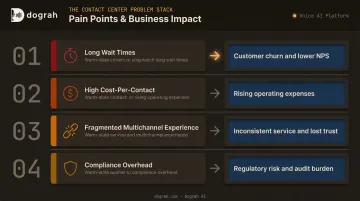
Each maps to a measurable business impact — churn, operating costs, regulatory risk, or NPS. The vendors profiled below are organized by which of these problems they solve best, and what kind of buyer they're built for.
Top AI Consultants and Platforms for Banking and Customer Service
The firms and platforms below were evaluated across five dimensions: banking-specific experience, compliance posture, voice and chat capabilities, deployment flexibility, and market presence.
Dograh AI
Dograh AI is an open-source, self-hostable Voice AI platform built by Y Combinator alumni — purpose-built for organizations that need production-ready voice agents without surrendering control over their data. It positions itself as the open-source alternative to closed platforms like Vapi and Retell, and is actively deployed in fintech, insurance, and financial services environments.
The platform's most significant differentiator for banking is its fully managed private cloud deployment option. Dograh AI's team builds and operates the entire voice agent infrastructure inside the customer's own cloud environment, so sensitive call recordings, transcripts, and customer data never leave the organization's infrastructure. This eliminates the vendor data processing requirements that GDPR Article 28, HIPAA, and SOC 2 frameworks typically impose — accelerating procurement and reducing compliance overhead significantly.
Additional technical differentiators include Speech-to-Speech orchestration that substantially reduces end-to-end latency, and a hybrid pre-recorded plus TTS voice feature that mixes real human voice clips with synthetic fallback in the same cloned voice — delivering meaningfully better outbound conversion rates at lower cost than pure TTS approaches.
| Feature | Detail |
|---|---|
| Key Features | Open-source under BSD 2-Clause license; visual no-code workflow builder; 70+ languages; MCP support for building agents from Claude Code; automated post-call QA and sentiment analysis; inbound and outbound voice agent support |
| Deployment Model | Self-hosted OSS (free), fully managed cloud, or fully managed private cloud within your own infrastructure — deployable in under 2 minutes |
| Best Suited For | Financial services and banking organizations in GDPR-regulated regions or data-sensitive environments requiring full data sovereignty and scalable voice automation |
Jinba
Jinba is a YC-backed, SOC 2 compliant AI workflow platform built for large regulated financial institutions - banks and insurers with 20,000+ employees that need deterministic, auditable automation. Where voice platforms handle the conversation layer, Jinba handles what comes after it: the KYC document processing, compliance checks, contract review, and loan underwriting workflows that run behind every customer interaction.
Its core differentiator is combining natural-language workflow generation with fully deterministic execution - workflows are 80% rule-based, producing consistent, auditable outputs by design. Jinba deploys on-premise or in air-gapped environments and is already in production at MUFG (Mitsubishi Bank). It is positioned as a faster alternative to failed Microsoft Power Automate and UiPath implementations, building governed workflows in days rather than months.
| Feature | Detail |
|---|---|
| Key Features | Chat-to-flow generation; visual workflow editor; on-premise and air-gapped deployment; SOC 2 Type II; version control, RBAC, SSO, audit logging; API/MCP/batch publishing |
| Deployment Model | On-premise, private cloud, or air-gapped; Japan and US markets |
| Best Suited For | Large banks and insurers replacing failed RPA/automation implementations - especially for KYC, compliance, contract review, and loan underwriting workflows |
IBM (watsonx)
IBM has served regulated financial institutions for decades, and its watsonx Orchestrate platform provides AI assistants and agentic workflows designed for complex governance environments, with specific positioning around financial services compliance and risk management.
IBM's own IBV research shows 61% of banking executives see fraud detection as a top AI value driver, with 52% citing cybersecurity — which reflects where IBM's strongest banking AI credentials lie. For customer service specifically, watsonx Orchestrate supports conversational agents across voice, chat, mobile, and web with full audit trail and compliance logging capabilities.
| Feature | Detail |
|---|---|
| Key Features | Conversational AI agents for customer support, self-service transactions, fraud alerts, and loan processing; omnichannel deployment; real-time sentiment analysis; full audit trail and compliance logging |
| Deployment Model | Enterprise SaaS and hybrid cloud; pre-built connectors to major CRMs and core banking platforms; pricing via IBM sales |
| Best Suited For | Tier 1 and large enterprise banks with complex governance requirements and existing IBM infrastructure |
Neurons Lab
Neurons Lab is a specialist AI consultancy focused exclusively on financial services and banking. Rather than selling a platform, they build custom AI systems — including NeuraChat for text-based agents, NeuraVoice for voice AI, and NeuraDoc for document automation covering KYC and onboarding workflows.
The firm holds AWS Generative AI Competency recognition, awarded in March 2024, and operates across London, Singapore, and ASEAN markets. Their model emphasizes deep regulatory knowledge across GDPR, PSD2, and local privacy frameworks, and they focus on building embedded AI Centers of Excellence within client organizations for long-term capability.
| Feature | Detail |
|---|---|
| Key Features | Bespoke conversational and voice AI systems; KYC and document automation; omnichannel support; embedded AI Centers of Excellence |
| Deployment Model | Custom-built engagements; project-based pricing; available across Europe, UK, and ASEAN |
| Best Suited For | Mid-market and enterprise banks needing deep customization, regulatory alignment, and long-term AI partnership rather than off-the-shelf tooling |
NiCE Cognigy
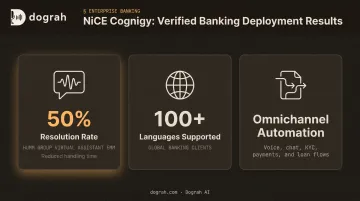
NiCE Cognigy represents the combination of NICE's contact center automation expertise with Cognigy's enterprise-grade conversational AI platform. NICE closed its ~$955M acquisition of Cognigy in September 2025, creating a unified platform for omnichannel voice and chat automation at scale.
Cognigy's banking credentials include a verified deployment with Humm Group, where its virtual assistant Emm achieved a 50% resolution rate and reduced average handling time through automated conversation lookup. The platform handles account inquiries, payment queries, lost-card flows, KYC tasks, and loan application assistance through AI agents supporting 100+ languages across global banking clients.
| Feature | Detail |
|---|---|
| Key Features | AI voice and chat agents; real-time data integration; emotion-aware escalation; FAQ and support workflow automation; multilingual support |
| Deployment Model | Cloud-based SaaS with enterprise licensing; available across North America, Europe, and global clients |
| Best Suited For | Banks requiring a scalable omnichannel contact center AI solution with strong out-of-the-box integrations |
Synechron
Synechron is a global financial services technology consultancy with 40 offices across North America, Europe, the Middle East, and APAC. The firm works with large banks on digital channel modernization, personalized customer journey design, and AI chatbot deployment for retail banking.
Its value proposition is the dual consulting-plus-technology model: Synechron doesn't just advise on AI strategy, it builds and deploys the systems. Their retail banking practice covers onboarding, digital channels, customer support automation, and predictive engagement — using behavioral data to anticipate customer needs before they escalate to a call.
| Feature | Detail |
|---|---|
| Key Features | Predictive analytics for customer behavior; AI chatbots for proactive engagement; personalized digital journey design; contact center optimization |
| Deployment Model | Project-based consulting and managed services; global delivery model across North America, Europe, and APAC |
| Best Suited For | Banks seeking both AI strategy consulting and implementation support to modernize customer experience end-to-end |
boost.ai
boost.ai is a purpose-built virtual agent platform for banks and credit unions, with a particularly strong track record in Nordic banking. Its NLU-powered agents handle high-volume FAQ resolution, self-service transactions, and internal IT and HR helpdesk automation — with minimal custom setup required to get to production.
The proof points are concrete. At Nordea, 12 AI agents across 4 markets achieved 90%+ in-scope resolution handling over 220,000 private-banking conversations per month. At SpareBank 1 SR-Bank, the Banki virtual agent automated 49.5% of B2C and B2B support, resolving 4 out of 5 questions without human intervention. DNB's customer-facing agent automates over 50% of incoming chat traffic, with internal staff-facing bots adding further efficiency across HR and IT.
| Feature | Detail |
|---|---|
| Key Features | NLU-powered virtual agents for FAQs, self-service, and IT support; prebuilt banking intent libraries; staff-facing automation; analytics and conversation reporting |
| Deployment Model | Cloud SaaS with modular pricing; available across Europe and North America; fast onboarding with prebuilt banking templates |
| Best Suited For | Banks looking for quick deployment, high-volume query automation, and proven ROI without heavy customization overhead |
How to Choose the Right AI Consultant for Banking
Selecting an AI consultant or platform for banking isn't purely a technology decision — it's a compliance and risk decision. Banks that evaluate vendors on general AI capabilities, without examining regulatory alignment first, routinely hit procurement delays or fail compliance audits before a single agent goes live.
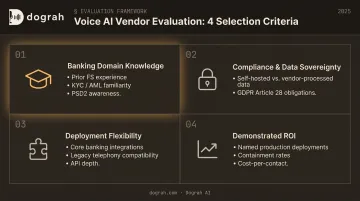
Banking-Specific Domain Knowledge
Prior work in financial services matters far more than general AI credentials. A vendor that understands core banking workflows designs systems that work within regulated constraints from the start — not after implementation begins.
Look for demonstrated experience with:
- KYC/AML requirements and automated verification flows
- Fraud escalation paths and real-time decisioning
- PSD2 open banking obligations and consent management
- Data residency rules across EU, UK, and APAC jurisdictions
Generalists typically discover these requirements mid-project, creating costly delays and rework.
Compliance and Data Sovereignty Posture
The critical question for any regulated bank is whether a vendor requires customer data to pass through their infrastructure. If it does, the bank inherits responsibility for that vendor's compliance posture under frameworks like GDPR Article 28.
Self-hosted or private cloud deployments — where all data stays within the bank's own infrastructure — eliminate this processing relationship entirely, which accelerates procurement and removes ongoing vendor audit obligations.
Deployment Flexibility and Integration Depth
The ability to connect with existing core banking systems, CRMs, and telephony infrastructure matters more than any feature list. Banks using legacy telephony stacks, older core systems with limited APIs, and complex network segmentation need vendors with proven integration patterns — not platforms that require a greenfield environment. Closed or rigid platforms also create long-term lock-in that limits future flexibility.
Demonstrated ROI with Measurable Outcomes
The best vendors can reference specific, named results: containment rate improvements, cost-per-contact reductions, onboarding completion rates. Pilot-stage claims and projected figures are common in vendor materials. Credible vendors point to production deployments with verifiable, named metrics — not forecasts.
Conclusion
The banks seeing real returns from AI aren't the ones that deployed the most feature-rich platform — they're the ones that matched vendor capabilities to their specific compliance environment, integration stack, and scale requirements before signing.
When evaluating options, weight how a vendor handles data governance and integration depth as heavily as feature breadth. A platform that automates 90% of inbound queries but requires sensitive data to leave your infrastructure may cost more in compliance overhead than it saves in contact center costs.
Those criteria — data sovereignty, integration flexibility, and deployment speed — are exactly where the deployment model matters most. For banks and fintech companies that need to keep sensitive data on-premise, Dograh AI offers an open-source, self-hostable path to production-ready voice agents, with fully managed private cloud options for regulated environments.
To explore the platform or discuss your specific deployment requirements, reach out at founders@dograh.com.
Frequently Asked Questions
What is the best practice for safe use of AI in a banking environment?
Maintain human oversight for any AI decision affecting regulated outcomes (lending, fraud, KYC). Ensure all customer data stays within compliant infrastructure, require full audit trails on every AI interaction, and select platforms with banking-grade governance controls and escalation logic built in.
Which are the four most important AI use cases in banking?
Customer support automation (balance inquiries, FAQs, account management), fraud detection and real-time alerts, loan and credit application assistance, and KYC/onboarding automation. Each delivers measurable ROI through shorter handling times, lower fraud losses, faster processing, and less manual document review.
What is the best conversational AI platform for banking?
It depends on your requirements. IBM watsonx suits large enterprises with complex governance needs; NICE Cognigy works well for omnichannel scale with prebuilt integrations. Dograh AI is the strongest fit for banks prioritizing voice-first automation with full data sovereignty and no vendor lock-in.
Can AI replace human agents in banking customer service?
Not entirely, and that's not the goal. AI handles high-volume tier-1 queries (balances, FAQs, fraud alerts, loan status) while human agents focus on complex, sensitive, or high-value interactions. The right model is augmentation — AI handles containable volume so agents can deliver better service where it actually matters.
What compliance standards should an AI platform for banking support?
GDPR, PSD2, SOC 2 Type II, PCI DSS, and ISO 27001 are the key frameworks. Self-hosted or private cloud deployments can eliminate vendor compliance overhead entirely — if the vendor never touches your data, their certifications become irrelevant to your procurement process.
How long does it take to deploy an AI voice agent for banking?
Off-the-shelf platforms with prebuilt banking templates can launch basic inbound or FAQ agents in days. Custom enterprise integrations connecting to core banking systems, CRMs, and legacy telephony typically take weeks to a few months, depending on API availability and integration complexity.