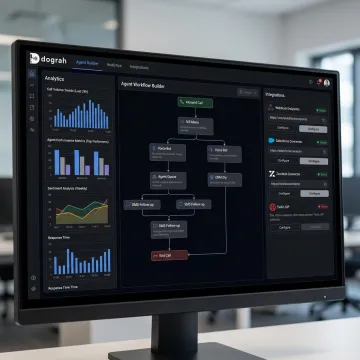
Workflow Builder
Design agentic workflows with a drag-and-drop interface, prebuilt templates, collaborative tools, and testing features that help teams move from concept to deployment faster.

Learn how Dograh AI helps teams design, deploy, and scale agentic workflows with open-source infrastructure, visual builders, and flexible deployment options. From workflow orchestration to real-time analytics and private-cloud control, this specialization is built for organizations that need production-ready AI agents without vendor lock-in or data sovereignty compromises.
Explore core capabilities for designing, deploying, integrating, and optimizing production-ready AI agent workflows.
Design agentic workflows with a drag-and-drop interface, prebuilt templates, collaborative tools, and testing features that help teams move from concept to deployment faster.
Connect agent platforms like Claude Code, OpenCode, Hermes, and Codex to build, configure, and launch AI agents faster inside existing internal systems.
Work with Dograh AI’s team to architect tailored AI agents and workflows aligned to your scripts, business logic, integrations, and operational goals.
Monitor workflow performance with live analytics that support rapid testing, refinement, and optimization across agent behavior, outcomes, and operational efficiency.
Deploy agent infrastructure inside your own cloud environment for stronger control, managed operations, and data residency aligned with sensitive enterprise requirements.
Self-host AI agents and workflows with auditable open-source infrastructure that gives your team transparency, customization, and freedom from platform lock-in.
Dograh AI helps organizations build agentic workflows that are practical, scalable, and production-ready. Teams can visually design flows, connect internal tools, deploy in cloud or self-hosted environments, and refine performance with live analytics. The result is faster implementation, stronger governance, and AI agents that fit real operational needs instead of forcing teams into rigid, closed platforms.

See how teams use Dograh AI to launch reliable, high-impact agent workflows.
Dograh AI combines open infrastructure, deployment flexibility, and builder-first product design for serious agentic systems.
Auditable BSD-licensed infrastructure gives teams transparency, customization, and freedom from vendor lock-in.
Production-ready agents can be deployed in minutes, accelerating testing and operational rollout.
Choose cloud, self-hosted OSS, or private cloud based on security and compliance needs.
Founded by experienced operators who built Dograh AI from real workflow and integration pain.
Experienced builders behind scalable AI agent systems.
Dograh AI was founded by Pritesh Kumar and Abhishek Kumar after firsthand frustration with rigid, closed Voice AI tools and low-code frameworks that still demanded heavy custom engineering. They built Dograh AI as an open-source alternative focused on speed, flexibility, and data control. Today, the platform supports appointment booking, inbound and outbound calling, and broader workflow automation through self-hosted OSS, managed cloud, and private-cloud deployments. The company’s vision is simple: businesses should be able to launch production-ready voice agents quickly, keep sensitive data within their own infrastructure, and avoid vendor lock-in. That builder-first mindset continues to shape Dograh AI’s product, support, and roadmap.
Start by defining the business objective, decision points, and systems the agent must access. Then map the workflow, add tools or integrations, set guardrails, test with realistic scenarios, and monitor outcomes after launch. Dograh AI supports this process with a visual workflow builder, MCP integrations, analytics, and flexible deployment options so teams can iterate quickly without rebuilding from scratch.
Talk with our team about architecture, deployment, and integrations.

Founder-backed startup pedigree and credibility.
Open-source licensing for transparent adoption.
Trusted deployment model for sensitive environments.
Share your use case, systems, and deployment goals. We’ll help you evaluate the right workflow architecture, integrations, and rollout path.
To help us assist you faster, please include the reason for your message so the relevant team can reach out as soon as possible.
To help us assist you faster, please include the reason for your message so the relevant team can reach out as soon as possible.