That choice shapes everything downstream, including time-to-market, ongoing engineering headcount, how much control you keep over your data, and your total cost over the next two years. Get it wrong, and you're either rebuilding for months or stuck on a platform that can't do what your business needs.
Here's why the plumbing matters more than it looks: practitioners building production voice AI in 2025 target roughly 800ms median voice-to-voice response time, with delays beyond that starting to feel unnatural to callers, according to Daily's engineering guidance on building voice AI. Hitting that number reliably, across noisy phone lines and mid-sentence interruptions, is where the real complexity lives.
This piece compares both paths on cost, complexity, and control, then walks through a founder's own experience of hitting this exact fork.
Key Takeaways
- Custom builds give you full control over models, latency, and data, but demand real STT/LLM/TTS orchestration expertise.
- Frameworks like Pipecat, LiveKit, Vapi, Retell, and Dograh AI cut time-to-production from months to days.
- Build custom when voice AI is your core product and your team owns infra; use a framework when speed and focus matter more.
- Compliance and data residency often tip the scale—self-hostable stacks keep audio and transcripts in-house.
- Open-source, self-hostable frameworks offer a middle path: framework speed with full data ownership.
Build From Scratch vs Framework: Quick Comparison
Four factors drive the call: time-to-live, cost shape, control, and who owns maintenance as you scale.
| Factor | From Scratch | Framework |
|---|---|---|
| Development time | Months of engineering for barge-in, streaming audio, and context management | Working agent live in days to a couple of weeks |
| Cost structure | Salaries + infrastructure; no platform fee, but the team is the ongoing cost | Usage or subscription pricing; lower upfront, meter runs with volume |
| Control & customization | Full ownership of every layer—models, latency, data flow—and full upkeep | Bounded by what the tool exposes; open-source narrows the gap vs. closed platforms |
| Maintenance & scaling | Permanent tax for STT/TTS/LLM updates and edge cases (interruptions, noise) | Vendors absorb model updates and infrastructure scaling |
What Is Building a Voice Agent From Scratch?
Building from scratch means writing your own orchestration layer: wiring speech-to-text, the LLM, text-to-speech, telephony, voice activity detection, and interruption handling together, without a pre-built abstraction doing it for you.
The payoff is complete control. You choose every model, tune latency at each hop, and decide exactly how data flows through your system. That level of control matters most when voice AI itself is your product's competitive moat, not a feature bolted onto something else.
The cost is operational. A cascaded voice pipeline (speech in, transcription, LLM response, speech out) involves at least 10 network traversals for a single response, according to Twilio's breakdown of core latency in AI voice agents.
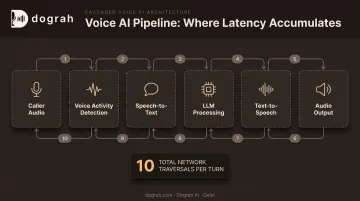
Every handoff introduces its own quirks: codec mismatches, buffering delays, reconnection handshakes, and provider-specific behavior that only surfaces under real call volume. Builders who've maintained these pipelines by hand often describe them as complex and brittle to keep running long-term.
There are two common flavors:
- Fully custom: You own every component — STT hosting, LLM inference, TTS engine, and the orchestration logic connecting them
- Partially custom: You use managed cloud STT/TTS APIs but write your own orchestration, state management, and interruption logic
This path makes sense when:
- Voice AI is your company's core product
- Data legally cannot leave your environment under any circumstance
- Backend integrations are proprietary enough that no framework has a hook for them
Use Cases of Building From Scratch
Those conditions show up most often among:
- Voice AI infrastructure startups building the next platform layer
- Defense and government contractors operating in air-gapped or classified environments
- Regulated enterprises where compliance rules out any third-party data touchpoint
One developer who built a full custom backend for a Python voice pipeline — wiring together STT, retrieval, LLM generation, and TTS across separate services — got it working, reaching close to a 1-second median voice-to-voice response.
Hitting that number required deploying three independent inference services, handling WebRTC and WebSocket connections manually, and geographically colocating services. It worked. It was also time-consuming to build and brittle to maintain as things scaled.
What Is Using a Voice Agent Framework?
Frameworks and platforms exist to abstract away the STT-LLM-TTS glue code. They standardize the pieces every voice pipeline needs—chunk-passing, context storage, streaming, model-swapping—so your team isn't rebuilding plumbing that dozens of other teams have already rebuilt.
The direct payoff is operational: faster time-to-market, lower ongoing maintenance, and the ability to swap a model provider without rewriting your pipeline from scratch.
Three distinct subtypes exist, and picking the wrong one matters:
- Open-source developer frameworks (Pipecat, LiveKit Agents): Give you orchestration primitives and real flexibility, but you still write meaningful custom code to reach production.
- Closed managed platforms (Vapi, Retell): Handle nearly everything for you, at the cost of flexibility and, in some cases, control over where your data lives.
- Open-source, self-hostable full-stack platforms (Dograh AI): Pair a visual, no-code workflow builder with self-hosting, giving teams framework-level speed without giving up data sovereignty.
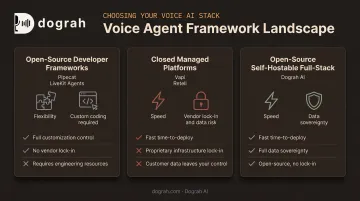
Watch for the trade-off buyers often miss: closed platforms can carry real data risk and vendor lock-in, since your call recordings, transcripts, and prompts live inside someone else's system. Pure open-source frameworks avoid that risk but still demand real engineering investment before they're production-ready. Full-stack, self-hostable platforms sit in that gap: faster path to production without surrendering data control.
When a Framework Fits
Frameworks and platforms suit rapid prototyping and MVP validation—especially for teams without dedicated ML or voice infrastructure expertise who need an agent live in days. That pattern shows up most in:
- Sales and customer support teams testing outbound or inbound call automation
- SMBs in healthcare, fintech, real estate, and hospitality that need a production-ready agent running in minutes, not months
- Contact center operators layering AI on top of existing telephony without touching their core infrastructure
Retell's managed platform charges $0.07 to $0.31 per minute depending on configuration, according to Retell's published pricing, with no separate engineering team required to keep the lights on.
For a team only validating whether voice AI fits their use case, that per-minute cost is often cheaper than months of engineering before the first live call.
Which Approach Should You Choose?
Four factors should drive this decision:
- Your team's existing ML and voice infrastructure expertise
- Your launch timeline and appetite for engineering risk
- Compliance and data residency requirements
- Whether voice AI is core to your product or a supporting tool
Choose building from scratch if:
- Voice AI is your core product or competitive moat
- Your data legally cannot leave your environment
- You need deep, non-standard integrations no framework reaches
Choose a framework or platform if:
- Speed-to-market matters more than owning every layer
- Lower engineering risk and maintenance outweigh custom control
Dograh AI's Founding Story
Dograh AI's founders hit this same fork while building a voice agent for the visa industry. Low-code frameworks like LiveKit and Pipecat needed heavy custom code just to get a working agent, and iterating on that code was slow.
Closed platforms fixed the speed problem but lacked flexibility and carried real data risk—sensitive applicant information would have lived in someone else's infrastructure.
Rather than compromise between "build everything ourselves" and "lock into a closed vendor," they built their own open-source, self-hostable platform: a visual workflow builder paired with full ownership of the stack.
Results that followed:
- Speech-to-Speech orchestration with models like Gemini Flash Live and OpenAI's GPT-Realtime-2—roughly half the end-to-end latency, stronger conversational reliability
- Hybrid pre-recorded human clips plus TTS fallback in the same cloned voice—up to 3× lower cost and 2× better outbound conversions
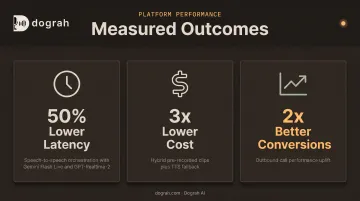
Open-source, self-hostable platforms sit in the middle: a production-ready voice agent in under 2 minutes, with full data sovereignty. If that split matches your constraints, try Dograh AI's open-source repository—or self-host it and time how long a live call actually takes.
Conclusion
There's no universal winner here. Choose based on what you optimize for:
- Own the stack if voice AI is your core product, or your data can't leave your walls at all—and accept the engineering cost
- Use a framework if speed and lower engineering risk matter more than owning every layer
Open-source, self-hostable platforms increasingly blur that line, giving you framework speed without surrendering data control. The choice affects time-to-market, total engineering cost, and whether sensitive call data stays in-house. The "build or buy" debate is turning into a different question: which framework gives you the most control, not whether to use one at all.
Frequently Asked Questions
How much does it cost to build an AI voice agent?
A fully custom build runs on engineering salaries and infrastructure, often a significant multi-month investment with no recurring platform fee. Framework or platform-based builds cost less upfront, typically $0.05 to $0.31 per minute depending on the provider, but that cost recurs with every call.
Which framework is best for building voice agents?
It depends on your priorities: Pipecat or LiveKit for maximum flexibility, Vapi or Retell for the fastest setup, or open-source self-hostable platforms like Dograh AI when you want speed plus full data control.
Which AI model is best for voice agents?
There's no single best model. Most teams test combinations of STT, LLM, and TTS providers against their own latency, cost, and quality targets. Speech-to-speech models are emerging as a lower-latency alternative to the traditional three-model pipeline.
How long does it take to build a voice agent from scratch compared to using a framework?
A custom build typically takes months of dedicated engineering. Framework or platform-based deployments usually go live in days to a couple of weeks.
Can I get full data control without building everything from scratch?
Yes. Open-source, self-hostable platforms let you deploy production-ready agents quickly while keeping all data inside your own infrastructure, removing the trade-off between speed and data sovereignty.
When does it actually make sense to build a voice agent completely from scratch?
Three scenarios justify it: voice AI is your core product, your data cannot leave your environment under any circumstance, or your integrations require non-standard system access no framework supports.