Introduction
Manual call reviews used to cover a sliver of what actually happened on the phones. A supervisor would sample a handful of calls, fill out a scorecard, and hope those calls represented the other 95% nobody heard.
AI call scoring changes that math. These systems use speech recognition, natural language processing, and large language models to transcribe, analyze, and grade every sales, support, or collections call against custom criteria. Scoring lands automatically, often within minutes of the call ending.
2026 marks a turning point: AI voice agents now handle live calls, and generative AI scores conversations on outcomes, not just script adherence. Knowing where the technology is heading matters as much as knowing what it does today.
This article breaks down the top AI call scoring trends for 2026, the forces driving them, their business impact, and what to watch for next.
Key Takeaways
- Scoring 100% of calls is now the baseline, not a premium add-on
- Live, in-call AI guidance turns scoring into real-time coaching
- LLM-powered outcome scorecards are replacing rigid script checklists
- Scoring now covers AI voice agents' calls, not just human reps
- Data sovereignty concerns are driving regulated industries toward self-hosted scoring
Key Trend 1: Full Call Coverage Becomes the Baseline, Not a Premium Feature
For decades, quality assurance meant sampling. A QA team might listen to 2-5% of calls each month, simply because grading transcripts by hand doesn't scale. Everything else went unheard.
That standard no longer holds. Modern ASR and NLP pipelines transcribe and grade every call within minutes of it ending, at a fraction of the cost of a human reviewer's time.
The Coverage Gap, Closed
Concentrix's quality team could only evaluate 5% of customer-agent calls before adopting speech analytics. After deploying Sestek's speech analytics platform to monitor 100% of calls, results included:
- Agent interruption rates dropped 86%
- Overall call-quality scores rose 7%
- Coverage jumped from a thin sample to every single conversation
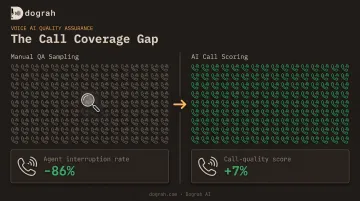
The gain is not only volume. It is what those unheard calls used to hide: a churn-triggering comment, a compliance slip, a rep going off-script under pressure. All of that stayed invisible in a 5% sample.
Full coverage means coaching decisions and compliance audits rest on complete data, not a biased slice that happened to get picked.
Key Trend 2: Real-Time, In-Call Scoring Moves Coaching from After the Call to During It
Scoring used to be a post-mortem. A rep would make a mistake on Monday and find out about it in a coaching session the following Thursday, long after the customer had hung up frustrated.
That timeline is collapsing. AI now listens to calls live, surfacing dynamic checklists, rebuttal prompts, sentiment alerts, and compliance warnings while the conversation is still happening.
What Live Guidance Actually Looks Like
Real-time scoring tools typically layer in:
- Dynamic on-screen checklists that update based on what's already been said
- Live sentiment alerts flagging when a caller's tone shifts negative
- Whisper coaching: quiet prompts only the agent hears, suggesting a next move
- Compliance nudges that fire the moment a required disclosure gets skipped
Hard numbers back this up. Mnet Health saw compliance rates climb from 30% to nearly 70% after deploying Balto's Real-Time Guidance paired with AI-driven reporting.
That more than doubles compliance adherence on the same calls, with the same agents—guidance at the right second instead of the wrong day.
A missed disclosure caught in a report three days later is a liability already logged. A missed disclosure caught mid-call is a problem that never happened.
Key Trend 3: Outcome-Based Scorecards Replace Rigid Script-Adherence Checklists
Old-school scorecards asked binary questions: Did the rep say the required greeting? Did they use the exact compliance phrase? Yes or no.
The problem: those checkboxes rarely correlated with what actually mattered. Did the customer's issue get resolved? Did they stay satisfied? Did the call drive revenue?
LLMs have changed what's possible to measure. Instead of hunting for exact phrases, modern platforms evaluate behaviors like tone, empathy, and resolution quality, then correlate them against real outcomes such as CSAT and retention.
From "Did They Say It" to "Did It Work"
Rather than a rigid script check, managers can now write plain-language questions an LLM evaluates directly, such as:
- Did the agent address the customer's underlying concern, not just their stated request?
- Was there a genuine attempt to de-escalate before the call ended?
- Did the resolution path match the customer's expressed urgency?
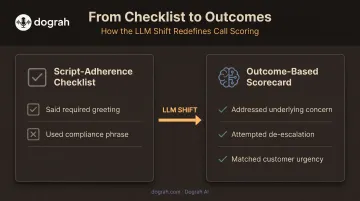
This shift toward LLM-evaluated resolution sentiment, escalation risk, and tone adherence moves past binary greeting checks. Gladia's research on modern call center QA points to that gap as the meaningful difference between old and new scorecards.
There's a catch worth naming honestly. Early LLM-based scorecards had a tendency toward a "yes bias," agreeing with whatever framing a question implied, even contradictory ones.
A 2026 study testing 14 LLM judges found some would answer "yes" to a proposition and its direct negation in paired framings. That's not a reason to abandon outcome-based scoring. It's a reason to calibrate scores against human judgment periodically, not blindly trust the first score a model returns.
Done well, this approach removes the arbitrary criteria agents have distrusted for years and ties every coaching conversation to something measurable instead of a checklist assumption nobody can defend.
Key Trend 4: AI Call Scoring Expands to Evaluate AI Voice Agents, Not Just Humans
Here's a shift that would have sounded strange five years ago: AI is now grading other AI.
As voice agents take on a growing share of inbound and outbound calls, the same quality lens applied to human reps now applies to machine-run conversations. Systems score interruption handling, sentiment, miscommunication, and adherence on calls where no human ever picked up the phone.
Why AI-on-AI Scoring Is Different
This goes beyond porting human QA onto machines. It creates a feedback loop:
- Scoring data reveals where a voice agent misread intent or interrupted mid-sentence
- Those insights get used to refine the agent's prompts, decision logic, and conversation branches — not just to coach a person
- Teams can adjust greeting language, add conditional branches for objections, or fix escalation triggers based directly on what the scoring surfaced
Dograh AI builds this directly into its open-source, self-hostable voice AI platform. Instead of bolting on a separate QA tool after deploying voice agents, Dograh's automated post-call analysis runs on every AI-handled call and detects four things:
- Sentiment — the emotional tone of the interaction
- Miscommunication — moments where the caller and the AI clearly misunderstood each other
- Activity — what actually happened during the call, for behavior and outcome review
- Strict adherence — whether the call followed the required process or rules
Because scoring lives inside the same workflow builder used to design the agent, teams can review flagged calls, then adjust an Agent Node's prompt or add a decision branch without exporting data to another platform first.
Dograh also runs AI-to-AI stress testing through LoopTalk, simulating customer personas before an agent ever takes a live call.
The math is unavoidable. At thousands of concurrent AI-handled calls, manual review can't keep up. Automated scoring is the only practical quality-control mechanism for human and AI conversations alike.
Key Trend 5: Data Sovereignty Pushes Regulated Industries Toward Self-Hosted Call Scoring
Healthcare providers, banks, law firms, and government agencies have a problem most retail businesses don't: they can't casually ship sensitive call transcripts to a third-party cloud vendor and hope for the best.
Regulatory exposure has real teeth. IBM's 2026 Cost of a Data Breach Report puts the global average breach cost at $4.99 million, up 12% year over year, with AI-related attacks up 56%.
Under HIPAA, a cloud provider that touches ePHI — even encrypted data it can't read — still counts as a business associate requiring a signed agreement and full risk analysis.
The Self-Hosted Response
Three patterns are emerging in response:
- Automated PII/PCI redaction in enterprise tools, masking names, card numbers, and other sensitive fields before storage
- Private VPC deployments that keep scoring workloads inside the customer's cloud boundary
- Open-source, self-hostable platforms that run transcription and scoring entirely on internal infrastructure
Dograh AI's approach reflects the self-hosted pattern. Its platform runs under a BSD 2-Clause open-source license, deployable via Docker on a company's own servers, VPC, or fully air-gapped environments with zero external data transfer. Regulated customers can choose:
- Self-hosted OSS — full control over data paths, retention, and audit logs, with no platform licensing cost
- Fully managed private cloud — Dograh operates the infrastructure, but it lives inside the customer's own cloud environment
- On-premises deployment — voice data, transcripts, and recordings never leave the organization's own data center
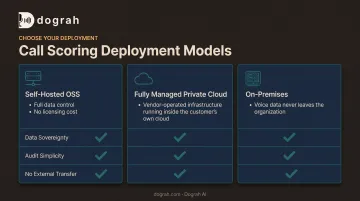
The upside isn't just data control. These organizations get fewer vendors in the audit scope, fewer BAAs and DPAs to negotiate, and no dependency on a third party's HIPAA, GDPR, or SOC 2 certification just to run call scoring.
What's Driving These AI Call Scoring Trends
A few forces are converging at once.
- Technology advances: LLMs and speech-to-speech AI made transcription and behavioral analysis fast and cheap enough to score every call in near real time.
- Market demand: Sales and support leaders want objective coaching data, not subjective manager notes. One supervisor grading 15 agents five times a month can burn a full workweek on evaluations alone.
- Cost pressures: Lean QA teams must do more with fewer analysts. Some organizations cut manual QA effort by as much as 75% after automating scoring.
- Regulatory influence: GDPR, HIPAA, and the EU AI Act's high-risk rules for worker-monitoring AI are forcing a rethink of where call data and scoring models live.
- Competitive dynamics: As AI voice agents spread, teams that don't score both human and AI-handled calls risk falling behind rivals who use that data to improve.
The market reflects this momentum. Speech analytics, the backbone behind much of this stack, is projected to grow from roughly $3.3 billion in 2024 to over $7 billion by 2029, driven largely by AI-powered scoring and analysis.
How These Trends Are Impacting the Call Center and Sales Industry
These shifts are already changing daily workflows, budget priorities, and team structures today.
Operational Impact
QA teams are shifting from manually grading transcripts to a different job entirely:
- Auditing AI-generated scores for accuracy
- Calibrating models against human judgment on a rolling basis
- Handling exceptions the AI flags but can't confidently resolve
Business Impact
Leadership is reallocating budgets accordingly. Rather than buying a scoring tool and a voice-agent platform separately, more organizations are purchasing both as one bundled workflow: scoring and agent-building under the same roof, feeding the same feedback loop.
Workforce Impact
Sales and support agent roles are shifting toward coaching-driven skill development, with performance data now visible to the agents themselves. Tier-1 QA analyst roles are evolving too: less time grading calls one by one, more time on AI calibration and quality strategy.
Future Signals for AI Call Scoring
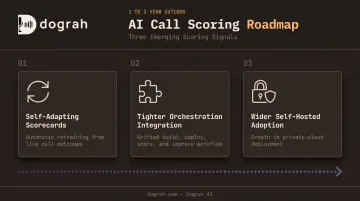
AI call scoring keeps evolving. Watch these shifts over the next one to three years:
- Self-adapting scorecards — frameworks that retrain as product messaging or customer sentiment shifts, without a manual rebuild every quarter
- Tighter orchestration integration — one system that builds, deploys, scores, and improves both human and AI conversations, instead of separate tools stitched together
- Wider self-hosted adoption — as AI data rules mature and vendor lock-in hits the board agenda, more enterprises will run scoring in private-cloud or self-hosted environments by default
Conclusion
AI call scoring in 2026 has moved well past its sampling-based, human-only origins. It's now a full-coverage, real-time, outcome-driven system: one that increasingly scores AI voice agents right alongside human reps.
Businesses adapting early are building a coaching and compliance advantage that's hard to close once competitors fall behind on manual sampling. The gap only widens as call volumes grow.
Choosing flexible, privacy-conscious platforms now, ones that don't force a tradeoff between scale and data control, will determine which teams scale confidently as AI-agent adoption keeps accelerating.
Frequently Asked Questions
What is AI call scoring?
AI call scoring is the automated evaluation of calls against custom criteria using AI, replacing manual sampling with full coverage. Every conversation gets graded within minutes of ending.
How does AI call scoring work?
AI call scoring transcribes calls using automated speech recognition, then applies NLP and LLM-based analysis to grade behaviors against custom criteria. This runs automatically on every call, not a sample.
Can AI call scoring evaluate calls handled by AI voice agents, not just humans?
Yes. Scoring AI-handled calls is a core 2026 use case. Platforms like Dograh AI build scoring directly into the voice agent workflow, evaluating sentiment, miscommunication, and adherence on those calls.
Is AI call scoring accurate enough to replace human quality reviews?
Most modern tools reach high accuracy, but not perfect agreement with human graders. Teams still spot-check and calibrate AI scores periodically to catch edge cases.
Is AI call scoring compliant with data privacy regulations like GDPR and HIPAA?
Compliance depends on the deployment model. Cloud tools require vendor certifications and signed agreements, while self-hosted or open-source platforms keep data in-house by design.
How much does AI call scoring cost in 2026?
Pricing ranges from per-agent monthly fees and per-minute analytics charges to enterprise platform quotes. Self-hosted, open-source options can eliminate per-seat licensing costs entirely.