Introduction
Real estate doesn't run on business hours. A buyer sees a listing at 9 PM, calls the number on the sign, and moves on to the next agent when nobody picks up. Meanwhile, agents are juggling six active conversations, three pending showings, and an inbox full of leads they haven't had time to call back.
The math doesn't work. Buyers and sellers expect immediate, personalized responses — but human capacity is finite.
Conversational AI closes that gap. Voice agents and intelligent chat systems can hold two-way, context-aware dialogues with prospects around the clock, handling tasks like:
- Qualifying inbound leads before they go cold
- Answering property-specific questions instantly
- Booking and confirming showings automatically
- Following up with buyers after tours
- Managing tenant inquiries without agent involvement
Below are five specific applications real estate businesses are deploying heading into 2026 — with practical detail on how each one works and what it actually takes to implement.
Key Takeaways
- Voice AI calls new leads within seconds of form submission — no waiting, no cold leads
- Outbound AI works cold databases systematically, reactivating prospects agents had written off
- Automated scheduling handles the entire booking loop without back-and-forth
- Follow-up sequences run automatically after showings, reducing buyer drop-off between tours
- Tenant and property management inquiries get resolved 24/7 before reaching staff
Application 1: Automated Lead Qualification and Outbound Follow-Up
The Speed-to-Lead Problem
Speed of response is the single biggest variable in lead conversion — and most agencies are losing on it by a wide margin.
MIT/InsideSales research found that contacting a web lead within 5 minutes versus 30 minutes produced 100× higher odds of contact and 21× higher odds of qualification. A more recent InsideSales benchmark from 2021 reported that conversion rates were 8× higher when the first call happened within 5 minutes — yet fewer than 1% of attempts occurred in that window, and 77% of leads received no response at all.
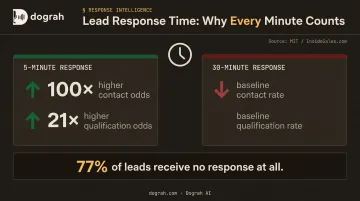
No agent can consistently call every lead within 5 minutes. A voice AI agent can.
How Outbound AI Qualification Works
When a prospect submits a form — on Zillow, the agency website, or a portal — a voice AI agent can call them within seconds. The conversation captures:
- Budget range and purchase timeline
- Preferred neighborhoods or property type
- Buyer vs. renter, pre-approved or not
- Level of urgency and motivation
That data flows directly into the CRM as a structured, scored lead profile — ready for an agent to pick up with full context.
The first 15 seconds of that call matter enormously. The AI needs to establish who it is, why it's calling, and create enough trust that the prospect stays on the line. This requires natural pacing, clean interruption handling, and a voice that sounds human — not robotic.
Dograh AI's hybrid pre-recorded + TTS feature addresses this directly. The system blends real human voice clips with TTS fallback in the same cloned voice — making outbound calls sound more natural than pure TTS. Dograh reports 2× better outbound conversions at up to 3× lower cost compared to traditional TTS-only approaches.
Lead Reactivation at Scale
Beyond new inquiries, voice AI can work through databases of cold leads — prospects who went quiet three, six, or twelve months ago. The agent references their previous search criteria, asks if priorities have shifted, and re-engages a portion that would otherwise remain permanently lost.
No rep needs to schedule these calls or track who to follow up with. Every interaction runs automatically, and all qualified data, call transcripts, and sentiment signals sync directly to the agent's CRM. Dograh AI integrates natively with Salesforce, HubSpot, and Zendesk — so agents pick up the conversation with full context already loaded.
Application 2: 24/7 Inbound Call Handling for Property Inquiries
The Cost of a Missed Call
Zillow's 2025 Consumer Housing Trends Report found that 47% of buyers hired the first agent they contacted, and 59% of sellers did the same. With 71% of buyers approaching only one or two agents total, missing an inbound call isn't a minor inconvenience — it's a direct revenue loss.
After-hours calls are where this matters most. A prospect who sees a listing at 9:30 PM isn't going to wait until morning.
What 24/7 Inbound AI Looks Like in Practice
A voice AI agent answers immediately, regardless of the time. In a single call, it can:
- Capture the caller's name and contact details
- Identify which listing they're calling about
- Answer common questions — price, square footage, availability, open house schedule
- Check showing availability and book a confirmed time slot
- Log the full interaction with notes and next steps
The agent wakes up the next morning with a confirmed showing already on the calendar. No missed opportunity, no follow-up required.
Multi-Language Coverage
For agencies serving diverse or international buyer markets, language is a meaningful barrier. NAR's 2025 International Transactions report recorded 78,100 foreign-buyer purchases of existing U.S. homes in a single year — up 44% from the prior period. In markets like Miami-Dade (75.3% non-English home language), Los Angeles County (55.1%), and Houston (47.1%), a monolingual inbound system excludes a substantial portion of potential buyers.
Dograh AI supports 70+ languages across its voice agents, so every caller — regardless of their first language — gets a complete, professional interaction from the first ring.
Intelligent Escalation
Broad language coverage solves reach — but not every call that comes in should stay with the AI. When a caller asks complex negotiation questions, raises legal concerns, or signals distress, the AI needs to recognize that and hand off cleanly. That means either transferring to a live agent or scheduling a callback — rather than attempting to respond alone. Dograh handles this through configurable condition nodes and warm transfer workflows that pass full conversation context to the human agent.
Application 3: Appointment Scheduling and Showing Coordination
Where Agent Time Goes
Scheduling is one of the most time-consuming administrative tasks in real estate — and one of the most automatable. According to the NAR 2024 Member Profile, scheduling listing presentations, closings, and appointments was among the top tasks delegated by agents who used personal assistants, cited by 55% of those with assistants. Only 23% of agent websites had any appointment scheduling capability at all.
Conversational AI closes that gap by automating the full scheduling workflow from first contact to confirmed booking.
The Autonomous Scheduling Loop
A voice or chat AI agent can handle the entire scheduling workflow without human involvement:
- Check availability against the agent's live calendar (Google Calendar or Outlook)
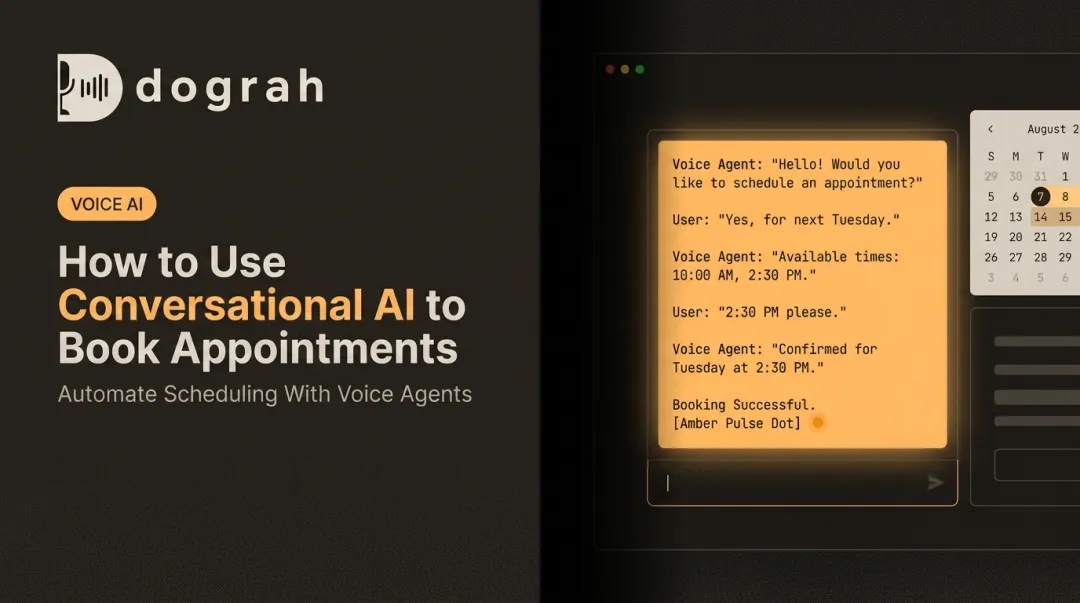
- Propose available times to the buyer during the call or chat session
- Confirm the booking and send calendar invites to both parties
- Send reminders via SMS or email before the showing
- Handle rescheduling requests when a prospect needs to change their time
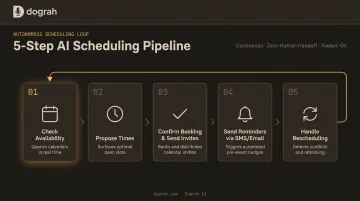
This triggers from a single inbound inquiry or automatically following lead qualification. The agent never double-books and maintains full calendar sync throughout.
For this to work reliably, the platform needs direct integration with the agent's calendar and ideally with MLS showing tools like ShowingTime, used by over 1 million real estate professionals across the U.S. and Canada.
Dograh AI's drag-and-drop workflow builder handles these connections out of the box — Google Calendar, Outlook, and major CRM-native scheduling systems — with 200+ additional app integrations for custom setups.
Application 4: Post-Showing Nurture and Lead Reactivation
The Drop-Off After Showings
Most buyers don't make an offer after the first tour. NAR data shows buyers spent a median 10 weeks searching for a home in 2025 — meaning the journey from showing to close is long, and follow-up persistence determines who converts.
InsideSales research found that 81% of sellers made five or fewer contact attempts, while making seven or more attempts increased connection rates by 15%. Most agents don't have the bandwidth to follow up with every prospect at that frequency.
Automated Post-Showing Sequences
A voice AI agent can follow up within hours of a showing — automatically, based on a time trigger in the workflow:
- Ask how the prospect felt about the property
- Answer any lingering questions about the listing
- Gauge current interest level and buying timeline
- Flag hot prospects for immediate agent attention
- Log the full conversation and update CRM lead status
Every prospect gets the same consistent follow-up, regardless of how full an agent's calendar is.
Reactivation for Silent Prospects
Automated sequences handle active prospects well — but the harder problem is the ones who go quiet. If a prospect hasn't engaged for two to three weeks after a showing, Dograh AI's inactivity-based triggers fire a reactivation call referencing the specific listings they viewed. The agent pulls prior conversation context to open with something like "Last time we spoke, you were focused on X — is that still your priority?" That specificity makes re-engagement feel personal rather than a generic check-in.
Each reactivation attempt automatically updates CRM fields — logging objection reasons, next-step dates, and escalation flags — so agents inherit a complete picture before any follow-up conversation.
Application 5: Tenant and Property Management Support
High Volume, Repetitive Inquiries
Property managers field the same questions repeatedly: rent payment confirmation, maintenance request status, lease renewal deadlines, move-in procedures. These are important to tenants but consume significant staff time, and none of them require human judgment to resolve.
AppFolio's 2025 AI report, based on 20+ hours of interviews with property management professionals, identifies communication as the primary AI application — with inquiry volume across phone, email, voicemail, and service calls cited as the main challenge.
Tier-1 Support Automation
A voice AI agent handles tier-1 tenant inquiries 24/7:
- Rent payment queries : confirm receipt or provide payment portal details
- Maintenance requests : log the issue, categorize priority, and route to the correct vendor
- Lease renewal questions : provide deadlines and renewal terms
- Move-in/move-out procedures : answer standard process questions
- Genuine emergencies : escalate immediately to on-call staff
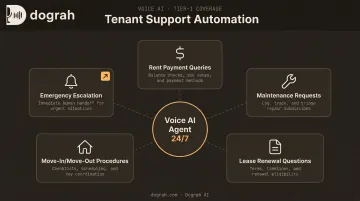
This functions as a first line of support that rarely requires human intervention for routine matters. JLL launched a similar natural-language property assistant in 2025 for retail, industrial, and office owners, integrated with Yardi, MRI, and other property management platforms. This shows the approach works in live deployments at scale. Platforms like Dograh AI enable the same pattern for property teams that want to deploy a working voice agent without building from scratch — handling inbound tenant calls, logging requests, and routing escalations automatically.
Commercial Real Estate Applications
The tier-1 automation pattern scales directly into commercial real estate, where inquiry volumes are higher and portfolios more complex. Conversational AI handles vendor coordination calls, access request processing, and tenant onboarding Q&A — cutting the administrative load that comes with managing multi-tenant portfolios. BOMA's 2025 property management AI work identified leasing, accounting, and procurement as the areas seeing the most AI-driven efficiency gains.
Choosing and Deploying a Conversational AI Platform for Real Estate
What to Evaluate
Not all platforms are equal for real estate use cases. The criteria that matter most:
- Voice quality and naturalness — particularly for outbound calls where a robotic tone kills conversations fast
- Latency — ITU-T G.114 recommends one-way delays below 150ms for acceptable voice quality; anything noticeably above that creates awkward pauses
- CRM and calendar integration depth — shallow integrations mean manual data cleanup
- Multi-language support — essential for diverse or international buyer markets
- Data privacy practices — real estate conversations involve financial data, contact information, and sensitive client details
Deployment Flexibility Matters
Shared-cloud platforms are fast to set up, but call data lives on a vendor's servers. Agencies in regulated markets — or those managing high-value client portfolios — face real compliance complexity as a result.
A self-hosted or private-cloud deployment keeps data entirely within the agency's own infrastructure. There's no vendor processing client conversations, which simplifies CCPA, GDPR, and NAR confidentiality obligations. In self-hosted deployments, there are no vendor compliance certifications to procure — no SOC 2, no GDPR data processing agreements — which cuts procurement timelines significantly.
Dograh AI as a Starting Point
Given those deployment requirements, Dograh AI is worth evaluating as a starting point. It's an open-source, self-hostable voice AI platform built for inbound and outbound calling automation. For real estate, it offers:
- A working voice agent deployable in under 2 minutes
- Native CRM integration with Salesforce, HubSpot, and Zendesk
- Google Calendar and Outlook integration for scheduling automation
- Hybrid pre-recorded + TTS voice for more natural outbound calls
- 70+ language support for diverse buyer markets
- Three deployment options: shared cloud, self-hosted OSS (free, BSD 2-Clause license), or fully managed private cloud within your own infrastructure
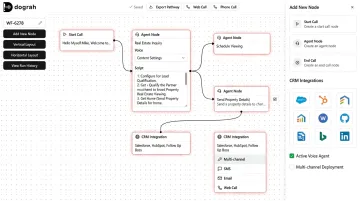
It's an open-source alternative to closed platforms like Vapi and Retell — with full data sovereignty for agencies that need it.
Frequently Asked Questions
How can conversational AI help real estate agents?
Conversational AI handles the repetitive tasks that eat into agent capacity: qualifying leads, answering property inquiries, booking showings, and following up after tours. Agents can then focus on negotiations, client relationships, and closings — where human judgment actually matters.
How is AI being used in commercial real estate?
Commercial property managers use conversational AI for tenant inquiries, vendor coordination, access requests, lease renewal outreach, and investor communication. The scale of commercial portfolios — where one manager often oversees dozens of tenants — makes automation especially valuable for handling high inquiry volume without growing headcount.
What form of AI is most commonly used in real estate?
Chatbot-based text AI has historically been most common, but voice AI is gaining adoption quickly given how phone-centric real estate transactions are. Many agencies now deploy both — chat AI for website and portal inquiries, voice AI for inbound calls and outbound follow-up sequences.
Can AI generate real estate listings?
Generative AI can draft listing descriptions, but that's a different category from conversational AI. Conversational AI refers specifically to interactive dialogue systems used for lead engagement, inquiry handling, and scheduling — not content generation. The two are complementary but distinct tools.
What is the difference between a chatbot and conversational AI in real estate?
Rule-based chatbots follow fixed decision trees and break easily when users ask something unexpected. Modern conversational AI uses natural language processing and large language models to handle open-ended, unpredictable dialogue — meaning it can respond to questions it wasn't explicitly programmed for. Most real estate voice agents deployed today fall into the latter category.