The tradeoffs are real: latency compounds across every vendor hop, data sovereignty requirements can disqualify entire categories of platform, and the advertised per-minute rate rarely reflects what you'll actually pay in production once LLM, STT, TTS, and telephony costs stack up.
This guide evaluates 9 Voice AI APIs across three architecture types — full-stack carrier-owned platforms, developer-facing orchestration layers, and no-code/workflow builders — with a selection criteria breakdown and pricing transparency you can actually use.
Key Takeaways
- Dograh AI — Best open-source, self-hostable platform with hybrid pre-recorded + TTS and full data sovereignty
- Vapi — Best for rapid prototyping with bring-your-own LLM and voice model
- Retell AI — Best for configurable inbound/outbound flows with strong post-call analytics
- Bland AI — Best for developer teams running high-volume outbound campaigns
- Telnyx — Best for production voice AI on a carrier-owned full stack with sub-200ms RTT
- Twilio — Best for teams already in the Twilio CPaaS ecosystem needing voice AI on existing infrastructure
- ElevenLabs — Best for voice quality and multilingual realism in AI-generated speech
- Synthflow — Best no-code option for non-technical teams deploying voice agents quickly
- JustCall — Best full-stack business calling platform with built-in AI coaching and CRM sync
What Is a Voice AI API for Calling?
A Voice AI API for calling is a programmable interface that connects telephony (inbound/outbound PSTN or SIP), speech-to-text, an LLM reasoning layer, and text-to-speech — enabling AI agents to hold real-time phone conversations without human agents.
Three architectures dominate the market:
| Architecture | Description | Trade-off |
|---|---|---|
| Full-stack | Telephony + inference + speech on one bill (e.g., Telnyx) | Lowest latency, least flexibility |
| Orchestration layer | BYO LLM + third-party telephony (e.g., Vapi, Retell) | Flexible, but costs stack |
| Component API | STT-only or TTS-only (e.g., ElevenLabs TTS) | Plugs into a larger stack |
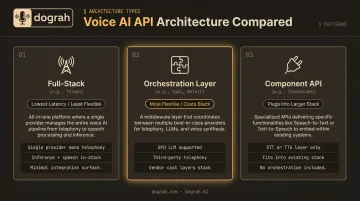
Architecture choice directly affects call quality. Each additional vendor hop adds 20–50ms of latency, and in a stitched multi-vendor stack, total end-to-end latency can reach 600ms–1,700ms. Carrier-owned stacks eliminate most of those hops by design.
According to MarketsandMarkets, conversational AI is projected to grow from $17.05B in 2025 to $49.80B by 2031 at a 19.6% CAGR. Gartner predicts agentic AI will autonomously resolve 80% of common customer service issues by 2029.
9 Best Voice AI APIs for Outbound & Inbound Calling
These nine APIs were selected for their ability to handle real production calling workloads. Evaluation criteria:
- Latency — end-to-end response time under real call conditions
- API completeness — inbound and outbound support, not just one direction
- Developer experience — documentation quality, onboarding speed, tooling
- Compliance — HIPAA, GDPR, SOC 2 availability and pricing
- Pricing transparency — total cost of a production stack, not just the headline rate
Dograh AI
Dograh AI is an open-source, self-hostable Voice AI platform — think n8n, but for voice agents — built for teams that need production-ready inbound and outbound calling with full data sovereignty and no vendor lock-in. It came out of the founders' own frustration: existing platforms either required heavy custom code or carried real data risk.
Three capabilities separate it from the field:
- Hybrid pre-recorded + TTS — the only platform mixing real human voice clips with TTS fallback in the same cloned voice, cutting costs up to 3× and delivering 2× better outbound conversions
- Speech-to-Speech orchestration — across Gemini Flash Live and OpenAI GPT-Realtime-2, targeting sub-600ms end-to-end latency
- MCP support — agent platforms like Claude Code can build and spin up voice agents directly, cutting agent setup time from hours to minutes
| Category | Details |
|---|---|
| Key Features | Visual no-code/low-code workflow builder; hybrid pre-recorded + TTS; Speech-to-Speech orchestration; MCP support; 100,000 concurrent agents; automated post-call QA; 70+ languages; Twilio, Telnyx, Vonage telephony integrations; locally hosted model support (Llama, Whisper, Mistral, and others) |
| Pricing | Open-source self-hosted: free under BSD 2-Clause license. Managed cloud and fully managed private cloud: contact for details |
| Best For | Data-sensitive businesses (GDPR, HIPAA, finance, legal, healthcare), developers wanting open-source control, and any team prioritizing outbound conversion with lower TTS costs |
A notable compliance advantage: when self-hosted, Dograh never processes your data — eliminating the need for a vendor HIPAA BAA or GDPR DPA from Dograh itself. Your compliance surface shrinks to only the third-party STT/TTS/telephony services that actually touch your data.
Vapi
Vapi is a developer-first voice AI orchestration platform letting teams connect their own LLM, voice engine, and telephony provider through a clean API — one of the fastest paths from idea to a ringing phone.
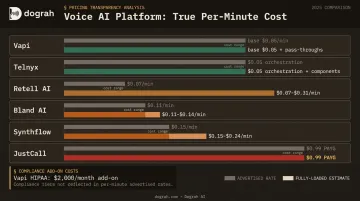
Highly modular BYO-everything architecture with strong function calling and webhook support. A visual workflow builder was added in 2025. Watch the cost stack carefully: the advertised $0.05/min platform rate has LLM, STT, TTS, and telephony costs passed through separately. HIPAA compliance is available but priced at $2,000/month.
| Category | Details |
|---|---|
| Key Features | BYO LLM + voice + telephony; function calling mid-conversation; visual workflow builder; real-time webhooks; 10 concurrent calls included |
| Pricing | $0.05/min platform fee + pass-through model costs; HIPAA add-on $2,000/month; zero data retention add-on $1,000/month |
| Best For | Technical teams prototyping custom voice pipelines quickly |
Retell AI
Retell AI is an LLM-powered voice agent platform for building, deploying, and monitoring inbound and outbound phone agents — known for its proprietary turn-taking model and strong post-call analytics.
Configurable interruption handling and barge-in detection produce natural conversations. Post-call analysis scores 100% of calls with sentiment, resolution tracking, and custom dashboards. HIPAA BAA is self-serve — every account, including pay-as-you-go, can be HIPAA-eligible.
| Category | Details |
|---|---|
| Key Features | Drag-and-drop agentic flow builder; warm transfer with full context; post-call analysis; CRM integrations; self-service HIPAA BAA |
| Pricing | $0.07–$0.31/min for AI Voice Agents; example production stack ~$0.11/min (LLM $0.04 + infra $0.055 + TTS $0.015); $10 free credits for new users |
| Best For | Support and sales teams needing production-grade call automation with strong analytics |
Bland AI
Bland AI is a developer-focused voice infrastructure platform for building custom phone agents via API, with pathway-based call logic and high-volume outbound calling support.
Conversational Pathways enables complex if/then branching and agent handoffs. There's no visual builder — this platform requires full API fluency. Enterprise tier supports unlimited concurrent calls.
| Category | Details |
|---|---|
| Key Features | Pathway-based conversation logic; high-concurrency outbound; proprietary TTS; SOC 2/HIPAA/GDPR |
| Pricing | Start: $0/month at $0.14/min (10 concurrent, 100 calls/day); Build: $299/month at $0.12/min; Scale: $499/month at $0.11/min; Enterprise: custom |
| Best For | Developer teams running high-volume outbound campaigns requiring precise call flow control |
Telnyx Voice AI API
Telnyx is a carrier-owned full-stack platform running telephony, LLM inference, STT, and TTS on its own private backbone — one of the only providers where the audio path, inference path, and speech path are co-located.
Telnyx claims sub-200ms audio RTT by co-locating GPU inference with telephony points of presence. It operates as a licensed carrier in over 30 markets. The single-bill architecture eliminates the multi-vendor latency tax entirely.
| Category | Details |
|---|---|
| Key Features | Carrier-owned network; co-located LLM inference; full call control (SIP, DTMF, warm transfers, recording); SOC 2/HIPAA/PCI/GDPR |
| Pricing | Voice AI orchestration $0.05/min; Call Control $0.002/min; TTS from $0.000009/character; LLM inference varies by model |
| Best For | Production teams needing carrier-grade reliability, lowest latency, and global PSTN reach |
Twilio
Twilio is the largest CPaaS by adoption with mature SIP, PSTN, and programmable voice APIs — but it does not run native LLM inference, requiring teams to integrate a third-party model layer (OpenAI Realtime API, Anthropic via LiteLLM, etc.).
The ecosystem breadth and developer familiarity are hard to match. Twilio's Conversation Relay and Media Streams make third-party LLM integration documented and well-supported. The trade-off is a multi-vendor architecture that adds latency and stacks costs.
| Category | Details |
|---|---|
| Key Features | Mature SIP trunking; global number provisioning; large SDK/integration ecosystem; Twilio Studio; ConversationRelay |
| Pricing | US outbound $0.0140/min; US inbound $0.0085/min; ConversationRelay $0.07/min; Generative AI Virtual Agent $0.00283/second |
| Best For | Teams already standardized on Twilio extending into AI calling without switching vendors |
ElevenLabs Conversational AI
ElevenLabs is best known for producing the most natural-sounding synthetic voices on the market. Its Conversational AI API extends this into real-time voice agent capabilities, though telephony provisioning requires a third-party bridge (such as Twilio).
The voice library — 10,000+ voices across 70+ languages with strong emotional range — is the main draw. Official documentation claims sub-second responsiveness. Best used when voice naturalness is the primary differentiator, not telephony control.
| Category | Details |
|---|---|
| Key Features | Best-in-class TTS quality; 10,000+ voice library; 70+ languages; SOC 2; real-time streaming; Twilio integration for phone calls |
| Pricing | Free: 10k credits/month; Starter: $6/month (30k credits); Pro: $99/month (600k credits); Scale: $299/month (1.8M credits); Business: $990/month (6M credits) |
| Best For | Developers building voice-first products where voice naturalness and emotional quality are the top priority |
Synthflow
Synthflow is a no-code and low-code AI voice agent builder with a visual flow designer and white-label capabilities — designed for non-technical teams and agencies.
The fastest no-code path to a live agent, with 200+ integrations out of the box. A Global Low Latency Edge add-on ($0.04/min) targets sub-600ms latency. Off-script handling is weaker than LLM-native platforms, but for structured workflows it works well.
| Category | Details |
|---|---|
| Key Features | Visual drag-and-drop flow builder; 200+ integrations; white-label for agencies; SOC 2/HIPAA/GDPR; unlimited agents on enterprise |
| Pricing | Pay-as-you-go: $0/start, $0.09/min voice engine + LLM + telephony (typical stack $0.15–$0.24/min); Enterprise: contact for 10,000+ min/month |
| Best For | Agencies and non-technical teams building voice agents for clients without engineering resources |
JustCall AI Voice Agent API
JustCall is a cloud-based VoIP and AI voice platform offering a dedicated REST API for triggering outbound AI calls from configured agents — supporting dynamic variables for personalized conversations and dual inbound/outbound from a single agent.
The POST https://api.justcall.io/v2.1/voice-agents/calls endpoint is clean and purpose-built — E.164 number targeting and dynamic variable injection (caller name, appointment date, etc.) are built in. Consent management for compliant outbound is included.
| Category | Details |
|---|---|
| Key Features | REST API for outbound call initiation; dynamic variable personalization; dual inbound/outbound from single agent; CRM integrations; AI call analytics |
| Pricing | Pay-as-you-go: $0.99/min; Agent Lite: $99/month (100 min included); Agent Max: $249/month (300 min included); Custom for higher volumes |
| Best For | SMBs and sales/support teams wanting a full-stack business phone system with an outbound AI calling API |
How We Chose the Best Voice AI APIs
The Evaluation Framework
APIs were assessed across six criteria:
- Latency performance — targeting sub-800ms end-to-end (ITU-T G.114 sets 400ms as the one-way telecom standard; Telnyx's production benchmark identifies responses above 800ms as conversation-breaking)
- Native inbound and outbound API support — not all platforms handle both well
- Developer experience — documentation depth, SDK quality, webhook support
- Compliance coverage — HIPAA BAA access path, GDPR posture, SOC 2
- Pricing transparency at scale — fully loaded cost, not headline platform rate
- Integration ecosystem depth — telephony providers, CRMs, automation tools
The Pricing Trap
The most common mistake buyers make: choosing based on the advertised per-minute rate. Vapi's $0.05/min becomes something else entirely once LLM, TTS, STT, and telephony pass-throughs are added. Retell explicitly publishes a $0.07–$0.31/min range. Synthflow's typical PAYG deployments are estimated at $0.15–$0.24/min.
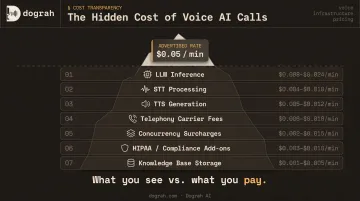
Always calculate fully-loaded cost — including concurrency fees, compliance add-ons, knowledge base charges, and transfer rates.
Data Sovereignty as a Selection Factor
For healthcare, finance, legal, and GDPR-region businesses, deployment model is not a preference — it is a procurement requirement.
Cisco's 2025 Data Privacy Benchmark Study found 90% of privacy and security professionals view local data storage as safer, and 64% worry about sensitive data leakage in GenAI systems. Self-hosted platforms like Dograh AI address this directly — when data never leaves your infrastructure, HIPAA BAA negotiations, SOC 2 vendor reviews, and GDPR data processing agreements are no longer part of the procurement process.
Outbound-Specific Criteria
For outbound calling specifically, evaluate:
- First-call answer rate behavior and initial greeting quality
- Interruption handling in the first 15 seconds (callers form impressions fast)
- Batch calling API support and DNC list integration
- Dynamic variable personalization for contact-level customization
Conclusion
The right platform depends on your architecture — pick the one that matches where you'll feel the pain first:
- Carrier-owned stack (Telnyx) — best for lowest latency and global PSTN reliability
- Orchestration layer (Vapi, Retell) — best for developer flexibility and rapid iteration
- High-volume outbound (Bland AI) — best for developer-led teams with structured call flows
- No-code agency builds (Synthflow) — best for non-technical teams and resellers
- Voice quality priority (ElevenLabs) — best when synthetic voice naturalness is paramount
- Open-source with data sovereignty (Dograh AI) — best for regulated industries, GDPR-region deployments, and teams that can't afford vendor lock-in
Before committing to any platform, calculate fully-loaded production cost, test compliance access paths, and stress-test latency under realistic call volumes — not just demo conditions. How a platform handles off-script conversations under load is the most reliable signal you'll get before signing a contract.
For teams that want open-source Voice AI with no vendor lock-in, self-hosting or private cloud deployment, and 2× better outbound conversions with hybrid pre-recorded + TTS — Dograh AI is free under the BSD 2-Clause license on GitHub, or start on the managed cloud at app.dograh.com.
Frequently Asked Questions
What is the best voice AI API for outbound and inbound calling?
The best choice depends on your deployment model and use case. Full-stack platforms like Telnyx own both telephony and inference for lowest latency, while open-source options like Dograh AI offer full data sovereignty and no platform fees. Developer-first APIs like Vapi provide rapid prototyping flexibility with bring-your-own components.
Which voice AI technology offers the best performance for scaling contact centers?
At contact center scale, "performance" means concurrent call handling, latency consistency under load, and post-call analytics quality. Platforms with elastic concurrency — Dograh AI, Retell AI, and Bland AI's enterprise tier — handle volume best. Always test at realistic call volumes before production commitment.
Who are the leading AI agents in voice AI?
The most recognized agent runtime platforms are Vapi, Retell AI, Bland AI, Telnyx, and Dograh AI. ElevenLabs and Deepgram function as component APIs — TTS and STT respectively — rather than full agent runtimes, and are often embedded inside the orchestration platforms above.
What is the difference between a voice AI API and a traditional IVR?
Traditional IVR uses DTMF menus, forcing callers through rigid numbered sequences. Voice AI APIs use LLMs to understand natural language, handle multi-turn conversations, execute tasks mid-call, and route based on intent. The operational difference shows up directly in first-call resolution rates.
How do I choose between a self-hosted and a cloud voice AI API?
Cloud APIs offer faster initial setup and managed infrastructure. Self-hosted options like Dograh AI provide full data sovereignty, no platform fees, and no vendor compliance overhead — meaning no HIPAA BAA or GDPR DPA required from the vendor. Your decision comes down to data sensitivity, geographic compliance requirements, and how fast you need to go live.
What latency should I expect from a voice AI API in production?
Natural conversation requires end-to-end latency below 800ms. Carrier-owned stacks like Telnyx claim sub-200ms audio RTT, while full-stack orchestration platforms like Retell and Dograh AI with Speech-to-Speech target 400–600ms. Multi-vendor stitched stacks often exceed 900ms under load, producing perceptible pauses that signal AI to callers before the conversation has started.