Introduction
Every business running a call center or phone-based workflow knows the pain: repetitive inbound queries answered by the same five agents, outbound teams burning hours on cold lists, and appointment reminder calls that never actually happen. Meanwhile, closed voice AI platforms promise automation but charge per-minute fees that compound fast, while processing every call recording on servers you don't control.
According to Grand View Research, the AI voice agents market sits at $2.54 billion in 2025 and is projected to reach $35.24 billion by 2033 — a 39% CAGR. The investment is accelerating because the economics of human-staffed phone operations don't scale.
Open source voice AI changes the equation. Instead of paying platform markups and accepting third-party data custody, businesses can now self-host a full STT → LLM → TTS pipeline on their own infrastructure — keeping call data private, eliminating vendor lock-in, and building exactly what their workflows require.
This guide covers how voice AI works, why open source matters, the technology stack available today, the top use cases, and how to choose the right deployment model for your business.
TLDR
- Voice AI automates calls using STT → LLM → TTS pipelines — not rigid IVR menus
- Open source tools let businesses self-host, keep data on-premise, and avoid per-minute platform fees
- Core components: Whisper/Voxtral (STT), Llama/Qwen (LLM), Kokoro/Coqui (TTS)
- Key use cases: customer support, lead qualification, appointment booking, post-call QA
- Deployment options — cloud, self-hosted, or private cloud — depend on data sensitivity and team capacity
What Is Voice AI for Business Automation
Beyond the Phone Menu
Voice AI agents are software systems that combine speech recognition, natural language processing, and large language models to hold genuine two-way phone conversations — autonomously. Traditional IVR systems follow rigid decision trees and break the moment a caller goes off-script. Voice AI agents don't.
Here's how the two approaches compare:
| Dimension | Traditional IVR | Voice AI Agent |
|---|---|---|
| Input handling | Keypresses, fixed keywords | Natural speech, any phrasing |
| Intent understanding | Menu-driven | Context-aware |
| Off-script behavior | Loops or fails | Adapts and responds |
| CRM integration | Rare | Native |
| Escalation | Blind transfer | Full transcript handoff |
McKinsey reports that 7 in 10 companies have IVR containment rates of 30% or less — meaning most callers give up or press zero before reaching resolution. Advanced analytics and deep learning applied to voice automation can improve customer satisfaction 5x and reduce live-agent call volume by more than 10%.
Why the Market Is Moving Now
Three forces are driving enterprise adoption:
- Always-on demand — customers expect 24/7 availability that human staffing can't provide cost-effectively
- Labor costs — human agents cost multiples of what automated calls cost per interaction
- Conversational quality — modern voice AI handles complex exchanges naturally; the uncanny valley problem is behind us
The broader conversational AI market is projected to reach $49.80 billion by 2031, with CRM integration, customer support automation, and cost reduction as the primary growth drivers.
Why Open Source Voice AI Is the Smarter Choice for Businesses
The Problem with Closed Platforms
Proprietary voice AI platforms like Vapi and Retell offer fast setup — but the business model creates structural problems at scale. As of mid-2025, Retell's published pricing runs $0.07–$0.31 per minute, and Bland AI lists $0.11–$0.14 per minute depending on tier. These per-minute costs add up fast.
More than pricing, closed platforms create three risks that buyers often underestimate:
- Vendor lock-in — your entire call workflow is built on a third party's API and product roadmap
- Data custody — call recordings and transcripts live on vendor servers, not yours
- Platform risk — if pricing changes or the platform shuts down, you lose everything you've built
The Data Sovereignty Case
For healthcare (HIPAA), financial services, legal, and businesses operating under GDPR — including the EU, UK, and Switzerland — allowing sensitive customer voice data to transit third-party infrastructure creates compliance complexity. HHS guidance confirms that HIPAA-covered entities may use cloud service providers to store or process ePHI only if they execute a HIPAA-compliant Business Associate Agreement with appropriate safeguards.
That BAA negotiation takes time. Every new vendor adds procurement overhead, legal review, and ongoing audit obligations.
Self-hosted open source eliminates this entirely. When the stack runs on your own infrastructure with locally hosted models, there is no third-party data processor: no BAA required, no DPA negotiation, no vendor audit to manage.
The Cost Advantage at Scale
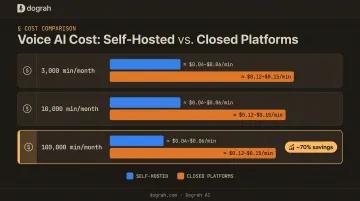
Compliance aside, the cost case is equally compelling. Based on internal cost modeling comparing self-hosted infrastructure against closed platform pricing:
| Monthly Volume | Self-Hosted (est.) | Closed Platform (est.) | Approx. Savings |
|---|---|---|---|
| 3,000 min/month | ~$0.04–0.06/min | ~$0.13–0.15/min | Moderate |
| 10,000 min/month | ~$0.04–0.06/min | ~$0.13–0.15/min | Significant |
| 100,000 min/month | ~$0.035/min | ~$0.12/min | ~70% |
At 100,000 minutes per month, closed platforms run roughly $12,000/month while self-hosted infrastructure costs approximately $3,500/month. The break-even point typically falls around 50,000–100,000 minutes depending on call length and model choices.
Customization and the Dograh AI Origin Story
Open source platforms let teams swap individual components without waiting on a vendor's roadmap. Replace one STT model with a better-performing one, plug in a locally hosted LLM, add custom compliance logic — no support ticket needed.
That flexibility is exactly why Dograh AI exists. The founders were building a voice agent for the visa industry when they hit the same wall many builders hit: low-code frameworks like LiveKit and Pipecat required heavy custom code and made iteration slow, while closed platforms lacked flexibility and carried real data risk. That frustration led directly to building Dograh AI — an open-source, self-hostable voice AI platform under BSD 2-Clause license, built on the premise of being "like n8n, but for voice agents and AI calling."
The Open Source Voice AI Technology Stack
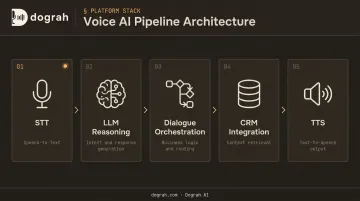
Every voice AI interaction runs through the same real-time loop:
- STT — Speech-to-Text converts the caller's speech to text
- LLM reasoning — the language model interprets intent and generates a response
- Dialogue orchestration — business logic, compliance rules, and workflow routing applied
- CRM/knowledge-base integration — relevant context retrieved in real time
- TTS — Text-to-Speech converts the response back to natural audio
Speech-to-Text Options
The STT layer determines transcription accuracy and latency. Key open source options:
- OpenAI Whisper — trained on 680,000 hours of multilingual data, supports ~100 languages, multiple model sizes for speed/accuracy tradeoffs, fully self-hostable
- Voxtral (Mistral) — newer multilingual model that Mistral reports outperforms Whisper large-v3 in published comparisons
- NVIDIA Canary — ranks at the top of the Hugging Face Open ASR Leaderboard with a reported 6.67% average WER
Self-hosting any of these eliminates per-call API costs. OpenAI's Whisper API charges $0.006/minute; at 100,000 minutes that's $600/month just for transcription before anything else.
LLM Options
The LLM is the reasoning layer — it decides what the agent says next. Proven self-hostable options:
- Llama 3.1 (Meta) — available in 8B, 70B, and 405B; optimized for multilingual dialogue
- Llama 3.2 — lighter 1B and 3B models for lower-latency or edge deployments
- Qwen2.5/Qwen3 — dense models from 0.5B to 72B, strong multilingual performance, released through April 2025
Locally hosted LLMs mean zero data leaves the environment. For voice agents handling 45-minute complex conversations — which Dograh AI supports while maintaining full context — model selection and hardware sizing directly affect response latency, context retention, and infrastructure cost.
For teams prioritizing the lowest possible latency, there's an alternative architecture worth considering.
Speech-to-Speech (S2S) Models
S2S models like GPT-4o Realtime and Gemini Live bypass the STT→LLM→TTS pipeline entirely, processing audio input and generating audio output in a single step. OpenAI reports GPT-4o can respond to audio in as little as 232 ms, with an average of 320 ms — approaching the 200–300 ms range typical of natural human turn-taking.
Dograh AI's S2S orchestration using Gemini Flash Live and GPT-Realtime-2 targets sub-600ms end-to-end latency, roughly halving latency compared to cascaded pipelines.
TTS Options and the Hybrid Approach
- Kokoro-82M — lightweight open-weight TTS with 82M parameters, high quality output
- Coqui/XTTS — deep learning TTS toolkit with voice cloning support across 16 languages
- Chatterbox (Resemble AI) — MIT-licensed, emotion control, zero-shot voice cloning from just 5 seconds of audio
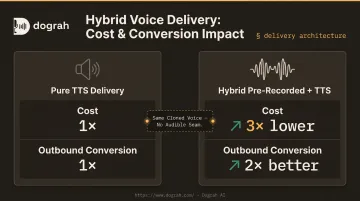
The hybrid pre-recorded + TTS approach blends real human voice clips with TTS fallback in the same cloned voice. Pre-recorded clips play for common, predictable utterances; TTS handles dynamic responses — and since both use the same voice profile, the caller hears no seam.
Dograh AI ships this as a production feature. The result: costs cut up to 3× (primarily from reduced TTS API calls), and 2× better outbound call conversion rates compared to pure TTS delivery.
Orchestration and Telephony
Assembling STT + LLM + TTS into a production calling system requires orchestration. Most DIY builds underestimate this layer — it's where routing logic, failure handling, and concurrency management quietly determine whether a system holds up at scale.
Dograh AI's visual drag-and-drop workflow builder handles this layer, covering:
- Routing logic, fallback handling, and CRM lookups
- Concurrency management across parallel calls
- Telephony integration via Twilio, Vonage, or custom SIP trunks
- Automated API key rotation across LLM, STT, and TTS providers to manage concurrency limits at scale
Top Business Use Cases for Voice AI Automation
Inbound Customer Support
Voice AI handles high-volume tier-1 inquiries 24/7, without queues or wait times. When a call exceeds scope, it transfers to a human agent with a full transcript and intent summary already loaded.
Routine inquiries handled automatically include:
- FAQs and product questions
- Order status and tracking updates
- Account lookups and balance checks
- Appointment confirmations and reschedules
This frees human agents to focus entirely on complex, judgment-intensive conversations — the ones that actually require a person.
Outbound Sales and Lead Qualification
Outbound voice agents work through lead lists, qualify prospects against defined criteria, and book meetings directly into calendars — at scale. The first 15 seconds of any outbound call determine whether the conversation continues. Four factors decide that window:
- Interruption handling — recovering smoothly when a prospect talks over the agent
- Pacing — matching the prospect's energy and speaking rhythm
- Context framing — establishing why this call is relevant in the first sentence
- Legitimacy signals — sounding like a credible, professional interaction from the start
Dograh AI's platform incorporates Neuro-Emotional Persuasion Questioning (NEPQ) methodology into conversation design, helping agents probe pain points and guide calls toward qualification rather than early hang-ups.
Appointment Booking and Reminders
Healthcare, legal, real estate, and hospitality all run on appointment-based revenue. Voice AI agents schedule, confirm, and remind clients automatically — cutting front-desk call volume and reducing no-shows without adding headcount.
Industries seeing the most impact:
- Healthcare — patient scheduling, recall reminders, pre-visit confirmations
- Legal — consultation bookings and document deadline reminders
- Real estate — showing confirmations and follow-up scheduling
- Hospitality — reservation confirmations and check-in reminders
Post-Call Analysis and QA
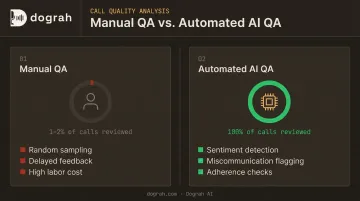
An ICMI/NICE survey of 258 contact center leaders found that only 12% of contact centers monitor 100% of inbound phone calls for quality. Most teams sample 1–2% and hope it's representative.
Voice AI platforms with automated post-call analysis change this entirely. Every call gets reviewed automatically — sentiment detection, miscommunication flagging, activity classification, and adherence checks run without manual listening. Dograh AI's LoopTalk framework extends this further, using AI-driven customer personas to simulate hundreds of call scenarios for testing and refinement.
Key Open Source Voice AI Tools and Frameworks
The Component Landscape
The individual building blocks are mature:
- STT: Whisper, Voxtral, Canary
- LLM: Llama 3.1/3.2, Qwen2.5/Qwen3
- TTS: Kokoro, Coqui/XTTS, Chatterbox
Frameworks like LiveKit and Pipecat provide scaffolding, but complex business workflows still require substantial custom code. That gap is exactly what Dograh AI's founders ran into when building a voice agent for the visa industry — and why they built their own platform instead.
Dograh AI: The Complete Platform
Dograh AI is the self-hostable alternative to Vapi and Retell — a visual, no-code/low-code drag-and-drop workflow builder for voice agents, available under BSD 2-Clause license.
Key capabilities:
- Deployment options: self-hosted OSS via Docker, fully managed cloud, or fully managed private cloud within your own infrastructure
- Model support: locally hosted Whisper, Voxtral, Kokoro, Llama, Qwen, Chatterbox, Coqui — or bring your own keys to any provider
- S2S orchestration: Gemini Flash Live and GPT-Realtime-2 for sub-600ms end-to-end latency
- Hybrid voice: pre-recorded + TTS in the same cloned voice — 3× lower cost, 2× better outbound conversion
- MCP support: build and configure voice agents directly from Claude Code, OpenCode, or other agent platforms
- Languages: 70+ supported across STT and TTS providers
- Setup time: production-ready agents deploy in under 2 minutes
That 2-minute setup isn't a rounding error. Open the dashboard, choose inbound or outbound, name the bot, describe the use case in 5–10 words — the platform generates the workflow and the agent is ready to test via web call immediately.
What to Look For in Any Open Source Voice AI Tool
- Choose BSD, MIT, or Apache 2.0 licenses — AGPL can create complications for commercial use
- Verify it runs entirely on your infrastructure without calling home to vendor servers
- Confirm you can swap STT, LLM, or TTS components independently without rebuilding everything
- Check that the codebase is inspectable for compliance and security audits
- Look for active GitHub issues, real production references, and accessible community support
How to Choose the Right Voice AI Platform for Your Business
Start With Data Sensitivity
The deployment decision maps cleanly to regulatory exposure:
- Regulated industries (healthcare, finance, legal, GDPR regions): default to self-hosted or private cloud. No vendor BAA or DPA required. Data stays on-premise. Procurement moves faster because there's no third-party compliance certification to validate.
- SMBs with standard data: managed cloud works fine. Lower setup overhead, faster time to first call.
Once you know your deployment model, the next step is evaluating platforms against the criteria that actually matter in production.
Evaluation Criteria
| Criterion | What to Check |
|---|---|
| Deployment flexibility | Cloud, self-hosted, private cloud all available? |
| Model compatibility | Can you plug in your own STT, LLM, TTS? |
| Latency | Does it support S2S for sub-500ms responses? |
| Telephony | Connects to Twilio, Vonage, or your SIP trunk? |
| Workflow builder | Visual/no-code option available? |
| Post-call analytics | Automated QA, sentiment, adherence checks? |
| Scalability | Concurrent call handling without degradation? |
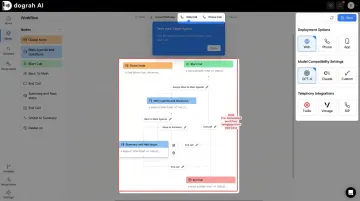
That checklist reveals the platform's capabilities — but it won't show you what the pricing page hides.
The Hidden Costs of Closed Platforms
Buyers focus on the per-minute rate and miss four compounding costs:
- Platform markup on every minute — you're paying for the vendor's infrastructure margin, not just AI compute
- Inability to use your own model keys — you can't optimize costs by routing to cheaper providers
- Vendor compliance overhead — BAA/DPA negotiations slow regulated-industry procurement by weeks or months
- Platform risk — your entire voice AI infrastructure depends on a third party's business continuity
Self-hosting puts all four variables back under your control. Based on Dograh AI's benchmarks across production deployments, businesses running at 100,000 minutes per month typically see around 70% reduction in per-minute costs — and that's before factoring in compliance speed and model flexibility.
Frequently Asked Questions
Which AI is best for business automation?
The right AI depends on the use case. Voice AI agents (STT + LLM + TTS pipelines) handle phone call automation; text-based LLMs suit email and chat. For voice automation at scale with data sovereignty, open source platforms like Dograh AI provide full control without vendor lock-in or per-minute platform fees.
Can AI fully automate a business?
AI automates specific, high-volume workflows effectively — inbound support, outbound calls, scheduling, lead qualification. The most successful deployments use a human-AI model: AI handles tier-1 repetitive tasks while humans manage complex, judgment-intensive conversations where full automation isn't practical.
What is open source voice AI and how does it differ from closed platforms?
Open source voice AI tools have publicly available, auditable code that can be self-hosted on your own infrastructure. Closed platforms are vendor-managed, charge per-minute fees, and process call data on third-party servers, creating compliance obligations and vendor dependency that self-hosted deployments avoid.
Can I self-host a voice AI agent to keep my data private?
Yes. Platforms like Dograh AI are available under BSD 2-Clause license, deployable via Docker, and support locally hosted STT, LLM, and TTS models. Sensitive call data never leaves your own infrastructure — no vendor BAA required, no third-party data processor involved.
What are the best open source tools for building a voice AI stack?
Core components: Whisper or Voxtral for speech-to-text, Llama or Qwen for LLM reasoning, Kokoro or Chatterbox for text-to-speech. For a complete production-ready platform that orchestrates all components without custom integration work, Dograh AI combines all of these under a single visual workflow builder.
How much does open source voice AI cost compared to closed platforms?
Self-hosted open source eliminates per-minute platform fees, reducing costs to compute infrastructure and model API usage. At 100,000 minutes per month, self-hosted infrastructure runs approximately $0.035/minute versus $0.12/minute on closed platforms — roughly 70% lower, with break-even typically at 50,000–100,000 monthly minutes.