Introduction
Closed voice AI platforms like Vapi and Retell make it easy to launch a voice agent quickly. But that convenience comes with real tradeoffs: call recordings leave your infrastructure, per-minute costs scale unpredictably at volume, and you're locked into whatever models and features the platform chooses to support.
The alternative — assembling Whisper, Kokoro, LiteLLM, and a custom orchestration layer yourself — gives you full control, but demands serious engineering time before anything is production-ready.
This guide covers both paths: what self-hosted voice AI actually means, the four technical layers every deployment requires, a structured comparison of your main options, and a decision framework based on your team size, timeline, and compliance constraints.
Key Takeaways
- Self-hosted voice AI means running your STT, LLM, TTS, and orchestration stack on infrastructure you control
- Two distinct paths exist: assemble open-source components yourself (maximum flexibility, heavy engineering lift) or deploy a self-hostable platform via Docker (production-ready, faster to launch)
- For regulated industries (healthcare, fintech, legal, government), self-hosting eliminates HIPAA BAA and GDPR data processing agreements entirely
- The right path depends on your ML/DevOps capacity, compliance requirements, and how quickly you need agents live
Why Businesses Are Moving to Self-Hosted Voice AI
Three business drivers are pushing organizations toward self-hosting, and they compound on each other.
Data Sovereignty and Compliance Simplification
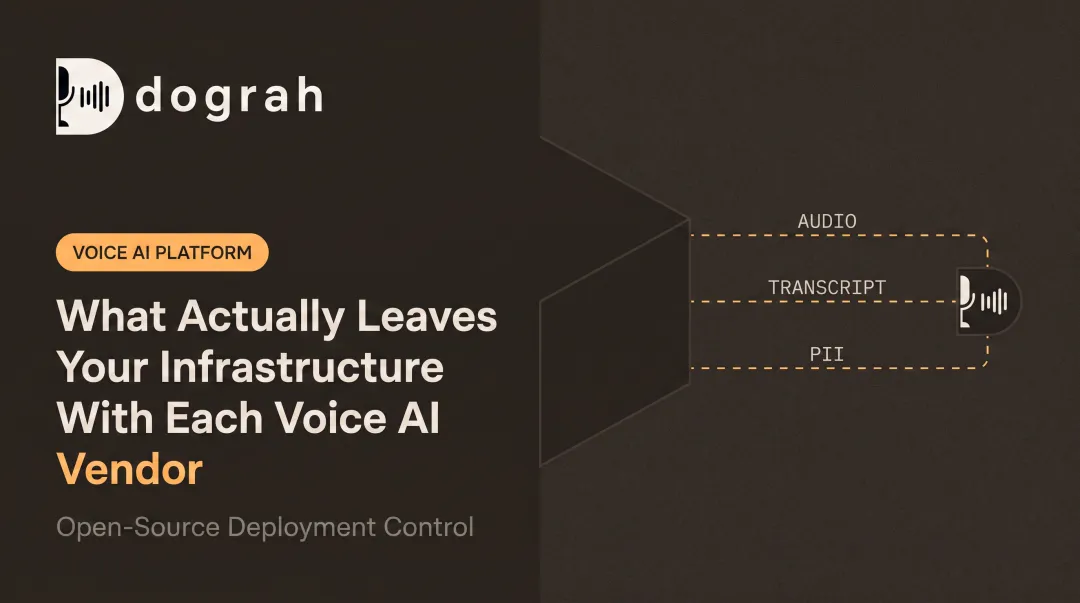
When call recordings, transcripts, and PII never leave your own servers, the vendor compliance layer disappears entirely. That means no negotiating a HIPAA Business Associate Agreement with your platform provider, no GDPR data processing terms to review, and no waiting on a third party's SOC 2 certification to clear procurement.
A 2024 Cisco study found that 27% of organizations had temporarily banned GenAI over data privacy and security risks, and 63% had limited what data employees could enter into AI tools.
For voice AI specifically — where calls frequently contain PHI, financial data, or legally sensitive content — the exposure surface is significant.
Linux Foundation research found that 43% of organizations cite security and data control as their primary motivation for owning AI infrastructure, with 36% citing data sovereignty and residency requirements specifically.
Cost Predictability at Scale
The compliance savings connect directly to another driver: cost structure. Closed platforms charge per call minute — Retell's published pricing sits around $0.115/minute, with LLM and voice infrastructure costs layered on top. At moderate volume, that's manageable. At scale — thousands of concurrent calls, high-volume outbound campaigns — per-minute pricing compounds quickly.
Self-hosted infrastructure costs are primarily compute. Once deployed, additional call volume doesn't generate additional platform fees.
Vendor Lock-In Risk
Cost predictability also exposes a structural risk: platform dependency. Closed platforms lock you into proprietary APIs, block access to underlying models, and make it impossible to swap in a newer LLM or a cheaper TTS engine without the platform's cooperation. If pricing changes, a feature gets deprecated, or the platform shuts down, there's no alternative stack ready.
The parallel to n8n for workflow automation is direct — organizations adopted it because workflow automation was too critical to leave in a single vendor's hands. Voice AI has reached the same point.
Self-hosting matters most for: enterprises in regulated industries (healthcare, fintech, legal, insurance, defense), companies operating under GDPR (EU, Switzerland, UK), and any business where calls include sensitive personal, financial, or health data.
Core Components of a Self-Hosted Voice AI Stack
Every voice AI deployment — whether DIY or platform-based — must address four functional layers. The conversation flows in sequence: User speaks → STT → LLM → TTS → User hears response.
Automatic Speech Recognition (STT/ASR)
The STT layer converts raw audio into text the LLM can process. Key open-source options:
- OpenAI Whisper — the most widely deployed option; supports multilingual recognition, model sizes from 39M (tiny) to 1.55B (large) parameters, VRAM requirements from ~1GB to ~10GB
- faster-whisper — CTranslate2 reimplementation of Whisper with int8 quantization; benchmarked at 2,926 MB VRAM for large-v2 on an RTX 3070 Ti, processing 13 minutes of audio in 59 seconds
- NVIDIA Canary-1B-v2 — 1B-parameter model covering 25 European languages, strong for multilingual enterprise use cases
- Silero VAD — companion component that detects when the speaker has stopped talking and triggers the pipeline; MIT license, supports 8kHz and 16kHz audio, fast CPU inference
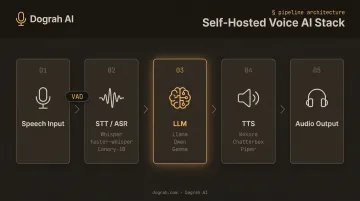
Voice Activity Detection is required in production — without it, the pipeline has no trigger for when to process audio.
Large Language Model (LLM)
The LLM is where your business logic lives: system prompts, tool calls, CRM lookups, calendar integrations. It's also the primary latency bottleneck in a cascaded pipeline.
Self-hosted options by hardware requirement:
| Hardware Tier | VRAM | Models |
|---|---|---|
| Consumer | 8–16 GB | Llama 3 8B, Qwen3 4B/8B, Gemma 4 E2B/E4B |
| Higher-end local | 24 GB+ | Llama 3 70B (quantized), Qwen3 14B/32B |
| Hosted open models | Cloud inference | Groq-hosted Llama 3.1 8B (560 tok/s), Llama 3.3 70B (280 tok/s) |
Time-to-first-token matters more than raw throughput for voice. Groq's 2024 public benchmark recorded 0.22 seconds time-to-first-token for Llama 2 70B — fast enough to sustain natural conversational pacing.
Text-to-Speech (TTS)
TTS quality is the most perceptible quality signal to callers. Robotic-sounding output directly impacts conversion rates and caller satisfaction. Open-source options:
| Model | License | Notable Capabilities |
|---|---|---|
| Kokoro-82M | Apache 2.0 | 8 languages, 54 voices, lightweight |
| Chatterbox | MIT | Emotion control, zero-shot voice cloning from 5s of audio, 23 languages |
| Piper (OHF-Voice fork) | GPL-3.0 | Fast local inference, espeak-ng phonemization |
| Coqui XTTS-v2 | ⚠️ Maintenance risk | Project shut down; community fork active but unsupported |
Choose TTS engines based on license and maintenance status. Coqui's shutdown is a cautionary example — production infrastructure built on an unmaintained project creates real operational risk.
Orchestration and Telephony
Orchestration is the layer most tutorials underestimate. It handles everything that isn't a model call:
- Streaming audio in and out of the pipeline in real time
- Managing conversation turns and context across the full call
- Handling interruptions gracefully (caller speaks while the agent is mid-sentence)
- Executing tool calls mid-conversation — CRM lookups, calendar updates, payment triggers
- Integrating with telephony providers (SIP trunks, Twilio, Vonage, Telnyx) so agents can actually make and receive calls
Latency compounds here. STT + LLM + TTS each add processing time, and under 1.5–2 seconds for first response is the industry benchmark for natural-feeling voice AI in production calling use cases.
Speech-to-Speech (S2S) orchestration is an alternative architecture that collapses multiple pipeline steps into a single model call — Gemini Flash Live and OpenAI GPT-Realtime both support this approach. The tradeoff is some customizability in exchange for roughly half the end-to-end latency of a cascaded pipeline.
Two Paths to Self-Hosting: DIY vs. Self-Hostable Platform
Path 1: DIY Component Stacking
This approach means deploying each service as a separate Docker container — STT server (faster-whisper/Speaches), LLM server (Ollama, LiteLLM proxy), TTS server (Kokoro, Piper) — and building or configuring the orchestration layer that wires them together.
Genuine appeal:
- Maximum technical control over every component
- No platform fees — only compute costs
- Independent component swapping as models improve
Honest engineering cost:
- Custom code required across multiple layers before anything is production-ready
- Ongoing maintenance burden as models update and APIs change
- Expertise needed across ML infrastructure, latency optimization, and telephony
- Even low-code frameworks like LiveKit and Pipecat (targeting 500–800ms round-trip latency) still require developer-owned agent logic, tool design, deployment, and observability
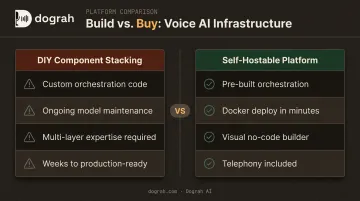
Best suited for: teams with dedicated ML/platform engineers, flexible deployment timelines, and a strong reason to own every layer.
Path 2: Self-Hostable Voice Agent Platform
A self-hostable platform ships the orchestration layer pre-built. Instead of wiring components together yourself, you deploy a complete stack via Docker and configure agent logic through a visual workflow builder.
What a production-ready platform handles for you:
- Conversation state and context management across full calls
- Interruption detection and graceful turn management
- Tool call execution mid-conversation
- Telephony integrations (SIP, Twilio, Vonage, Telnyx) already connected
- Post-call analysis, transcription, and QA
Dograh AI is a concrete example of this approach: an open-source, self-hostable voice agent platform (BSD 2-Clause license) built as the self-hosted alternative to closed platforms like Vapi and Retell. It ships with a visual no-code workflow builder, Speech-to-Speech orchestration via Gemini Flash Live and OpenAI GPT-Realtime-2, support for locally hosted models, and native integrations with CRMs, calendars, and automation tools like n8n.
The founding team built it after running into the exact frustrations described above while building a voice agent for the visa industry: low-code frameworks requiring too much custom code, closed platforms with real data risk and no path to sovereignty.
Dograh supports three deployment options depending on your infrastructure needs:
- Cloud-hosted managed service — Dograh manages the infrastructure; your team focuses on building agent logic
- Self-hosted OSS via Docker — deploy under BSD 2-Clause license with full data sovereignty; first startup takes roughly 2–3 minutes
- Fully managed private cloud — Dograh deploys and operates the entire stack inside your own cloud environment, built for regulated industries where data sovereignty is non-negotiable but internal DevOps capacity is limited
Comparing Self-Hosted Voice AI Options
| Dimension | DIY Open-Source Stack | Self-Hostable Platform (e.g., Dograh AI) | Closed Cloud Platform (e.g., Vapi, Retell) |
|---|---|---|---|
| Setup complexity | High — custom orchestration required | Low-Medium — Docker deploy + visual builder | Low — API keys and configuration |
| Time to first agent | Days to weeks | Minutes to hours | Minutes |
| Data control | Full on-premise | Full on-premise | Data leaves your infrastructure |
| Compliance posture | Strongest — no vendors touch data | Strong — platform vendor eliminated | Requires vendor BAA/DPA |
| Model flexibility | Maximum — any model | High — plug in local or cloud models | Limited — platform-bundled models |
| Telephony | Build yourself | Native integrations included | Native integrations included |
| Workflow builder | None — custom code | Visual no-code builder | Varies |
| Post-call analytics | Build separately | Ships with platform | Varies by platform |
| Cost structure | Compute only (no platform fees) | Free OSS tier; paid managed options | Per-minute usage pricing |
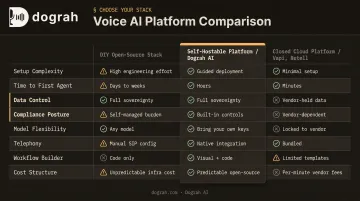
Two dimensions from the table above — latency and model flexibility — shape day-to-day production performance more than any other factor. Here's what each looks like in practice.
Latency
In a cascaded pipeline (STT → LLM → TTS), latency accumulates at each step. The production benchmark for acceptable voice AI response time sits at under 1.5–2 seconds for first response. Three techniques reduce perceived latency meaningfully:
- Streaming between layers — STT begins feeding tokens to the LLM before transcription completes; TTS begins generating audio before the LLM finishes
- API key rotation across providers to navigate concurrency limits and avoid throttling
- Speech-to-Speech orchestration — collapses the cascade into a single model call, roughly halving end-to-end latency
Model Flexibility
For multilingual deployments, model selection significantly affects accent handling and language coverage — 30+ languages is table stakes for many enterprise use cases. A self-hosted stack lets you connect models that actually perform in your target languages, rather than accepting whatever the closed platform supports.
Dograh AI's plug-in architecture supports connecting any of these directly:
- STT: Voxtral, Whisper, Canary
- TTS: Chatterbox, Kokoro, Coqui
- LLM: Qwen3 (strong non-English performance), Llama, or any OpenAI-compatible endpoint
Is Self-Hosted Voice AI Right for You?
Decision Framework by Business Profile
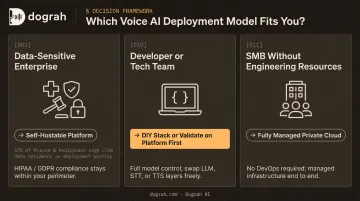
Profile 1: Data-sensitive enterprise (healthcare, fintech, legal, government)
Self-hosting is the right call for most teams in this category. Eliminating the platform vendor from your data flow removes a HIPAA BAA, simplifies GDPR compliance, and reduces audit scope. A self-hostable platform rather than a DIY stack is usually the better fit — procurement timelines rarely accommodate months of custom infrastructure work.
Linux Foundation research found data privacy cited as a GenAI adoption barrier by 57% of finance and healthcare organizations — higher than any other industry segment.
Profile 2: Developer or well-resourced tech team DIY component stacking is viable with ML infrastructure experience and a longer runway. Consider starting with a self-hostable platform to validate the business use case before investing in custom infrastructure — you can always go deeper on custom components once you know what actually matters.
Profile 3: SMB without dedicated engineering resources A fully managed private cloud deployment — where the platform vendor manages infrastructure inside your environment — delivers the data sovereignty of self-hosting without requiring internal DevOps capacity. This is increasingly the model for regulated SMBs that need compliance without a dedicated ML engineering team.
The Hybrid Pre-Recorded + TTS Consideration
For outbound calling specifically, blending pre-recorded human voice clips with TTS fallback in the same cloned voice addresses two problems at once: TTS compute costs and voice naturalness. Dograh's hybrid voice feature was built on this insight, and the results are concrete:
- Cuts voice AI costs up to 3× versus fully synthetic pipelines
- Delivers 2× better conversion performance on outbound calls
- Maintains a consistent voice identity across pre-recorded and synthetic segments
Key Questions Before Choosing a Path
Before committing to a deployment approach, answer these:
- Do you have ML/DevOps engineers available for ongoing maintenance?
- Does call data include PII, PHI, or regulated financial information?
- Do you need agents live within days, or do you have weeks for custom infrastructure?
- Can your team absorb ongoing model maintenance as underlying models update?
- What volume of concurrent calls do you need to support at launch?
Frequently Asked Questions
Is there a self-hosted AI?
Yes. Multiple self-hosted voice AI options exist — open-source models like Whisper (STT), Llama (LLM), and Kokoro (TTS) can each be deployed independently. Self-hostable platforms like Dograh AI bundle all four layers into a Docker deployment, keeping all data on your own infrastructure with no third-party vendor touching the pipeline.
What are the main components of a self-hosted voice AI stack?
A production voice AI stack has four layers:
- ASR/STT — converts speech to text (Whisper, faster-whisper)
- LLM — generates the response (Llama, Qwen, Gemma, or a hosted API)
- TTS — converts the response to audio (Kokoro, Chatterbox, Piper)
- Orchestration — coordinates all layers, manages conversation state, handles telephony, and executes tool calls
Can I self-host voice AI without coding experience?
Raw component stacking requires significant engineering expertise. Self-hostable platforms with visual no-code workflow builders — like Dograh AI — allow non-engineers to build and configure voice agents without writing orchestration code, while the platform handles the underlying infrastructure and conversation state management.
How does self-hosted voice AI handle GDPR or HIPAA compliance?
When the full stack runs on your own infrastructure, call recordings, transcripts, and PII never reach a third-party vendor. This eliminates GDPR data processing agreements and HIPAA BAA requirements with the platform provider, reducing your vendor compliance surface area and simplifying procurement significantly.
What's the difference between DIY component stacking and a self-hostable platform?
DIY stacking means deploying STT, LLM, and TTS services separately and writing custom orchestration code to connect them. A self-hostable platform like Dograh AI ships as a pre-integrated Docker deployment — orchestration, workflow building, telephony, and conversation state management are already built in.
How much does it cost to self-host voice AI?
Open-source component costs are primarily compute — GPU/server infrastructure with no licensing fees. Self-hostable platforms like Dograh AI offer a free OSS tier alongside paid managed options. Total cost depends on call volume, hardware choices, and whether you run local or cloud-hosted models for STT, LLM, and TTS.