Introduction
Deepgram's Voice Agent API has become a popular choice for teams building real-time conversational AI — and for good reason. It packages STT, LLM routing, and TTS into a single managed interface. But that convenience has a cost: your call data lives on Deepgram's infrastructure, per-minute fees compound fast at scale, and you have zero ability to audit or modify the underlying logic.
For teams in healthcare, fintech, or any regulated industry, those trade-offs aren't acceptable. HIPAA and GDPR requirements often make it impossible to route sensitive conversations through a third-party hosted platform without complex vendor agreements.
Beyond compliance, the vendor lock-in problem is real. The conversational AI market is projected to reach $41.39 billion by 2030, and as voice agents become mission-critical infrastructure, treating them as a black-box vendor dependency carries serious operational risk.
This post covers the top open-source, self-hostable platforms that replicate — and in some cases exceed — what Deepgram's Voice Agent API offers, with a consistent breakdown of architecture, strengths, and trade-offs for each.
Key Takeaways
- Deepgram's Voice Agent API is closed-source, priced per minute, and keeps your call data on their servers
- Open-source voice agent platforms let you self-host the full STT → LLM → TTS → telephony stack on your own infrastructure
- Top options include Dograh AI, LiveKit Agents, Pipecat, Vocode, and Bolna — covering a range of deployment approaches, from low-level frameworks to full orchestration platforms
- Dograh AI stands out for teams that need full data sovereignty, a no-code workflow builder, and production-ready agents deployable in under 2 minutes
What Is Deepgram's Voice Agent API — and Why Go Open-Source?
Deepgram's Voice Agent API is not just their transcription product. It's a managed, full-stack orchestration layer combining Nova-3 STT, Aura-2 TTS, and an LLM routing layer into a single real-time conversational interface. Barge-in handling, turn-taking prediction, end-of-thought detection, and function calling are all built in.
For rapid prototyping, that's a compelling package. At production scale, the tradeoffs start to matter:
- Per-minute costs at scale: Deepgram's Voice Agent API runs at $0.075/min (Standard), $0.163/min (Advanced), or $4.50/hour connection-time — fees that compound significantly across high-volume deployments
- Data residency: All call audio and transcripts flow through Deepgram's infrastructure. Under HHS HIPAA cloud guidance, any cloud service provider that handles ePHI on your behalf is a business associate requiring a BAA — adding procurement complexity and compliance risk
- No locally hosted models: You can't swap in Whisper, Llama, or Kokoro — you're tied to their model stack
- No auditability: The orchestration logic is a black box; you can't inspect, modify, or extend it
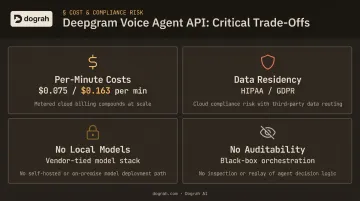
Each of these constraints has a direct open-source answer — which is what the rest of this guide covers.
Top Open-Source Alternatives to Deepgram Voice Agent API
Not every open-source voice tool qualifies as a true Deepgram Voice Agent alternative. To make this list, each platform had to meet three criteria:
- Genuinely open-source licensing (auditable, forkable code)
- Full self-hostability (not just a free tier of a closed SaaS)
- Complete voice agent stack — not just STT or TTS in isolation
Dograh AI
Dograh AI is an open-source, self-hostable Voice AI platform built by Y Combinator alumni who encountered the same pain points firsthand while building a voice agent for the visa industry. Low-code frameworks required too much custom code; closed platforms lacked flexibility and carried data risk. So they built their own.
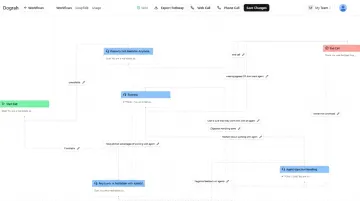
The closest analogy is n8n, but for voice agents and AI calling. The visual drag-and-drop workflow builder lets non-technical users configure conversational flows, conditional branching, multi-step agent logic, and integration triggers — without writing code.
What sets it apart:
- Production-ready agents deployable in under 2 minutes via Docker
- Speech-to-Speech orchestration (Gemini Flash Live, OpenAI GPT-Realtime-2) that roughly halves end-to-end latency compared to cascaded STT→LLM→TTS pipelines
- Hybrid pre-recorded + TTS voice — mixing real human voice clips with TTS fallback in the same cloned voice, cutting costs up to 3× and improving outbound conversions
- Support for locally hosted models: Llama, Mistral, Whisper, Voxtral, Kokoro, Chatterbox, Coqui — viable for fully air-gapped or on-premise deployments
- MCP support enabling agent platforms like Claude Code, OpenCode, and Codex to build and configure voice agents directly
- 70+ language coverage, Twilio/Vonage/Telnyx telephony, CRM integrations (Salesforce, HubSpot, Zendesk), and post-call QA
- Fully managed private-cloud deployments — Dograh manages the infrastructure within your own cloud environment
| Details | |
|---|---|
| License & Deployment | BSD 2-Clause; self-hosted via Docker, fully managed cloud, or fully managed private cloud within customer's own infrastructure |
| Key Features | Full voice agent orchestration (STT + LLM + TTS + telephony), hybrid pre-recorded + TTS voice, S2S orchestration, MCP support, 70+ languages, no-code workflow builder, post-call QA, CRM/calendar integrations |
| Best For | Businesses needing full data sovereignty, regulated industries (healthcare, fintech, legal), developers wanting a no-code visual builder, enterprises requiring private-cloud deployments |
LiveKit Agents
LiveKit Agents is an open-source Python/Node SDK maintained by LiveKit for building real-time voice and multimodal agents. It has the strongest contributor community of any platform on this list — 379 contributors and last committed May 2026. It's broadly used as a composable building block for custom voice pipelines.
The plugin architecture supports multiple STT, TTS, and LLM providers (Deepgram, AssemblyAI, ElevenLabs, OpenAI, and more), with WebRTC-based audio transport for real-time communication.
The important caveat: LiveKit Agents is a framework, not a turnkey platform. Getting from "installed" to "production voice agent" requires writing significant custom orchestration code, managing your own infrastructure, and handling telephony separately.
| Details | |
|---|---|
| License & Deployment | Apache 2.0; self-hosted, requires infrastructure setup and custom orchestration code |
| Key Features | Plugin-based STT/TTS/LLM integrations, WebRTC real-time transport, voice activity detection, turn detection, multi-modal support |
| Best For | Engineering teams comfortable writing custom pipeline code who need low-level control over agent architecture |
Pipecat
Pipecat is an open-source Python framework by Daily.co for building voice and multimodal AI conversation pipelines. With 12,450 GitHub stars — the highest of any platform on this list — and active contributions from the Daily.co engineering team, it has strong community momentum.
Its frame-based pipeline architecture is clean: audio, text, and AI processing steps are composed into a real-time workflow where frame processors handle tasks like STT conversion and audio playback. It connects to 100+ AI services and uses Daily's WebRTC transport layer.
Like LiveKit Agents, Pipecat is a developer framework. Production hardening — telephony routing, scaling, monitoring — requires additional work on top of the framework itself.
| Details | |
|---|---|
| License & Deployment | BSD 2-Clause; self-hosted, developer framework requiring custom deployment and orchestration |
| Key Features | Frame-based pipeline architecture, broad STT/TTS/LLM provider support, Daily.co WebRTC transport, turn-taking logic, interruption handling |
| Best For | Python developers who want a clean compositional framework for voice AI pipelines and are willing to build production infrastructure around it |
Vocode
Vocode (vocodedev/vocode-core on GitHub) is one of the earlier open-source voice agent frameworks, offering Python-native abstractions for telephony, transcription, and synthesis in a unified agent interface. It officially supports Twilio for inbound and outbound phone calls, with a FastAPI-based TelephonyServer.
It's relatively easy to get a basic voice agent prototype running — which makes it useful for internal tools or proof-of-concepts. The limitations show at scale: Vocode's last verified commit was November 2024, the contributor base is small (59 contributors), and it lacks the no-code tooling or managed deployment options of more mature platforms.
| Details | |
|---|---|
| License & Deployment | MIT license; self-hosted Python library, requires infrastructure and telephony setup |
| Key Features | Telephony integrations (Twilio), STT/TTS/LLM abstractions, streaming conversations, basic action/tool support |
| Best For | Developers building voice agent prototypes or internal tools who want a lightweight Python-native starting point |
Bolna
Bolna (bolna-ai/bolna on GitHub) is an open-source end-to-end voice agent platform designed to help developers build and deploy production voice agents quickly — closer in ambition to a full platform than a bare framework.
It ships telephony integrations out of the box (Twilio, Plivo, Exotel, and others), supports inbound and outbound call automation, and uses a configuration-driven agent setup that reduces boilerplate. Docker and Kubernetes on-prem deployment is officially documented. The platform had a commit as recently as May 2026, suggesting active maintenance.
The gap: with 649 GitHub stars and 31 contributors, the community and documentation are considerably less mature than LiveKit or Pipecat.
| Details | |
|---|---|
| License & Deployment | MIT license; self-hosted via Docker/Kubernetes, cloud deployment supported |
| Key Features | End-to-end voice agent orchestration, inbound and outbound call support, telephony integrations, multi-provider STT/TTS/LLM, configuration-driven setup |
| Best For | Developers wanting a more complete open-source voice agent platform with telephony included, without building pipeline plumbing from scratch |
How We Chose These Open-Source Alternatives
Not every voice-related library qualifies — here's what each alternative had to pass:
- Genuine open-source license — permissive (MIT, BSD, Apache 2.0) with no proprietary runtime dependency
- Full voice agent stack — not just STT or TTS in isolation, but an integrated orchestration layer
- Self-hostable — call data must be capable of staying within the user's own infrastructure
Beyond those hard requirements, five factors determined how each alternative was weighted against the others:
Factors weighted in comparison:
- Time-to-first-agent: Can a team get a working voice agent running without weeks of custom engineering?
- Orchestration depth: Is STT + LLM + TTS + telephony integrated, or are they loose components requiring glue code?
- Local model support: Critical for air-gapped or fully isolated or regulated environments
- Community health: Star count, contributor count, and recency of last commit — signals whether the project is actively maintained or quietly stalling
- Production hardening: Scaling, monitoring, post-call analytics — does the platform ship these, or does the team build them?
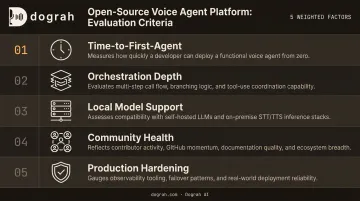
These factors surface the gaps that spec sheets rarely show. They also expose where teams tend to go wrong:
Common mistakes teams make evaluating this category:
- Confusing a framework (Pipecat, LiveKit Agents) with a platform (Dograh AI, Bolna) — the engineering effort to productionize a framework is substantial
- Underestimating the operational burden of managing real-time audio infrastructure at scale
- Overlooking data residency requirements until after deployment, when rearchitecting is costly and disruptive
Conclusion
The five platforms here represent a clear spectrum. Pipecat and Vocode are developer frameworks — powerful building blocks that require significant engineering investment before they're production-ready. LiveKit Agents and Bolna sit closer to the platform end, with more integrated orchestration and telephony support.
Dograh AI stands apart as the only option that combines all of the following under a permissive BSD 2-Clause license:
- No-code visual workflow builder
- Fully managed private-cloud deployments
- Speech-to-Speech orchestration
- Hybrid pre-recorded + TTS voice
- MCP support
The right choice depends on your team's engineering depth, compliance requirements, and how quickly you need to reach production. A team of experienced Python engineers building a custom voice pipeline might prefer Pipecat's flexibility. A regulated healthcare or fintech company that needs full data sovereignty and can't afford months of infrastructure work should look closely at Dograh AI.
Before committing to any platform, test each against your real call volumes, latency requirements, and compliance obligations.
Teams that want to skip the infrastructure plumbing and deploy a production-grade, fully open-source voice agent in under 2 minutes can get started at github.com/dograh-hq/dograh or reach out directly at founders@dograh.com.
Frequently Asked Questions
What exactly is Deepgram's Voice Agent API?
Deepgram's Voice Agent API is a managed, full-stack orchestration product combining their Nova-3 STT, Aura-2 TTS, and LLM routing into a single real-time conversational interface — distinct from their standalone transcription or TTS APIs. It is a closed-source, hosted-only product with no self-deployment option.
Can open-source voice agent platforms match Deepgram's latency?
Latency depends heavily on the models chosen and your deployment infrastructure. Speech-to-Speech orchestration — available in platforms like Dograh AI using Gemini Flash Live and OpenAI GPT-Realtime-2 — can roughly halve end-to-end latency compared to cascaded STT→LLM→TTS pipelines. Co-locating your stack with your telephony provider makes a significant additional difference.
Is self-hosting a voice agent platform HIPAA or GDPR compliant?
Self-hosting removes the need for a vendor BAA or GDPR data processing agreement, because call data never leaves your own infrastructure. Compliance becomes an internal infrastructure question — though you still need agreements with any external services (telephony, STT APIs, hosting) that touch sensitive data.
How much engineering effort is needed to deploy an open-source voice agent?
Engineering effort ranges widely depending on your starting point. Bare frameworks like Pipecat or Vocode require substantial custom engineering to reach production. Platforms like Dograh AI are designed for deployment in under 2 minutes via Docker, with a no-code workflow builder for non-technical users.
Can I use locally hosted LLMs like Llama or Mistral with these platforms?
Most open-source voice agent platforms support custom model configurations. Dograh AI specifically supports locally hosted LLMs (Llama, Mistral), STT models (Whisper, Voxtral), and TTS models (Kokoro, Chatterbox, Coqui). This makes it viable for fully air-gapped or on-premise deployments where sensitive data cannot leave your environment.
What is the difference between a voice agent framework and a voice agent platform?
A framework (Pipecat, LiveKit Agents) provides composable building blocks — engineers write the orchestration logic and manage the infrastructure themselves. A platform (Dograh AI) delivers production-ready features out of the box: telephony, scaling, monitoring, a no-code builder, and post-call analytics — with minimal setup required to go live.