Introduction
Every real estate agent knows the feeling: a lead comes in at 9 PM, the phone rings twice, nobody answers, and by morning that prospect has already booked a showing with someone else.
This isn't a hypothetical. Research from MIT's Lead Response Management Study found that the odds of contacting a lead drop 100x when response time goes from 5 minutes to 30 minutes.
A Harvard Business Review audit of 2,241 U.S. companies found the average response time was 42 hours — and firms that responded within one hour were nearly 7x more likely to have a meaningful conversation than those who waited longer.
AI voice bots close this gap. These are autonomous phone agents — not chatbots, not IVR menus — that call leads, qualify them through natural spoken conversation, and route hot prospects to human agents, around the clock, without any manual involvement.
This guide covers the five strongest platforms for real estate lead generation in 2026 — so you can pick the one that fits your team's workflow, budget, and response-time goals.
Key Takeaways
- AI voice bots autonomously make and receive calls, qualify leads, and route prospects — no human ISA required
- Voice conversations surface buyer intent, budget, and motivation faster than SMS or email
- Top platforms are evaluated on latency, voice quality, CRM fit, deployment flexibility, and pricing
- Platforms reviewed: Dograh AI, Ylopo AI Voice, Structurely, Vapi, and Retell AI
What Are AI Voice Bots for Real Estate Lead Generation?
AI voice bots are software agents that communicate over live phone calls using a combination of speech recognition, large language models, and text-to-speech. They're distinct from two things buyers often confuse them with:
- Chatbots — text-only, website or messaging-based, no phone capability
- IVR systems — menu-driven ("press 1 for sales"), not conversational, can't adapt to what a caller says
A voice bot holds a two-way spoken conversation. It hears what a caller says, figures out what they need, responds naturally, and acts — booking appointments, logging outcomes to a CRM, or routing a qualified lead to a live agent.
The Two Core Real Estate Use Cases
Inbound: A prospect calls after seeing a listing. The bot picks up instantly, asks qualifying questions, captures buyer intent, and either books a showing or alerts an agent — even at 2 AM.
Outbound: The bot works through a list of portal leads, expired listing contacts, or cold prospects, making calls simultaneously and routing any interested parties to your team.
Both use cases solve the same underlying problem: human agents can't be everywhere at once, and the first team to respond wins the lead. That's what makes response speed — not just availability — the metric that matters most.
Why Voice Outperforms Text for Real Estate Lead Qualification
The Speed-to-Lead Problem
In real estate, first contact wins. The MIT data is stark: wait just 10 minutes instead of 5 and contact odds drop 5x. Wait an hour and qualification odds fall by more than 6x. Most teams aren't responding in 5 minutes — they're responding in hours, if at all.
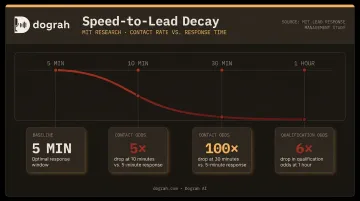
An AI voice bot eliminates response latency entirely. It calls the moment a lead submits a form, regardless of the hour or how many leads came in at once.
Voice Builds Rapport Faster
Property decisions are emotional. A buyer shopping in a specific school district, with a firm budget and a lease expiring in 60 days, will reveal all of that in a two-minute phone conversation — information that would take 10 back-and-forth texts to surface.
University of Texas research found people feel significantly more connected through voice than text-based media. A peer-reviewed study in PubMed confirmed that voice-only communication enhances empathic accuracy. For a purchase this size, that difference in connection directly affects whether a lead converts.
The Scale Advantage
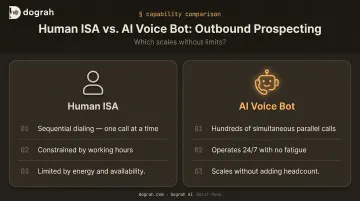
A single AI voice bot can run hundreds of simultaneous outbound calls. A human ISA works sequentially through a dial list — one call at a time, constrained by working hours and energy. For teams running high-volume outbound prospecting, the gap compounds fast:
- Calls every new lead instantly, in parallel — no queue, no delay
- Operates 24/7 with no fatigue, scheduling gaps, or sick days
- Scales to hundreds of simultaneous dials without adding headcount
Best AI Voice Bots for Real Estate Lead Generation in 2026
These five platforms were evaluated on voice quality and naturalness, latency, real estate workflow fit, CRM integrations, pricing transparency, and deployment flexibility.
Dograh AI
Background: Dograh AI is an open-source, self-hostable voice AI platform built by YC-backed founders Pritesh Kumar and Abhishek Kumar — the latter previously exited PushOwl as CTO/CEO to Brevo. The platform was born from the founders' own frustration building a voice agent for the visa industry, where closed platforms lacked flexibility and open frameworks required too much custom code.
Dograh supports inbound and outbound voice agent workflows across real estate and other industries. Deployment options include:
- Fully managed cloud — hosted and maintained by Dograh
- Self-hosted open-source — BSD 2-Clause license, free
- Fully managed private cloud — deployed within a customer's own infrastructure
Key Differentiators:
- Hybrid pre-recorded + TTS voice: An industry-first feature that blends real human voice clips with TTS fallback in the same cloned voice, cutting costs up to 3× and delivering 2× better outbound conversion rates on calling campaigns
- Speech-to-Speech orchestration using Gemini Flash Live and OpenAI GPT-Realtime, achieving sub-600ms end-to-end latency with near-zero perceptible delay
- Self-hosted data sovereignty: For real estate teams with data privacy concerns or enterprise procurement requirements, self-hosting eliminates HIPAA, GDPR, and SOC 2 vendor certification overhead entirely
- 70+ language support — relevant for multilingual markets and international real estate
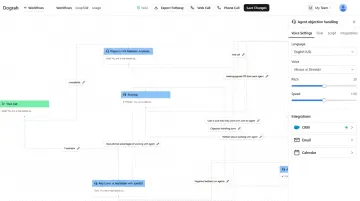
- Deploy a working voice agent in under 2 minutes using pre-built templates or the no-code workflow builder
| Feature | Details |
|---|---|
| Key Features | Visual no-code workflow builder; hybrid pre-recorded + TTS voice; Speech-to-Speech orchestration; CRM integrations (Salesforce, HubSpot, Zendesk); calendar integrations (Google Calendar, Outlook); automated post-call analysis; MCP support; 100,000 concurrent agents |
| Pricing | Open-source self-hosted version is free under BSD 2-Clause license; fully managed cloud and private-cloud pricing available — verify current rates at dograh.com |
| Best For | Real estate teams and brokerages that want full data control, low-latency outbound calling, and the flexibility to self-host or deploy in a private cloud environment |
Ylopo AI Voice
Background: Ylopo AI Voice is a real estate–specific AI voice calling tool built within Ylopo's broader lead nurturing platform. It's designed to call leads already in a real estate CRM, qualify them, and book appointments — without agent involvement.
Key Differentiators:
- Calls new Ylopo-generated leads within 3–5 minutes of form submission
- Makes up to 14 follow-up attempts over 90 days before moving a lead to database status
- Personalization based on behavioral data — the bot knows which listings a prospect viewed
- Tight integration with Follow Up Boss for call notes, recordings, and routing
- Covers both outbound lead calls and inbound call routing per Ylopo's 2026 lead-gen documentation
Important note: Ylopo AI Voice is not available as a standalone product — it requires an active AI Text subscription. It's Ylopo/Follow Up Boss-centered, not a general developer platform.
| Feature | Details |
|---|---|
| Key Features | Outbound AI calling; real estate–specific conversation scripts; 14-call/90-day follow-up cadence; behavioral data integration; inbound call routing; appointment booking |
| Pricing | $250 setup fee; monthly pricing $250–$1,350 based on database size; bundled AI Squared pricing $400–$2,160/mo — verify at ylopo.com |
| Best For | Agents and teams already on the Ylopo platform who want AI-powered calling tightly integrated with their lead behavioral data |
Structurely
Background: Structurely is a conversational AI platform functioning as an AI-powered inside sales agent, communicating with real estate leads via phone calls, SMS, and email. It automates outreach, qualification, and appointment setting across long-term follow-up sequences.
Key Differentiators:
- Follows up with leads for over 12 months via calls, texts, and emails
- Uses local phone numbers to improve answer rates
- Achieves a 31% higher answer rate, 17% increase in qualified leads, and 3–21× average ROI according to Structurely's platform data
- Real-time lead routing and live phone transfers when a prospect is ready
| Feature | Details |
|---|---|
| Key Features | AI phone calls, SMS, and email follow-up; automated appointment booking; 12+ month lead nurture; CRM integrations (Salesforce, Follow Up Boss, Calendly); real-time lead routing |
| Pricing | Team: $499/mo + $2,000 onboarding; Company: $999/mo + $2,500 onboarding; usage billed via Action Credits ($0.06–$0.08/credit) — verify at structurely.com/pricing |
| Best For | Real estate teams with large lead databases that need automated multi-channel follow-up and appointment setting without manual ISA effort |
Vapi
Background: Vapi is a developer-focused voice AI infrastructure platform for building, deploying, and scaling custom AI phone agents. Not real estate–specific, but widely used by real estate teams and proptech developers.
Key Differentiators:
- Connect any LLM, STT, and TTS provider — OpenAI, Groq, Deepgram, ElevenLabs, Azure, and more
- Supports custom call flows and CRM integration via webhooks and API
- STT options span 100–140+ languages depending on provider
- Telephony via Twilio, Telnyx, Plivo, Vonage, Zadarma, or custom SIP trunk
- Default 10 concurrent calls; custom plans available for 50,000+ min/month volumes
| Feature | Details |
|---|---|
| Key Features | Customizable voice agent infrastructure; multi-LLM/STT/TTS support; inbound and outbound calling; webhook integrations; real-time transcription and analytics |
| Pricing | Build plan: $0.05/min call hosting (60 min included); Scale plan requires annual contract — verify at vapi.ai/pricing |
| Best For | Real estate tech teams and developers building custom voice agent workflows with full control over AI models, call logic, and CRM integrations |
Retell AI
Background: Retell AI is a voice AI platform for building, deploying, and managing AI phone agents. It positions itself between raw API infrastructure (like Vapi) and closed real estate–specific products — a production-ready option with lower engineering overhead.
Key Differentiators:
- 4.8 stars from 2,240 verified reviews on G2
- Supports agent-to-agent call transfers, dynamic variable injection for personalized scripts, and post-call transcription
- 20 free concurrent active calls included on pay-as-you-go; additional concurrency at $8/slot/month
- Telephony integrations: Twilio, Vonage, Telnyx, custom telephony, SIP
| Feature | Details |
|---|---|
| Key Features | Inbound and outbound voice agents; dynamic call scripts; agent transfer support; post-call transcription and analytics; telephony integrations |
| Pricing | Pay-as-you-go $0.07–$0.31/min depending on components; $10 free credits for new users — verify at retellai.com/pricing |
| Best For | Real estate businesses and developers who want production-ready voice AI with lower infrastructure overhead than raw API builds |
How We Chose the Best AI Voice Bots for Real Estate
What This List Is — and Isn't
This guide focuses specifically on voice (phone call) AI agents. The most common mistake buyers make is selecting a general-purpose chatbot that includes a "voice" feature — then discovering the call quality is poor, latency introduces awkward silences, and connection rates suffer.
We evaluated each platform on whether voice is a core, production-ready capability — not an add-on.
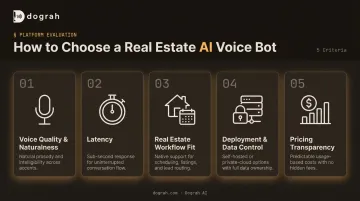
Evaluation Criteria
- Voice quality and naturalness — human enough to sustain a real estate conversation without the lead hanging up
- Latency — near-real-time response with no noticeable pauses mid-call
- Real estate workflow fit — lead qualification, appointment booking, and CRM integrations
- Deployment and data control — especially relevant for enterprise teams or GDPR-regulated markets
- Pricing transparency — predictable total cost at volume, not just per-seat sticker price
Not every platform fits every team. Here's where each one has real constraints.
Honest Limitations
- Vapi and Retell are infrastructure layers — they require engineering resources to set up and maintain. They're not plug-and-play for non-technical teams
- Ylopo AI Voice operates within a closed ecosystem — if you're not already on Ylopo and Follow Up Boss, it isn't a realistic option
- Dograh AI's self-hosted OSS path gives maximum control, but teams without technical resources should use the managed cloud option instead
Use those constraints as a filter before reading the full reviews — they'll save you time.
Conclusion
AI voice bots have moved from experimental to operational for real estate teams. Human agents can't respond to every inbound lead within 5 minutes or run hundreds of outbound calls simultaneously — AI voice bots can.
Start with one use case. Either replace manual outbound prospecting (high-volume dialing on portal leads, expired listings, or cold lists) or automate after-hours inbound call handling. Get that working, measure cost-per-qualified-lead, then expand.
When evaluating platforms long-term, look beyond upfront pricing. Three factors matter most:
- Latency — even 300ms of added delay measurably drops connection rates
- Voice quality — the bot needs to sound natural enough to hold a conversation past the first 10 seconds
- Data control — know exactly where call recordings and lead data are stored
For real estate teams that want the lowest latency available, 2× better outbound conversion rates from hybrid voice technology, and the option to self-host for complete data control — Dograh AI offers a free open-source deployment or a fully managed cloud option with a working voice agent live in under 2 minutes. The open-source repository is at github.com/dograh-hq/dograh.
Frequently Asked Questions
What is the best AI assistant for real estate agents?
It depends on the use case. For voice-based lead qualification and outbound calling, purpose-built voice bots like Dograh AI, Ylopo AI Voice, or Structurely are the strongest options. For general task assistance — drafting emails, summarizing documents — platforms like ChatGPT or Lindy serve different workflows entirely.
How do AI voice bots qualify real estate leads?
The bot calls leads and asks structured qualifying questions — budget, timeline, property type, motivation — through natural conversation. Responses are logged into a CRM and hot leads are routed to human agents automatically, no manual follow-up needed.
What is the difference between an AI voice bot and a real estate chatbot?
Voice bots operate over live phone calls using speech recognition and text-to-speech. Chatbots handle text conversations on websites or messaging apps. For outbound prospecting and building quick rapport with new leads, voice bots are the stronger tool.
Can AI voice bots handle both inbound and outbound real estate calls?
Yes — most modern platforms support both modes. Inbound bots answer incoming property inquiries 24/7; outbound bots proactively call lead lists, follow up on portal inquiries, or re-engage cold contacts on a scheduled cadence.
Do AI voice bots for real estate integrate with CRM systems?
Most platforms integrate with major real estate CRMs — Follow Up Boss, HubSpot, Salesforce — via API or native connectors. Call outcomes, transcripts, and qualified lead data log automatically after each call.
How much do AI voice bots for real estate cost?
Pricing ranges widely by model. Usage-based platforms like Vapi and Retell charge $0.05–$0.31/min; SaaS platforms like Structurely start around $499/mo. Open-source options like Dograh AI eliminate platform fees entirely for self-hosted deployments.