That's the core problem. Manual call review is slow, expensive, and inconsistent from one reviewer to the next. Because it only samples a tiny fraction of conversations, sentiment issues, compliance risks, and obvious coaching opportunities slip through unnoticed, sometimes for months.
This article breaks down what AI call analytics actually is, how the technology works, which metrics it tracks, and how to pick a platform that fits your business. We'll also cover something most guides skip: analytics for calls handled by AI voice agents, not just human reps.
Key Takeaways
- AI call analytics transcribes, scores, and extracts insights from every call—not a small manual sample.
- Teams get sentiment, intent, compliance checks, summaries, and coaching flags at scale.
- For AI voice agents, automated post-call analysis can replace manual QA entirely.
- Pick a platform by privacy needs, deployment model, and depth of calling-stack integration.
What Is AI Call Analytics?
AI call analytics is the use of technologies like automatic speech recognition (ASR), natural language processing (NLP), and large language models (LLMs) to automatically capture, transcribe, and analyze voice conversations.
Instead of a supervisor listening to a handful of calls and typing notes, the software processes the conversation itself and produces structured, searchable insights on every interaction: sentiment scores, topic tags, compliance flags, summaries.
That shift matters more than it sounds. When manual QA teams can realistically review only a couple of calls per agent each week, they're making staffing, coaching, and compliance decisions based on a sliver of the real picture. AI-powered systems remove that ceiling, processing calls at whatever volume a contact center or voice agent platform generates.
Call analytics maturity typically moves through four stages:
- Descriptive - what happened on this call or across this batch of calls
- Diagnostic - why it happened, such as why a customer escalated or a call ran long
- Predictive - what's likely to happen next, like which callers show churn risk based on tone
- Prescriptive - what to actually do about it, such as rerouting a caller or updating a script
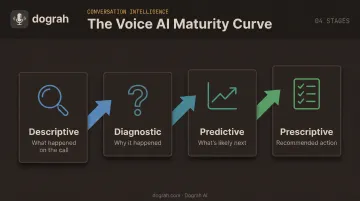
Most manual QA programs never get past descriptive. AI-driven analytics is what pushes companies toward the predictive and prescriptive end of that spectrum, where insights start driving decisions rather than just documenting them.
AI Call Analytics vs. Traditional Call Analytics
Traditional call analytics leans on manual listening, spot-checks, and basic metrics like call volume and duration. AI-powered analytics flips that model:
| Traditional Call Analytics | AI Call Analytics |
|---|---|
| Manual review of 1-3% of calls | Automated coverage of up to 100% of calls |
| Basic volume/duration metrics | Sentiment, intent, and compliance detection |
| Reactive, delayed insights | Near real-time and predictive insights |
| Reviewer-dependent consistency | Standardized scoring across every call |
Real-Time vs. Post-Call Analytics
Real-time analytics works while the call is still happening. It can flag a frustrated tone so a supervisor can jump in, or surface a live coaching cue on an agent's screen.
Post-call analytics kicks in after the call ends, generating summaries, QA scores, and compliance checks from the completed transcript.
For calls handled by AI voice agents rather than human reps, post-call analytics becomes the primary QA mechanism. There's no supervisor listening live, so the system needs to automatically score the bot's own performance: detecting sentiment, miscommunication, and script adherence issues without human review.
Platforms like Dograh AI build this in directly, running automated sentiment detection, miscommunication identification, activity detection, and strict adherence checks on every completed call.
How AI Call Analytics Works: The Technology Stack
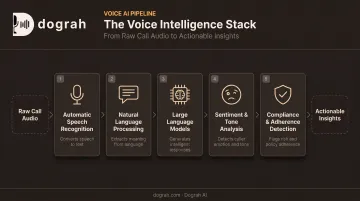
AI call analytics isn't one single model. It's a pipeline of technologies, each handling a different part of turning raw audio into a usable insight.
Automatic Speech Recognition (ASR): This is the foundation. Speech-to-text models convert call audio into a written transcript. Every downstream step depends on how accurate that transcript is. Get the transcription wrong, and the sentiment score, summary, and compliance check built on top of it will be wrong too.
Natural Language Processing (NLP): Once a call becomes text, NLP models detect sentiment, identify topics, and pull out named entities like product names, competitor mentions, or account numbers. This turns a wall of transcript text into tagged, searchable data.
Large Language Models (LLMs): LLMs handle the heavier lifting on top of that tagged text:
- Generate custom call summaries and extract action items
- Answer specific questions about a conversation (did the rep mention the refund policy?)
- Aggregate patterns across thousands of calls to surface trends sampling would miss
Sentiment and tone analysis: Beyond text-level sentiment from NLP, this layer reads emotional cues—frustration, confusion, escalation risk—from word choice, pacing, and vocal tone. It can run live on the call or in post-call review.
Compliance and adherence detection: For regulated industries and for AI voice agents that must follow strict conversation flows, this layer flags script deviations, missed disclosures, or required phrases that weren't said.
In a production stack, those layers run together. Dograh AI, for example, supports ASR options including Whisper and Voxtral, locally hosted LLMs like Llama, and speech-to-speech orchestration through Gemini Flash Live and GPT-Realtime-2.
Real-time response latency is documented under 600 milliseconds. That speed matters for analytics as much as for conversation quality—delayed processing means delayed insight.
Key Metrics and KPIs Tracked by AI Call Analytics
AI call analytics turns raw conversations into a short list of KPIs that drive cost, quality, and compliance. These are the metrics most teams track first.
First Contact Resolution (FCR)
FCR measures the percentage of issues resolved in a single interaction, without a callback or follow-up. It's one of the clearest signals of both customer experience and operational efficiency.
Hard industry-wide figures tying AI call analytics to FCR gains are still limited. Case studies show the same pattern anyway: better visibility into why calls fail to resolve leads directly to fewer repeat contacts.
Average Handle Time (AHT)
AHT tracks how long agents spend per call, including hold and follow-up work. AI-driven summarization tools are already moving this number. Genesys reports that Newcastle Greater Mutual Group cut AHT by 50 seconds per call and hold time by 30 seconds after deploying AI copilot and auto-summarization tools.
Customer Satisfaction (CSAT) and Sentiment Score
Traditional CSAT relies on post-call surveys, and most customers just don't respond. Medallia notes that typical survey response rates sit between 5% and 30%. AI sentiment scoring closes that gap by reading tone, word choice, and resolution outcome on every call—not only the few customers who complete a survey.
Compliance/Script Adherence Rate
Compliance rate tracks whether agents or AI voice bots delivered required disclosures, regulatory language, and approved talking points. For voice agents, adherence checks matter even more. There's no human judgment filling gaps in real time, so the script has to be enforced and verified after the fact.
Call Drop-Off Points and Intent Breakdown
AI automatically categorizes why customers called, then pinpoints where conversations break down:
- Which question triggers a hang-up
- Which menu option loses callers
- Which topic causes the most confusion
That breakdown turns a pile of transcripts into an actual action list.
Benefits of AI Call Analytics
Full-coverage analysis beats manual sampling in one simple way: it's statistically reliable. The gains show up in three places:
- Analyzes 100% of calls so every trend, complaint, or compliance gap reflects reality—not a 1–3% sample
- Surfaces the exact timestamp and reason for coaching (e.g., "frustration spike at 4:32") instead of full 12-minute scrub-downs
- Flags pattern spikes in days, so teams fix root causes before they become churn
A SaaS support example shows the stakes. Analytics flags a sudden 20% spike in calls tagged "billing confusion" over two weeks. Transcripts reveal dozens of customers confused by a recent pricing page change. Clarifying the pricing copy and adding an FAQ takes an afternoon—without full-call visibility, that pattern might only surface as a churn spike a quarter later.
AI Call Analytics Use Cases Across Industries
Sales and RevOps
Call analytics tracks objection patterns, flags competitor mentions, and scores deal risk from sales call transcripts. Managers see what actually happened on the call—not only what reps logged in the CRM afterward.
Customer support and contact centers
Sentiment tracking, resolution-rate monitoring, and QA automation run at a scale no human review team can match. Supervisors spend time on the highest-risk calls instead of random sampling.
Regulated industries
Healthcare, finance, insurance, and legal teams use call analytics for compliance monitoring, script adherence, and audit trail generation.
Data sovereignty matters here. Many organizations need on-premise or self-hosted deployment rather than sending sensitive conversations through a third-party cloud. Dograh AI, for example, supports HIPAA-oriented healthcare deployments and finance/insurance workflows with regulated scripting, forced disclosure checkpoints, and structured logging that stays entirely within the customer's own environment.
Choosing the Right AI Call Analytics Solution
Not every platform fits every business. A few questions actually narrow the field.
How accurate is the transcription, and does it integrate with what you already use? Every downstream insight—sentiment, compliance, summaries—depends on transcription quality. Confirm how the tool connects to your telephony provider, CRM, and calling stack before you evaluate anything else.
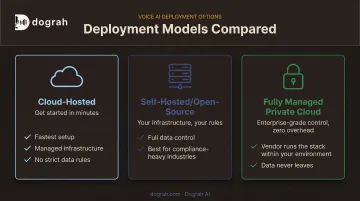
What are your deployment and data privacy requirements? This is where the options really diverge:
- Cloud-hosted — fastest setup and managed infrastructure; fits teams without strict data-residency rules
- Self-hosted / open-source — full control over data location and retention; strong fit for compliance-heavy industries
- Fully managed private cloud — vendor runs the stack in your cloud so data never leaves your environment
Open-source, self-hostable platforms like Dograh AI build automated post-call analysis into this model—sentiment detection, miscommunication flags, and adherence checks included.
You keep full data sovereignty and avoid the BAA/DPA overhead that comes with stitching together multiple closed vendors.
Do you need standalone analytics, or analytics built into your voice agent platform? Layering a separate analytics tool onto an existing calling stack means more integration work and more vendors to manage. If you already run AI voice agents—or plan to—native analytics usually means less setup. You also get fewer gaps between what the bot does and what actually gets measured.
Frequently Asked Questions
How can you tell if a phone call is AI?
Common signals include unnaturally even pacing, slightly repetitive phrasing, and small delays before responses. Some regions are also introducing rules requiring AI callers to disclose that fact at the start of the call.
Is AI calling illegal?
No. AI calling is legal in most regions, but it must follow consent, disclosure, and telemarketing rules such as the TCPA in the US. Requirements vary by jurisdiction and call purpose.
What's the difference between call analytics and speech analytics?
Speech analytics focuses narrowly on audio signals such as tone, pace, and stress. Call analytics is broader, covering full conversation content, business outcomes, and metrics like resolution rate and compliance.
How accurate is AI call analytics?
Accuracy depends on transcription quality and model training. Modern speech recognition often approaches human-level accuracy on clean telephone audio. Noisy lines and strong accents are still harder.
Can AI call analytics work with AI voice agents, not just human agents?
Yes. It applies equally to bot-handled calls. Platforms like Dograh AI build this in natively, scoring sentiment, miscommunication, and script adherence on every AI-handled call automatically.
What's the typical ROI timeline for implementing AI call analytics?
Initial insights like transcripts and sentiment tags typically appear within weeks of setup. Measurable improvements in handle time, satisfaction, and coaching effectiveness usually show up within a few months.