But that developer-first design has a flip side. Teams building on Retell increasingly run into coding overhead, unpredictable third-party billing, and a lack of control over where their call data actually lives. That's pushing a lot of buyers to shop around.
This guide compares the top Retell AI alternatives of 2026, breaking down deployment models, pricing structures, and which platform fits which use case.
TL;DR
- Retell AI is a strong developer-first API, but many teams now want faster setup, predictable costs, or full data ownership
- The right alternative hinges on your technical resources, compliance needs, and pricing model
- Five leading options range from open-source, self-hosted platforms to enterprise-managed solutions
- Each platform is scored on setup speed, cost predictability, data ownership, and production readiness
Overview of the Retell AI Alternatives Landscape in the Voice AI Market
Retell AI alternatives are platforms that let businesses build, deploy, and manage AI voice agents for inbound and outbound calling—from appointment reminders to full contact-center automation.
The category is expanding fast with the broader conversational AI market MarketsandMarkets tracks above. Most comparisons still flatten one distinction that shapes cost, compliance, and time to go live: deployment model.
The landscape splits into three lanes:
- Self-hosted/open-source — you run the platform on your own infrastructure, keeping full data control
- Fully managed cloud — the vendor hosts everything, optimized for speed of setup
- Developer API — you get building blocks (LLM, STT, TTS, telephony) and assemble your own stack
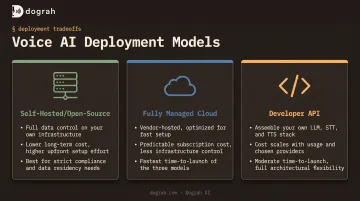
Each lane changes your cost structure, your compliance exposure, and how fast you can go live. The rankings below account for all three.
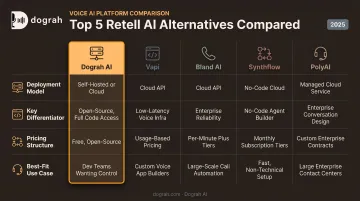
Top 5 Retell AI Alternatives and Competitors in 2026
Each platform below was evaluated on deployment flexibility, conversation latency and naturalness, integration depth, pricing transparency, and compliance readiness.
Dograh AI
Dograh AI is an open-source, self-hostable voice AI platform built by exited Y Combinator alumni who ran into the same walls Retell users are hitting now. It positions itself as "n8n, but for voice agents": a visual, drag-and-drop builder rather than a code-first API.
What sets it apart:
- Full data sovereignty — self-host under a BSD 2-Clause license, or run fully managed private cloud inside your own AWS, Azure, or GCP environment
- Speech-to-Speech orchestration using Gemini Flash Live and GPT-Realtime-2 that roughly halves end-to-end latency versus a traditional cascaded STT-LLM-TTS pipeline
- Hybrid pre-recorded + TTS calling — blends real human voice clips with TTS fallback in the same cloned voice, cutting costs up to 3× and improving outbound conversions 2×
- MCP support — build and configure agents directly from Claude Code, OpenCode, Hermes, or Codex
- Local model support — run Whisper, Llama, Voxtral, or Kokoro for fully on-premise stacks
| Aspect | Details |
|---|---|
| Deployment Model | Self-hosted OSS (Docker), managed cloud, or fully managed private cloud in your own infrastructure |
| Key Features | Speech-to-Speech orchestration, hybrid voice + TTS calling, no-code workflow builder, MCP support, 30+ languages by default (extensible via BYO STT/TTS), local model support |
| Pricing | Free, self-hosted under BSD-2; usage-based cloud plans; custom pricing for managed private cloud |
Best fit: teams that want Retell-level developer flexibility without vendor lock-in, especially where self-hosting should remove compliance overhead entirely rather than only certify against it.
Vapi
Vapi is a developer-first voice AI API built around full modularity. You can bring your own LLM, STT, and TTS providers and swap any layer independently.
Vapi's official engineering benchmarks target p50 latency under 500ms and p95 under 800ms, which is fast when tuned correctly. The tradeoff is that "modularity" means you're also managing multiple vendor bills and integration points yourself.
| Aspect | Details |
|---|---|
| Deployment Model | Cloud API, bring-your-own LLM/TTS/STT stack |
| Key Features | Full stack customization, real-time monitoring, enterprise configurability |
| Pricing | Platform fee starting near $0.05/minute plus separate third-party model and telephony costs |
Best fit: engineering teams that want granular control and already have infrastructure expertise to manage a multi-vendor billing stack.
Bland AI
Bland AI targets high-volume enterprise calling, particularly in compliance-heavy sectors like healthcare and financial services.
Bland claims support for up to 1 million simultaneous calls and offers SOC 2 Type II certification alongside HIPAA-aligned workflows backed by a signed BAA. It also includes a memory layer that tracks intent and context across multiple calls with the same contact. That helps follow-up sequences; it helps less if you need a five-minute setup.
| Aspect | Details |
|---|---|
| Deployment Model | Cloud API with self-hosted infrastructure options |
| Key Features | High concurrency handling, omnichannel voice + SMS, conversational memory, audit logging |
| Pricing | Tiered per-minute plans, plus a minimum outbound charge (around $0.015) even on failed connections |
Best fit: enterprises running high call volumes that need audit trails and formal compliance documentation, and that have developer time to spare on setup.
Synthflow
Synthflow is a no-code visual builder aimed at ops teams that want production voice agents without hiring engineers.
Unlike most competitors, Synthflow built and operates its own telephony network: SBCs, media servers, and regional points of presence. In one deployment, this cut telephony round-trip time from 191ms to 99ms, a 48% latency reduction for regional traffic. That's network latency specifically, not full conversational turn-gap, but it's a meaningful edge for latency-sensitive use cases.
| Aspect | Details |
|---|---|
| Deployment Model | Managed cloud with no-code drag-and-drop builder |
| Key Features | 200+ integrations (Salesforce, HubSpot, Five9, Genesys), owned telephony layer, mid-call CRM updates via Custom Actions, multilingual support |
| Pricing | Per-second usage billing with volume bundles; enterprise plans priced separately |
Best fit: ops-led teams that need enterprise integrations and low network latency without writing code.
PolyAI
PolyAI is an enterprise conversational voice platform built around near-human speech quality, primarily serving large contact centers.
Its proprietary speech models are widely regarded as some of the most natural-sounding in the category. PolyAI also supports first-class multilingual agents (up to 10 additional languages per agent from a single UI) and integrates natively with major CCaaS platforms like NICE CXone, Genesys, and Amazon Connect, plus Salesforce CRM.
| Aspect | Details |
|---|---|
| Deployment Model | Fully managed enterprise platform, sales-assisted onboarding |
| Key Features | Ultra-low latency, lifelike voice quality, native CRM/CCaaS integrations, complex call-flow support |
| Pricing | Custom per-minute enterprise quotes; no public self-serve pricing |
Best fit: large enterprises with complex, high-stakes call flows where voice naturalness is a dealbreaker and budget for sales-assisted onboarding exists.
How We Chose the Best Retell AI Alternatives
The most common mistake buyers make is comparing voice quality and price alone, while ignoring deployment model and long-term data control. A platform can sound great and cost little per minute, and still box you into a vendor relationship that's expensive to unwind later.
Here's what we actually weighed:
- Conversation latency and naturalness — Twilio's 2025 guidance targets about 1,115ms mouth-to-ear for cascaded architectures, with 1,400ms as the upper limit. Anything slower feels robotic to callers.
- Integration depth — CRM and telephony connections that work out of the box save weeks of implementation time versus custom webhook builds.
- Pricing transparency — per-second billing and flat self-hosted tiers make budgeting predictable; stacked third-party billing (LLM + STT + TTS + platform fee) does not.
- Compliance and data-sovereignty posture — vendor certifications like SOC 2 and HIPAA solve compliance for some teams. Self-hosting solves it differently by removing the vendor from the data path entirely.
We also weighed technical resourcing against urgency. A no-code platform gets you live faster if you don't have engineers to spare. A developer API gives you more control if you do, and if you're not in a rush.
Conclusion
No single Retell AI alternative wins on every front. Match the platform to your top priority:
- Developer control — Vapi or Bland AI, with more setup time
- No-code speed — Synthflow gets you live fastest
- Natural voice quality — PolyAI when budget covers enterprise onboarding
- Full data ownership — self-hosting is the only real answer
Before committing to any platform, run short pilot call flows, measure latency and resolution rates under real traffic, and confirm compliance fit with your legal team.
Teams that want full data control without vendor lock-in can explore Dograh AI's open-source, self-hostable platform — free to deploy, with managed cloud or private-cloud options when you're ready to scale.
Frequently Asked Questions
Is Retell AI legit?
Yes. Retell AI is a legitimate, widely used developer platform for building voice AI agents. It's best suited for technical teams comfortable with API-based setup rather than no-code builders.
What is the best open-source alternative to Retell AI?
Dograh AI is a leading open-source, self-hostable alternative under a BSD 2-Clause license, letting teams keep call data entirely on their own infrastructure.
How do pricing models differ across Retell AI alternatives?
You'll see per-minute usage billing, per-second billing, flat monthly tiers, and custom enterprise quotes depending on the platform. Self-hosted open-source options like Dograh AI can eliminate platform fees entirely.
Can I self-host a Retell AI alternative to keep data on-premise?
Yes. Platforms like Dograh AI support self-hosted or fully managed private-cloud deployment, meaning sensitive call data never has to leave your own environment.
Which Retell AI alternative is best for compliance-heavy industries?
It depends on your approach: vendor certifications like SOC 2 and HIPAA (offered by Bland AI and Synthflow) solve compliance one way. Self-hosting solves it by removing vendor compliance overhead altogether.
Do Retell AI alternatives support multiple languages and telephony providers?
Most leading alternatives support dozens of languages and integrate with major telephony providers like Twilio and Vonage. Exact breadth varies; Dograh AI supports 70+ languages by default and extends further via connected STT/TTS providers.