AI automation doesn't solve all of this overnight. But it changes the math in ways that human staffing alone cannot.
This guide covers how AI automation works across inbound and outbound call center operations, the use cases driving real ROI, the business benefits worth quantifying, and why the open-source versus closed-platform decision matters far more than most teams realize at the outset. It's written for customer service leaders, call center operators, and technical builders — especially those in regulated or data-sensitive industries where vendor compliance overhead is its own problem to solve.
Key Takeaways
- AI voice agents handle inbound calls, route by intent, assist agents live, and analyze every interaction for QA
- Top use cases include conversational IVR, intelligent routing, self-service deflection, outbound automation, agent assist, and post-call QA
- Core benefits are 24/7 availability, lower costs, faster resolution, consistent quality, and headcount-independent scale
- Open-source platforms give you full data sovereignty, no vendor lock-in, and freedom from expensive third-party compliance overhead
- Platforms like Dograh AI can deploy a production-ready voice agent in under two minutes
What Is AI-Powered Automation for Customer Service and Call Centers?
AI-powered call center automation uses machine learning, natural language processing, and voice AI to handle customer interactions, route inquiries, assist agents, and analyze call data — replacing or supplementing tasks that previously required human effort at every step.
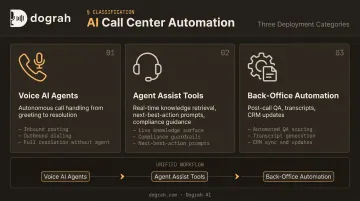
There are three main categories worth distinguishing:
- Voice AI agents — handle phone calls autonomously, from greeting to resolution or escalation
- Agent assist tools — support human reps in real time with knowledge retrieval, next-best-action prompts, and compliance guidance
- Back-office automation — post-call analysis, QA scoring, transcript generation, CRM updates, and data entry
Modern platforms often combine all three. A caller might be greeted by a voice AI agent, routed intelligently to a human rep who receives real-time coaching, and have the entire interaction automatically logged, scored, and surfaced to a manager — without any manual step in the chain.
How This Differs from Legacy IVR
That end-to-end continuity is exactly where traditional IVR falls apart. Legacy systems ask customers to navigate rigid menus — press 1 for billing, press 2 for support. ContactBabel found that 42% of contact centers say too many IVR options lead to abandonment, and 38% say customers abandon because they don't trust the system.
AI replaces the menu with a conversation. Instead of navigating prompts, customers speak naturally — "I need to reschedule my appointment" — and the system understands intent, resolves what it can autonomously, and routes the rest with full context attached. That shift changes how contact centers are designed from the ground up — not just a faster menu, but a system that reasons, adapts, and hands off with context intact.
Key Use Cases: How AI Automation Works in Call Centers
Inbound Customer Service Automation
Conversational IVR and voice AI agents let customers speak naturally rather than press keys. The AI understands intent, handles straightforward requests — appointment bookings, order status, balance inquiries, scheduling — autonomously. When escalation is needed, it hands off to the right human agent with full call context already in place, cutting hold times and abandoned call rates.
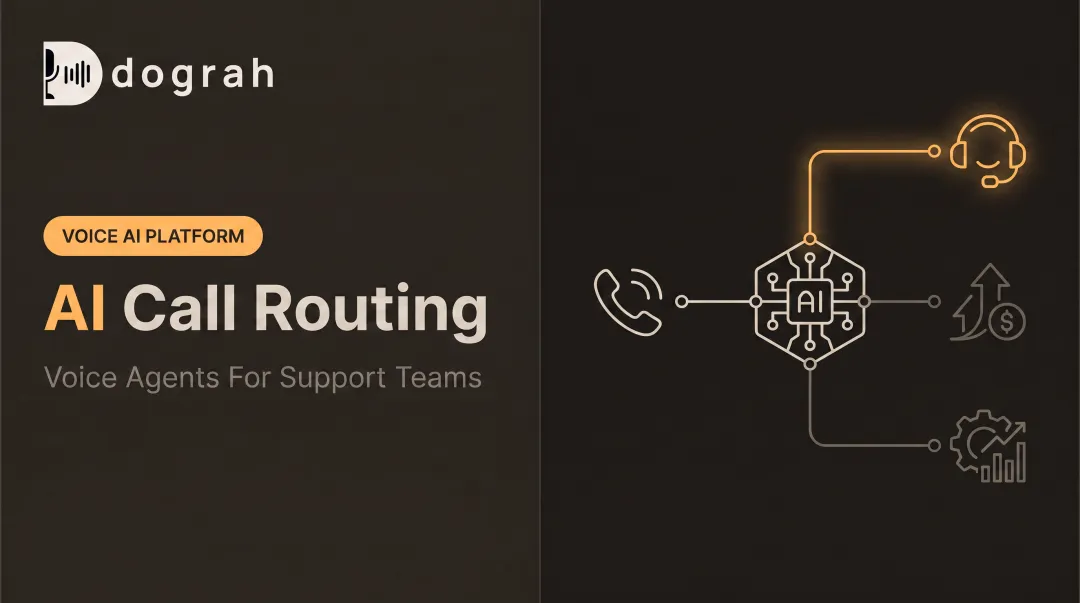
Intelligent call routing takes this further. Instead of routing by agent availability, AI analyzes customer intent, sentiment, language, and history in real time to match the call to the best-suited agent or team. The result: fewer transfers, lower average handle time (AHT), and higher first-call resolution (FCR). FCR consistently ranks as one of the top three contact center metrics, and reducing transfers is one of the fastest ways to move it.
Self-service deflection extends these gains by handling tier-1 inquiries — FAQs, status checks, password resets, scheduling changes — without human involvement. Every call deflected reduces inbound volume for agents and sharpens their focus on complex, high-value conversations.
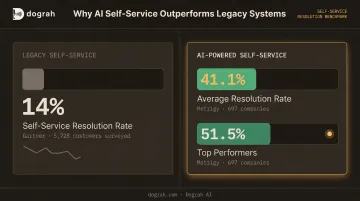
A note of caution on deflection claims: Gartner's survey of 5,728 customers found only 14% of service issues are fully resolved in self-service today — largely because legacy self-service fails to understand customer intent. AI-powered self-service performs significantly better. Metrigy's benchmark of 697 companies found AI resolves 41.1% of interactions without live-agent support on average, rising to 51.5% for top performers.
Outbound Calling and Agent Support
Outbound AI handles the high-volume, low-complexity work that ties up sales and operations teams:
- Appointment reminders and confirmations
- Lead qualification and initial outreach
- Payment follow-ups and collections nudges
- Re-engagement campaigns for lapsed customers
Voice agents run the opening phase — qualifying intent, confirming details, scheduling — then transfer warm leads or confirmed appointments to human reps. Conversion rates improve; reps focus on the conversations that actually require them.
One approach that's moved the needle on outbound performance: mixing real human voice recordings for key conversational moments with TTS fallback — all within the same cloned voice profile. Dograh AI's hybrid pre-recorded + TTS feature does exactly this, cutting costs up to 3× and delivering 2× better outbound conversions compared to standard TTS alone.
Real-time agent assist surfaces relevant knowledge base articles, next-best-action prompts, and compliance guidance during live calls. Agents spend less time searching for answers mid-conversation, and quality becomes more consistent across the team — especially useful for onboarding new reps quickly.
Post-Call Analysis and Quality Assurance
Manual QA programs are structurally limited: McKinsey reports that traditional programs analyze only 1%–2% of total customer interactions. Managers work from a tiny, often unrepresentative sample. Compliance gaps go undetected. Coaching opportunities surface weeks late.
AI-powered QA evaluates 100% of interactions — scoring for compliance, sentiment, tone, and resolution quality automatically. McKinsey estimates this approach has the potential to deliver 50%+ QA cost savings and 25–30% improvement in agent efficiency. Managers get continuous visibility rather than periodic, sample-based reports.
The Business Benefits of AI Automation for Customer Service Teams
Cost Reduction and Scalability
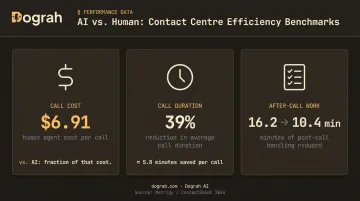
AI handles high volumes of tier-1 interactions without adding headcount. The cost difference is significant: the average inbound call costs $6.91 to handle with a human agent (ContactBabel 2024), while AI-handled interactions run a fraction of that. Metrigy's benchmark found AI reduced average customer interaction duration by 39% — equivalent to 5.8 minutes per call — and cut after-call work from 16.2 to 10.4 minutes.
For peak demand, the math is even more compelling. Staffing for peaks means overstaffing during normal periods. AI scales elastically, handling thousands of simultaneous calls without the cost of idle agents.
24/7 Availability Without Shift Premiums
Voice and chat AI agents operate around the clock. No after-hours gaps, no holiday staffing problems, no midnight calls that ring out. For SMBs that previously couldn't justify round-the-clock coverage, this is a genuine capability shift.
The stakes are real: 74% of consumers expect 24/7 customer service availability (Zendesk CX Trends 2026), and 78% have abandoned a business after an unanswered call.
Faster Resolution and Reduced Agent Burnout
AI directly improves the metrics that drive customer satisfaction. Specifically, it:
- Reduces wait times by handling tier-1 volume instantly
- Eliminates repeat transfers by routing with full context
- Cuts AHT and improves FCR by briefing human agents before they pick up
On the agent side, absorbing repetitive tier-1 tasks means human reps focus on complex, high-empathy conversations rather than FAQ lookups and data entry. This matters for retention: contact center attrition hit 36% in 2024 (ContactBabel), and 45.3% of companies in Metrigy's success group reported that agent-assist tools directly reduced it.
Replacing an agent isn't cheap. SHRM tracks recruitment, onboarding, and productivity loss as the core cost drivers, and high turnover compounds into one of the largest hidden costs in call center operations.
Open Source vs. Closed Platform: Why It Matters for Call Center AI
The Problem With Closed Platforms
Proprietary voice AI platforms — Vapi, Retell, and similar SaaS offerings — come with a structural problem: your sensitive customer call data flows through their infrastructure. For regulated industries, that creates real compliance exposure.
Under HIPAA guidance, any cloud service provider that creates, receives, maintains, or transmits ePHI on behalf of a covered entity is a business associate — requiring a BAA, a vendor security review, and ongoing compliance oversight. GDPR adds its own layer. SOC 2 procurement reviews add months to deployment timelines.
Beyond compliance, vendor lock-in is a pricing risk. As dependency deepens, pricing leverage shifts to the vendor.
The Advantages of Self-Hosted Open Source Voice AI
Data sovereignty means all call data, transcripts, and customer information stay within your own infrastructure — no third-party access, no shared cloud risk. For regulated industries, this eliminates the need to certify a vendor's compliance posture entirely, cutting procurement timelines and reducing legal exposure.
No vendor lock-in means LLM, STT, and TTS providers can be swapped freely. Open-source code is fully inspectable — teams can see exactly how data is processed, how models are called, and how decisions are made. Locally hosted models (Whisper, Llama, Kokoro) are drop-in options.
Dograh AI is the open-source, self-hostable alternative to closed platforms like Vapi and Retell. Built by Y Combinator alumni, it operates like a visual workflow builder for voice agents and AI calling — think n8n, but purpose-built for voice.
Core capabilities at a glance:
| Capability | What It Delivers |
|---|
| BSD 2-Clause license, Docker deployable | Full commercial freedom, no platform fees | | Speech-to-Speech orchestration | Roughly halves end-to-end latency | | Hybrid pre-recorded + TTS voice | Up to 3× lower cost, 2× better outbound conversions | | 70+ language support | Global coverage across any accent or industry | | Fully managed private cloud option | Dograh manages infrastructure within your own environment | | Production-ready agent deployment | Under two minutes on cloud or self-hosted |
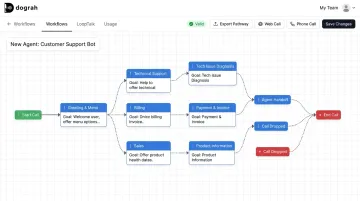
Three deployment options are available: fully managed cloud, self-hosted OSS (free to host and use), and fully managed private cloud — where Dograh's team builds and deploys the entire voice agent infrastructure within the customer's own cloud environment, handling orchestration, upgrades, and operational overhead while keeping all data on-premise.
How to Implement AI Automation in Your Call Center: A Practical Checklist
Step 1 — Audit and prioritize
Map your current call flows. Identify the highest-volume, most repetitive interactions: after-hours gaps, tier-1 FAQs, routing failures, appointment reminders. Start with 2–3 use cases where automation delivers the fastest, most measurable ROI. A focused pilot teaches you more than a broad rollout. Automate one thing well before scaling.
Step 2 — Choose the right platform for your data and compliance needs
Your deployment model determines your compliance posture, procurement complexity, and long-term cost structure. Three main paths exist:
- SaaS/closed platforms — fastest to launch, but data leaves your infrastructure
- Open-source self-hosted — full data sovereignty, no vendor lock-in, requires internal hosting capacity
- Managed private cloud — vendor-managed infrastructure within your own cloud environment
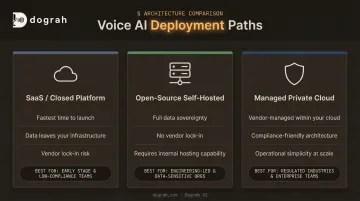
Healthcare, finance, legal, and government organizations should prioritize options that keep data on-premise and eliminate third-party compliance overhead entirely.
Step 3 — Integrate, test, and iterate
Connect your AI platform to your CRM, telephony, and ticketing systems. Run a pilot on one use case. Track the metrics that matter:
- Containment rate : percentage of interactions resolved without human escalation
- AHT : average handle time per call
- FCR : first-call resolution rate
- CSAT : customer satisfaction scores
- Transfer rate : how often calls are passed between agents
Refine prompts, escalation thresholds, and routing logic based on real call data. Then scale what's working.
Frequently Asked Questions
How is AI used in contact centers?
AI handles inbound calls and chat via voice agents, routes inquiries by intent and sentiment rather than availability, assists human agents in real time with knowledge and prompts, and analyzes 100% of interactions for QA and performance coaching — replacing the manual effort at each of these steps.
What is the difference between an AI call center and a traditional call center?
Traditional call centers rely on availability-based routing, rigid IVR menus, and manual QA that reviews 1–2% of calls. AI-driven operations route by intent, automate QA across all interactions, and deliver conversational self-service — resulting in lower costs, faster resolution, and continuous 24/7 coverage.
Can AI replace human call center agents?
AI handles tier-1 tasks — routing, FAQs, data lookups, and scheduling — while humans focus on complex, high-stakes conversations. The outcome is augmentation, not replacement: agents handle fewer low-value calls, and satisfaction and retention typically improve.
What are the benefits of open-source AI automation for call centers?
Call data stays on-premise (full data sovereignty), there's no vendor lock-in, the code is fully auditable, and compliance procurement is faster because you're not certifying a third-party vendor's infrastructure. These advantages are especially significant for healthcare, finance, legal, and government organizations.
How do you get started with AI automation in a customer service operation?
Audit your call flows to identify the highest-volume, most repetitive interactions. Choose a platform that fits your compliance requirements — critical if you're in a regulated industry. Run a focused pilot on one or two use cases, track FCR, AHT, containment rate, and CSAT, then scale based on results.