
Introduction
Contact center agent turnover isn't a morale problem. It's a structural operations crisis. According to ContactBabel's 2025 US Contact Center Decision-Makers' Guide, US agent attrition hit 31% in 2024 — nearly one in three agents left their role within the year.
A separate survey of 540 contact center agents by Calabrio found that burnout and stressful workloads tied with pay and benefits as the top reasons agents consider leaving. Only 49% felt positive about staying long term.
The conversation about AI voice tools often gets framed as "better tools for agents." The real opportunity is structural: changing what human agents are asked to do, removing entire categories of calls from the human queue rather than making those same calls slightly easier.
This article breaks down the three core operational advantages of AI voice tools in reducing burnout and churn, explains why each matters in practice, and covers which metrics to track to confirm it's working.
Key Takeaways
- US contact center attrition reached 31% in 2024 — burnout is a structural problem, not a resilience failure
- AI voice tools reduce burnout by removing entire call categories from human agents, not by assisting through the same volume
- Agents benefit most from three shifts: fewer repetitive tier-1 calls, lower real-time cognitive load, and automated after-call work
- Without AI, burnout compounds into a self-reinforcing churn cycle — fewer agents handle more calls, accelerating further attrition
- Track agent-centric metrics (ESAT, attrition, ACW time) alongside CSAT — burnout reduction shows up in agent metrics first
What Is Agent Burnout in Contact Centers?
The WHO classifies burnout in ICD-11 as an occupational phenomenon — not a personal weakness — arising from chronic workplace stress that goes unmanaged. The WHO identifies three markers: energy depletion and exhaustion, mental distance or cynicism toward work, and reduced professional effectiveness.
Contact centers create the conditions for all three. The work structure is the problem:
- Back-to-back calls with minimal recovery time between interactions
- Performance measured simultaneously across AHT, FCR, CSAT, and compliance metrics
- Scripts that remove autonomy while demanding emotional management
- Systems requiring constant context-switching mid-conversation
A 2021 academic study of 1,440 participants across 15 contact center companies confirmed what most operators already feel — contact centers are consistently associated with high turnover, absenteeism, stress, and burnout. The work itself, not the person doing it, is the primary driver.
Why Burnout Is an Operations Problem, Not a Wellness Problem
Burnout degrades performance before agents quit — and replacing them costs even more. ContactBabel notes that staffing can account for up to 75% of a contact center's operational cost, meaning every percentage point of avoidable attrition directly degrades the financial model.
When experienced agents leave, the damage extends well beyond headcount. Each departure takes months of embedded product knowledge and call-handling proficiency that can't be replaced quickly. The downstream effects compound fast:
- Service quality drops as newer agents handle complex calls with less confidence
- CSAT scores fall, compounding pressure on the remaining team
- Recruitment and training costs stack on top of the revenue already lost
Key Advantages of AI Voice Tools in Reducing Agent Burnout and Churn
The three advantages below reflect structural changes in what agents actually handle. These aren't abstract claims about improving the "agent experience" — each maps to measurable outcomes.
Advantage 1: Offloading Tier-1 and Repetitive Calls Entirely
AI voice agents handle entire inbound and outbound call categories autonomously: FAQs, appointment scheduling, order status, billing inquiries, account balance checks, and routine outbound follow-ups. No human agent enters the loop. This is categorically different from agent assist tools — the agent isn't involved at all.
McKinsey's 2025 analysis of millions of interactions across 30+ organizations found that 50–60% of customer interactions remain transactional. At one European bank, transactional queries accounted for roughly 50% of total call volume. At a North American telco, around 40% of call reasons were transactional. These aren't edge cases — they represent the majority of what human agents currently handle.
That same research found an energy company reduced billing call volume by roughly 20% and cut up to 60 seconds from authentication by integrating an AI voice assistant into its call workflow.
Academic research on contact center stress consistently identifies monotonous, repetitive work with little autonomy as a primary burnout accelerant. Answering the same question 50 times in a shift doesn't just feel tedious — it erodes professional identity and engagement in a way that varied, complex work does not.
When agents shift from handling tier-1 volume to handling only calls requiring genuine judgment and empathy, the job changes structurally. A 2021 contact center stress study found that work lacking complexity or challenge is a consistent predictor of disengagement.
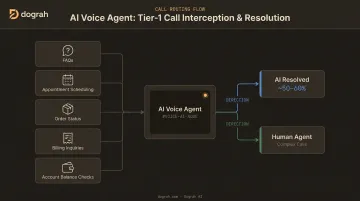
Platforms like Dograh AI are built specifically for this structural shift. Deployed as the first point of contact for defined call intents, Dograh's AI voice agents handle inbound and outbound call categories around the clock — scaling to thousands of simultaneous calls without adding human headcount. Human agents receive only tier-2 and above interactions from the start.
KPIs impacted:
- Agent attrition rate
- Call deflection rate
- Human agent utilization
- ESAT (Employee Satisfaction)
- Cost per handled interaction
When this matters most: High-volume contact centers in retail, financial services, insurance, healthcare scheduling, and hospitality — industries where tier-1 volume is predictably high and call intent is well-defined.
Advantage 2: Reducing Cognitive Load During Live Calls
For calls that do reach human agents, AI tools reduce the mental effort required. They surface customer context before connection, suggest next-best actions in real time, and flag sentiment shifts so agents can respond proactively rather than reactively.
The cognitive burden on today's contact center agents is well-documented. ContactBabel's 2025 data shows 34% of inbound calls have agents spending 21–30% of the call just navigating screens. In many centers, agents routinely duplicate or copy-paste data across multiple systems during a single interaction.
ICMI reports that calls marked as "difficult" by agents increased by around 50% since the pandemic, alongside a 68% increase in issues escalated up the chain. ICMI also found that approximately 60% of agents say AI helps them save time by automating repetitive duties like routing and inquiry processing.
Multi-tasking across CRM systems, compliance requirements, emotional management, and performance metrics simultaneously isn't just tiring — it compounds across a full shift in ways that pure call volume doesn't. Calabrio's data shows agents navigate an average of 4.3 systems per contact while simultaneously managing an upset customer's tone. That's not busy; that's operating at a cognitive ceiling that drains empathy and quality faster than call count alone.
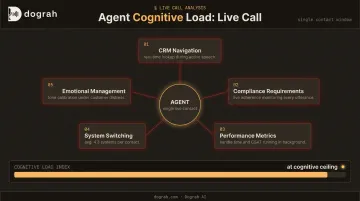
Reducing that friction has a direct downstream effect. Agents under less cognitive strain handle calls with better focus, which cuts escalations, callbacks, and the performance pressure those generate.
KPIs impacted:
- Average Handle Time (AHT)
- First Call Resolution (FCR)
- CSAT
- Quality assurance scores
- Agent-reported confidence scores
When this matters most: Compliance-heavy industries — financial services, insurance, healthcare, legal — where agents must balance regulatory accuracy with empathy under time pressure and where the consequences of errors are high.
Advantage 3: Automating After-Call Work and Quality Monitoring
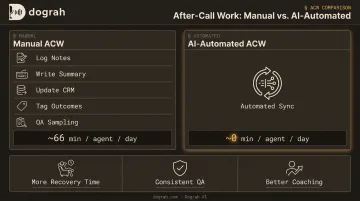
After every call, agents spend additional time logging notes, writing summaries, updating CRM records, and tagging call outcomes. AI voice tools automate this entirely: generating post-call summaries, pushing updates to CRM platforms, and scoring calls for quality and compliance without agent input.
The scale of this problem is often underestimated. ContactBabel's 2025 data shows post-call wrap-up accounts for 13.7% of agent activity. Across a standard 8-hour day, that translates to approximately 66 minutes per agent per shift spent on administrative tasks that carry no sense of accomplishment.
Dograh AI automates post-call workflows directly, syncing call logs, outcomes, and notes to platforms like Salesforce, HubSpot, and Zendesk through real-time integration — removing documentation from the agent's workflow entirely. Agents move directly to their next interaction or a genuine recovery break instead of spending time on repetitive paperwork.
After-call work extends every interaction without any of the engagement of a live conversation. It's low-stimulation, high-frequency administrative grind that erodes energy across a shift without building skill or satisfaction. Across hundreds of daily interactions, that accumulation is a consistent driver of end-of-shift exhaustion and long-term disengagement.
There's also a fairness dimension to automated QA that often goes unaddressed. When quality monitoring is manual, agents are evaluated on a small random sample that may not reflect their actual performance. That randomness creates performance anxiety — the sense of being arbitrarily audited — without improving coaching outcomes.
Automated QA that analyzes every call removes the lottery quality of manual sampling. Supervisors gain consistent, actionable coaching data across the full team. Agents get feedback grounded in their actual work, not a snapshot that may have caught an unusually difficult day.
KPIs impacted:
- ACW time per call
- Agent utilization rate
- QA coverage rate
- Coaching effectiveness
- Absenteeism rate
When this matters most: High-volume contact centers with strict documentation requirements — financial services, healthcare, and legal — where manual ACW is both time-consuming and compliance-critical.
What Happens When AI Voice Tools Are Missing
Without structural intervention, burnout doesn't stabilize. It compounds.
The mechanism is straightforward: burned-out agents leave, their call volume distributes across the remaining team, utilization rises, recovery time shrinks further, and more agents reach their breaking point. Calabrio's data shows agent idle time has already fallen from 14% in 2010 to just 8% today — meaning agents have less recovery between calls than at any point in the past 15 years.
The consequences add up fast:
- Rising AHT and falling FCR as fatigued agents slow down and make more errors
- Declining CSAT as emotional exhaustion reduces empathy and engagement
- Accelerating recruitment costs as attrition outpaces onboarding capacity
- Institutional knowledge loss every time an experienced agent exits

There's also a scaling problem that headcount alone cannot solve. Adding agents raises cost and management complexity without touching the structural causes of burnout.
At every new headcount level, the same repetitive call volume still lands on human agents. The burnout problem scales with growth until the nature of what agents are asked to handle actually changes.
How to Get the Most Value from AI Voice Tools
Deploy to Own Call Categories, Not Assist Through Them
The highest-value deployment is one where the AI makes an entire class of calls disappear from the human queue. Start by identifying the top 3–5 most repetitive call types — FAQs, appointment confirmations, billing inquiries, order status, account balance checks — and deploy AI voice agents to handle those categories end-to-end from day one.
McKinsey's guidance aligns with this sequencing: AI-driven solutions should solve simple transactional issues through virtual voice assistants as the first deployment layer, before expanding into more complex call types.
For Dograh AI, this means a working voice agent can be live in under 2 minutes through the platform's drag-and-drop workflow builder. The initial deployment covers one call type with one integration and defined escalation rules, then expands as quality is proven.
Track Agent Metrics, Not Just Customer Metrics
Burnout reduction shows up in agent-facing data before it appears in CSAT or FCR. The leading indicators to monitor:
- ESAT (Employee Satisfaction) — tracks job quality from the agent's perspective
- Agent attrition rate — the clearest lagging indicator of structural improvement
- ACW time — a direct measure of administrative burden reduction
- Agent utilization — identifies whether load distribution has improved
- Absenteeism rate — a behavioral signal of sustained stress before formal attrition
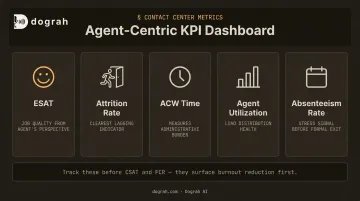
CSAT and FCR remain important, but they're outcome metrics. Agent-centric metrics are the early warning system.
Address Data Sovereignty Before Deployment Stalls in Regulated Industries
For healthcare, legal, fintech, and insurance contact centers, cloud AI deployments can trigger compliance barriers that delay or block procurement. Under HIPAA, any cloud service provider handling protected health information is classified as a business associate and requires a signed BAA — even for encrypted services.
Dograh AI's self-hostable architecture addresses this directly. Organizations in regulated industries can deploy the full voice agent infrastructure within their own cloud environment, keeping sensitive data off third-party systems entirely. There's no vendor compliance certification chain to navigate, which means faster procurement and go-live without sacrificing data control.
Conclusion
AI voice tools address agent burnout at the structural level — not by making difficult work slightly easier, but by redesigning which work reaches agents at all. Removing tier-1 calls from the human queue, lowering cognitive load during complex calls, and automating post-call work together eliminate the three core sources of agent exhaustion.
These advantages compound over time. Agents who stay longer become more capable. Teams with lower attrition maintain institutional knowledge. Contact centers with better-structured roles attract better candidates. When agent experience improves, customer experience follows — a sequence that's easy to reverse accidentally when organizations focus on CX metrics alone.
AI voice tools deliver durable results when treated as a permanent structural change in how contact centers are designed — not a seasonal experiment or a stopgap during a staffing crunch. Organizations that see the strongest outcomes typically follow the same pattern:
- Identify the highest-frequency, lowest-complexity call categories first
- Deploy AI to handle those categories completely, not partially
- Track agent-centric metrics (satisfaction scores, attrition rate, handle time) from day one
- Expand AI scope only after the first deployment is stable and measured
Frequently Asked Questions
What is the main cause of agent burnout in contact centers?
Burnout in contact centers is primarily driven by repetitive call volume, emotional labor from frustrated customers, cognitive overload from juggling multiple systems, and post-call documentation burden — all measured against strict real-time performance metrics. These conditions stack predictably, making burnout a structural outcome of how the work is designed.
How do AI voice tools specifically reduce agent churn?
AI voice tools reduce churn by removing the structural causes of burnout: tier-1 calls are handled autonomously, cognitive load during complex calls is reduced, and after-call documentation is automated. Agents who spend more time on meaningful work and less on administrative overhead experience less per-shift exhaustion, which directly improves retention.
Can AI voice tools fully replace human agents?
No. AI voice tools are designed to handle tier-1 and routine interactions autonomously, while human agents remain essential for complex, emotionally sensitive, and high-stakes conversations. The model is a structural division of labor: AI handles what's predictable and repetitive, while humans focus on what requires genuine judgment and empathy.
Which KPIs should contact centers track to measure whether AI is reducing burnout?
Focus on agent-centric metrics first: ESAT, attrition rate, absenteeism, ACW time, and agent utilization. These leading indicators surface burnout reduction before it shows up in customer-facing metrics like CSAT and FCR, giving leaders earlier visibility to act.
How quickly can AI voice agents be deployed to start relieving agent load?
Modern platforms like Dograh AI support deployment in under 2 minutes for initial use cases using pre-built templates and a drag-and-drop workflow builder. The recommended approach is to start with the highest-volume, most repetitive call type, confirm quality, then expand scope from there.
What types of calls should be automated first to reduce agent stress fastest?
Start with the highest-frequency, lowest-complexity call types: FAQs, appointment confirmations, billing inquiries, order status, and account balance checks. These represent the bulk of repetitive volume, are easiest to automate reliably, and deliver the most immediate reduction in agent call load.