Introduction
Customer support quality depends almost entirely on how well agents are trained — yet most contact centers still rely on static scripts, classroom role-play, and manual QA reviews to prepare their teams. These methods were built for a different era.
The reality today: traditional QA processes review only 3%–5% of customer interactions, leaving 95% of calls unanalyzed. Feedback loops can take weeks. And new agents spend their first weeks on live calls making avoidable mistakes that frustrate customers and drain supervisor time.
AI voice agents address each of these gaps directly. They simulate realistic customer conversations, evaluate every session with consistent scoring, and adapt scenarios to the exact challenges agents will face on live calls — without requiring trainer time or scheduling windows.
What follows is a practical breakdown of how AI voice agents work as training tools, what changes in onboarding and ongoing coaching, how to measure the impact, and what to prioritize when building your program.
Key Takeaways
- Traditional QA reviews just 3–5% of calls; AI can evaluate 100% of training sessions with consistent scoring
- AI voice training simulators run 24/7, handle concurrent sessions, and adapt scenarios from cooperative to combative customers
- TELUS Digital cut onboarding time by 20% and ran 50,000+ simulations after deploying AI-powered agent training
- Regulated industries benefit most from self-hosted platforms, where training data never leaves their own infrastructure
- Dograh AI lets teams deploy a working training voice agent in under 2 minutes
Why Traditional Customer Support Training Falls Short
The Classroom-to-Call-Floor Gap
Agents complete onboarding, pass their assessments, and then spend their first weeks on live calls making mistakes that training never prepared them for. One ICMI case study found agents were still struggling with complex calls after 60 days — until two targeted process changes cut that ramp time by 75%, bringing them to full competency in 15 days instead.
TELUS Communications previously required up to 10 weeks of training for agents handling diverse service lines. The problem isn't agent capability — classroom training simply doesn't replicate the pressure, pacing, and unpredictability of real calls.
The QA Blind Spot
Even after agents are live, the feedback loop is broken:
- QA teams review 3%–5% of interactions — the other 95% are invisible
- Traditional supervisors can wait weeks before an agent learns what went wrong
- Scoring varies between reviewers, making it hard to identify systemic patterns
This means agents can repeat the same mistakes for weeks before anyone catches it. And by the time feedback arrives, the context is long gone.
The Generational Dimension
By 2034, Millennials, Gen Z, and the first adult Gen Alphas will make up 80% of the workforce in advanced economies, according to the World Economic Forum. This is a generation that grew up with on-demand, interactive, personalized learning — not PowerPoint decks and quarterly coaching sessions.
Static training formats don't match how this workforce learns. They expect to practice in realistic scenarios, get feedback immediately, and repeat until they've got it right — none of which traditional onboarding delivers. That's exactly the gap AI voice agents are built to close.
How AI Voice Agents Work as Training Simulators
The Core Mechanism
AI voice training simulators use LLMs and speech-to-speech technology to engage trainees in dynamic, unscripted conversations. The system listens to what the agent says, interprets their intent, responds naturally, and adjusts the conversation based on how the interaction unfolds — not from a rigid decision tree, but from contextual language understanding.
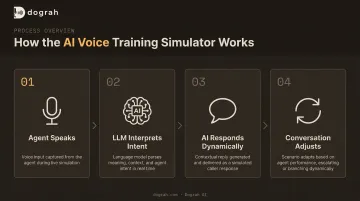
Platforms like Dograh AI support this through a feature called LoopTalk — an AI-to-AI testing framework where the AI acts as the customer, simulating real-world caller behavior and stress-testing agent responses across different scenarios. The system maintains sub-600ms response times, producing conversations that feel live rather than scripted.
Grounded in Real Data
The difference between a generic simulation and a useful one is the data it runs on. Effective training simulators are built from:
- Actual call transcripts from your live call center
- Knowledge base articles and product documentation
- SOPs and decision trees agents will use on real calls
- Policy rules including compliance scripts and exception handling
This grounds every simulation in the specific calls, objections, and scenarios agents will actually encounter — not generic retail or telecom examples that don't match your business.
Configurable Scenario Difficulty
Not every training scenario should throw an angry caller at a new hire in week one. Effective simulators let you control the escalation curve:
- Cooperative, friendly personas in early stages — building foundational confidence
- Skeptical callers at mid-stage, asking harder questions and requesting exceptions
- Frustrated or combative customers in advanced scenarios — billing disputes, cancellation requests
Dograh AI's LoopTalk supports persona configuration that simulates different customer behaviors — including interruptions and edge-case scenarios — so agents build genuine resilience before facing those situations on live calls.
Multilingual and Accent Training
For global support teams, language coverage isn't a nice-to-have — it's a readiness gap. Dograh AI supports 70+ languages natively, including mid-call language switching, and the architecture is provider-agnostic — teams can plug in additional STT/TTS providers to extend coverage further.
Key multilingual training capabilities include:
- Exposure to diverse accents and communication styles before live queue deployment
- Mid-call language switching to simulate real multilingual caller behavior
- Provider-agnostic architecture for extending language and accent coverage
Key Ways AI Voice Agents Transform Support Training
Always-On, Scalable Practice
Human role-play requires a trainer, a schedule, and a room. AI training simulators need none of that:
- Available 24/7 across every shift
- Run hundreds of concurrent sessions simultaneously
- No competition for trainer time or session slots
- Every agent can practice as often as needed
This matters most during high-volume hiring periods — when you're onboarding 50 agents at once, you can't give every one of them adequate human role-play time. AI simulators remove that ceiling entirely.
100% Evaluation Coverage
Traditional QA's 3–5% sample rate isn't just inefficient — it's statistically unreliable. You might review five calls from an agent and miss the pattern showing up in 30 others.
AI-powered evaluation changes this:
- Every training session is scored using the same rubric
- No scorer variability — identical standards apply across every agent and every shift
- Patterns emerge that sporadic human review would never catch
NICE's Auto Score product reports 100% evaluation coverage as a direct outcome of AI-powered quality management. The same principle applies to training: when every simulated session generates a scorecard, managers get a complete picture — not a sample.
Accelerated Speed-to-Competency
The benchmark that matters most for training ROI is how quickly new hires reach independent productivity. Vendor evidence is promising:
- Avantive Solutions reports a 13% lift in new hire performance after introducing AI training bots
- TELUS Digital cut onboarding time by 20% and ran over 50,000 simulations across 70,000 associates using AI-powered voice training
- TELUS also reduced roleplay training time from several hours per 2–3 scenarios down to 45 minutes, with roleplay productivity improving 75%–85%
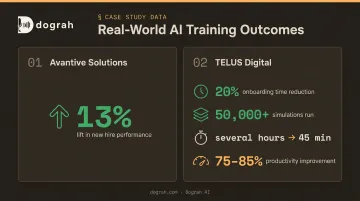
These are operational outcomes from contact centers running AI training at scale — which brings up another dimension regulated industries can't ignore: compliance.
Compliance and Script Adherence Testing
For regulated industries, training isn't just about soft skills — it's about whether agents deliver required disclosures, avoid prohibited language, and follow mandated call structures. AI simulators can enforce this at scale.
Dograh AI supports:
- Disclosure nodes with locked scripts that agents cannot bypass mid-conversation
- Custom guardrails defining prohibited language and compliance boundaries
- Strict adherence checks built into automated post-call analysis
- Complete audit trails documenting every decision made during the simulation
This makes compliance training testable and repeatable — not dependent on whether a supervisor happened to sit in on a call.
From Onboarding to Ongoing Coaching: Training Use Cases
AI voice training simulators aren't just for new hires. The same infrastructure serves multiple use cases across the agent lifecycle:
- New hire onboarding: Replace or supplement classroom sessions with immersive AI call simulations. Agents arrive on the floor having already practiced their hardest scenarios, not experiencing them for the first time with a live customer.
- Objection handling and de-escalation: Build targeted simulations for the call types agents struggle with most — angry customers, billing disputes, cancellation requests — so practice happens in a safe environment before it counts.
- Compliance certification: Regulated industries carry the highest training stakes. For insurance, healthcare, and financial services contact centers, deploying AI simulation across 170+ scenarios with compliance guardrails has demonstrated 34% shorter average handle time and 30% fewer abandoned calls.
- Product and policy refreshers: When something changes — new product launch, updated pricing, policy revision — push updated simulations to the entire team immediately. Dograh AI's drag-and-drop workflow builder accepts plain-English edits, so training updates deploy without requiring development work.
Measuring Training Effectiveness with AI Voice Analytics
Training programs that can't be measured can't be improved. The KPIs that matter most for AI voice training:
| Metric | What It Measures |
|---|---|
| Speed-to-green | Days from hire to meeting live performance benchmarks |
| First-call resolution (new hires) | Whether early-tenure agents resolve issues without transfers |
| Simulation scores by competency | Performance across specific dimensions — rapport, objection handling, compliance |
| Escalation and transfer rates (first 90 days) | How often new agents can't resolve independently |
| Agent retention at 2 years | ICMI reports only 54% of agents remain past 2 years — training quality affects this directly |
Dograh AI's per-turn logging captures structured data from every conversation, including:
- ASR confidence scores — how accurately speech was recognized
- Tool execution status — whether the agent triggered the right actions
- Sentiment signals — emotional tone shifts across the call
- Outcome labels — resolution, escalation, transfer, or abandonment
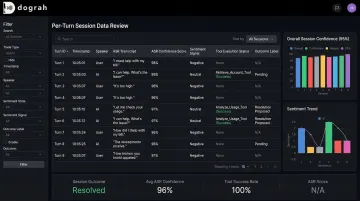
This turns every training session into reviewable performance data — no more relying on anecdotal coaching notes or spot-check QA.
The platform integrates Langfuse observability for real-time monitoring, so supervisors can review conversation transcripts and performance metrics as they happen. That visibility lets training managers act on patterns early, before bad habits solidify across a cohort.
Building Your AI Voice Training Program: Key Considerations
Start With Your Highest-Stakes Scenarios
Don't try to simulate every possible call type from day one. Identify the scenarios that are:
- Calls every agent handles daily — your highest-volume interactions
- Objection handling, escalations, and edge cases agents find hardest
- Regulated disclosures and prohibited language — your highest compliance-risk calls
Build simulations around those first. The ROI is faster, and you'll learn what works before expanding coverage.
Prioritize Data Control in Regulated Industries
Training data includes call recordings, internal knowledge bases, and potentially sensitive customer information. For healthcare, financial services, legal, and other regulated industries, where that data lives is a real procurement and compliance concern.
Dograh AI's open-source, self-hostable platform addresses this directly. Teams can deploy the entire training infrastructure within their own cloud environment — all data stays in their VPC or data center, with no external data transfer. The platform supports fully air-gapped deployments for the highest-security environments, and its BSD 2-Clause licensed source code can be audited by internal security teams.
This architecture doesn't eliminate compliance obligations — organizations still need to implement their own security controls, BAAs, and audit logging — but it removes vendor exposure from the equation entirely. For organizations procuring AI training tools in regulated industries, that's a meaningful difference in both risk profile and procurement speed.
Plan for Continuous Iteration
A training program built on 12-month-old call data will drift out of sync with reality. Build in a regular cadence for:
- Reviewing live call performance data for new objection patterns
- Flagging policy changes and product updates for simulation content
- Pushing updated scenarios to training bots before agents encounter those changes on live calls
Dograh AI's knowledge base integration supports real-time RAG queries during simulations, and the feedback loop through call summaries keeps scenario libraries in sync with live call realities — so agents train on what's actually happening, not what was happening last quarter.
Frequently Asked Questions
What skills are needed for AI customer service?
Active listening and empathy remain essential — AI handles repetitive tasks while humans manage complex cases. Agents also need familiarity with AI tools, adaptability to AI-augmented workflows, and the ability to act on AI-generated performance insights rather than waiting for manual coaching.
How do AI voice agents simulate customer conversations for training?
LLM-powered voice agents engage trainees in dynamic, unscripted dialogue based on real call transcripts and knowledge bases. The AI listens to what the agent says, responds naturally, and adjusts the conversation flow accordingly — creating a realistic simulation without a human trainer in the room.
Can AI voice agents replace human trainers in customer support?
No — they augment trainers rather than replace them. AI handles scalable practice, consistent scoring, and 24/7 availability. Human trainers focus on nuanced coaching, culture, and situations simulations can't fully replicate: politically sensitive escalations, compliance edge cases, and building team trust.
How do you measure the effectiveness of AI voice agent training?
Track speed-to-green (days from hire to hitting live performance benchmarks), first-call resolution rates for new hires, simulation scores across weighted competencies, and downstream metrics like escalation rates and agent retention. Structured per-turn logging turns every session into measurable data.
What types of customer support scenarios can AI voice agents simulate?
Everything from routine FAQs and order status calls to objection handling, billing disputes, de-escalation, and compliance-sensitive conversations requiring mandatory disclosures. Difficulty scales by changing the customer persona, from cooperative to combative, within the same simulation framework.
How long does it take to deploy an AI voice agent for training purposes?
Dograh AI's pre-built templates and no-code workflow builder get a functional training agent running in minutes, connecting your knowledge base and call recordings via RAG integration. Full deployment with compliance configuration takes longer and depends on your infrastructure requirements.