Introduction
Call centers are caught in a compounding problem. Call volumes don't follow a schedule, customer expectations for instant responses keep rising, and staffing at scale is genuinely expensive — ContactBabel's 2024 US benchmark puts mean inbound call cost at $6.91 with staffing consuming up to 75% of operating costs. Add agent attrition running at a mean of 31% annually, and you have a system that's expensive, fragile, and increasingly hard to scale.
Voice AI addresses all three pressure points simultaneously. The proof isn't in vendor promises — it's in daily metrics: CSAT scores, wait times, first-call resolution rates, and whether your agents are burning out or actually doing meaningful work.
This article covers how Voice AI improves customer satisfaction in practice, through three specific, measurable operational advantages.
Key Takeaways
- Voice AI handles calls 24/7 at any scale without proportional headcount increases, keeping wait times near zero during volume spikes
- First-call resolution drives satisfaction more than speed alone — and Voice AI is built to deliver both
- Automated post-call analysis covers 100% of interactions, closing quality gaps that manual QA sampling never catches
- Call centers without Voice AI face rising costs, inconsistent service, and customer frustration that compounds with every unanswered call
- Sustained CSAT improvement requires iteration — reviewing outcomes and acting on insights, not just deploying and moving on
What Is Voice AI for Call Centers
Voice AI for call centers refers to AI-powered voice agents that understand natural speech, interpret caller intent, and respond conversationally. This is a clear departure from traditional IVR systems — the keypress menus that CFI Group's 2022 Contact Center Satisfaction Index scored only 58 out of 100 for ease of accessing useful information.
Modern Voice AI uses three core technologies working together:
- ASR (Automatic Speech Recognition) — converts spoken words to text
- NLU (Natural Language Understanding) — interprets what the caller actually wants
- TTS (Text-to-Speech) — responds in natural-sounding spoken language
In practice, Voice AI is deployed across three main models:
- Inbound support — answers questions, resolves issues, and routes calls without hold queues
- Outbound engagement — sends reminders, follow-ups, and proactive notifications at scale
- Hybrid — AI handles Tier-1 interactions and hands off complex cases to human agents with full conversation context already loaded
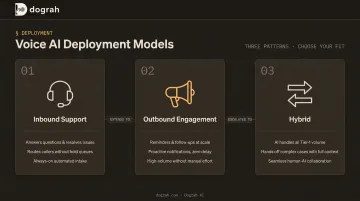
Each model addresses a different point of friction in the customer journey — whether that's reducing wait times, following up faster, or making sure escalations don't lose context. The result is faster resolutions, more consistent experiences, and operations that scale without proportionally scaling headcount.
Three Advantages of Voice AI for Customer Satisfaction
These aren't abstract improvements. Each advantage maps directly to KPIs that customer experience leaders track every week.
Advantage 1: 24/7 Availability and Instant Scalability
The core problem Voice AI solves here is simple: human staffing has a ceiling. When call volume spikes — during a product issue, a marketing campaign, or seasonal demand — a human-only operation forces callers into queues or misses calls entirely.
Voice AI removes that ceiling. Agents can handle inbound calls at any hour and scale to handle surges without the lag of recruiting, hiring, and training.
Why wait time matters so much:
ContactBabel's 2024 US data puts average speed to answer at 79 seconds, with a 7.1% abandonment rate. A Mindful report found that nearly 60% of customers won't wait more than one minute, and over 90% hang up after five minutes. Customers who abandon don't just call back later — many don't return at all.
Forrester's 2025 research adds important nuance: 95% of US online adults said they'd wait longer on hold if guaranteed first-attempt resolution. Speed matters, but resolution matters more.
KPIs this affects:
| Metric | Why it moves |
|---|---|
| Average Speed to Answer (ASA) | AI picks up instantly, no queue |
| Call Abandonment Rate | Near-zero hold times eliminate hang-ups |
| CSAT / NPS | Faster resolution = higher reported satisfaction |
| Cost-per-contact | Automation absorbs volume without proportional cost |
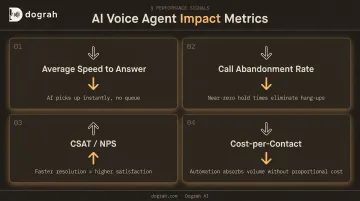
When this matters most: E-commerce during peak sales periods, healthcare during enrollment windows, insurance during claim surges — any business that loses revenue when calls go unanswered after hours.
Dograh AI handles this through dynamic auto-scaling that maintains sub-600ms latency as concurrent call volume grows — no manual capacity planning required.
Advantage 2: Faster, More Natural Conversations
Speed to answer gets customers in the door. What happens next determines whether they leave satisfied.
Traditional IVR forces callers through rigid menu trees. Modern Voice AI — using NLU and, in advanced implementations, Speech-to-Speech orchestration — engages callers in natural back-and-forth. It understands intent, maintains context across turns, and resolves issues without making customers repeat themselves.
Why first-call resolution is the central metric:
SQM Group's research establishes a direct relationship: each 1% improvement in First-Call Resolution corresponds to a 1% improvement in CSAT. CFI Group's data shows that callers who reached resolution on the first call scored CCSI 82, compared to an overall average of CCSI 69. Yet only 47% of callers in that study reported their issue was resolved on the first call.
That 53% of callers leaving without resolution represents the clearest opportunity for Voice AI to move the needle on CSAT.
How it works operationally:
- Eliminates menu navigation friction that frustrates callers before the conversation even starts
- Handles high-volume Tier-1 inquiries completely — order status, balance checks, appointment scheduling, account resets
- Passes clean context to human agents when escalation is genuinely needed, so agents don't spend the first two minutes re-gathering information the caller already provided
The highest-impact starting point is the 60%-80% of calls that are predictable and repetitive: order status, returns policy, password resets, claim status, billing inquiries. These are the interactions where AI containment drives the fastest, most measurable AHT and FCR improvement.
KPIs this affects:
- Average Handle Time (AHT)
- First-Call Resolution (FCR)
- Call Transfer Rate
- Customer Effort Score (CES)
- CSAT
When this matters most: Financial services, healthcare, and legal — where nuanced questions carry the highest cost of mishandling. Also multilingual operations, where Dograh AI's support for 70+ languages with mid-call switching removes the language barriers that extend handle times and erode caller confidence.
Advantage 3: Automated Post-Call Analysis
The first two advantages improve calls as they happen. Post-call analysis improves every call that follows.
Voice AI captures, transcribes, and analyzes 100% of interactions — detecting sentiment, flagging miscommunications, tracking resolution success, and identifying patterns that manual QA sampling would never surface.
The coverage gap in traditional QA:
ICMI's data suggests roughly 60% of contact centers monitor fewer than five calls per agent per month. That's not a quality program — it's a sampling exercise. Automated post-call analysis replaces sampling with complete coverage: every call, every agent, every shift.
This creates a compounding advantage. Teams can identify the exact conversation points where customers disengage or escalate, coach agents on recurring patterns, and refine AI scripts or escalation logic — continuously, not reactively.
Dograh AI's approach includes:
- Call run history and debugging tools for past conversations
- LoopTalk, an AI-to-AI testing framework that simulates real customer scenarios using AI-driven personas
- LangFuse integration for full observability into agent decision-making in real time
- Feedback loop through call summaries to support faster script iteration
KPIs this affects:
| Metric | Impact |
|---|---|
| QA Coverage Rate | From ~5% sampled to 100% analyzed |
| CSAT Consistency | Reduces variance across agents and shifts |
| Escalation Rate | Flagged patterns inform script and routing improvements |
| Agent Coaching Efficiency | Managers coach on real patterns, not sampled guesses |
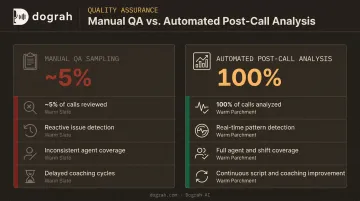
When this matters most: The higher the call volume, the larger the gap between what manual QA can catch and what automated analysis surfaces. In regulated industries — healthcare, financial services, insurance — this isn't optional. HIPAA requires safeguarding patient information across all interactions, and FINRA Rule 3110 mandates supervisory systems covering registered representatives' customer conversations.
What Happens Without Voice AI
- Inconsistent service quality — agents vary in knowledge, energy, and tone across shifts. CFI Group found first-agent resolution fell from 63% to 55% in recent years, directly driving CSAT variance.
- Reactive firefighting — quality issues accumulate undetected without automated post-call analysis. PwC's 2025 Customer Experience Survey found 52% of consumers stopped using a brand after a single bad experience.
- Rising costs with diminishing returns — staffing additional agents is slow and expensive. ContactBabel reports 62% of managers cite attrition and recruitment as their primary barrier to operational goals.
- Volume spikes cause service degradation — any surge strains a human-only operation, producing longer hold times, missed calls, and the satisfaction erosion that follows both.
How to Get the Most Value from Voice AI
Voice AI delivers sustained CSAT improvement when treated as an operational practice, not a one-time deployment. The platforms that see consistent gains are the ones that build iteration into their workflow from the start.
The conditions under which it works best:
Start with the right call types — high-volume, Tier-1 interactions where the customer goal is simple and completion can be confirmed automatically. Dograh AI's routing logic sends calls to AI when policy is clear and the action is reversible; humans take over when sentiment turns negative, exceptions are needed, or compliance flags appear.
Review outcomes regularly — use post-call analytics and CSAT data to identify where customers disengage, where transfers happen unnecessarily, and where scripts need updating. Treat this as a weekly operational rhythm, not a quarterly review.
Act on what the analysis surfaces — update AI scripts, adjust escalation logic, retrain human agents on the patterns AI uncovers. Dograh AI's visual no-code workflow builder lets operations teams make these changes directly, without waiting on engineering cycles.
Nail the handoff — the transfer from AI to human is where many implementations lose the satisfaction gains they created. Dograh AI passes a complete summary to the receiving agent: caller intent, verification status, API results, transcript, sentiment, and recommended next step. Agents start from context, not zero.

Deployment Flexibility for Compliance-Sensitive Operations
For regulated industries, how you deploy matters as much as what you deploy. Dograh AI supports three models:
- Cloud — voice agents live in under two minutes, fully managed
- Self-hosted OSS — open source under BSD 2-Clause license for full data sovereignty and auditable code
- Fully managed private cloud — entire voice infrastructure runs within your own environment, critical for healthcare, financial services, and any industry where data residency isn't optional
Conclusion
These advantages build on each other. Availability and scale eliminate friction at the point of contact. Faster, more natural conversations improve resolution quality. Automated post-call analysis makes each iteration better than the last.
The result is a customer satisfaction profile that's more consistent, more recoverable when scores dip, and no longer hostage to which agent happened to pick up the phone. Voice AI compounds in value over time — the operational layer quietly tightens as post-call data informs the next interaction, pushing the baseline higher with each cycle.
Frequently Asked Questions
What are the benefits of AI in call centers?
AI enables 24/7 availability, near-zero wait times during volume spikes, automated quality monitoring across 100% of calls, and lower cost per interaction — benefits that compound into higher CSAT, stronger retention, and fewer repeat contacts.
What are the benefits of AI voice agents?
AI voice agents handle natural spoken conversation and resolve Tier-1 inquiries completely, routing complex cases to human agents with full context. The result is faster resolution and consistent caller experiences regardless of time of day or call volume.
How is AI being used for customer service?
AI handles inbound inquiries autonomously, routes complex cases to the right human agent, performs post-call analysis for QA and coaching, and sends proactive outbound notifications. Voice remains the channel where AI delivers the highest impact: highest stakes, highest volume.
Do call centers use AI voice changers?
No. Call centers use Voice AI — systems that understand spoken intent and respond conversationally using ASR, NLU, and TTS. This is distinct from voice conversion technology, which transforms voice characteristics to sound like a different speaker.
Will Voice AI replace human agents in call centers?
Voice AI handles high-volume, Tier-1 interactions autonomously, but human agents remain essential for complex, emotional, and high-stakes conversations. The most effective call centers use AI to free agents for cases where judgment, empathy, and relationship-building genuinely matter.
How quickly can a business deploy a Voice AI agent?
Platforms like Dograh AI let teams configure and launch a working voice agent in under two minutes via no-code visual builders. Cloud deployment is near-instant; self-hosted Docker deployment adds setup time but gives you full data control and zero platform fees.