Introduction
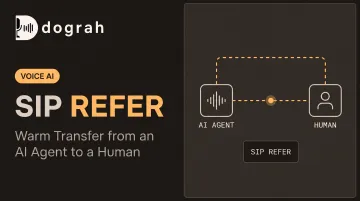
When an AI voice agent hits a question it can't handle, the call has to reach a human without the caller noticing the seam. SIP REFER is the SIP method that makes that handoff work: one party redirects an active call to a third party, then steps out of the conversation.
This explainer is for developers, product teams, and technical decision-makers building or evaluating AI voice agent platforms that need human escalation. A clean handoff protects customer satisfaction and compliance—and decides how much volume your AI contains versus escalates.
SIP REFER shows up constantly in vendor docs and RFCs. The operational details—warm versus cold transfer, Refer-To and Replaces headers, and the NOTIFY dialog flow—rarely get explained clearly.
This article breaks down the call flow, when warm transfer applies, what determines reliability, and where AI-to-human handoffs typically fail.
Key Takeaways
- SIP REFER (RFC 3515) redirects an active call to a third party while the referring party exits gracefully.
- Warm (attended) transfer pairs REFER with the Replaces header (RFC 3891) and a consultation call; cold transfer skips both.
- AI voice agents use warm transfer to escalate to humans without making callers repeat themselves.
- Core signaling steps: REFER, 202 Accepted, NOTIFY with sipfrag, then a Replaces-based INVITE.
- Reliable handoffs need SBC/carrier REFER support, context passed in signaling, and low transfer latency.
What Is SIP REFER Warm Transfer?
SIP REFER is a SIP method defined in RFC 3515. It instructs a user agent to contact a third party specified in a Refer-To header. On its own, a plain REFER request just contains a destination — no history of the call it's replacing rides along with it.
That's where attended transfer comes in. Add the Replaces header (RFC 3891) plus a prior consultation call, and REFER becomes a "warm" transfer. The AI already has the human on a separate line, briefs them, then triggers the handoff that connects the caller to that pre-briefed human.
The goal is to move the caller from the AI agent to a human while keeping the call alive and its context intact—no dead air, no dropped call, and no "let me explain this again."
Warm Transfer vs. Blind Transfer vs. Conferencing
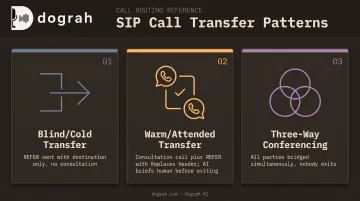
Two related patterns get confused with warm transfer:
- Blind/cold transfer — REFER is sent with just the destination URI, no Replaces, no consultation. The AI hands off and hopes the human picks up. RFC 5589 calls this "unattended" transfer.
- Three-way conferencing — all parties stay bridged at once. Nobody exits, which is different from transfer, where the AI's leg terminates once the human connects.
Warm transfer sits between the two. It uses the same underlying REFER mechanism as blind transfer, but adds a consultation step and Replaces correlation so the outcome is known before the AI leaves the call.
Why SIP REFER Warm Transfer Matters for AI Voice Agent Handoffs
Callers who get transferred already start at a disadvantage. Research from SQM Group, which studies more than 500 North American call centers annually, found transferred calls score 12% lower on customer satisfaction and 14% lower on first-call resolution than calls that aren't transferred.
Warm transfers close part of that gap. SQM's data shows higher CSAT and FCR for warm transfers than cold ones, largely because customers don't have to repeat themselves to a stranger.
For AI-to-human handoffs specifically, that consultation step is the mechanism that decides whether the human starts with context or starts cold. Three things matter most:
- Context continuity: the human needs intent, account details, and conversation history before they say hello, not after.
- Minimal handoff latency: a few seconds of dead air during the switch reads as a dropped call to the person on the line.
- Uninterrupted recording: in healthcare and financial services, the conversation has to stay recorded and reviewable across the handoff, not restart as a separate call.
Skip proper warm transfer support and the failure modes are predictable: calls drop mid-transfer, callers re-explain problems they already explained to a bot, and regulated conversations never get human eyes on them because the "transfer" was really an untracked blind redirect.
RFC 5589, the IETF's call-control best-practice document, treats attended transfer via REFER plus Replaces as the standard pattern for session mobility—not something proprietary to any voice AI platform.
Escalation logic in the AI workflow matters as much as the SIP mechanics. Platforms like Dograh AI build transfer steps into a visual workflow builder so the AI handles tier-1 inquiries and routes out when a call hits a defined trigger:
- Repeated low confidence
- An explicit "talk to a human" request
- Distress signals
- A compliance-sensitive topic
The handoff carries intent, extracted fields, and a transcript summary, so humans spend time on tier-2 and complex conversations instead of fielding every call from the start.
How SIP REFER Warm Transfer Works (Conceptual Flow)
An active call already exists between the caller and the AI agent. The AI, acting as what RFC 5589 calls the "transferor," brings in a human (the "transfer target") and then exits, leaving caller and human directly connected.
Three things need to be in place before the handoff happens:
- An established caller-AI dialog (the live call)
- A side consultation channel to the human agent
- Context to brief that human, typically a transcript or intent summary passed via API, webhook, or SIP INFO
During the handoff, the AI holds the caller, briefs the human on the consultation channel, then signals a re-point of the caller's media path to the human's endpoint. Refer-To, Replaces, and Referred-By headers, plus NOTIFY messages with sipfrag status, let the AI track progress.
When it completes, the caller is bridged directly to the human, the AI's leg drops, and any out-of-band context arrives with the handoff.
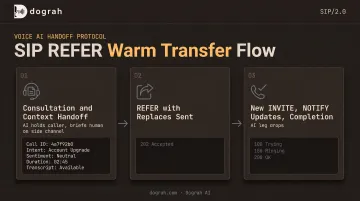
Step 1: Consultation and Context Handoff
The AI places the caller on hold and opens a side call to a human agent. Before the formal transfer, it shares a transcript or intent summary—via API, webhook, or SIP INFO/custom header—so the human has full context.
Step 2: REFER with Replaces Is Sent
The AI's SBC or platform sends a SIP REFER on the caller's leg. The Refer-To header points to the human agent's SIP URI and carries a Replaces parameter referencing the consultation dialog from Step 1. The caller's user agent responds with 202 Accepted, which acknowledges the request was received. It does not confirm the transfer succeeded.
Step 3: New INVITE, NOTIFY Updates, and Completion
The caller's UA (or the SBC acting for it) sends a new INVITE with the Replaces header to the human agent's endpoint. NOTIFY messages relay status back to the AI: 100 Trying, 180 Ringing, then 200 OK.
Once the human answers, the AI drops its leg so caller and human stay directly connected. Platforms like Dograh AI use this same REFER flow to hand a live call to a human without the caller hearing the switch.
Where It's Used and What Affects Reliability
Where SIP REFER Warm Transfer Is Applied
Common workflows include:
- Contact center IVR-to-agent escalation
- AI support or sales bot handoff to human closers
- Healthcare triage bot escalation to clinical staff
- SIP trunking/SBC platforms with REFER-based transfer (e.g., Twilio Elastic SIP Trunking, Oracle SBC)
Typical triggers include low intent-detection confidence, an explicit caller request, negative sentiment, or a compliance rule requiring human review. The process is condition-based: it fires per call on real-time signals, not on a fixed schedule.
Key Factors That Affect Reliability
Carrier and SBC support for REFER plus Replaces varies significantly:
| Provider/Platform | Documented Transfer Support | Notes |
|---|---|---|
| Twilio Elastic SIP Trunking | Blind transfer via REFER | Attended/Replaces support isn't documented; early media and emergency-number transfer are unsupported |
| Cisco IOS 15M&T | Blind and attended transfer | Replaces is required for attended transfer; Cisco copies it from Refer-To into the triggered INVITE |
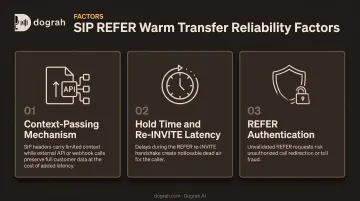
Beyond carrier support, three other factors decide whether a handoff actually feels seamless:
- Context-passing mechanism: SIP headers versus an external API/webhook determine how much conversation history the human receives before picking up.
- Hold time and re-INVITE latency: delays here create the dead air callers notice most.
- REFER authentication: RFC 3515 flags this directly—an unvalidated REFER can redirect calls to an attacker-controlled destination or enable toll fraud, so authorization policies at the SBC boundary matter.
Common Pitfalls, Misconceptions, and When to Skip It
Two misconceptions cause most of the confusion around this feature.
Any REFER equals a warm transfer. It doesn't. Plain REFER without Replaces and a prior consultation is a blind/cold transfer. The Replaces header and the consultation call are what make it attended.
202 Accepted means the handoff succeeded. It doesn't. That response only confirms the caller's UA accepted the REFER and set up a subscription. Teams should track the NOTIFY/sipfrag final status line to confirm the human agent actually answered.
Skip warm transfer in these cases:
- Self-service IVR only — no human fallback, so no attended handoff to build
- Low-value campaigns — a blind transfer is enough; warm transfer adds complexity without payoff
- Legacy PSTN gateways — trunks without Replaces can't run attended transfer, no matter what the AI platform supports
Frequently Asked Questions
What does SIP REFER mean?
SIP REFER is a SIP method (RFC 3515) that instructs a user agent to contact a third party using a Refer-To header. It redirects an active call to a new destination.
What is a warm transfer?
A warm transfer briefs the receiving agent before the caller is connected. In SIP, that usually means a consultation call plus REFER with a Replaces header so the handoff is attended, not blind.
What is SIP calling?
SIP calling means placing voice calls over the internet using the Session Initiation Protocol rather than traditional PSTN lines. VoIP apps and softphones commonly use it.
What's the difference between SIP REFER and a blind transfer?
Plain SIP REFER without Replaces or consultation performs a blind/cold transfer. Adding Replaces plus a consultation call turns it into an attended, warm transfer.
Does SIP REFER work with AI voice agents on any telephony provider?
Support varies by provider and SBC. Some only support blind transfer via REFER, so attended warm transfers require confirming Replaces-header support first.
What is the Replaces header used for in SIP transfers?
The Replaces header (RFC 3891) lets a new INVITE reference and take over an existing dialog. This is what enables attended/warm transfers to bridge the caller directly to the new party.