Introduction
Missed appointments cost the U.S. healthcare system an estimated $150 billion annually, with median no-show rates running between 5% and 7% across most practices. For a mid-size clinic, that's real revenue walking out the door — most of it preventable with the right outreach.
Conversational AI can automate appointment reminders end-to-end: outbound calls, confirmation capture, rescheduling, multilingual outreach, all without staff involvement. But healthcare is uniquely regulated.
The moment an AI system touches a patient's name, appointment time, or provider information, it's handling Protected Health Information (PHI). Most implementations go wrong here — either by choosing platforms without proper safeguards or by misunderstanding what HIPAA actually requires.
This article covers what HIPAA requires for automated reminders, which technical safeguards to verify before going live, what a compliant voice AI can realistically do, and why your deployment model — cloud versus self-hosted — changes the compliance picture entirely.
Key Takeaways
- HIPAA permits automated appointment reminders without special patient authorization, but limits PHI exposure and requires opt-out mechanisms
- Every third-party vendor processing PHI must sign a BAA — missing one exposes the practice to OCR enforcement action
- Voice AI can handle confirmations, rescheduling, multilingual outreach, and 24/7 patient calls within HIPAA boundaries
- Self-hosting keeps PHI inside your own infrastructure and eliminates the vendor compliance layer entirely
- Evaluate vendors on TLS 1.3 in transit, AES-256 at rest, audit logs, RBAC, data residency controls, and BAA readiness
What HIPAA Actually Requires for AI Appointment Reminders
HHS OCR confirms that appointment reminders are considered part of treatment under 45 CFR 164.506(c) — no special patient authorization is required to send them. Where most implementations fall short is in the guardrails around how PHI is used and shared.
Appointment Reminders and PHI: Where the Risk Lives
Under 45 CFR 160.103, PHI is any individually identifiable health information that relates to health status, provision of care, or payment, and identifies (or could identify) the individual. In the reminder context, this threshold is lower than most teams expect — a patient's name combined with an appointment time and provider name is sufficient to constitute PHI. A voicemail left at the wrong number qualifies as a breach.
The minimum necessary standard under 45 CFR 164.502(b) requires that reminder messages include only what the patient needs to show up.
| Compliant | Non-Compliant |
|---|---|
| "Your appointment with Dr. Smith's office is confirmed for Tuesday at 2 PM." | "Your oncology follow-up with Dr. Smith is scheduled for Tuesday." |
| "This is a reminder from Riverside Clinic — please call us to confirm your Thursday appointment." | "A reminder about your diabetes management visit on Thursday at 10 AM." |
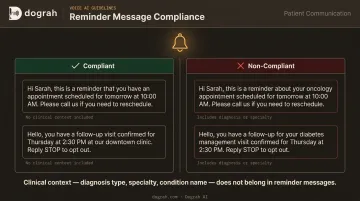
The pattern is consistent: clinical context (diagnosis type, specialty, condition name) doesn't belong in reminder messages. That same principle applies to the mechanics of how reminders are delivered.
Patient Consent and Opt-Out Obligations
HIPAA permits reminders without special authorization, but patients have the right to request restrictions on how they're contacted. Practices must honor channel preferences (voice, SMS, email) and provide a clear opt-out mechanism on every automated communication.
These channel restrictions don't operate in isolation — they intersect with the TCPA. Under FCC rules from 2015, healthcare providers using automated calls and texts for treatment purposes receive certain exemptions — but those exemptions are conditioned on including an opt-out mechanism and respecting prior opt-outs.
Two practical requirements that often get overlooked:
- Log channel preferences and opt-out history in a format that's auditable on demand
- Automate opt-out suppression — manual list management creates compliance exposure and operational risk
The Technical Safeguards Every Compliant Voice AI Platform Must Have
HIPAA's Security Rule requires "reasonable and appropriate" administrative, physical, and technical safeguards under 45 CFR 164.306. For voice AI, this translates into specific architectural requirements that must be verified before any patient data flows through the system.
Encryption, Access Controls, and Audit Logs
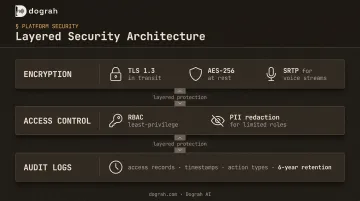
Encryption requirements for voice AI deployments:
- In transit: TLS 1.3 for all API calls; SRTP for voice streams
- At rest: AES-256 for stored call recordings and transcripts
- Breach safe harbor: HHS confirms that encrypting PHI to NIST standards renders it "unusable, unreadable, or indecipherable" — meaning an encrypted breach does not trigger notification obligations
Dograh AI's HIPAA-ready architecture implements TLS 1.3 in transit and AES-256 at rest across both its managed cloud and self-hosted deployments. For self-hosted configurations, encryption key management stays entirely within the organization's own environment.
Role-Based Access Control (RBAC) ensures least-privilege access to reminder logs and call transcripts. A scheduler confirming appointment volumes gets different permissions than a compliance officer reviewing full transcripts. Dograh AI implements role-based permissions with PII redaction in logs for roles that don't require full transcript access.
Audit logs must capture:
- Who accessed PHI-containing records
- When and from where access occurred
- What action was taken (viewed, exported, edited)
Under 45 CFR 164.530(j), compliance documentation must be retained for six years. Dograh AI generates audit logs covering logins, exports, workflow edits, and prompt edits — with the option to export to external logging systems for SIEM integration.
The Business Associate Agreement (BAA)
Encryption and access controls protect data in motion and at rest. A BAA is what governs who is accountable when something goes wrong.
A BAA is a legally required contract between a covered entity (the healthcare provider) and any third-party vendor — a "Business Associate" — that creates, receives, maintains, or transmits PHI on their behalf. A voice AI platform that processes patient names and appointment data is a Business Associate by definition.
The stakes of skipping this step are documented. In 2017, OCR fined the Center for Children's Digestive Health $31,000 after finding the practice had disclosed PHI to FileFax, Inc. without a signed BAA in place. The fine was modest by OCR standards — but the finding also required a corrective action plan and two years of monitoring.
Minimum BAA evaluation criteria:
- Does the vendor commit to HIPAA-compliant data handling in writing?
- Are their sub-processors (telephony, STT, TTS, hosting) also covered?
- What are the breach notification timelines?
- Do the vendor's compliance commitments hold if their infrastructure changes?
Data Retention, Residency, and Zero-Retention Policies
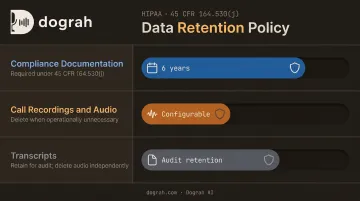
Compliance documentation and call recordings aren't subject to the same rules. While documentation must be retained for six years under 45 CFR 164.530(j), call recordings and transcripts containing PHI should be kept only as long as operationally necessary — then securely deleted with documented procedures.
Dograh AI supports configurable retention windows for audio and transcripts independently, allowing organizations to retain transcripts for audit purposes while deleting raw audio on a shorter cycle. For organizations requiring stricter controls, the self-hosted deployment model allows custom storage lifecycle policies, including potential zero-retention configurations for audio post-call.
For multinational health systems or European practices, GDPR adds a geographic layer: patient data must remain within specific regional boundaries. Dograh AI's fully managed private-cloud deployment supports configurable data residency — the entire voice agent infrastructure deploys within the customer's own cloud environment, in the region they specify, with no data transiting external Dograh AI servers.
What HIPAA-Compliant Conversational AI Can Do for Appointment Reminders
Beyond robocall-style reminders, modern voice AI uses natural language understanding to hold genuine two-way interactions — and all of these capabilities can be delivered compliantly when the underlying architecture is built for it.
Automated Confirmation, Cancellation, and Rescheduling
A compliant voice AI agent can:
- Call the patient and deliver a HIPAA-safe reminder script (minimum necessary PHI, no clinical details)
- Interpret natural spoken responses — "Yes, I'll be there," "I need to cancel," or "Can we move to next week?"
- Check live scheduling availability via API integration with the practice management or EHR system
- Offer alternative slots in real time and confirm the new appointment
- Write the updated appointment back to the scheduling system without staff involvement
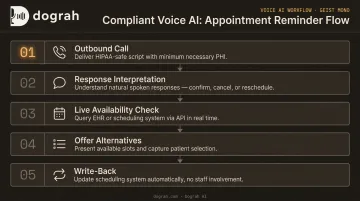
That last step — write-back — is critical. Without it, every AI interaction requires manual reconciliation, which defeats the operational purpose of automation. Dograh integrates with scheduling systems via webhooks and API tool calls, enabling the voice agent to sync changes in real time during the same outbound call.
Natural, Low-Latency Dialogue
Latency is a compliance-adjacent issue that directly affects outcomes. High latency creates awkward pauses that confuse patients — leading to hang-ups before confirmation is captured. Research on conversational timing shows that natural adult conversation turn gaps run around 200 ms; systems that stray far beyond that feel unresponsive.
Dograh's Speech-to-Speech orchestration — using Gemini Flash Live and OpenAI GPT-Realtime-2 — targets sub-1,000ms end-to-end latency with a platform turn gap target of 885ms. S2S processes audio directly, skipping intermediate text conversion and producing more fluid conversations that patients stay on the line for.
Multilingual Support and 24/7 Availability
Diverse patient populations require outreach in their preferred language. Communication failures — delivering a reminder in the wrong language, or with low accuracy on regional accents — create both care gaps and potential equity concerns under HHS language access guidance.
Dograh supports multilingual voice agents across 70+ languages, with custom STT dictionary support that preserves clinical terminology across regional accents and pronunciation variations.
That same availability extends the window for patient responses. Kyruus Health data shows that 1 in 3 appointments are scheduled outside business hours — and the same is true for confirmations. Many patients won't call back during office hours to reschedule. A voice AI that handles those interactions at 7 PM on a Tuesday reduces both no-show rates and staff call volume.
The Self-Hosting Advantage: Eliminating Vendor Compliance Overhead
Closed-platform voice AI creates a compliance chain problem in healthcare. When PHI flows to a third-party cloud vendor, the provider must vet that vendor's compliance posture, negotiate and sign a BAA, trust their encryption and retention policies, and re-evaluate every time the vendor updates its infrastructure.
Each additional vendor in the audio path adds legal agreements, breach exposure, and data residency risk.
Self-hosting cuts this chain at the source. When Dograh AI is deployed within a healthcare organization's own infrastructure — on-premise or in a private cloud — PHI never leaves the organization's environment. There is no third-party vendor processing patient data, no dependency on a vendor's SOC 2 attestations, and the organization retains complete control over encryption keys, audit trails, and data retention.
Specifically, for healthcare organizations deploying Dograh in self-hosted or fully managed private-cloud configurations:
- Voice data, transcripts, and conversation logs are processed locally
- No patient data transits Dograh's own servers at any point
- The compliance audit perimeter stays entirely within the organization's own infrastructure
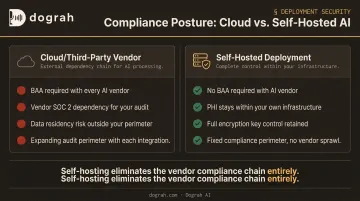
The one friction point teams raise: self-hosting typically demands internal engineering resources. Dograh's fully managed private-cloud deployment model removes that constraint. Dograh's engineers deploy and manage the entire voice agent infrastructure within the customer's own cloud environment — handling orchestration, upgrades, and ongoing operations without any patient data leaving that environment. The result is the data sovereignty of on-premise with the operational simplicity of a managed service.
For healthcare organizations in regulated jurisdictions, that means faster procurement, fewer BAAs to negotiate, and a compliance perimeter that doesn't expand every time a vendor updates its infrastructure.
Deploying Conversational AI for Appointment Reminders: Key Steps
Pre-deployment:
- Map all PHI touchpoints — document which data fields the agent reads (from your EHR or scheduling system) and which it writes back, so access is scoped to the minimum necessary from day one
- Lock down message templates before go-live — apply the minimum necessary standard across voice scripts, SMS fallback, and voicemail; any PHI included must be justified, not incidental
- Automate consent and opt-out handling — suppression lists must update in real time and remain auditable; if a patient opts out at 9am, the 9:05am call should never go out
Dograh AI provides pre-built healthcare workflow templates for appointment reminders, including configurable reminder timing, confirmation and cancellation handling, and multilingual support. These templates accelerate deployment without requiring teams to build PHI-handling logic from scratch.
Rollout approach:
Start with a single department or appointment type before expanding system-wide. Track three metrics against your pre-deployment baseline:
- Confirmation rate
- No-show rate
- Call completion rate
This limits exposure during the calibration period and builds the internal evidence needed for broader adoption.
KPIs to track:
| KPI | What It Measures |
|---|---|
| No-show rate | Primary operational outcome |
| Confirmation rate | Call effectiveness |
| Call completion rate | Technical performance |
| Call abandonment rate | Latency and script issues |
| Opt-out rate | Script quality and consent concerns |
| Staff hours on manual reminders | Operational ROI |
A rising opt-out rate usually points to script tone or consent framing problems — not a rejection of reminders. Investigate the script before assuming the channel is broken.
Frequently Asked Questions
Which AI chatbots are HIPAA compliant?
HIPAA compliance is a set of operational requirements, not a product certification. Any AI system handling PHI must use encryption, maintain audit logs, enforce access controls, and either operate under a signed BAA with the healthcare provider or run within the provider's own infrastructure so PHI never reaches a third party.
Does AI in healthcare violate HIPAA?
AI does not inherently violate HIPAA — compliance depends on implementation. Deployed with proper safeguards (encryption, minimum necessary data use, BAA or self-hosted architecture, audit logging), AI is fully HIPAA-compatible and healthcare organizations already use it widely in compliant settings.
Do I need a BAA with my voice AI vendor for appointment reminders?
Yes, if the vendor's platform processes or stores PHI (patient names, appointment data), a BAA is legally required. The exception is a self-hosted deployment where PHI never leaves the provider's own infrastructure; in that configuration, no BAA with the AI vendor is needed.
What is the "minimum necessary" rule and how does it apply to AI reminders?
The minimum necessary standard requires reminder messages to include only what the patient needs to attend: name, date, time, location. Clinical details (reason for the visit, diagnosis, specialty) must be excluded. Including those details in a message sent to a wrong number or overheard by another person constitutes unnecessary PHI disclosure.
Can conversational AI handle rescheduling during the reminder call?
Modern voice AI can understand natural language responses, check live scheduling availability via API, offer alternative slots, and write the updated appointment back to the scheduling system. All of this happens within the same outbound call and within compliant data handling boundaries.
How does self-hosting a voice AI platform affect HIPAA compliance?
Self-hosting means PHI never leaves the organization's own infrastructure. This eliminates the need for a BAA with the AI vendor, removes dependency on the vendor's SOC 2 or HIPAA attestations, and gives the organization complete control over data retention, encryption keys, and audit trails.