Many teams still test their IVR the old-fashioned way: someone calls in, presses a few buttons, and calls it QA. That works for one path, on one day, in one language. It doesn't work for the hundreds of menu combinations, accents, and failure scenarios a modern IVR needs to handle around the clock.
This guide breaks down what automated IVR testing actually involves — the core test types, the scenarios worth prioritizing, and how AI-driven voice agents are reshaping what "testing" even means.
Key Takeaways
- Automated IVR testing covers functionality, scalability, availability, and accuracy to prevent dropped calls and lost revenue
- Functional, load, stress, spike, soak, regression, monitoring, and speech-accuracy tests catch failures before callers do
- Manual "secret shopper" calls can't scale to cover every menu path, accent, and language combination
- AI voice agents need sentiment, intent, and script-adherence checks that legacy DTMF tools never supported
What Is IVR Testing?
Understanding IVR
IVR stands for Interactive Voice Response. It's the automated telephony layer that greets callers, gathers input through touch-tone keypad presses (DTMF) or spoken commands, and routes them to the right department, self-service flow, or live agent. No human is required until one is actually needed.
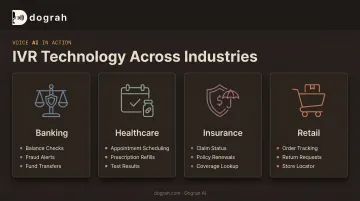
You'll find IVR wherever calls need triaging at scale:
- Banking: balance checks, payments, fraud alerts
- Healthcare: appointment scheduling, prescription refills, triage routing
- Insurance: policy information, claim status, voice payments
- Retail: order tracking, returns, delivery updates
Each of these industries depends on the IVR getting it right the first time. A wrong turn in the menu usually means a frustrated caller demanding a human.
Why Testing an IVR Matters
IVR testing validates a system's infrastructure and application logic under real and simulated traffic. It confirms the system performs as designed, both before launch and continuously afterward.
The market backing these systems isn't small. According to MarketsandMarkets, the conversational AI market behind modern IVR is projected to grow from $17.05 billion in 2025 to $49.80 billion by 2031 (19.6% CAGR). That's a lot of infrastructure businesses are betting real revenue on getting right.
When an IVR breaks or degrades, the damage compounds fast:
- Calls drop before reaching resolution
- Customers get misrouted to the wrong department
- Frustrated callers escalate to live agents, driving up handle time and staffing costs
- Repeated bad experiences push customers toward competitors
Testing can't be a one-time, pre-launch checkbox. Carrier changes, new third-party integrations, and routine system updates can silently break a call flow that worked perfectly last week. Ongoing testing catches what a launch-day test alone will always miss.
Types of Automated IVR Testing
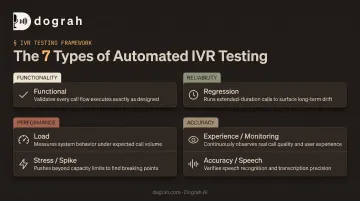
IVRs live inside a tangled web of PSTN access, call routing, databases, and third-party integrations. No single test can catch every failure point hiding in that stack, which is why mature testing programs combine several distinct approaches.
Functional (Feature) Testing
Functional testing validates every menu path and dialog traversal, not just the "happy path" where callers press exactly the right keys. It also covers edge cases: invalid input, silence, mid-prompt hangups, and unexpected key presses. The goal is confirming the IVR behaves exactly as designed for whatever a real caller throws at it.
Load Testing
Load testing gradually ramps simulated calls up to expected peak volumes (think Black Friday or open-enrollment season) while tracking CPU, memory, and response time. It answers a simple question: can the system handle a busy day without buckling?
Stress and Spike Testing
Stress testing pushes traffic far beyond normal peaks to find where the system actually breaks. Spike testing instead simulates sudden, sharp bursts (a viral outage announcement, a mass alert) to see whether the system degrades gracefully or falls over entirely. Both matter, because how a system fails often matters more than when.
Soak Testing
Soak testing runs the IVR at full expected load for an extended stretch, often 24 to 48 hours straight. Short tests miss slow-building problems like memory leaks or connection-pool exhaustion that only surface after hours of sustained use.
Regression Testing
Every new integration, configuration change, or system update carries risk. Regression testing re-validates entire call flows after each change to confirm nothing that worked before has broken.
Experience (Monitoring) Testing
Experience testing works like an automated secret shopper that never sleeps, placing test calls every few minutes around the clock to catch outages or degraded performance before real customers hit them.
Accuracy and Speech Testing
As IVRs shift from keypad menus to voice-driven ones, accuracy testing evaluates speech recognition (ASR) and natural language understanding across accents, languages, and background noise.
One common metric is word error rate: insertions, deletions, and substitutions divided by total words in the reference transcript. According to Google Cloud, 0% means a perfect match. A system with a flawless menu tree still fails if it can't understand what callers are actually saying.
Key Scenarios Every IVR Testing Plan Should Cover
Not every menu path deserves equal scrutiny. Three scenario types show up in almost every serious IVR testing plan, because they're where failures cost the most:
- Verification and fraud prevention: Identity checks (date of birth, account number, security questions) need more than a "does it work" pass. Confirm blank responses and repeated guesses can't bypass them, and that failed attempts trigger the escalation your fraud policy requires.
- Call routing and transfer accuracy: A lost-card or payment caller can't land in the wrong queue. Target sensitive paths (fraud reports, payments, account closures) and verify correct routing every time, not most of the time.
- Multi-language, accent, and retry logic: Callers don't share one language or one English accent. Confirm the system adapts across languages and speech patterns, and retries or escalates to a human when it can't understand, instead of looping forever.
Why Automate IVR Testing Instead of Testing Manually
Recruiting people to repeatedly call in worked fine when IVRs had five menu options and one language. It doesn't scale to what modern systems require: hundreds of path combinations and concurrent call volumes in the thousands. Monitoring also has to run 24/7 — not only during business hours when your QA team is at their desks.
Automated testing tools remove that ceiling. They can:
- Generate unlimited simulated calls on demand, in parallel, across every menu path at once
- Scale to thousands of concurrent calls without adding a single headcount
- Run continuously, catching a broken flow at 3 a.m. instead of after the first angry customer calls in
That speed shows up in the data. Cyara reports that customers using automated IVR testing saw a 90% decrease in IVR testing time and a 50% acceleration in rolling out IVR updates, compared with walking through call permutations one by one. Vendor figures can run optimistic, but the pattern holds: automation compresses weeks of manual test calls into hours.
Testing Traditional IVR vs. Testing Modern Conversational Voice AI
Legacy IVR testing tools were built for static menu trees: press 1 for sales, press 2 for support. They validate routing, DTMF tone registration, and whether a call correctly hit "option 3." That validation still matters. It just isn't enough on its own.
AI voice agents don't route callers through a fixed tree. They hold a conversation. That changes what QA has to measure:
| What legacy IVR testing checks | What voice AI testing adds |
|---|---|
| Did the tone register correctly? | Did the agent understand caller intent, across phrasings? |
| Did the call hit the right menu option? | Did caller sentiment shift, and did the agent notice? |
| Did the transfer connect? | Did the agent hold context across multiple turns? |
| Did the input validate? | Did the agent follow every required disclosure, in order? |
A voice agent can say all the right words in the wrong tone, misunderstand a caller's second sentence after nailing the first, or skip a required disclosure entirely. A DTMF-focused tool would still mark that call as a pass.
Building QA Directly Into the Voice Agent
This is the gap Dograh AI's platform is built to close. Rather than treating QA as a separate, bolted-on step, Dograh AI runs automated post-call analysis directly inside its open-source voice agent platform, on every call rather than a sampled subset.
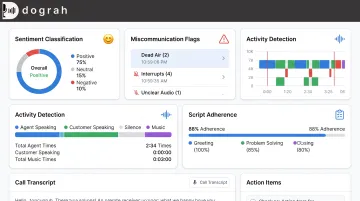
For each call, the platform flags:
- Sentiment: classifies the interaction as positive, neutral, or negative
- Miscommunication: surfaces moments where the conversation likely broke down
- Activity detection: captures what actually happened during the call
- Adherence: checks whether the agent followed required scripts, disclosures, or workflow steps
That kind of coverage would take a QA team weeks to replicate by hand, sampling calls and listening back one at a time. Dograh AI's LoopTalk suite complements this by running AI-generated customer personas against the agent before it ever takes a live call. Those simulations stress-test interruptions, tool timeouts, and handoffs across dozens of caller types.
Because Dograh AI is self-hostable under a BSD 2-Clause license, teams aren't stuck trusting a vendor's black box. They can inspect how sentiment gets scored, fork the logic, and tune it to their own compliance rules. Closed platforms simply don't allow that level of control.
Frequently Asked Questions
What is IVR testing?
IVR testing validates a system's functionality, performance, and accuracy through simulated calls, before launch and continuously. It confirms the system routes callers, understands input, and handles load the way it's designed to.
What does IVR stand for?
IVR stands for Interactive Voice Response — automated phone technology that interacts with callers through voice commands, keypad tones, or both, without requiring a live agent.
How do IVR and CRM work together?
IVR handles the call interaction itself, while a CRM stores customer data. Integrating the two lets the IVR pull up or update a caller's record, like account status or order history, in real time during the call.
What is an IVR in healthcare?
Healthcare IVRs handle tasks like appointment scheduling, prescription refill requests, and symptom-based triage routing. Because they touch sensitive patient data, they require especially strict testing around compliance and data handling.
How do you test an IVR system?
Testing typically combines automated functional, load, and regression tests with continuous production monitoring. Most mature teams rely on automated tools rather than manual test calls, since manual testing can't keep pace with menu complexity or 24/7 monitoring needs.
What's the difference between testing a traditional IVR and testing a voice AI agent?
Traditional IVR testing focuses on menu-path and DTMF validation. Voice AI testing adds conversational accuracy, sentiment analysis, and intent understanding, so you validate where the call went and how well the conversation worked.