Introduction
Law firms are losing clients before the first conversation even happens. According to Clio's 2024 secret-shopper research, 48% of firms were unreachable by phone — and with 78% of potential clients hiring the first attorney to respond, every missed call is a missed case.
The pressure goes beyond intake. Associates spend entire mornings on contract review that AI can complete in minutes. Paralegals chase billing entries that automated tools capture in real time.
That drag adds up fast. Thomson Reuters reports legal professionals expect AI to free nearly 240 hours per year — worth roughly $19,000 in annual value per professional.
AI support agents in 2026 are no longer glorified chatbots. They handle voice intake, contract review, legal research, eDiscovery, billing capture, and compliance monitoring. That expanded capability is driving serious investment: the legal AI software market is projected to grow from $3.11B in 2025 to $10.82B by 2030 at a 28.3% CAGR. Firms that haven't adopted are already falling behind.
This article covers the 10 best AI support agents for law firms in 2026, selected for legal-specific capability, data security, integration depth, and real ROI.
Key Takeaways
- AI support agents automate intake calls, document review, research, billing, and compliance — freeing attorneys for higher-value work
- The 10 tools cover every major friction point: voice intake, legal research, contract review, eDiscovery, and billing
- Prioritize tools with self-hosted or private-cloud options if your firm handles sensitive client data
- Dograh AI leads on 24/7 voice intake with full data sovereignty; Harvey AI and CoCounsel lead on research and drafting
- Start with your biggest bottleneck — intake, research, or contracts — before expanding to other workflows
Why Law Firms Are Adopting AI Support Agents in 2026
Law firms face pressure from two directions simultaneously: clients expect instant, 24/7 responses, while internal efficiency demands keep rising. AI agents address both by automating the high-volume, repeatable work that consumes associate and paralegal capacity.
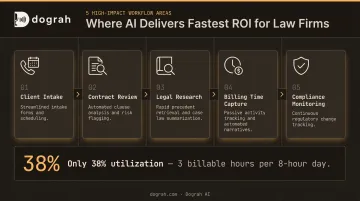
The five workflow areas delivering the fastest ROI:
- Client intake agents qualify prospects, screen practice areas, and book consultations around the clock
- Contract review AI scans documents for clause anomalies, red flags, and deviations from standard positions in minutes
- Legal research tools layer on top of Westlaw, LexisNexis, and regulatory databases to surface cited precedents faster
- Billing time capture via automated logging reduces revenue leakage from unrecorded time
- Compliance monitoring tracks deadlines and regulatory changes, reducing exposure from missed filings
Those workflow gains have a measurable financial floor. Average law firm utilization sits at just 38% — lawyers capture 3 billable hours out of every 8-hour day, per Clio's benchmarks. Administrative drag is the culprit: 74% of small-firm lawyers said spending too much time on admin was at least a moderate challenge, according to Thomson Reuters.
That's the gap AI support agents are built to close — and why adoption is accelerating across firms of every size.
10 Best AI Support Agents for Law Firms in 2026
Selection criteria: tools were evaluated on legal use-case depth, data security posture, integration with major legal platforms, deployment flexibility, and evidence of measurable time or cost savings.
1. Dograh AI
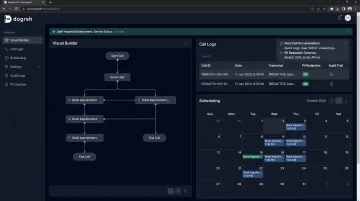
Dograh AI is an open-source, self-hostable voice AI platform built for production-ready inbound and outbound call handling. For law firms, that means 24/7 client intake, appointment scheduling, and after-hours call answering — without routing sensitive call data through third-party servers.
Why it stands out for law firms: Full data sovereignty via self-hosted or private-cloud deployment means client call transcripts and recordings never leave your own infrastructure. This eliminates HIPAA, GDPR, and SOC 2 vendor compliance overhead during procurement — no Business Associate Agreements to negotiate, no Data Processing Agreements to review with an additional AI vendor in the chain.
Key performance features include:
- Hybrid pre-recorded + TTS voice — more natural-sounding calls at up to 3× lower cost, with 2× better conversion on outbound intake follow-ups
- Speech-to-Speech orchestration using Gemini Flash Live and OpenAI GPT-Realtime-2, roughly halving end-to-end latency
- Visual no-code builder — non-technical administrators can deploy a working intake agent in under 2 minutes
Practical integrations include Clio, PracticePanther, and MyCase via API, plus real-time attorney availability checks before routing or scheduling. Post-call, every conversation is documented with full audit logs, call recordings, transcripts, and PII redaction — all within your controlled environment.
| Category | Details |
|---|---|
| Best For | Law firms needing 24/7 voice-based client intake, appointment booking, and after-hours call handling |
| Key Features | Open-source (BSD 2-Clause), self-hostable, Speech-to-Speech orchestration, hybrid voice, 70+ languages, MCP support, visual no-code builder |
| Deployment Options | Cloud, self-hosted OSS (free), or fully managed private cloud within your own infrastructure |
2. Harvey AI
Harvey is a GPT-based legal research and drafting platform built for large and mid-size firms. It integrates directly with LexisNexis (following their June 2025 strategic alliance), EDGAR, and EUR-Lex — covering 500+ legal data sources — and returns memo-style research responses with inline citations.
Strong on complex multi-jurisdictional research and contract drafting. The Microsoft Word add-in and spreadsheet-style clause comparison tables make it practical for associates who live in documents. API access is workspace-configured and may require customer-success support to activate.
| Category | Details |
|---|---|
| Best For | Large firms needing advanced legal research, drafting, and document review |
| Key Features | RAG-powered research, citation validation, Word add-in, clause comparison, 500+ legal data sources |
| Limitation | No published performance benchmarks; API access not self-serve |
3. Thomson Reuters CoCounsel
CoCounsel is embedded within the Thomson Reuters ecosystem, connecting directly to Westlaw and Practical Law for litigation analytics, document review, and case preparation. It carries SOC 2 Type II and ISO 27001 compliance certifications and runs 1,500+ automated quality tests nightly.
Vendor-reported results include 60% faster contract creation and review, and an 88% increase in in-house counsel confidence on business advice. Best suited for firms already invested in the Westlaw ecosystem; less flexible for importing firm-specific or custom data sources.
| Category | Details |
|---|---|
| Best For | Litigation-heavy and mid-to-large firms already using Westlaw |
| Key Features | Westlaw/Practical Law integration, litigation analytics, SOC 2 Type II, ISO 27001, audit logging |
| Limitation | Limited ingestion of firm-specific or custom internal data sources |
4. Lexis+ AI
LexisNexis's AI research layer features Shepard's citation validation — the gold standard for checking whether a case is still good law — plus a drafting agent add-on and semantic search across statutes and case law. The LexisNexis Trust Center confirms SOC 2 Type 2, SOC 3, and HIPAA/HITECH reports for Lexis+ AI.
The Shepard's Citation Agent is now integrated into General AI results, surfacing "At Risk" alerts directly in research output. The drafting agent is a more recent addition and still maturing. Workflow customization is limited to the LexisNexis ecosystem.
| Category | Details |
|---|---|
| Best For | Research-intensive practices needing validated citations and regulatory monitoring |
| Key Features | Shepard's validation, semantic legal search, drafting agent add-on, SOC 2 Type 2, HIPAA/HITECH |
| Limitation | Drafting agent newer; limited customization outside LexisNexis |
5. Clio Duo (Manage AI)
Clio's AI assistant is natively embedded in Clio Manage — the most widely used case management platform for small and mid-size firms. It handles matter summaries, deadline extraction from court documents, billing prompts, and client update drafts without leaving the Clio interface.
No additional setup, no new platform to learn. For SMB firms already on Clio, this is the lowest-friction AI adoption path available — though it's limited to the Clio ecosystem and won't extend to complex enterprise workflows requiring external integrations.
| Category | Details |
|---|---|
| Best For | Small to mid-size law firms on Clio Manage |
| Key Features | Matter summaries, deadline syncing, billing prompts, client update drafts, no-code setup |
| Limitation | Clio-only; not extendable to external systems or large-firm complexity |
6. Luminance
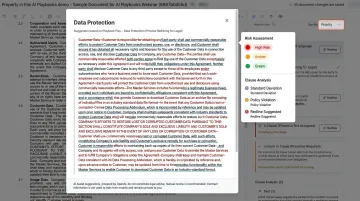
Luminance is an AI contract review platform built for M&A, procurement, and employment law. It scans document portfolios, compares clauses against historical negotiations, and surfaces red flags across bulk document sets. Traffic-light clause analysis and one-click redlining make due diligence reviews faster and less dependent on junior associate time.
Vendor-reported benchmarks include 90% time savings on contract review and 98% reduction in contract management costs. Independent validation isn't available, but the time savings in high-volume due diligence scenarios are real enough to make it worth piloting.
| Category | Details |
|---|---|
| Best For | Corporate, M&A, and procurement legal teams with high document review volumes |
| Key Features | Traffic-light clause analysis, redlining, anomaly detection, concept clustering, due diligence reports |
| Limitation | Primarily contract-focused; limited value for litigation or general practice workflows |
7. Spellbook
Spellbook is a generative AI contract drafting copilot embedded directly in Microsoft Word. Attorneys draft, redline, and revise agreements from prompts in plain language without switching tools. A private deal library stores firm-specific clause preferences for consistent output.
Pricing includes a 7-day free trial with flexible team plans. It's a strong fit for startup counsel, boutique firms, and high-volume contract practices. Firms requiring strict role-based access controls and enterprise governance will need to look elsewhere.
| Category | Details |
|---|---|
| Best For | SMBs, boutique firms, and startup counsel doing high-volume contract work in Word |
| Key Features | Word-native drafting, clause generation from prompts, private deal library, redlining, contract benchmarking |
| Limitation | Limited RBAC and enterprise governance; not designed for complex firm-wide deployments |
8. DISCO
DISCO is a cloud-native eDiscovery platform that uses AI to process, tag, and prioritize electronic evidence for litigation teams. Cecilia AI handles document Q&A, automated review, and timeline generation. DISCO Hold manages legal holds with integrations to Workday, SAP SuccessFactors, Microsoft 365, and Slack.
Vendor-reported results include up to 50% reduction in document population size and million-page productions processed in 25 minutes. Per-matter costs are high — this one is built for active litigation practices managing large commercial or regulatory matters, not for general practice use.
| Category | Details |
|---|---|
| Best For | Litigation teams handling eDiscovery in large commercial, employment, or regulatory cases |
| Key Features | AI relevance ranking, privilege detection, document tagging, legal hold management, cloud-native |
| Limitation | High cost for smaller firms; primarily useful for litigation, not transactional work |
9. Activepieces
Activepieces is an open-source, self-hostable workflow automation platform with a visual no-code builder. It's not legal-specific — but for firms with disconnected tech stacks, it fills a real gap. A new email can trigger a case file update, billing log entry, and attorney notification in sequence, automatically.
The platform supports 280+ integrations and approximately 400 MCP servers. Human-in-the-loop approval steps, multi-LLM support, and enterprise audit logs make it viable for compliance-conscious deployments.
| Category | Details |
|---|---|
| Best For | Law firms needing custom cross-system automation across intake, billing, scheduling, and document management |
| Key Features | 280+ integrations, no-code visual builder, self-hostable, human approval steps, audit logs, multi-LLM support |
| Limitation | Not legal-specific; requires workflow design effort; no built-in legal research |
10. EvenUp
EvenUp auto-generates demand letters and case summaries for personal injury law firms. It analyzes medical records, liability documents, and case facts to produce structured, ready-to-send demand packages — integrating with major PI case management tools.
The Brooks & Baez case study (vendor-reported) documents 20-30 hours saved per month on case valuation and demand writing. EvenUp also claims 69% higher likelihood of policy-limit settlements for firms using the platform. Both figures are vendor-reported and haven't been independently verified.
| Category | Details |
|---|---|
| Best For | Personal injury and mass tort law firms that draft high volumes of demand letters |
| Key Features | AI demand letter generation, medical record analysis, case summary drafting, PI case management integrations |
| Limitation | Narrowly focused on PI/pre-litigation; not useful for transactional, corporate, or litigation-heavy practices |
How We Chose These AI Support Agents
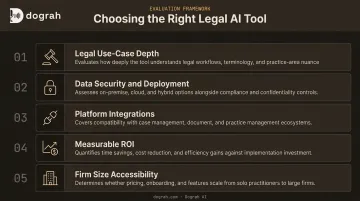
Each tool was assessed against five criteria:
- Legal-specific use case depth — not generic AI repurposed for law
- Data security and deployment flexibility — on-premise, private cloud, or auditable hosting options
- Integration with major legal platforms — including Clio, Westlaw, and iManage
- Measurable time or cost savings — backed by evidence, not marketing claims
- Accessibility across firm sizes — from solo practices to enterprise
The most common mistake law firms make is selecting tools based on brand recognition rather than fit. A contract review platform won't help a litigation-heavy firm. A cloud-only platform with unclear data retention policies is a liability for firms handling privileged client communications. Match the tool to your specific workflow bottleneck first — then evaluate security posture and integration depth.
Conclusion
The right AI support agent for your firm is the one that fits your specific workflow bottleneck, data security requirements, and budget — not necessarily the most recognized name. Start with one concrete use case: intake calls, contract review, or billing capture. Get that working before expanding.
Before signing any contract, evaluate vendors on data residency controls, scalability, and total cost of ownership — including any compliance overhead added by bringing a new vendor into your data chain.
For law firms that need 24/7 voice-based client intake with full data sovereignty and no third-party compliance risk, Dograh AI offers a free deployment path. Self-host the open-source version at no cost, or contact the team for a fully managed private-cloud setup at founders@dograh.com.
Frequently Asked Questions
What is an AI support agent for law firms?
AI support agents are autonomous software systems that handle specific legal workflows — answering client calls, reviewing contracts, monitoring compliance deadlines — without human input. They free attorneys and staff for higher-value, judgment-intensive work.
How do AI support agents protect attorney-client privilege?
Core safeguards include encryption at rest and in transit, role-based access controls, and comprehensive audit logs. For maximum protection, choose platforms with self-hosted or zero-retention deployment options — these prevent client data from being stored on or used to train third-party systems.
Can AI support agents replace lawyers or paralegals?
No. AI agents handle repetitive, high-volume tasks — intake screening, document review, research summarization — but cannot exercise legal judgment, develop client strategy, or take professional responsibility. Under ABA Formal Opinion 512 and state bar guidance, human oversight remains required.
What should law firms prioritize when evaluating AI support agents?
Prioritize these four factors:
- Workflow fit: Does it solve your specific bottleneck (intake, research, compliance)?
- Data security: Self-hosted vs. cloud, and what data retention policies apply
- Integrations: Compatibility with your CMS, billing software, and email
- Proven ROI: Time or cost savings documented by comparable firms
Can AI agents handle phone calls and client intake for law firms?
Yes. Voice AI agents answer inbound calls 24/7, qualify prospects with practice-area-specific questions, schedule consultations, and route to attorneys. This eliminates missed calls, reduces intake staff workload, and removes the need for voicemail entirely.
How much do AI support agents for law firms typically cost?
Pricing ranges from free (open-source self-hosted options like Dograh AI) to per-user SaaS subscriptions and usage-based models. When evaluating total cost, factor in billable hours recovered, staff time saved, and any vendor compliance overhead.