Introduction
Inbound leads are piling up. Outbound lists keep growing. And your SDR team is already stretched thin.
The pressure is real: sales reps spend roughly 60% of their time on non-selling tasks, leaving qualification capacity badly constrained. Meanwhile, response speed is everything — companies that contact leads within five minutes are 21 times more likely to qualify them than those who wait 30 minutes.
Both AI voice agents and human SDRs can qualify leads over the phone. But they work in very different ways — and choosing the wrong one costs you either money from over-hiring SDRs, or pipeline from AI falling flat on complex conversations.
This guide breaks down exactly where each approach wins, where it falls short, and how the strongest sales teams are combining both.
Key Takeaways
- AI voice agents qualify leads 24/7 at massive scale with near-zero marginal cost; human SDRs excel at nuanced conversations and complex objections
- AI voice agent platforms typically run $0.07–$0.31 per minute vs. SDR on-target earnings of $80,000–$98,000+ annually — not counting benefits, tooling, or management
- For high-volume, top-of-funnel qualification with clear ICP criteria, AI wins on cost and speed
- For enterprise or high-ACV deals requiring discovery conversations, human SDRs deliver better outcomes
- Hybrid works best: AI handles volume and first-touch, humans close warm pre-qualified leads
- Open, self-hostable platforms let teams run outbound voice agents with full data sovereignty and no vendor lock-in — Dograh AI deploys a working agent in under 2 minutes
AI Voice Agents vs. Human SDRs: Quick Comparison
Use this table as a fast reference when evaluating both options for your lead qualification process. The dimensions that matter most will depend on your team size, lead volume, and how much conversational nuance your deals require.
| Dimension | AI Voice Agent | Human SDR |
|---|---|---|
| Cost | $0.07–$0.31/min platform cost | $80K–$98K+ OTE annually, plus benefits and tooling |
| Availability | 24/7, no time zones, no sick days | 8–10 business hours; gaps on evenings and weekends |
| Scale | Hundreds to thousands of simultaneous calls | Constrained by headcount; scaling requires hiring and ramp |
| Qualification Accuracy | High for structured BANT/MEDDIC criteria; struggles with ambiguous signals | Stronger at reading tone, intent, and off-script cues |
| Conversation Flexibility | Handles common objections well; may falter on deeply unexpected questions | Fully adaptive; handles empathy, rapport, and complex objections naturally |
| Speed-to-Lead | Instant — responds within seconds of form submission | Subject to rep availability; often minutes to hours |
What Are AI Voice Agents for Lead Qualification?
AI voice agents are automated systems that conduct real-time phone conversations using large language models, speech-to-text, and text-to-speech — qualifying leads based on predefined criteria without human involvement.
How They Work End-to-End
The workflow is fully autonomous:
- Receive the lead — via inbound form fill or outbound dial list
- Initiate or receive the call — within seconds of the trigger
- Conduct structured qualification — asking BANT-style questions, detecting intent, handling common objections
- Log outcomes to CRM — structured fields including use case, timeline, budget band, and intent level
- Route or book — schedule a meeting with the right AE, move to nurture, or flag for human escalation
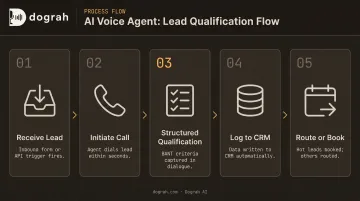
Dograh AI's outbound agents, for example, can call a lead in as little as 30 seconds of a form submission, conduct a full qualification conversation, and sync the outcome directly to Salesforce, HubSpot, or any connected CRM — all without a human touching the workflow.
Deployment Models
How you deploy an AI voice agent shapes what data you control and how quickly you can ship. The options vary significantly:
- Cloud-based closed systems (Vapi, Retell, Bland): Quick to launch, but call data routes through the vendor's infrastructure — a real constraint for regulated industries
- Open-source, self-hostable platforms (Dograh AI): Full data sovereignty, no vendor lock-in, deployable in under 2 minutes via Docker. For fintech, healthcare, or legal teams where data residency requirements are strict, this is often the deciding factor
Where AI Voice Agents Dominate
Real-world deployments show strong results across several verticals:
- SaaS: Smartcat used Synthflow AI voice agents to qualify over 2,000 leads per month and cut demo booking costs by 70%, achieving a 30% demo booking rate
- Insurance: Matic's Retell AI deployment automated 50% of low-value tasks, handled 8,000+ calls in Q1 2025, and maintained 90 NPS — with 80% of customers completing calls without asking for a human
- Agency/local business outbound: One advertising agency using AI voice agents for cold outreach reported a $4.19 cost per lead and a 250% increase in qualified lead conversion (anonymized case study)
Across these deployments, the consistent finding is that AI agents absorb high-volume, time-sensitive qualification — freeing human reps to focus where judgment and relationship actually matter.
What Are Human SDRs for Lead Qualification?
Human SDRs are trained salespeople responsible for top-of-funnel prospecting, qualification, and handoff — identifying whether a prospect fits the ICP, has budget authority, and is ready for a sales conversation.
That role demands judgment, flexibility, and social intelligence — capabilities that define where humans still hold a real edge.
Where Human SDRs Are Irreplaceable
- Adaptive conversation skills — reading tone, emotion, and subtext that AI misses
- Complex objection handling — managing resistance that goes off-script or requires genuine empathy
- Relationship-building — warming up cold or skeptical prospects through authentic human connection
- Nuanced judgment — qualifying enterprise or high-ACV deals where the checklist doesn't tell the full story
For ABM motions, strategic accounts, multi-stakeholder enterprise deals, and industries where buyers expect a consultative first interaction (legal, pharma, government), human SDRs remain the right tool.
The Compounding Cost Problem
Scaling SDR teams is expensive — and the math compounds fast:
- Average SDR OTE sits at $80,000, with experienced reps reaching $98,000+ in total cash compensation (OpenComp, 2024)
- Average SDR tenure is just 15 months, with ramp time of roughly 3 months
- Normal anticipated attrition runs 40–50% annually — meaning half your team turns over every year
- Bridge Group modeled that on a 10-person SDR team at 50% attrition, churning 5 reps could cost $750K in lost pipeline from ramp-period production gaps
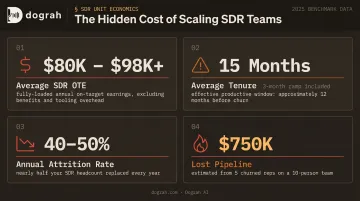
Every hiring cycle resets ramp time, training investment, and pipeline momentum — a structural drag that grows proportionally with headcount.
AI Voice Agents vs. SDRs: Which Is Better for Lead Qualification?
Neither is universally better. The right choice depends on deal complexity, lead volume, qualification structure, and budget.
Choose AI Voice Agents When:
- You have high inbound or outbound volume with clearly defined ICP criteria
- Your product is SMB-focused or transactional — qualification is largely criteria-checking
- Speed-to-lead is a competitive advantage (and for most markets, it is — companies responding within 1 hour are nearly 7x more likely to qualify a lead than those waiting longer)
- You need 24/7 follow-up on every lead without staffing evenings or weekends
- You want to reduce cost per qualified lead while maintaining consistent outreach
Choose Human SDRs When:
- You're running enterprise or strategic account motions with multiple stakeholders
- Qualification requires extended discovery — understanding political dynamics, competing priorities, or organizational structure
- Objection handling is central to even getting a prospect to engage
- Your buyers expect a consultative, research-backed first interaction
The Hybrid Model: The Strongest Setup
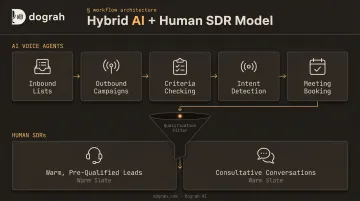
Most teams don't need to choose one or the other. The winning configuration:
- AI voice agents handle Tier-1 volume — criteria checking, initial intent detection, meeting booking from inbound lists and outbound campaigns
- Human SDRs focus exclusively on warm, AI-pre-qualified leads — prospects who have already confirmed interest, budget fit, and availability
This model cuts SDR workload on repetitive outreach, increases rep productivity on conversations that matter, and ensures no lead goes uncontacted due to capacity constraints. Platforms like Dograh AI are built specifically for this setup — scaling outbound coverage to thousands of simultaneous calls while routing only qualified prospects to your reps.
Will AI Replace SDRs?
No — but it shifts the role significantly. SDRs move from high-volume dialing (a task that drives burnout and churn) to consultative conversations with prospects who are already qualified. The result: fewer calls, better conversion rates, and reps spending their time on deals that are actually winnable.
Real-World Results and What to Do Next
Teams that have deployed outbound voice agents through hybrid approaches consistently report the same pattern: faster follow-up, lower cost per qualified lead, and SDRs spending more time on conversations that convert.
Dograh AI's hybrid pre-recorded + TTS feature — which mixes real human voice clips with TTS fallback in the same cloned voice — delivers 2× better conversions on outbound calls at 3× lower cost compared to standard TTS-only approaches. Human voice in the critical opening moments drives authentic engagement, while TTS handles dynamic content efficiently.
Speech-to-Speech orchestration (Gemini Flash Live, OpenAI GPT-Realtime-2) halves end-to-end latency on top of that — the combined result is a conversation that feels and performs more like a human call.
The teams that see the biggest gains share a common starting point: SDR capacity constraints, inconsistent follow-up on high-volume lists, and slow speed-to-lead. Deploying AI voice agents frees SDRs to focus on accounts where their judgment makes the difference.
For teams ready to explore this model, Dograh AI is an open-source, self-hostable platform with a short path to deployment:
- Deploy a working voice agent in under 2 minutes via self-hosted OSS or managed cloud
- 70+ language support with no vendor lock-in
- Fully managed private-cloud deployments for data-sensitive industries — all call data stays on-premise, eliminating GDPR and HIPAA vendor-processing requirements entirely
AI voice agents handle top-of-funnel volume at a fraction of the cost. Human SDRs close the warm pipeline AI qualifies and hands off. For most teams, that division is where the efficiency gains are.
Frequently Asked Questions
Can AI voice agents replace human SDRs entirely?
Not across the board. AI agents are well-suited for high-volume, structured qualification — criteria checking, intent detection, meeting booking. For complex or high-ACV deals requiring discovery, empathy, and adaptive objection handling, human SDRs consistently deliver better outcomes. The strongest setup is a hybrid model where AI handles Tier-1 volume and humans handle warm, pre-qualified leads.
How do AI voice agents handle objections during lead qualification calls?
Modern AI voice agents handle common objections — timing concerns, budget questions, wrong-contact situations — using predefined response logic and LLM reasoning. For deeply unexpected objections or emotionally charged conversations, most platforms include warm transfer protocols that escalate to a human SDR mid-call, preserving the conversation context.
What lead qualification frameworks can AI voice agents support?
AI voice agents can be configured to follow structured frameworks like BANT (Budget, Authority, Need, Timeline) or MEDDIC by asking the relevant qualifying questions during the conversation. Dograh AI's workflow builder lets teams define conditional logic for routing or scoring leads based on responses — making qualification deterministic rather than dependent on conversational improvisation.
How much does it cost to run AI voice agents compared to hiring SDRs?
AI voice agent platforms typically run $0.07–$0.31 per minute for platform and model costs. A human SDR carries an OTE of $80,000–$98,000+ annually, before factoring in benefits, tooling, onboarding, and management overhead. At scale, AI voice agents handle equivalent outreach at a fraction of the fully loaded SDR cost.
Are AI voice agents compliant with TCPA and GDPR regulations?
The FCC confirmed in 2024 that AI-generated voices fall under TCPA, requiring prior express consent for outbound calls — reputable platforms include opt-out management and disclosure prompts to address this. Self-hosted platforms like Dograh AI give data-sensitive teams full control over where call data is stored, eliminating GDPR and HIPAA vendor-processing risk without needing to negotiate processor agreements.
What types of businesses benefit most from AI voice agents for lead qualification?
Businesses with high lead volume, clearly defined ICP criteria, and transactional or SMB sales motions see the highest ROI. Strong results are documented across SaaS (demo booking), insurance (web form triage), fintech (loan qualification), real estate (listing inquiry follow-up), and healthcare (appointment screening) — anywhere speed-to-lead is a competitive advantage.