
Fixed subscriptions feel familiar, but they create a structural problem. Your call volume fluctuates — campaigns end, seasons shift, inbound spikes are unpredictable — yet your bill stays the same. Usage-based pricing solves that mismatch directly.
This article covers why usage-based pricing is well-suited to AI call automation, what it changes operationally, and where the advantages are most pronounced.
Key Takeaways
- Pay for activity, not capacity — charges apply to calls handled or minutes used, not idle seats
- Low-volume months cost less; high-volume campaign periods cost more only while they're running
- No over-provisioning penalty — you don't pay for 20 concurrent lines when you only needed 4
- Seasonal demand, outbound campaigns, and unpredictable inbound spikes are where this model delivers the most value
- Pair it with cost controls and visibility tools — passive deployment leads to surprise bills
What Is Usage-Based Pricing in AI Call Automation?
Usage-based pricing means your bill reflects what the AI actually does. You pay for minutes handled, calls completed, or conversation events — not for a fixed monthly allocation of capacity you may or may not use.
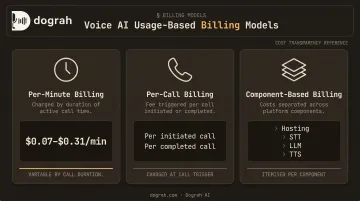
In practice, this model shows up in several forms across the AI voice platform market:
- Per-minute billing — platforms like Retell AI charge $0.07–$0.31/min; Bland AI charges $0.11–$0.14/min depending on tier
- Per-call or per-conversation billing — charges triggered when a call is initiated or completed
- Component-based billing — platforms like Vapi separate infrastructure hosting ($0.05/min) from STT, LLM, and TTS costs, which pass through at cost or disappear entirely when you bring your own API keys
Flat subscriptions and per-seat models charge for capacity regardless of whether that capacity is used. A team running 200 calls one month and 2,000 the next pays the same flat rate either way.
Usage-based pricing keeps cost proportional to business activity. For teams with variable call volumes — seasonal spikes, campaign-driven outbound, or unpredictable inbound demand — that alignment between spend and usage is what makes the model worth examining.
Key Advantages of Usage-Based Pricing in AI Call Automation
The advantages below are operational. They show up in cost reports, campaign budgets, and ROI calculations — not in marketing language.
Cost Alignment — You Only Pay for Calls That Actually Happen
Under a flat-rate or seat-based model, you pay for peak-load capacity even during off-peak periods. Think of it like paying full overnight staffing rates on every quiet Tuesday — except it's a software line item, not a wage bill.
Usage-based pricing eliminates idle-capacity cost. A business handling 200 calls in a slow month and 2,000 in a campaign month pays for 200 and 2,000 respectively — not for a fixed ceiling set at the higher number.
Why this matters financially:
- Cost-per-conversation becomes a trackable metric rather than an estimate derived from a fixed monthly fee
- Finance teams can evaluate AI calling ROI against actual call outcomes, not justify a fixed line item
- McKinsey reports that AI-agent implementations can reduce cost per call by 50% — but capturing that saving requires cost structures that move with volume
KPIs this affects: cost per conversation handled, monthly communications spend as a percentage of revenue, idle capacity rate
When it matters most: Retail and hospitality businesses with seasonal demand, outbound campaigns with defined end dates, and any organization that can't yet predict its monthly call volume with confidence.
Instant Scalability Without Overstaffing Costs
Traditional call automation — and staffed call centers — require you to provision for peak load before that peak arrives. Get it wrong in one direction and you miss calls. Get it wrong in the other and you're paying for agents or platform capacity that sits unused.
Usage-based AI call automation removes that tradeoff. The system handles simultaneous volume elastically, and your cost only increases while that volume is live.
The missed-call cost is real. A 2025 SMB survey from Vida found that 42% of small businesses estimated losing more than $500/month from unanswered calls — $6,000/year from a problem that elastic AI calling directly addresses.
What elastic scalability enables:
- Run a high-volume outbound campaign without pre-provisioning infrastructure or hiring temporary agents
- Handle inbound spikes from product launches or PR events without pre-purchasing concurrency lines
- Scale down automatically after a campaign ends — costs drop without any manual intervention
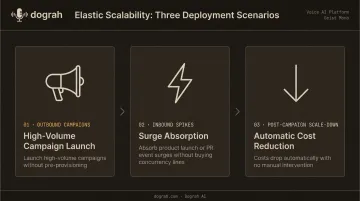
Dograh AI's platform dynamically auto-scales based on real-time demand, handling large numbers of simultaneous interactions without tier-based concurrency caps.
One documented case: a solar business in Australia where inbound volume spikes 3–4x during summer peaks and rebate windows. The platform scaled from 50 calls/day to 500 without a single staffing decision.
KPIs this affects: call answer rate, abandoned call rate, concurrent agent utilization, overstaffing cost ratio
When it matters most: High-growth companies, businesses running outbound campaigns for collections or lead qualification, and any team with inbound volume tied to marketing activity.
Lower Barrier to Entry and Faster Time to ROI
Flat subscription models require financial commitment before results exist. A business buying $500/month of AI calling capacity has already spent $1,500 before it has three months of data to evaluate whether the investment worked.
Usage-based pricing inverts that. Teams can deploy at low volume, observe outcomes, and scale spend only when results justify it. Early spend stays small until the model proves itself.
What faster experimentation enables:
- Test outbound scripts or inbound IVR flows at minimal cost before committing to scale
- Identify which conversation flows convert, then increase volume on those specifically
- Validate the model against human agent benchmarks before replacing headcount
Dograh AI's platform supports deployment of a working voice bot in under 2 minutes — which means teams can go from "no AI calling" to first real call data in a single afternoon. That speed directly shortens the time between deployment and first measurable outcome.
For organizations considering the self-hosted path, the math shifts further. With Dograh's open-source deployment, businesses pay only for their underlying LLM, STT, and TTS vendor costs — no platform fee markup. At 100,000 minutes/month, that translates to roughly $0.035/min self-hosted versus $0.12/min on managed proprietary platforms: a potential saving of over 70%.
KPIs this affects: time to first measurable outcome, cost per qualified lead or appointment set, monthly AI calling spend relative to pipeline generated
Best fit for: SMBs testing AI calling for the first time, teams running pilots before full deployment, and organizations moving from human agents to AI handling tier-1 calls.
What Happens When Usage-Based Pricing Is Absent or Ignored
When businesses lock into flat-rate or per-seat AI calling models, the financial incentives misalign with actual usage:
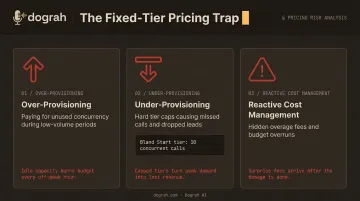
- Over-provisioning — Fixed costs don't scale down during low-volume periods. You pay for concurrency you don't use.
- Under-provisioning — Tier-based concurrency limits (Bland's Start tier caps at 10 concurrent calls; Vapi's Build tier does the same) mean volume spikes can hit a hard ceiling, resulting in missed calls and dropped leads.
- Reactive cost management — Teams either cap usage to stay within budget or absorb unexpected overage fees from usage add-ons that weren't visible at signup.
Without consumption-tied billing, isolating what each call actually costs becomes difficult. If you can't measure cost per outcome, you can't determine whether the AI calling investment is working — or where to cut waste.
Fixed-tier platforms compound this further. Separate charges for platform access, telephony, STT, TTS, and LLM stack on top of each other, creating billing complexity that makes true cost-per-call nearly impossible to calculate.
How to Get the Most Value from Usage-Based Pricing
Three operational habits consistently separate teams that control their AI calling costs from those that don't.
1. Set up usage tracking from day one
Monitor cost-per-minute, volume by campaign or time period, and peak usage windows — without that visibility, spend becomes unpredictable instead of controllable. Dograh AI provides real-time analytics for monitoring and optimizing voice agent performance — use that data actively, not retrospectively.
2. Implement cost guardrails before campaigns go live
Configure limits at the vendor API level — OpenAI, Deepgram, ElevenLabs, and other providers all support spend caps and rate limits. For outbound sequences, define active-hours windows so campaigns don't run outside intended time periods. A few minutes of upfront configuration prevents runaway spend before it starts.
3. Treat usage data as a feedback loop
Review which call flows, time slots, and agent configurations generate the most conversations relative to cost. Beyond cost control, this creates a data trail showing exactly where spend is producing outcomes. Teams that review this weekly tend to identify underperforming call flows within days — not after an entire campaign budget is spent.
Conclusion
Usage-based pricing in AI call automation keeps cost and capacity proportional to actual business activity. That's not a minor financial preference — it's a structural advantage for any business where call volume fluctuates, campaigns are time-bound, or adoption is still early enough that volumes aren't predictable.
Cost alignment, elastic scalability, and lower entry risk each deliver value on their own. Paired with clear usage visibility and regular review, they reinforce each other over time. Businesses that get the most out of usage-based pricing don't just monitor consumption to manage invoices — they use that data to tune performance, catch underutilized capacity, and inform how they scale next.
Frequently Asked Questions
How is usage-based pricing different from a flat subscription for AI call automation?
Flat subscriptions charge a fixed fee regardless of how many calls the AI handles. Usage-based pricing charges only for actual consumption — minutes used or calls completed. When call volumes fluctuate or aren't yet predictable, usage-based models avoid paying for capacity that goes unused.
Can usage-based pricing work for businesses with highly unpredictable call volumes?
Unpredictable volumes are exactly where usage-based pricing performs best. Costs scale with activity rather than being fixed at a peak-load rate, so slow periods don't cost peak-period prices — and volume spikes don't hit a hard tier ceiling.
What metrics are typically used to measure usage in AI call automation?
The most common billing metrics are:
- Call minutes handled
- Number of calls completed
- Concurrent agents active
- Per-conversation events
Inbound use cases typically bill on minutes handled; outbound campaigns bill per call initiated or completed.
How do I prevent unexpected costs with usage-based AI call automation?
Set spend caps at the vendor API level (LLM, STT, TTS), configure active-hours windows for outbound sequences, and review usage dashboards regularly. Usage-based pricing rewards active configuration. Passive deployment without guardrails is where surprise bills come from.
Is usage-based pricing better suited to inbound or outbound AI calling?
Both benefit, but differently. Inbound avoids paying for idle capacity during low-traffic periods. Outbound benefits because costs start and stop with the campaign, with no fixed monthly line item running after it ends.
Does self-hosting an AI call automation platform affect the usage-based pricing model?
Self-hosting eliminates vendor per-minute markups across LLM, STT, and TTS costs, so businesses pay only wholesale rates to their chosen providers with no platform fee on top. Dograh AI's open-source deployment carries zero platform charges — you pay only for the underlying AI services you select.