Choosing between usage-based and subscription pricing for AI call automation isn't just a procurement decision. It shapes your scalability, your finance team's ability to forecast, and how much leverage you have when you want to switch vendors. This guide breaks down both models with real pricing data, practical decision rules, and the compliance angle that most comparisons skip entirely.
Key Takeaways
- Usage-based pricing charges per minute, per call, or per interaction — best for variable or unpredictable volumes
- Subscription pricing charges a flat recurring fee — best for teams with consistent, predictable call volumes
- Usage-based wins on flexibility; subscription wins on billing simplicity at steady volumes
- Hybrid models combine a flat base fee with per-minute overages — balancing predictability with burst capacity
- In regulated industries, vendor compliance overhead is a hidden cost — often the deciding factor for self-hosted deployments
Usage-Based vs. Subscription Pricing: Quick Comparison
Both models serve legitimate use cases — the right choice comes down to how predictable your call volume is and how much cost variability your team can absorb.
| Factor | Usage-Based | Subscription |
|---|---|---|
| Cost structure | Variable; charged per minute, call, or interaction | Fixed monthly or annual fee regardless of volume |
| Scalability | Scales naturally with demand; no plan upgrades for spikes | Scaling often requires tier upgrades or contract renegotiation |
| Budget predictability | Harder to forecast without historical usage data | Easy to forecast; finance teams prefer fixed costs |
| Risk of overpaying | Low during slow periods; high during unexpected spikes | High if actual volume stays below plan capacity |
| Best fit | Seasonal businesses, startups, variable outbound campaigns | Established teams with steady, predictable call volumes |
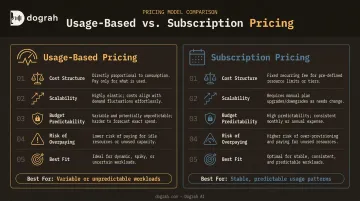
Neither model is universally cheaper — the one that costs less depends almost entirely on your usage patterns. The sections below break down each model in detail.
What Is Usage-Based Pricing for AI Call Automation?
Usage-based pricing ties your costs directly to what you actually consume — call minutes, number of calls handled, concurrent agent capacity, or AI processing events like transcription and LLM inference. If the AI isn't on a call, you're not paying. For teams with unpredictable call volumes, that alignment between cost and usage is the primary draw.
How Billing Units Work
The most common billing units across AI calling platforms:
- Per-minute billing — the most common unit; rates often differ between inbound and outbound calls
- Per-call billing — a flat charge regardless of call duration, which can favor longer conversations
- Per-concurrent-agent — charged based on how many AI agents run simultaneously, not total call count
- Credit-based — prepaid credits drawn down per interaction, common on developer-tier plans
Real pricing from current vendor pages shows the range: Vapi charges $0.05/min for platform hosting, Retell AI charges $0.07–$0.31/min depending on configuration, Bland AI charges $0.11–$0.14/min for talk time, Deepgram's Voice Agent API runs $0.075/min, and Twilio Conversation Relay starts at $0.07/min.
The Cost Stack Problem
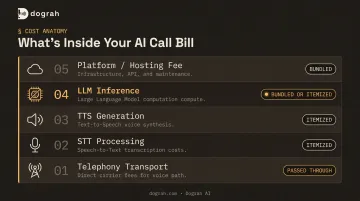
Most usage-based quotes advertise a single rate. The actual bill is a stack of components.
A typical bill includes:
- Telephony transport (carrier costs)
- STT (speech-to-text) processing
- TTS (text-to-speech) generation
- LLM inference
- Platform/hosting fees
Some platforms bundle these without itemizing. Bland AI, for example, bundles LLM, STT, TTS, and PSTN into a single per-minute rate with no component pass-throughs. Retell and Synthflow itemize each layer separately. Vapi passes through model costs "at cost" on top of its hosting fee — meaning the $0.05/min figure is just the starting point.
The BYOK (bring-your-own-keys) model goes further still. Dograh AI, for example, charges no markup on underlying provider costs — you pay wholesale rates directly to your STT, TTS, and LLM providers, and the platform layer itself carries no per-minute fee. That's a fundamentally different cost structure than any bundled or pass-through model.
Where Usage-Based Pricing Fits
Usage-based is the right default for:
- Outbound campaign teams running periodic lead qualification or appointment-setting blasts where call volume varies month to month
- Seasonal businesses — retail during holiday peaks, real estate during spring listing season, hospitality around booking periods
- Startups validating AI calling before committing to a monthly capacity they may not fill
- Any team where monthly call volume swings more than 30–40% from one month to the next
What Is Subscription Pricing for AI Call Automation?
Subscription pricing gives you a flat recurring fee — monthly or annual — in exchange for access to a defined set of platform features, included call minutes, or agent capacity. The structure is borrowed from traditional SaaS and adapted for voice platforms.
Subscription Tier Examples
From current vendor pricing pages:
- Goodcall charges $79–$249/month per agent, with unlimited minutes and overage at $0.50/customer beyond monthly unique-customer thresholds
- My AI Front Desk offers a $99/month Business plan with 200 included minutes; overages run 25 credits/minute ($0.25/min)
- ElevenLabs uses subscription credit tiers from a free plan up to $990/month with 6 million credits
Core Benefits
- Finance teams can set a fixed line item and hold to it month over month
- Analytics, integrations, and CRM connectors are typically bundled at no extra cost
- Annual contracts usually come with dedicated support and customer success resources
Common Drawbacks
Subscription pricing looks cleaner than it often is in practice:
- Overage fees kick in when included minutes run out, erasing the predictability advantage at the worst time
- Paying for 10,000 minutes/month when you consistently use 6,000 is straightforward waste
- Agent-based costs compound quickly as teams scale, with each seat adding to the monthly total
- Annual contracts raise switching costs and reduce your negotiating leverage at renewal
The Hybrid Model
Those drawbacks pushed many platforms toward a middle ground: a base subscription plus per-minute overages. Current examples include:
- Bland AI (Build tier): $299/month plus $0.12/min for talk time
- Goodcall: per-agent monthly fee with additional per-customer overages on top
- My AI Front Desk: 200 included minutes, then credit-based overages beyond that
This structure gives vendors a predictable revenue floor while giving customers some flexibility for volume spikes. For buyers, it means you still need to model your usage carefully — the subscription fee is just the starting point, not the ceiling.
Which Pricing Model Is Right for Your Business?
Four factors determine the right fit:
- Call volume consistency — how much does your monthly volume vary?
- Growth stage — are you validating or scaling a proven workflow?
- Data control requirements — do compliance obligations constrain which vendors can touch your call data?
- Cost transparency needs — does your finance team need to understand what each dollar buys?
Decision Rule: Call Volume
If your monthly call volume varies by more than 30–40% month over month, usage-based pricing almost always wins on cost efficiency. You're not funding idle capacity during slow months.
If your volume stays within a 10–15% band consistently, subscription pricing is easier to manage. The fixed cost is predictable, and you're likely close enough to capacity utilization to justify the plan.
A practical way to check: pull three to six months of call logs and calculate the standard deviation of monthly minutes. If that number is large relative to your mean, usage-based is your model.
Decision Rule: Growth Stage
Early-stage teams and startups should default to usage-based. Over-committing to a subscription tier before you know your real volume patterns is one of the cleaner ways to burn budget unnecessarily.
Once you cross roughly 50,000–100,000 minutes per month at a consistent level, the math typically shifts. At that volume, subscription tiers or self-hosted deployments often deliver a lower per-unit cost through volume discounts baked into higher tiers. Synthflow, for example, moves teams to custom Enterprise pricing at 10,000+ minutes/month.
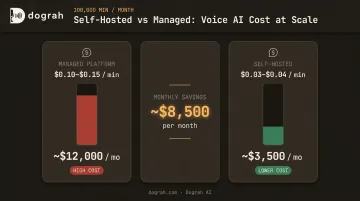
At 100,000 minutes/month, self-hosted deployments running on Dograh AI's open-source platform can cost approximately $0.03–$0.04/min in raw operational expenses (telephony + STT + TTS + LLM at wholesale rates), compared to $0.10–$0.15/min on managed platforms. That's roughly $3,500/month versus $12,000/month — a gap that becomes a real business decision.
The Compliance Cost Factor
For healthcare, fintech, and legal teams, subscription-managed platforms often bundle compliance features but require routing your call data through the vendor's infrastructure. That triggers:
- HIPAA Business Associate Agreement (BAA) requirements — HHS requires a HIPAA-compliant BAA with any cloud service storing or processing ePHI
- GDPR Data Processing Agreement (DPA) requirements — EDPB requires a formal contract governing every controller-processor relationship, with written authorization for any sub-processors
- Procurement delays — legal review of BAAs and DPAs adds weeks to onboarding timelines
- Explicit compliance add-on costs — Vapi charges $2,000/month for HIPAA compliance and $1,000/month for Zero Data Retention
Self-hosted platforms sidestep this entirely. With Dograh AI's self-hosted deployment, voice data stays within your own infrastructure. There's no vendor processing your call recordings or transcripts, which means no BAA or DPA with the platform vendor, no compliance add-on fees, and a simpler procurement process.
Healthcare providers, law firms, and financial services firms have adopted Dograh's self-hosted model specifically to reduce compliance surface area. Fewer vendor hops means fewer agreements, a simpler audit scope, and direct control over data retention and deletion.
Situational Recommendations
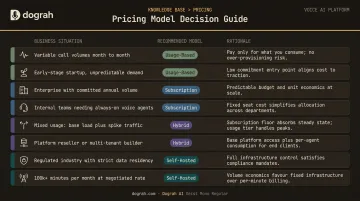
| Your situation | Recommended model |
|---|---|
| Variable call volumes (30%+ monthly swing) | Usage-based |
| Early-stage, validating AI calling | Usage-based |
| Periodic outbound campaigns | Usage-based |
| Steady, predictable inbound volume | Subscription |
| Need bundled features and vendor support | Subscription |
| Need burst capacity with cost floor | Hybrid |
| Regulated industry, data sovereignty priority | Self-hosted (no platform fees, no compliance overhead) |
| 100,000+ minutes/month at consistent volume | Self-hosted or enterprise contract |
Conclusion
Usage-based and subscription pricing each serve a distinct operational reality. The mistake most businesses make is comparing sticker prices without accounting for how their actual call patterns, compliance obligations, and growth trajectory interact with the billing model.
Teams that get this right treat the pricing model as core to the infrastructure decision itself. The right fit depends on your situation:
- Usage-based works best for seasonal outbound teams with unpredictable call volume
- Subscription suits steady inbound support operations where predictable monthly costs matter
- Self-hosted deployment eliminates platform fees entirely — the right call for regulated industries handling sensitive data
Matching your cost structure to how your business actually operates is the deciding factor. If you want to compare all three models in one platform, Dograh AI offers cloud, self-hosted OSS, and fully managed private cloud deployments — so you can start on the model that fits now and shift as you scale.
Frequently Asked Questions
What is the difference between a usage fee and a subscription fee?
A usage fee charges based on actual consumption — typically per call minute or per call handled. A subscription fee is a flat recurring charge for platform access regardless of how much you use. Most platforms today blend both: a base subscription covers features, and a per-minute rate applies to actual call time.
Is AI making call center agents better or replacing them?
Right now, AI handles tier-1 repetitive inquiries — FAQs, scheduling, lead qualification — while human agents focus on complex conversations. Gartner predicts agentic AI will autonomously resolve 80% of common customer-service issues by 2029, but today's dominant pattern is augmentation.
What pricing model works best for small businesses with low or inconsistent call volumes?
Usage-based pricing is the right default for SMBs with variable or low volumes — you only pay when the AI is active. Self-hosted options like Dograh AI can eliminate platform fees entirely for teams comfortable managing their own infrastructure.
Are there hidden costs in subscription-based AI call automation plans?
Yes. The most common are overage fees when included minutes are exceeded, per-seat charges as teams grow, and compliance add-on costs — such as HIPAA BAA fees — that can add both procurement time and monthly cost for regulated industries.
Can I switch from usage-based to subscription pricing mid-contract?
Most cloud platforms allow plan changes at renewal, but mid-contract switches may incur fees or require negotiation. Self-hosted platforms sidestep this entirely — there's no vendor contract governing your usage, so you can adjust your deployment model without asking permission.
What metrics should I track to know if my AI call automation pricing is efficient?
Track cost per call handled, cost per minute versus your included-minutes utilization rate, idle capacity percentage (for subscription plans), and month-over-month usage variance. If idle capacity is consistently high on a subscription plan, that's a signal to move to usage-based billing.