Introduction
P&C insurers are under real pressure to modernize how they handle inbound calls. Policyholders expect immediate answers on claims, billing, and coverage — not hold music.
The obstacle is structural: almost everything a voice agent needs to function — policy details, claim status, payment balances, endorsement history — lives inside systems built long before real-time API calls were a design consideration.
A voice agent that can't read from or write to your core system of record is just a sophisticated voicemail box.
According to a 2026 survey of more than 250 P&C professionals reported by Carrier Management, legacy systems can cost insurers up to $5M annually in hidden operational expenses — and that's before you account for the friction they introduce when you try to connect modern AI tooling to them.
This guide breaks down what that friction actually looks like in practice — and covers the integration patterns, highest-value starting workflows, and compliance requirements that matter most for P&C voice AI deployments.
Key Takeaways
- Legacy P&C systems weren't built for real-time queries: integration requires careful architecture, not just an API call
- Read operations (policy lookup, billing) and write operations (FNOL, AMS logging) need different integration patterns
- A middleware layer between your voice agent and legacy systems is the most resilient production approach
- FNOL intake, billing FAQ, and renewal data collection offer the strongest ROI for Phase One
- Data sovereignty matters: routing call audio and policy data through a third-party cloud creates GDPR/CCPA exposure
Why Legacy P&C Systems Are Notoriously Difficult to Integrate
The Data Model Problem
"Legacy" in P&C doesn't always mean mainframe. Even relatively modern platforms create serious integration friction. Applied Epic requires an SDK-API license, a utility purchase, and a production request process that includes your enterprise ID and Epic database name before you can access production APIs. Guidewire's InsuranceSuite Cloud API exposes RESTful endpoints, but line-of-business-specific endpoints aren't provided out of the box — they have to be generated after your LOB structure is configured.
Vertafore's AMS360 still uses XML/WSAPI v3.0, where even authentication depends on whether your agency has employee-code data security enabled.
Beyond access gates, the data model itself is the deeper problem. P&C systems use insurance-native schemas — ACORD standards, proprietary policy objects, and jurisdiction-specific fields. A voice agent asking "what's this policyholder's deductible?" has to navigate endorsements, coverage layers, and effective-date logic. There's no flat field in a database that answers that question directly.
ACORD's P&C data standards define two primary exchange formats: AL3 for one-way batch processing of policy and commission data, and XML for real-time request/response transactions like quotes, policy changes, and renewals. Voice agents need the latter — but many agency systems were built around the former.
Latency, Authentication, and Vendor Lock
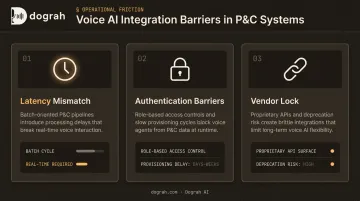
The data model problem doesn't exist in isolation. The operational layer adds its own friction — three issues that surface the moment you try to connect a real-time voice agent to a system that wasn't designed for it:
- Latency mismatch: Legacy systems often process in batch cycles — nightly downloads, daily carrier feeds. A voice conversation is real time. Serving accurate policy data mid-call when the underlying system is hours behind requires a caching or read-replica strategy, not a direct query.
- Authentication barriers: Most legacy P&C systems enforce role-based access at the user level, not the API level. Provisioning a service account with scoped permissions for a voice agent runs through procurement and compliance review — adding weeks before a single API call can be made in insurance environments.
- Vendor lock: Closed platforms and proprietary APIs mean your integration is subject to the vendor's release schedule and deprecation policies. One AMS version update can break a voice agent integration that wasn't designed with decoupling in mind.
The P&C System Landscape: What Voice AI Needs to Connect To
A voice agent in a P&C environment needs to interact with multiple system types, each with different read/write priorities:
| System Type | Primary Role | Voice AI Interaction |
|---|---|---|
| Policy Administration (PAS) | Coverage, premiums, endorsements | Read: coverage lookup, deductible retrieval |
| Agency Management (AMS) | Client records, activities, workflows | Read + Write: client lookup, activity logging |
| Claims Management (CMS) | FNOL, claim status, adjudication | Read + Write: status checks, new FNOL records |
| Billing Systems | Invoices, balances, payment plans | Read: due dates, balance inquiries |
| CRM / Producer Tools | Routing, ownership, producer assignments | Write: call disposition, lead routing |
Each system category carries distinct latency requirements and risk profiles — which shapes how the voice agent should connect to it.
Read Operations (What the Voice Agent Queries Mid-Call)
These need to happen fast — within the call, while the policyholder is on the line:
- Policy number lookup and coverage verification
- Deductible and limit retrieval (including endorsement logic)
- Claim status checks
- Payment balance and due-date inquiries
For these operations, low-latency access via a REST or GraphQL API layer, or a synchronized data store, is essential. Direct mainframe queries mid-call aren't viable — even 3–5 seconds of processing lag creates dead air that erodes caller confidence and increases hang-up rates.
Write Operations (What the Voice Agent Records After or During a Call)
Write operations carry higher risk and should be designed with validation logic:
- Opening a new FNOL record in the claims system
- Logging an activity or task in the AMS
- Capturing renewal data updates from a policyholder
- Recording call disposition and routing outcomes
Best practice: Include human-review steps before going fully autonomous — particularly in the first 30 days of a new workflow. A voice agent writing malformed data to a claims system without a review gate creates audit problems that are far harder to unwind than a missed read.
Integration Architecture Patterns for Voice-to-Legacy Connections
Three patterns dominate production P&C voice AI deployments. Each involves a different tradeoff between deployment speed, flexibility, and long-term maintainability.
Pattern 1 — Direct API Integration
Works when: the AMS or PAS has documented REST API coverage, the voice platform supports outbound HTTP calls mid-conversation, and the team has sandbox credentials.
- Advantage: Fewer moving parts, simpler to build initially
- Risk: Tight coupling — any API change on the AMS side breaks the voice agent directly
Direct integration is appropriate for proofs of concept or single-system integrations with stable, well-documented APIs. In production P&C environments with multiple backend systems, it rarely survives the first vendor update cycle.
Pattern 2 — Middleware or iPaaS Layer
This is the preferred pattern for P&C carriers with heterogeneous backend systems. A middleware service — whether a custom microservice, an iPaaS platform, or an internal API gateway — sits between the voice agent and the legacy system. The voice agent calls the middleware; the middleware handles authentication, ACORD data translation, error handling, and system-specific routing.
PacificComp's MuleSoft Anypoint deployment illustrates this in practice: a single integration layer connected an AS/400 policy management system, Guidewire ClaimCenter, STG Billing, document workflows, SQL databases, and file shares — replacing a web of fragile point-to-point connections.
- Advantage: Isolates the voice agent from backend changes; centralizes ACORD translation and error handling
- Consideration: Adds an infrastructure layer to maintain; middleware itself becomes a dependency
For teams building out this layer, Dograh AI's MCP support lets developer platforms like Claude Code, OpenCode, and Codex build, configure, and spin up voice agents directly — cutting the manual work of wiring agents to internal systems like this considerably.
Pattern 3 — Event-Driven / Async Integration
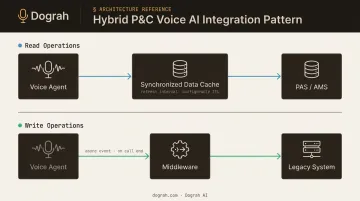
Instead of querying the legacy system mid-call, the voice agent fires a webhook or event at end-of-call. The legacy system or middleware processes it asynchronously — creating the AMS activity, opening the claim record, or updating the exposure field.
- Advantage for writes: Resilient, no call-time latency dependency on legacy system uptime
- Limitation: Not appropriate for mid-call lookups ("Is my claim approved?")
The Hybrid Architecture Most Production Deployments Use
Read operations go through a synchronized data cache (refreshed at defined intervals from the PAS/AMS). Write operations fire as async events at call end. This keeps call latency low, reduces dependency on legacy system uptime during live calls, and produces a clean audit trail for compliance review.
High-Value P&C Workflows to Prioritize in Phase One
Phase One selection follows three criteria: high call volume, structured data requirements, low licensed-advice risk. Workflows that require premium quotes, coverage interpretation, or payment processing without explicit authorization confirmation belong in later phases.
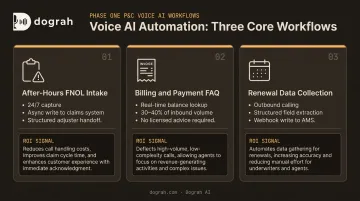
Three workflows offer the strongest ROI at integration maturity level one:
1. After-Hours FNOL Intake The voice agent captures loss details (location, cause of loss, probable damage amount, description) and opens a record in the claims system via async write. ACORD's Property Loss Notice fields provide the intake schema. The workflow runs 24/7 without staffing cost, and every captured record goes to a human adjuster with a complete structured intake already done.
2. Billing and Payment FAQ The agent reads balance and due-date data from the billing system and answers without human involvement. No licensed advice required, data is structured and low-risk to cache, and billing inquiries routinely account for 30–40% of inbound call volume at agencies and carriers — making this one of the highest-volume targets for automation.
3. Renewal Data Collection The voice agent calls policyholders proactively to collect updated exposure information — mileage, property changes, new drivers, address updates — and pushes structured fields back to the AMS ahead of producer review.
Dograh AI's platform supports this pattern directly: outbound calling, variable extraction of structured fields during the call, and webhook-driven writes to external systems at call end.
All three workflows stay firmly within non-licensed territory — which is precisely why they're safe to automate first. The following actions cross that line:
What to avoid in Phase One:
- Quoting a premium or recommending coverage changes
- Interpreting policy language or exclusions
- Processing payments without explicit authorization confirmation
These require licensed-producer oversight and additional compliance design before you can automate them.
Data Security, Compliance, and Sovereignty in P&C Voice AI
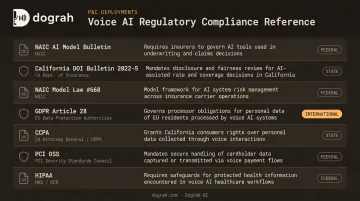
The compliance landscape for P&C voice AI integrations is jurisdiction- and data-type-specific:
- NAIC AI Model Bulletin: Applies to insurer use of AI in customer service, underwriting, and claims — requires governance, risk management, and compliance with insurance laws
- California DOI Bulletin 2022-5: Addresses AI use in marketing, rating, underwriting, and claims for admitted and non-admitted carriers operating in California
- NAIC Insurance Data Security Model Law #668: Defines third-party service provider obligations for licensees handling nonpublic information
- GDPR Article 28: When European policyholder data passes through a third-party cloud processor, a controller-processor contract is required for every vendor in the chain
- CCPA: Applies to for-profit businesses in California with annual gross revenue over $25M; voice biometrics and precise geolocation are classified as sensitive personal information
- PCI DSS: Applies if the voice agent touches payment card data during a call
- HIPAA: Adjacent for workers compensation workflows where PHI may be disclosed to covered entities
The Data Sovereignty Problem
When a voice agent queries a PAS mid-call and the response passes through a third-party cloud, that policy data is now in a vendor's infrastructure. For carriers operating under GDPR or state privacy mandates, this creates a data processing agreement requirement for every vendor in the call stack — a procurement and legal process that adds significant time to go-live.
Self-hosted or private-cloud-deployed voice AI platforms eliminate this exposure by keeping call audio, transcripts, and policy query results entirely within the insurer's own infrastructure. Dograh AI's fully managed private cloud option deploys the complete voice agent stack inside the customer's own environment — AWS, Azure, GCP, or on-premises — with Dograh handling orchestration and upgrades while all data stays within the customer's perimeter.
This removes the platform vendor as a data processor entirely, simplifying the GDPR controller-processor chain and bypassing the need to run the platform through a separate vendor compliance certification pipeline.
Minimum Compliance Checklist
- Encryption in transit and at rest for all call audio, transcripts, and policy data
- Scoped service account with role-based read/write permissions for the voice agent
- Audit logging of every read and write operation with timestamps and correlation IDs
- Consent disclosure to callers before any data capture begins
- Data retention and deletion policies aligned to state and federal requirements
A Phased Integration Roadmap
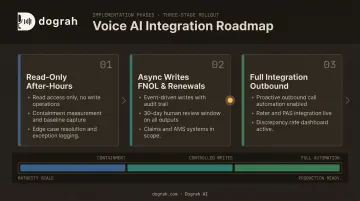
Phase 1: Read-Only, After-Hours
Start with read access to billing and basic policy data only — no write operations. This validates the integration architecture against production systems without exposing any risk.
- Route all after-hours inbound calls through the voice agent
- Measure containment rate, call resolution rate, and transcript accuracy
- Identify and fix edge cases before expanding scope
Phase 2: Async Writes, FNOL and Renewals
Once Phase 1 is stable, introduce event-driven write operations for FNOL records and renewal data captures.
- Require human review of all AI-written records for the first 30 days
- Bring the claims system and AMS activity logging into integration scope
- Expand coverage to lunch-hour and overflow traffic
Phase 3: Full Integration, Outbound Automation
With inbound fully stable, activate proactive outbound and complete the data pipeline.
- Enable outbound renewal calls, payment reminders, and post-claim follow-ups
- Integrate with the rater or PAS for quote intake routing
- Build dashboards comparing voice-captured data quality against manually entered records — discrepancy rate is the primary integration health metric
Frequently Asked Questions
Can AI voice agents integrate with legacy policy administration systems like Guidewire or Duck Creek?
Yes. Most modern PAS platforms expose REST APIs or support middleware connectors, but access scope, latency, and licensing tier vary significantly. Request API documentation and a sandbox environment before committing to an integration architecture — Guidewire requires generated LOB endpoints, and Duck Creek ties implementation resources to its customer portal.
What is the best way to connect an AI voice agent to an AMS like Applied Epic or AMS360?
A middleware service handling authentication, data translation, and error handling is the most reliable pattern — it insulates the integration from version changes. Note that Applied Epic requires an SDK-API license and AMS360 uses XML/WSAPI rather than standard REST.
Do you need to replace your legacy P&C system to deploy AI voice agents?
No replacement is necessary. Voice AI agents are designed to sit on top of existing infrastructure, reading and writing via APIs or middleware. The goal is to avoid touching the system of record directly ; middleware and caching layers handle that boundary.
How do you keep policyholder data secure when a voice agent queries a legacy system mid-call?
Route all queries through the insurer's own infrastructure using encrypted service accounts with scoped read permissions, and log every data access event for audit. Self-hosted or private-cloud deployments eliminate third-party cloud exposure entirely.
What P&C call types should be automated first when integrating AI voice with a legacy system?
After-hours FNOL intake, billing and payment FAQ, and renewal data collection offer the highest ROI as starting points. All three are high volume, structurally predictable, and carry low licensed-advice risk — a practical combination for Phase One.
How long does Phase 1 integration typically take?
Timeline depends on AMS or PAS API maturity, service account provisioning time, compliance review, and whether a middleware layer needs to be built. API access and authentication are typically the longest steps — not the voice agent configuration itself.