Introduction
Most AI sales agent deployments fail before they ever reach a prospect. The technology works. What breaks is the setup — teams scope the wrong use case, skip configuration, or assume the model will handle edge cases it was never trained for.
An AI sales agent is a system that autonomously handles sales tasks: lead qualification, outreach, follow-ups, and live conversations — with minimal human input per interaction. The term now covers everything from email sequences to fully conversational voice agents making outbound calls.
According to Salesforce, sales professionals spend 60% of their time on non-selling tasks. That's the structural problem AI agents solve — not by replacing reps, but by handling the volume work so humans focus on closing.
This guide is for sales teams, founders, and developers who want to fix that. It covers what AI sales agents are, how to build one step-by-step, what makes voice deployments succeed or fail, and which mistakes to cut before they cost you.
Key Takeaways
- AI sales agents automate qualification, outreach, scheduling, and live conversations, so reps spend more time on relationships and closing
- Two primary types: assistive agents (support humans) and autonomous agents (act independently); most production setups combine both
- Building one follows six steps — from defining the use case and choosing a channel to connecting data, testing, and setting guardrails
- Voice AI drives the highest outbound conversions; latency, scripting, and the first 15 seconds decide the outcome
- Data quality, clear escalation paths, and consistent monitoring are what separate agents that close deals from those that hurt your brand
What Is an AI Sales Agent?
An AI sales agent is a system that can perceive inputs (text, voice, CRM data), reason based on instructions and context, and take actions — send messages, qualify leads, update records, book meetings, make or receive calls — with minimal human involvement per interaction.
That definition separates it from what most teams already have.
AI Agents vs. Chatbots: The Real Difference
A standard chatbot follows a script. Ask it something outside the script and it breaks.
An AI sales agent is context-aware and adaptive. A basic chatbot routes a query. An AI agent qualifies the lead, personalizes the response based on CRM history, handles objections, and books the meeting — all within a single conversation, without a human in the loop.
That distinction has a practical definition behind it. Google Cloud describes the difference this way: bots follow predefined rules with limited learning; agents perform complex, multi-step actions and make decisions independently.
Two Primary Categories
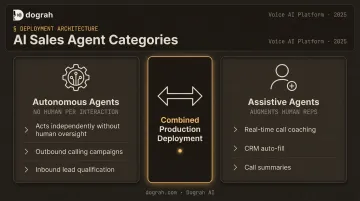
| Type | What It Does | Example Use Case |
|---|---|---|
| Autonomous agents | Act independently, no human per interaction | Outbound calling, inbound lead qualification |
| Assistive agents | Augment human reps | Real-time call coaching, CRM auto-fill, call summaries |
Most production deployments combine both. The autonomous layer handles inbound qualification at scale — volume, speed, consistency. The assistive layer gives the human rep what they need to close: live coaching cues, objection context, and a clean call summary before the follow-up goes out.
Why Sales Teams Are Deploying AI Sales Agents Now
McKinsey's analysis of nearly 500 B2B companies found non-selling activities consume two-thirds of the average sales team's time — and top-quartile firms that addressed this improved sales productivity by up to 30%. That lost capacity is exactly what AI sales agents are built to recover.
The Speed-to-Lead Problem
Speed matters more than most teams realize. Harvard Business Review research found firms contacting online leads within 1 hour were nearly 7× more likely to qualify the lead than those waiting another hour — and more than 60× more likely than firms waiting 24+ hours.
An AI agent responds instantly, at any hour. That alone justifies deployment for inbound-heavy teams.
What Breaks Without AI Agents
In a high-volume sales motion, the failure points are operational — not motivational:
- Inbound leads go cold waiting for a human to pick them up
- Outbound coverage is capped by team headcount
- CRM data goes stale from delayed manual entry
- Reps burn time on low-probability follow-ups instead of high-intent accounts
- XANT/InsideSales research shows the average rep makes 4.5 follow-up attempts — the recommended number is 12, yet only 9.4% of leads ever get that many touches
AI agents solve both the volume and consistency problem. An agent doesn't tire, lose track of a sequence, or skip the 11th follow-up because something else came up.
How to Build an AI Sales Agent: Step-by-Step
Before touching any tool, define the use case. The agent needs a single, measurable job — "qualify inbound leads and book demos" or "run outbound calls for this product offer" — tied to a KPI like response time, meeting conversion rate, or cost per qualified lead.
Vague scope produces vague agents.
Step 1: Choose Your Channel
Channel selection is strategic, not technical.
- Email and chat agents work well for asynchronous outreach and nurturing sequences
- Voice agents work for outbound conversion, appointment setting, and live qualification where tone and immediacy matter
Gong's analysis of 300M+ cold calls found an average 5.4% connect rate; top reps connect with 13.3% of prospects. Their cold email data from 28M+ emails shows average reps need 344 cold emails to book one meeting. Neither channel wins universally — the right choice depends on your audience, motion, and what your reps do best with live conversations.
Cold calling, even without a live conversation, nearly doubled email reply rates from 1.81% to 3.44% in Gong's data. The channels work together.
Step 2: Build Your Agent Logic and Script
Agent logic is the set of instructions, conversation flows, and decision rules that govern behavior.
For a voice agent, this includes:
- Opening hook — the first 15 seconds determine whether the call continues; the agent must establish legitimacy quickly, state context clearly, and handle interruptions gracefully
- Objection handling branches with specific responses per objection type
- Qualification questions in a natural sequence
- Escalation triggers — the conditions under which the agent hands off to a human
For text/email agents:
- Personalisation variables pulled from CRM data
- Conditional follow-up sequences based on engagement signals
- Tone guidelines and hard topic restrictions
One consistent failure pattern: agents deployed without clear escalation paths. If the agent can't hand off gracefully, it loops — and loops damage trust.
Dograh AI's workflow builder supports configurable escalation triggers with warm transfer and a structured conversation brief (intent, verification status, sentiment, next steps), so the human rep who receives the handoff has full context rather than starting from scratch.
Step 3: Connect Your Data and Integrations
An agent is only as good as its data. Stale or incomplete CRM records lead to mis-personalised outreach, incorrect assumptions, and broken handoffs.
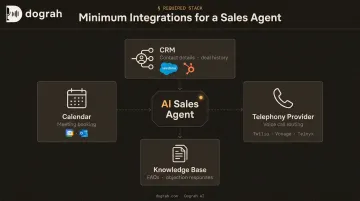
Minimum required integrations for a sales agent:
- CRM (Salesforce, HubSpot) — contact details, deal stage, interaction history
- Calendar (Google/Outlook) — for meeting booking
- Telephony provider — for voice agents (Twilio, Vonage, Telnyx)
- Knowledge base — product FAQs, objection responses, compliance constraints
During a live call, Dograh AI reads and writes structured fields including qualification answers, intent level, objection types, meeting outcomes, and transcript links — syncing everything back to the CRM automatically without manual entry.
Step 4: Select Your Platform and Deploy
Key criteria for platform selection:
- No-code/low-code build speed — can non-engineers iterate on the agent?
- Native CRM, calendar, and telephony integrations
- Voice capability if outbound calling is part of the scope
- Data residency and compliance posture — critical for regulated industries
- Flexibility to swap models or providers without rebuilding
Dograh AI is built specifically for voice AI sales agents. Its visual drag-and-drop workflow builder lets teams design conversational flows using nodes (Start Call, Agent Response, End Call, decision branches) without writing code. A working voice bot can be launched in under 2 minutes using the 2 Min Launch feature — select inbound or outbound, describe the use case in a sentence, and the system generates a working workflow.
For production deployments, Dograh supports three options:
- Cloud — fully managed, fastest to deploy
- Self-hosted OSS — BSD 2-Clause license, deployable via Docker, full code access
- Fully managed private cloud — Dograh builds and deploys the entire infrastructure within your own cloud environment
The self-hosted and private cloud options eliminate the vendor-as-data-processor problem entirely — no HIPAA Business Associate Agreements to negotiate, no GDPR data transfer complexity, no SOC 2 vendor audit requirements. For procurement teams in regulated industries, this is often the difference between a 3-week and a 3-month go-live.
For teams that need deeper automation, Dograh integrates with n8n, Zapier, and Make.com. It also supports MCP, meaning developers can build, configure, and spin up voice agents directly from Claude Code or OpenCode without switching tools.
Step 5: Test, Iterate, and Set Guardrails
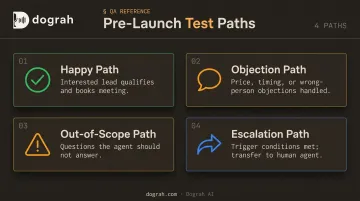
Before going live, test the agent across four conversation paths:
- Happy path — interested lead, qualifies cleanly, books meeting
- Objection path — common objections (price, timing, wrong person)
- Out-of-scope path — questions the agent shouldn't answer
- Escalation path — trigger conditions reached, handoff to human
Guardrails are rules that limit agent behavior: topic restrictions, escalation thresholds (e.g., escalate if intent confidence falls below a set level), sentiment-based triggers (escalate if distress is detected), and compliance constraints like consent-before-recording requirements.
Testing these paths before launch is where guardrails prove their value. Dograh's Looptalk testing suite runs AI-to-AI simulations — AI personas with specific traits (intent, objections, accents) stress-test the agent before real customers do. It's currently in beta, but the principle holds: every bug caught in simulation is one fewer damaged conversation with a real prospect.
Deploying an AI Voice Sales Agent: What to Get Right
Voice is the highest-conversion channel for outbound — and the highest-stakes. A poorly worded email gets ignored. A robotic or confusing voice call damages the brand immediately.
The First 15 Seconds
Most calls succeed or fail in the opening. The agent must:
- State who is calling and why, immediately
- Use natural pacing (not robotic speed or unnatural pauses)
- Handle interruptions gracefully — if the prospect talks over the agent, the agent must stop, listen, and adapt
- Establish legitimacy without sounding like a disclaimer
Getting the opening right is a scripting and testing challenge. The same opening that tests well in demos can fail in production if pacing is off or the context framing runs too long.
Latency Is Conversion
End-to-end latency — the time between a prospect finishing a sentence and the agent responding — directly affects whether the conversation feels human.
Academic research on spoken dialogue systems shows perceived willingness drops after 600ms and significantly drops at 700-800ms. The ITU-T G.114 standard recommends not exceeding 400ms one-way transmission delay.
Traditional voice pipelines (STT → LLM → TTS) compound latency across three steps. Speech-to-Speech (S2S) orchestration processes audio natively, collapsing that into one. OpenAI's GPT-4o processes audio responses in as little as 232ms, averaging 320ms, compared to prior pipeline averages of 2.8–5.4 seconds.
Dograh ships S2S orchestration across the full stack using Gemini Flash Live and OpenAI GPT-Realtime-2, roughly halving end-to-end latency while also improving context retention, interrupt handling, and reliability.
Hybrid Pre-Recorded + TTS: Cost and Conversion
Cutting latency gets you into the conversation. Sounding human keeps you there. For outbound calling specifically, Dograh's hybrid pre-recorded + TTS feature mixes real human voice clips with TTS fallback in the same cloned voice. The result: calls that sound more natural in the high-frequency opening phrases, with TTS handling dynamic content when needed. Dograh's data shows this delivers 2× better outbound conversions and cuts costs up to 3× by reducing the volume of TTS API calls required per conversation.
Post-Deployment Monitoring
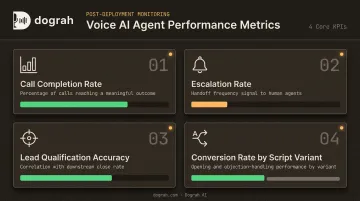
Once live, track these metrics:
- Call completion rate — percentage of calls reaching a meaningful outcome (booked meeting, disqualified, transferred)
- Escalation rate — how often the agent hands off (a spike signals script or logic problems)
- Lead qualification accuracy — are leads marked qualified actually closing downstream?
- Conversion rate by script variant — which opening or objection-handling version performs better
Set up post-call analysis for sentiment, miscommunication signals, and script adherence. A pattern of early hang-ups at call 50 is a fixable script problem. The same pattern at call 5,000 is lost revenue.
Compliance for Voice AI
For teams in GDPR regions or regulated industries (healthcare, finance, legal), outbound voice agents are touching sensitive prospect data in real time. The FCC ruled in 2024 that AI-generated voices in outbound calls are subject to TCPA robocall rules. GDPR treats voice AI vendors as data processors, with written contractual requirements for sub-processors.
Self-hosted or private cloud deployments cut through that complexity. They remove the vendor-as-processor from the data flow entirely: no shared multi-tenant infrastructure, no chain-of-custody tracking, no third-party certifications to audit before go-live.
Common Mistakes When Building AI Sales Agents
"The AI Will Figure It Out"
Teams deploy agents with vague instructions and no escalation paths, assuming the model handles edge cases gracefully. It doesn't. Under-specified agents hallucinate responses, loop on ambiguous inputs, or give answers that contradict product reality.
Agent quality scales with instruction quality, not just model quality. Precise prompts, defined escalation triggers, and tested objection branches are the work — the model is just the execution layer.
Gartner predicts over 40% of agentic AI projects will be cancelled by end-2027 due to escalating costs, unclear business value, or inadequate risk controls. All three causes trace back to insufficient scoping upfront.
Over-Automating Before Validating
Building a fully autonomous end-to-end agent before validating individual steps means you have no visibility into where failures occur. Start with one automated step — inbound qualification only — validate the KPIs, then expand.
A human-in-the-loop checkpoint at handoff points is not a weakness. It's a quality signal and a trust-builder with your sales team. Anthropic's guidance on building effective agents makes the same point: simple, composable patterns outperform complex end-to-end frameworks.
Treating Voice Like Text
A voice agent is not a chatbot with speech output. Voice performance depends on factors that don't exist in text:
- Latency and response pacing
- Prosody and natural speech rhythm
- Interruption handling
- Background noise tolerance
- Telephony provider quality and regional routing
Teams that repurpose chatbot logic for voice without adapting the script and testing voice-specific failure modes get burned. What reads cleanly in a chat interface often sounds unnatural when spoken aloud.
Frequently Asked Questions
Is there an AI for sales calls?
Yes. AI voice sales agents can make and receive calls autonomously — handling qualification, objection responses, and appointment booking. Platforms like Dograh AI let teams build and deploy outbound and inbound voice calling agents without code, connecting directly to existing CRMs and calendars.
What is an AI sales agent?
An AI system that autonomously performs sales tasks — outreach, lead qualification, follow-ups, and live conversations — using data and instructions. AI sales agents handle multi-step reasoning, adapt based on conversation context, and take actions across tools and systems.
How do AI sales agents differ from traditional chatbots?
Chatbots follow rigid scripts and respond only when triggered. AI sales agents proactively initiate actions, adapt based on CRM data and conversation context, handle multi-turn conversations, and can operate across both voice and text channels.
Will AI sales agents replace human sales reps?
No. AI agents handle high-volume, repeatable tasks — outreach, qualification, scheduling — while human reps focus on relationship-building, complex negotiation, and closing. The deployment model is augmentation, not replacement.
How long does it take to build and deploy an AI sales agent?
A basic working agent can be deployed in under 2 minutes with a modern no-code platform. A production-grade agent with CRM integration, custom conversation logic, and compliance guardrails typically takes days to a few weeks depending on complexity and regulatory requirements.
What industries benefit most from AI sales agents?
Industries with high inbound lead volume, repetitive qualification workflows, or time-sensitive outbound follow-ups see the strongest fit — real estate, insurance, fintech, healthcare, legal, hospitality, and e-commerce.