Introduction
Sales teams average 60+ outbound calls per representative daily, yet 77% of leads never receive any response and fewer than 1% are contacted within the critical first five minutes when conversion rates are . For the average small business, this disconnect translates to $126,000 in annual lost revenue.
AI voice assistants for sales go far beyond basic chatbots or rigid IVR menus. They conduct real conversations: handling objections, qualifying leads, and handing off to human reps at the right moment. The best platforms support natural, low-latency conversations while helping teams shorten response times, qualify leads faster, and reduce manual CRM updates.
This guide breaks down what separates strong AI voice platforms from weak ones, profiles the top five options for sales teams in 2026, and gives you a decision framework built around your actual call volume, compliance needs, and technical setup.
Key Takeaways
- AI voice assistants should be chosen based on the team’s main use case, whether that is outbound prospecting, inbound qualification, appointment setting, live coaching, or CRM automation.
- Even strong tools can fail if calls have awkward delays, interruptions, or poor turn-taking.
- Sales teams should check how accurately the platform captures call outcomes, updates CRM records, logs next steps, and triggers follow-ups.
- For sensitive customer data, deployment options like cloud, self-hosted, or on-premise matter.
- Pricing should be reviewed beyond the base fee, including call minutes, telephony, transcription, LLM usage, and voice generation.
- The right shortlist also depends on technical ownership: no-code tools launch faster, developer-first tools allow deeper customization, and self-hosted systems offer more control but need stronger technical support.
What Is an AI Voice Assistant for Sales?
An AI voice assistant for sales is a system that uses speech recognition, natural language processing, and conversational AI to conduct or augment phone-based sales interactions. Unlike text-based chatbots that rely on typed input or traditional IVR systems that follow rigid menu trees, these agents listen, respond, and manage phone conversations using real-time language understanding.
Core sales use cases include:
- Outbound prospecting calls – Initiating contact with leads at scale
- Inbound lead qualification – Screening and prioritizing incoming inquiries
- Real-time rep coaching – Surfacing objection-handling scripts and answers during live calls
- Post-call summaries and CRM updates – Automatically logging call notes, sentiment, and next steps
- Appointment scheduling – Booking meetings directly from conversation context
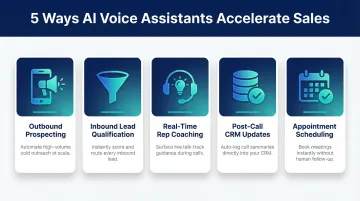
Each of these functions compresses the sales cycle by reducing response times, eliminating manual data entry, and ensuring no lead falls through the cracks. According to Salesforce's 2026 State of Sales report, 81% of sales teams now use AI, and 90% expect to deploy AI agents within two years. Voice automation is no longer experimental — it's a baseline expectation. The global conversational AI market is forecast to grow from $17.05 billion in 2025 to $49.80 billion by 2031, driven largely by B2B adoption in sales and support.
Best AI Voice Assistants for Sales Teams
Each tool below was evaluated on voice naturalness, latency, sales-specific functionality, compliance posture, integrations, and how fast a team can go from setup to live calls.
Dograh AI
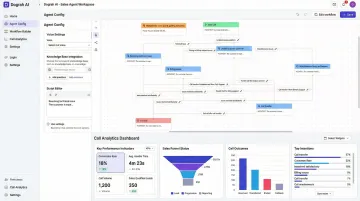
Dograh AI is a production-ready, open-source voice AI platform purpose-built for sales and support teams. It is open-source and self-hostable, giving teams more control over deployment, infrastructure, and data residency — especially useful for data-sensitive industries like healthcare, finance, and legal services.
Sales-specific highlights:
- Speech-to-speech orchestration using models like Gemini Flash Live, roughly halves end-to-end latency for natural, real-time conversations
- Pre-recorded voice mixing with TTS fallback — the LLM picks from real human voice clips for predictable responses and falls back to AI-generated voice (in the same voice) only when needed, cutting cost and latency while sounding more human
- MCP support is now shipped — making integrations with internal systems and tools significantly faster; agent platforms can spin up voice workflows directly
- No-code/low-code workflow builder — agents go live in under 2 minutes
- Automated QA and post-call analysis — Observability and post-call review features for tracing calls, debugging workflows, and auditing agent behavior
| Key Features | Speech-to-speech orchestration, pre-recorded voice mixing, MCP integrations, automated post-call QA, no-code workflow builder |
| Pricing Model | 100% open source (BSD 2-Clause license); free self-hosting with no Dograh platform fee; cloud/managed options may be usage-based; third-party STT/TTS/LLM, telephony, and infrastructure costs may still apply |
| Best For | Sales and marketing automation teams, data-sensitive industries (healthcare, finance, legal), and teams needing full on-premise data control |
Dialpad AI Sell
Dialpad AI Sell is a business communications platform with a dedicated sales intelligence layer, widely used by inside sales teams for real-time live coaching, AI-powered call transcription, and automated post-call summaries.
Where it pulls ahead for coaching-focused teams:
- Real-Time Assist (RTA) cards surface answers during live calls based on trigger words
- AI Scorecards automate quality management and performance benchmarking
- Live sentiment analysis gives managers visibility for in-call intervention
- Native integrations with Salesforce, HubSpot, Microsoft Teams, and Zendesk
| Key Features | Live AI coaching cards, call transcription, QA scorecards, sentiment analysis, AI Recaps |
| Pricing | Pricing varies by plan and sales/contact-center requirements; confirm current Dialpad Sell pricing and trial availability on Dialpad’s pricing page. |
| Best For | Sales teams prioritizing rep coaching, QA, and performance scoring on high-volume call operations |
Vapi
Vapi is a developer-first voice AI platform for teams building fully custom AI voice agents via API. It supports real-time function calling, mid-conversation CRM updates, and integration with any LLM or TTS provider.
Built for engineering-led sales teams:
- Sub-500ms latency across real-time voice interactions
- Supports programmatic control over call logic, tools, and integrations through APIs and webhooks.
- Supports concurrent calls through hosted infrastructure; the usage-based plan includes 10 concurrent calls, with additional lines available at an extra monthly cost.
- Granular programmatic control via webhooks and API
| Key Features | API-first architecture, real-time function calling, model-agnostic, webhook-triggered workflows, multi-call concurrency |
| Pricing | Pay-as-you-go: $0.05/min for calls, excluding model provider costs; STT/LLM/TTS billed at cost or through your own API keys; 10 concurrent calls included, with additional lines at $10/line/month. |
| Best For | Developer teams building deeply customized voice agents embedded into existing sales infrastructure |
Retell AI
Retell AI handles both inbound and outbound calls with a visual agent builder, knowledge base sync, and structured post-call analysis—including automated CRM updates via HubSpot and Slack notifications.
Standout capabilities:
- Conversation Flow builder handles complex call logic with fallback paths
- Post-call analytics and transcripts help teams review call outcomes, identify failure patterns, and improve agent performance.
- Pay-as-you-go pricing with no monthly platform fees
| Key Features | Visual conversation flow builder, knowledge base sync, HubSpot/Slack integration, post-call analytics, sentiment flagging |
| Pricing | Pay-as-you-go: $0.07–$0.31/minute for AI Voice Agents; $10 free credits; 20 free concurrent calls; enterprise pricing available for higher concurrency and advanced requirements. |
| Best For | Sales and support teams needing structured inbound/outbound handling with strong post-call data visibility |
Synthflow
Synthflow is a no-code voice AI platform designed for businesses and agencies that want to deploy AI voice agents for lead qualification, appointment booking, and follow-up calls without any engineering resources.
Why non-technical teams choose it:
- Drag-and-drop conversation builder — no code required at any stage
- Pre-built industry templates get the first agent live in under an hour
- CRM integration (including HubSpot) and built-in call transcript analytics
- Multilingual support for teams operating across multiple markets
| Key Features | No-code flow builder, pre-built templates, CRM integration, multilingual support, call transcript analytics |
| Pricing | Pay-as-you-go: $0.09/min voice engine + LLM usage based on selected model; Synthflow-managed Twilio is listed at $0.02/min, while BYO Twilio is listed at $0.00/min from Synthflow’s side; enterprise options available. |
| Best For | SMBs, agencies, and sales teams with no development resources who need rapid deployment of voice agents |
How We Chose the Best AI Voice Assistants for Sales
Every tool on this list was assessed against sales team requirements, not generic voice use cases. The evaluation focused on how well each solution supports the full sales call lifecycle — from first contact through CRM logging.
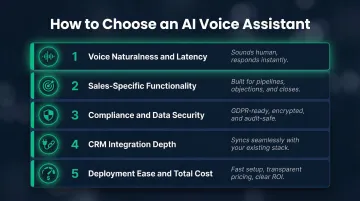
Five core evaluation criteria:
- Voice naturalness and latency – Human conversational gaps average around 200ms; ITU-T standards recommend one-way delays below 150ms for transparent interactivity
- Sales-specific functionality – Coaching, qualification logic, and sales workflow support
- Compliance and data security – Data sovereignty, on-premise deployment options, and auditability relevant to regulated industries
- CRM and workflow integration depth – Native integrations with Salesforce, HubSpot, and ability to trigger downstream workflows
- Ease of deployment and total cost of ownership – No-code vs. developer-required setup; transparent pricing without double billing
Common mistakes teams make:
- Choosing based on demo quality alone without testing real-call accuracy under load
- Ignoring data residency requirements until post-purchase
- Selecting general-purpose voice tools not designed for structured sales conversations
Bad call capture and weak CRM updates can create real revenue risk. Validity’s CRM data report found that in annual revenue. For sales teams, automated and accurate call logging is not just an admin feature — it protects pipeline visibility, follow-up quality, and forecast accuracy.
Conclusion
The best AI voice assistant for a sales team is the one that matches your call volume, compliance requirements, technical capacity, and sales methodology—not the most feature-rich or most recognizable name.
Before committing:
- Pilot shortlisted tools with real sales scenarios (not just demos)
- Evaluate latency and context retention over multi-turn conversations
- Verify data residency and security requirements before signing any contract
If those criteria point toward an open-source, self-hostable option, Dograh AI is worth a close look. The platform is fully open-source and self-hostable — ensuring data never leaves your own infrastructure — ships with speech-to-speech orchestration and MCP-native control, and gets agents running in under two minutes — without platform fees or vendor lock-in. Explore the GitHub repository or reach out via the community Slack to get started.
Frequently Asked Questions
How can AI help a sales team?
AI helps sales teams by automating repetitive tasks like lead qualification, follow-up scheduling, and CRM logging, while providing real-time coaching and conversation intelligence. This frees reps to focus on high-value interactions that require human judgment.
Is there an AI voice assistant?
Yes, AI voice assistants are actively used in sales today. Tools in this category can support real-time phone conversations with prospects, including lead qualification, appointment setting, follow-up routing, and handoffs to human reps when needed.
What is the best AI voice assistant for sales calls?
The best tool depends on your specific needs: Dograh AI is a strong fit for teams that need open-source, self-hostable deployment and more control over infrastructure and data residency; Dialpad AI Sell is stronger for live coaching and sales performance workflows; and Synthflow is useful for teams that need fast no-code deployment.Can AI voice assistants replace sales reps?
How do AI voice assistants integrate with CRM systems?
AI voice platforms offer native integrations with CRMs like HubSpot and Salesforce, automatically logging call summaries, updating contact records, and triggering follow-up tasks after each call. This eliminates manual data entry and keeps pipeline data current.
What should I look for in an AI voice assistant for sales?
Five criteria matter most when evaluating options:
- Low latency for natural, real-time conversation
- Sales-specific features like qualification logic and live coaching
- Data security and sovereignty — including on-premise deployment options for sensitive industries
- Deep CRM integration with HubSpot, Salesforce, or your existing stack
- Transparent pricing with no per-call fees or hidden STT/TTS charges