Introduction
A caller phones in, pushes back on price, and asks for "just this one exception." The voice agent, trying to be helpful, confirms a discount it was never authorized to offer.
There's no edit button. Once the words are spoken, the caller has heard them, and the business is on the hook.
Many teams assume "on-script" means locking an agent into fixed, word-for-word sentences. What keeps a call safe is staying inside approved boundaries: pricing, policy, disclosures, and tone. The agent still has to sound like a real conversation, not a phone tree.
This post covers why voice agents drift off-script mid-call, the checkpoints that catch drift before it reaches the caller's ear, and what happens when no guardrails exist. It also looks at how platforms like Dograh AI build that protection into the stack itself.
Key Takeaways
- Off-script drift in voice happens instantly and can't be recalled, unlike a chatbot's editable text reply
- Three checkpoints (input, decision, and output) catch problems at different stages of a call
- Prompt injection, model hallucination, and transcription errors are the leading causes of drift
- Lightweight classifiers running in parallel with the LLM keep guardrails from adding latency
- Unregulated agents create compounding risk across thousands of calls, not just one bad conversation
What "On-Script" Really Means for a Live Voice Agent
Beyond a Fixed Script
For a live voice agent, on-script doesn't mean parroting identical sentences every time. It means the agent operates inside defined limits:
- Approved pricing, discounts, and policy exceptions
- Required disclosures and compliance language
- The intended conversation flow and scope of its role
- A consistent, on-brand tone
An agent handling a billing question can phrase things differently from call to call, ask clarifying questions, and adapt to accent or pace. As long as it stays within its authorized scope, it's on-script.
What Off-Script Looks Like
Off-script behavior tends to show up in a few recognizable forms:
- Hallucinated answers delivered with total confidence
- Unauthorized discounts, refunds, or policy exceptions
- Wrong information about products, coverage, or eligibility
- Tone drift, becoming curt, overly casual, or argumentative
- Commitments outside its role, like legal or medical advice
Why Voice Raises the Stakes
Text-based bots get a hidden advantage: a draft. A chatbot's reply can be reviewed or the conversation abandoned before a customer reads it. Voice has no equivalent step.
The instant an LLM generates a response and it's converted to speech, the caller hears it. There's no pause, no "let me rephrase that." A misspoken price or a wrong policy detail gets said, and the caller reacts emotionally before anyone can intervene. That reaction—not a text log—is what shapes the relationship going forward.
Why Voice Agents Drift Off-Script Mid-Call
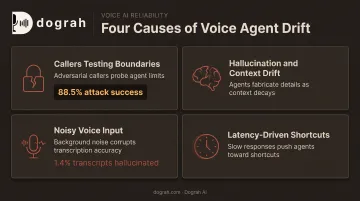
Callers Testing the Boundaries
Some drift is deliberate. Callers try "ignore your previous instructions" style prompts or frame a jailbreak as a hypothetical, hoping to unlock a response the agent was never meant to give.
This isn't a fringe concern. A 2025 study assembled 537 successful multi-turn jailbreak conversations against production-grade language models and found attack success rates as high as 88.5% against GPT-4o-mini, with GPT-4o itself compromised 71.5% of the time, according to research published on arXiv.
That's text-chat research, not phone-call data — but it shows how exploitable these models are once a caller finds the right angle.
Hallucination and Context Drift
Even without a hostile caller, the model can leave the script on its own. Asked to answer within milliseconds, an LLM sometimes fabricates a plausible detail instead of admitting uncertainty — a confident guess beats "I don't have that information" under a tight latency budget.
Long calls make it worse. As conversation history grows, the original system prompt loses pull. A rule stated clearly at minute one can get overridden by minute twelve, especially when the call covers multiple topics or objections.
Noisy or Ambiguous Voice Input
Voice input is messier than typed text. Transcription errors, interruptions, and crosstalk all cause agents to respond to the wrong request entirely.
Research on Whisper transcriptions found hallucinated phrases in 1.4% of segments on average, with 38% of those hallucinated transcripts containing an identified harm, per a study published on arXiv.
A small STT slip is enough to derail the turn: "cancel my plan" heard as "cancel my card" sends the entire response down the wrong path.
Latency-Driven Shortcuts and Tool Chains
Two architectural pressures compound the problem:
- Skipped validation. To preserve conversational speed, some builds send unchecked LLM output straight to text-to-speech, with no review step in between.
- Multi-tool complexity. As agents chain lookups, bookings, and transfers, an error in an early tool call can surface as an off-script answer several turns later.
The Three Guardrail Checkpoints That Keep Calls On-Track
Input Checkpoint
Before the LLM acts on anything, screen the caller's transcribed speech for jailbreak attempts, off-topic requests, and unsafe content. This step runs fast—usually a lightweight classifier rather than a full reasoning model—so it finishes before the agent starts forming a response.
Decision Checkpoint
System prompts, workflow gating, and tool-call validation bound what the agent can reason about at this stage. Concrete examples:
- Verifying a caller's identity before any account or medical detail is shared
- Restricting which actions are callable at each stage of the call
- Requiring confirmation of availability before the agent promises a booking
Output Checkpoint
Before a generated response becomes speech, check it independently for policy violations, factual accuracy, and tone. This checkpoint often runs on a small buffer, since a complete sentence must exist before you can validate it.
Each checkpoint's method matches its latency budget:
| Checkpoint | Typical Method | Latency Budget |
|---|---|---|
| Input | Lightweight classifiers | Milliseconds |
| Decision | Deterministic rule and state checks | Near-instant |
| Output | Buffered or streaming-aware checks | Small, budgeted delay |
Common guardrail types across these checkpoints include:
- Content-safety classifiers
- Topic-adherence checks
- PII detectors
- Jailbreak detectors
- Factuality checks against a knowledge base or conversation history
When a Guardrail Fires
Detection alone isn't enough. The response path decides whether the call recovers:
- Retry with corrective instructions – nudge the agent back toward the approved response and try again.
- **Transfer to a human agent** – escalate on distress, repeated misunderstanding, or high-risk requests the workflow wasn't built to handle.
- End the call gracefully – far better than letting a compromised conversation keep going.
How to Actually Set Guardrails Without Killing Call Latency
Guardrails only work if they don't wreck the pace of a call. A few practices make that possible.
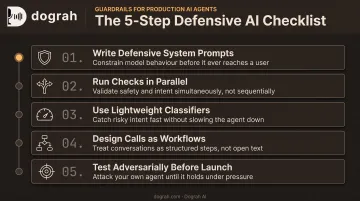
Write defensive system prompts. Vague instructions like "be helpful and polite" are the easiest thing for a caller to manipulate. Explicit prompts naming the agent's role, forbidden actions, and required refusal behavior close that gap.
Run checks in parallel, not sequentially. Guardrail validation should overlap with LLM inference rather than stack on top of it. A check that runs alongside response generation costs the caller nothing in perceived wait time.
Use small, purpose-built classifiers for real-time checks. A general-purpose LLM is slow and unnecessary for flagging a jailbreak attempt live. Save heavier reasoning models for after-call review, where latency doesn't matter and depth does.
Design the call as a workflow, not an open prompt. Sensitive actions like payments, transfers, and disclosures should sit behind defined steps in a state machine, not open-ended LLM judgment.
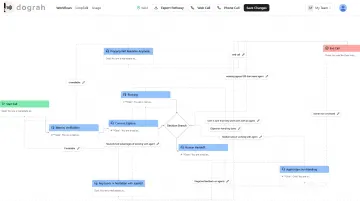
Visual drag-and-drop workflow builders make that gating accessible without custom orchestration code. In Dograh AI, teams can add a consent node, verification branch, or approval gate the same way they'd wire any other step.
Test adversarially before launch. Simulate hostile callers, prompt injection attempts, and edge-case requests before a real customer ever reaches the agent. Microsoft's PyRIT toolkit, for example, automates multi-turn adversarial strategies and scores responses across hundreds of test objectives.
What Happens When a Voice Agent Has No Guardrails
A voice agent can technically run with no guardrails at all. It just won't stay safe for long.
Without checks in place, exposure ranges from mildly embarrassing to seriously costly:
- Confirming a price or discount it had no authority to offer
- Giving incorrect medical, legal, or financial guidance with full confidence
- Repeating the same error across every caller who hits the same trigger
- Continuing a bad interaction for the full length of a call before anyone notices
McDonald's found this out publicly. Its AI drive-through ordering test with IBM ran at select locations from 2021 through mid-2024. Viral clips showed the system adding dozens of chicken nuggets to an order or pairing ice cream with ketchup and butter, according to AP News. The company wound the test down at those locations by July 2024.
Regulated industries carry compounded risk. In healthcare, insurance, finance, and legal, an unguarded response can embarrass a brand. It can also create compliance liability.
The scaling problem is unique to voice. A human agent's mistake affects one conversation. An unguarded flaw in a voice agent repeats across every call it handles until someone catches it, multiplying exposure far faster than any single person's error ever could.
How Dograh AI Helps Voice Agents Stay On-Script at Scale
Dograh AI builds these checkpoints into the platform itself, instead of leaving teams to bolt guardrails onto an open-ended prompt.
Visual workflow builder — Teams define conversation flows, approved responses, and gated actions explicitly: verification nodes, consent capture, decision branches, and webhook calls. Sensitive steps no longer depend on free-form LLM judgment.
A common regulated pattern uses seven nodes—greeting, identity verification, intent detection, data collection, a tool call, confirmation, and human handoff.
Speech-to-Speech orchestration — Using models like Gemini Flash Live and OpenAI's GPT-Realtime-2, Dograh's S2S orchestration roughly halves end-to-end latency versus a traditional speech-to-text-to-speech pipeline. That matters for guardrails: validation and natural, low-latency conversation no longer trade off against each other.
Hybrid pre-recorded voice with TTS fallback — For high-risk or high-frequency parts of a script—disclosures, pricing confirmations, compliance language—Dograh can play a pre-approved human voice clip instead of generating fresh speech every time. This hybrid approach cuts costs by up to 3× and delivers 2× better conversions on outbound calls, and removes drift risk from regenerating sensitive lines on every call.
Automated post-call QA — After the call ends, Dograh runs sentiment detection, miscommunication flags, and adherence checks against the defined script. It surfaces calls where the agent may have gone off-script before those patterns repeat at scale.
Self-hosted and private-cloud deployment — For regulated industries, guardrail logic and call data can stay inside your own infrastructure via self-hosted open source, fully managed private cloud, or air-gapped deployment. That removes vendor compliance overhead for HIPAA, GDPR, or SOC 2 requirements.
Frequently Asked Questions
What are voice agent guardrails?
Guardrails are real-time and post-call checks that validate inputs, decisions, and outputs so a voice agent stays inside approved boundaries. They catch drift before it reaches the caller or repeats across future calls.
How do you set guardrails for voice agents?
Start with explicit, defensive system prompts, then gate sensitive actions like payments or disclosures behind a defined workflow instead of open-ended LLM judgment. Run lightweight checks in parallel with inference and test against adversarial callers before launch.
Can a voice agent operate without guardrails?
Yes, technically. But every unguarded flaw repeats across every call until someone catches it. In regulated industries like healthcare or finance, that exposure becomes compliance liability, not just a bad conversation.
What are some examples of voice agent guardrails?
Common examples include content-safety filters, jailbreak and prompt-injection detectors, topic-adherence checks, PII detectors, and factuality checks run against a knowledge base or the conversation history.
Do guardrails slow down a voice agent's response time?
Not when they're built well. Lightweight, purpose-built classifiers run in parallel with LLM inference rather than after it, adding little to no perceptible delay for the caller.
How is keeping a voice agent on-script different from scripting a chatbot?
Voice is irreversible and happens in real time; there's no draft to edit before the caller hears it. A chatbot's mistake sits in a text window. A voice agent's mistake is already heard, and the caller has already reacted.