Introduction
Pick up the phone for an outbound campaign, and odds are you're not talking to a person.
B2B sales teams routinely see single-digit connect rates. Orum's dataset of over 1 billion outbound dials found averages from 3.8% for VPs to 7.8% for administrators and office managers, depending on seniority (Orum, 2025). That means most dials hit voicemail, an IVR menu, or nothing at all.
Every second an AI agent or human rep spends on a machine (or hangs up on a real person by mistake) burns agent time, telephony spend, and carrier trust. Answering Machine Detection (AMD) exists to solve that problem.
This guide explains what AMD is, how acoustic and AI-based detection differ, why the problem is harder than it looks, and the implementation practices that keep connect quality high. It also covers how platforms like Dograh AI handle the moment a call gets answered.
Key Takeaways
- Low connect rates make fast, accurate call classification essential to outbound ROI
- Acoustic AMD relies on silence and tone; modern AMD transcribes greeting speech to classify the call
- No AMD model hits 100% accuracy on both human precision and machine recall at once
- Regulations govern prerecorded voicemail drops no matter how the voicemail was detected
- Open, self-hostable AMD pipelines give regulated industries more control than closed vendor APIs
What Is Answering Machine Detection (AMD)?
AMD is the process of classifying what — or who — answered an outbound call before a voice agent starts speaking. It happens in the first few seconds after pickup, and it determines everything that follows in the conversation.
Get it wrong, and the cost cuts both ways. Twilio's own documentation acknowledges this tradeoff directly: tuning parameters to reduce false-human results tends to increase false-machine results, and vice versa (Twilio, 2026).
Standard Classification Categories
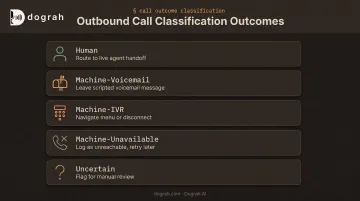
Most modern platforms sort answered calls into a handful of buckets, each triggering different agent behavior:
- Human: the agent proceeds with the live conversation immediately
- Machine-voicemail: the agent either leaves a scripted message or disconnects
- Machine-IVR: the agent switches to DTMF navigation or menu logic instead of a spoken greeting
- Machine-unavailable: the line is dead, busy, or disconnected; the agent logs it and moves on
- Uncertain: the agent defaults to a safe fallback, often treating the call as human to avoid disconnecting a real person
The Two-Sided Cost of Getting It Wrong
Two failure modes drive most of the damage:
- False positives: A real person gets flagged as a machine, so the agent hangs up mid-greeting and kills the conversion
- False negatives: A voicemail gets flagged as human, so the agent talks over the greeting and leaves a garbled recording that hurts brand trust
This isn't a niche problem. It shows up everywhere high-volume outbound calling happens:
- Outbound sales and lead generation teams dialing hundreds of prospects daily
- Healthcare appointment reminder systems calling patients ahead of visits
- Fintech and collections campaigns confirming payments or overdue balances
- Hospitality confirmations for reservations and bookings
How Does AMD Work? Acoustic vs AI-Based Detection
Traditional Acoustic AMD
Legacy AMD relies on acoustic heuristics: silence length, energy or amplitude thresholds, and beep-tone detection. These signals are often paired with lightweight CNN or spectrogram classifiers trained on MFCC (Mel-frequency cepstral coefficient) features.
The problem: voicemail isn't a standardized carrier feature. A rule tuned for one carrier's codec and greeting length breaks as soon as it hits a different network or a custom greeting.
A 2024 study using a YAMNet-plus-GRU acoustic model reported 96.67% accuracy on its own test set, rising to 98.10% with added silence detection across roughly 4,200 audio clips (Altwlkany, 2024). Strong numbers on a controlled dataset. They don't guarantee the same result on live traffic across dozens of carriers.
Modern AI/LLM-Based AMD
Modern systems transcribe the first few seconds of audio with an ASR model, then classify that text with an LLM or lightweight text classifier. Voicemail greetings often identify themselves with phrases like "leave a message after the tone," so the words usually carry more signal than the waveform.
Compared with acoustic AMD:
- Signal: words and intent, not only silence, energy, or beeps
- Failure mode: ASR errors and ambiguous greetings, not codec drift alone
- Strength: holds up better across carriers and custom greetings
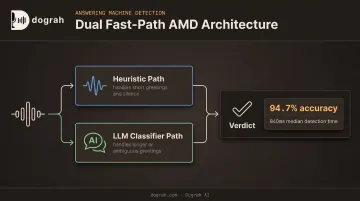
Leading platforms run a dual fast-path architecture:
- A quick heuristic path handles short greetings or extended silence
- An LLM-based classifier runs in parallel for longer or ambiguous greetings
- Whichever path concludes first produces the verdict
LiveKit's benchmark for this approach reported 94.7% micro F1/accuracy, 97.0% macro F1, and 840ms median (P50) detection time for its best-performing ASR-plus-LLM pairing (LiveKit, 2026).
That gap is the early-decision versus final-decision tradeoff: a verdict a couple of seconds in is fast but riskier; waiting for the full greeting improves accuracy at the cost of latency.
Streaming audio over WebSocket or SIP into an ASR-plus-classifier pipeline has become the standard integration pattern for this style of detection, whether you're building on open-source telephony stacks or modern voice AI frameworks.
Why AMD Is Harder Than It Looks
Carrier and codec variability breaks rule-based systems. Different carriers normalize audio, insert tones, and compress calls differently across codecs like G.711, Opus, and AMR. Add customized voicemail greetings, and a detector tuned on one network can fail silently on another.
Smart voicemail is starting to sound human. AI call screeners and modern voicemail systems increasingly mimic live conversation: a brief "hello?" followed by a pause looks almost identical whether a person or a machine answered.
IVR menus need their own category. They require DTMF navigation logic rather than voicemail handling, because the correct response (pressing digits versus leaving a message) is completely different.
Every business also has to pick a side of the precision-recall tradeoff:
- Human precision: never disconnect a real person
- Machine recall: never waste agent time on a machine
No model does both perfectly at once. A sales team burning hundreds of dials a day might tolerate a slightly higher false-machine rate. A healthcare reminder system handling sensitive appointments probably can't.
Best Practices for Implementing AMD in Outbound Campaigns
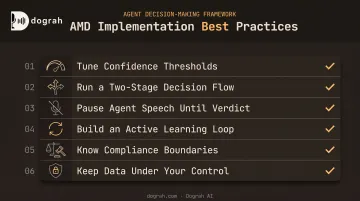
Tune confidence thresholds to your actual business cost. If wasted agent time is expensive, require higher confidence before labeling a call "human." If missed connections are costlier, loosen that threshold and accept more machine misclassifications.
Run a two-stage decision flow. Let agents act fast on high-confidence early verdicts, but fall back to a slower, more accurate final classification when the greeting is ambiguous. This mirrors the dual fast-path architecture described above: speed where you can afford it, patience where you can't.
Pause agent speech until AMD returns a verdict. This single rule prevents two of the most common failures: talking over a voicemail greeting, and interrupting a live person mid-sentence before the system knows who's on the line.
Build an active learning loop. Monitor confusion matrices by carrier and by script. Log low-confidence cases. Retrain or fine-tune your classifier on the flagged calls that keep tripping up the model.
Know the compliance boundaries before enabling voicemail drops. In the US, prerecorded or artificial voice messages left on an answering machine are regulated regardless of whether AMD flagged the call correctly. FCC rules under the TCPA apply whether a person or a voicemail answers, and messages must include an opt-out mechanism and a callback number (eCFR, current).
Healthcare and financial services messages face additional restrictions on content and frequency. AMD tells you who answered. It doesn't grant an exemption for what you're allowed to say.
Keep raw audio and training data under your own control where it matters. For HIPAA- or GDPR-sensitive campaigns, relying entirely on a closed third-party AMD API means trusting someone else's data handling. Self-hosted or private-cloud detection pipelines let you audit exactly where recordings go.
How Dograh AI Approaches Answering Machine Detection
Dograh AI's Speech-to-Speech orchestration, built on full-stack models like Gemini Flash Live and OpenAI GPT-Realtime-2, roughly halves end-to-end latency across the conversational pipeline. That low-latency architecture makes an early-decision AMD path viable without adding perceptible delay before the agent responds to a live caller. Nobody wants to hear a two-second gap after they say "hello."
Because Dograh AI is open-source and self-hostable under a BSD 2-Clause license, teams aren't stuck with a closed vendor's AMD black box. They can:
- Inspect and modify the detection pipeline directly
- Retrain or fine-tune classification logic on their own flagged calls
- Plug in locally hosted STT and LLM models (including Whisper, Voxtral, and Llama) instead of routing audio through a third party
That level of control matters most for regulated outbound campaigns in healthcare, fintech, and insurance, where audit trails and data residency aren't optional extras.
Once a call is flagged as voicemail, most AMD guides stop and leave the "now what" question unanswered. Dograh AI's hybrid pre-recorded and TTS voice feature addresses it directly. It drops a natural, human-sounding message in the same cloned voice used throughout the call, at a fraction of the cost of pure text-to-speech. Detection is only half the job. What happens in the next three seconds is the other half.
Frequently Asked Questions
What is answering machine detection (AMD) used for?
AMD identifies whether a human, voicemail, or IVR answered an outbound call, so the agent (human or AI) can respond appropriately. It prevents wasted time talking to non-human answers and reduces awkward or garbled voicemail recordings.
How accurate is AI-based answering machine detection?
Modern ASR-and-LLM approaches can separate human, voicemail, and IVR answers with high accuracy in controlled tests. Results still vary by carrier, language, and greeting style, so validate on your own call traffic before relying on them in production.
What happens after AMD detects a voicemail?
The agent typically either leaves a pre-scripted callback message and hangs up, or stays silent and disconnects, depending on campaign strategy and compliance requirements. Some platforms, like Dograh AI, can drop a natural-sounding recorded message automatically.
Can AMD tell the difference between an IVR menu and a voicemail?
Yes. Modern AMD systems use a distinct "machine-IVR" category separate from voicemail, which typically triggers automated DTMF navigation rather than a voicemail-style message drop.
Is answering machine detection legal for outbound calling campaigns?
AMD itself is legal. Leaving pre-recorded or automated voicemail messages is regulated in many regions. U.S. rules, for example, apply the same restrictions whether a call is answered live or by voicemail, so review telemarketing and consent rules before enabling automated drops.
How long does it take for AMD to make a decision?
Early decisions typically resolve within a couple of seconds of the call being answered. Final decisions that wait for the full greeting take a few seconds longer but generally improve accuracy, especially on ambiguous or unusually long greetings.