Introduction
You know the drill. You call a company, punch through four IVR menus, wait on hold, and finally reach someone — only to repeat your account number and problem all over again. It's exhausting, and you've stopped tolerating it.
The numbers back this up. U.S. contact centers recorded a 7.1% mean call-abandonment rate and a 79-second average wait to reach an agent in 2023, according to ContactBabel's Contact Center Decision-Makers' Guide. Nearly 1 in 10 calls get transferred at least once—more friction on top of the wait.
This guide breaks down what AI call routing actually is, how it works step by step, how it stacks up against traditional IVR, and where platforms like Dograh AI fit into the picture.
Key Takeaways
- AI call routing uses NLP and real-time data to send callers to the right agent or automated resolution instantly
- Natural conversation replaces "press 1 for billing" menus, cutting misroutes and repeat transfers
- Routing decisions weigh intent, sentiment, agent skills, account value, and past interaction history
- Skills-based, intent-driven routing lifts first-call resolution and customer satisfaction scores
- Self-hosted platforms like Dograh AI deliver intelligent routing without vendor lock-in or third-party data exposure
What Is AI Call Routing?
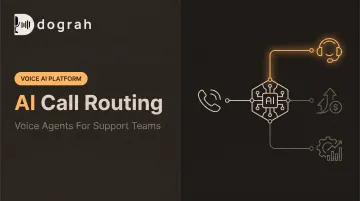
AI call routing uses artificial intelligence, natural language processing, and real-time data analytics to send inbound calls to the most appropriate agent, department, or automated resolution, instead of forcing every caller through the same static numeric menu.
Traditional IVR forces a caller to navigate "press 1 for sales, press 2 for support." AI call routing lets the caller simply say, "I want to cancel my order," and the system interprets that request, matches it to available context, and routes the call.
A routing decision typically factors in:
- Caller intent and sentiment (frustrated, urgent, neutral)
- Real-time and predicted call volume across teams
- Agent skill set, language, and expertise
- Existing account value or customer tier
- Current agent availability and business hours
When no qualified agent is free, the system still needs a fallback path. Mature platforms offer a virtual queue, voicemail, or an automated callback. Callbacks matter: long holds are exactly what drives abandonment in the first place.
Many AI routing setups also work alongside AI voice agents that resolve simple requests (booking an appointment, checking an order) before a human ever gets involved. That alone shrinks the volume hitting the routing layer.
Cold Transfers vs. Warm Transfers
A cold transfer passes the caller along with zero context. The next person has no idea who's calling or why, so the caller repeats everything from scratch. That repeat-yourself loop is a major driver of the frustration flagged in the TCN survey mentioned earlier.
A warm transfer passes the caller's details and a conversation summary ahead of the handoff. The receiving agent already knows the name, the issue, and what's been tried. This single difference is often what separates a smooth transfer from an infuriating one.
How Does AI Call Routing Work?
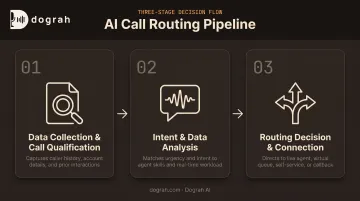
AI call routing runs through three connected stages, from the moment a call comes in to the moment it reaches the right agent, queue, or self-service path.
Step 1: Data Collection and Call Qualification
The system captures real-time inputs the moment the call starts: the spoken request, the phone number, and any account lookup triggered through conversational IVR. It layers this against historical data pulled from company systems: purchase history, past tickets, account status.
That mix lets the system decide with context instead of guessing from a single data point.
Step 2: Intent and Data Analysis
NLP interprets what the caller wants and how urgent it is. The system then matches that intent against routing rules, agent skill sets, and current workload balance.
Example: A caller saying "I need a refund" routes straight to billing. A caller flagged as an irate VIP account escalates immediately to a senior agent, bypassing the standard queue entirely.
Step 3: Routing Decision and Connection
Based on that analysis, the system picks one of several paths:
- Direct routing to a specific available agent with matching skills
- Virtual queue placement when the right agent is busy but expected soon
- Self-service deflection back to conversational IVR for simple requests
- Callback offer during peak volume, so the caller doesn't have to hold
Mature systems keep going after the connect. They run a feedback loop on call outcomes and adjust routing rules over time to improve accuracy and first-call resolution.
AI Call Routing vs. Traditional Call Routing
Traditional Automatic Call Distribution (ACD) routes calls based on static skill definitions and queue order, then holds the caller when no agent matches. It's rigid but predictable, and it puts the entire triage burden on human agents.
| Dimension | Traditional ACD / IVR | AI-Driven Routing |
|---|---|---|
| Technology | Fixed menus, static skill rules | NLP, real-time analytics, machine learning |
| Routing criteria | Queue order, department selection | Intent, sentiment, history, skills, account value |
| Wait times | 79 seconds average (ContactBabel) | Faster: match on the first utterance |
| Scalability | Requires more staff during volume spikes | Scales through automation, no added headcount |
| Triage cost | Human agents handle routine sorting | AI automates triage, reserving humans for complex calls |
One tradeoff matters more than the feature list: many "AI-powered" routing tools are still closed, proprietary platforms. Your call data, transcripts, and routing logic then live in a vendor black box, which is a hard problem if you need auditability or data that never leaves your environment.
Key Benefits and Industry Use Cases
Core Benefits Businesses See
- Fewer abandoned calls. Callers connect faster or get an immediate callback instead of holding indefinitely.
- Balanced agent workloads. Calls distribute by real-time capacity and skill, not random queue position, which eases burnout.
- Higher first-call resolution. The right person or bot handles the call on the first try.
Salesforce reports that 83% of customers expect to interact with someone immediately upon contact, and the same share expects complex problems resolved by one person, not five transfers.
Where AI Call Routing Delivers the Most Value
Healthcare: Routing scheduling and triage calls to the correct department reduces missed appointments and no-shows. A 2023 peer-reviewed study puts the cost of missed appointments to the U.S. healthcare system above $150 billion annually (roughly $200 per unused physician slot).
Financial services and insurance: Routing by account value, fraud flags, or claim type speeds resolution and cuts repeat identity verification, a common source of caller frustration in banking calls.
Customer support, BPO, and e-commerce: Skills-based and sentiment-based routing helps absorb high-volume periods without overwhelming any single team, improving first-contact resolution when it matters most.
How Dograh AI Enables Smarter, More Flexible Call Routing
Most AI routing platforms lock you into their infrastructure, their models, and their pricing. Dograh AI takes the opposite approach: an open-source, self-hostable voice AI platform built as the alternative to closed tools like Vapi and Retell.
What stands out for call routing:
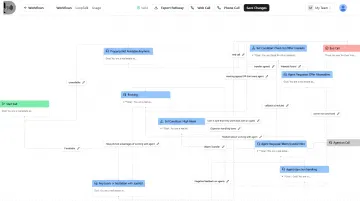
- Visual workflow builder. Drag-and-drop nodes (Start Call, Set Condition, Agent Response) build intent-based routing and warm-transfer logic without custom code—or describe a change in plain English and Dograh updates the workflow.
- Tier-1 resolution built in. NLP-driven agents handle scheduling, order status, FAQs, and basic intake, and send only complex or high-value calls to humans for tier-2 work.
- Deployment flexibility. Choose managed cloud, self-hosted open source, or managed private cloud. Healthcare, finance, legal, and GDPR-bound teams can keep call data on their own infrastructure and skip HIPAA, GDPR, and SOC 2 vendor overhead.
- Faster handoffs. Speech-to-Speech orchestration roughly halves end-to-end latency, so context reaches a human agent without awkward transfer lag.
- Rapid, elastic deployment. A voice bot with routing logic goes live in under 2 minutes and auto-scales during volume spikes, so you avoid overstaffing quiet weeks and scrambling through surges.
For self-hosted deployments, the cost model is straightforward: no platform fees, only infrastructure and vendor costs. Documented estimates run roughly $0.03–$0.04 per minute at scale, versus $0.10–$0.15 per minute on typical managed platforms.
Frequently Asked Questions
What is automated call routing?
Automated call routing is a system that uses predefined rules or AI to direct incoming calls to the right agent, department, or self-service option without manual transferring.
How can I detect an AI phone call?
Common signs include consistent pacing, subtle audio artifacts, and a lack of natural pauses or interruptions. Many businesses now legally disclose AI agent use at the start of the call.
Is AI calling illegal?
No, AI calling itself isn't illegal, but it's regulated. Rules like the TCPA require consent and disclosure, and legality depends on compliance with local telemarketing and consumer-protection laws.
What's the difference between AI call routing and a standard IVR?
Standard IVR relies on fixed numeric menus ("press 1 for sales"). AI call routing understands natural spoken language and routes based on intent, sentiment, and account data.
Does AI call routing integrate with existing CRM and phone systems?
Yes. Most platforms, including Dograh AI, integrate with CRMs like Salesforce and HubSpot, telephony providers such as Twilio, and calendars via API to inform routing decisions.
How much does AI call routing cost to implement?
Costs vary by deployment model: per-minute cloud pricing versus self-hosted open source with infrastructure-only costs. Open-source platforms can lower total cost of ownership over time.