Introduction
Outbound call centers are under real pressure heading into 2026. Commercial SaaS dialers keep raising per-seat pricing, pushing SMBs and large enterprises toward self-hosted, open-source alternatives that skip monthly per-agent licensing entirely.
Predictive dialers solve one specific problem: agent idle time. Between calls, agents wait for numbers to ring, voicemail pickups, and busy signals to clear. A predictive dialer's pacing algorithm dials ahead of agent availability, so sales teams, collections agencies, and survey operations spend more time talking and less time waiting.
This article ranks the top open-source predictive dialers available in 2026 and walks through the criteria that actually matter when you choose one. It also covers a newer path: AI voice agents that skip the agent-pacing problem by handling the conversation themselves.
TL;DR
- Open source predictive dialers deliver pacing-algorithm dialing without per-seat SaaS fees; you self-host and pay for infrastructure, not licenses.
- Selection hinges on four factors: telephony base (Asterisk vs FreeSWITCH), scalability, TCPA/DNC compliance tooling, and integration depth.
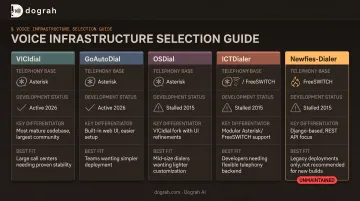
- This ranking covers five platforms: VICIdial, GoAutoDial, OSDial, ICTDialer, and Newfies-Dialer.
- AI voice agent platforms are emerging as an alternative that removes the agent-pacing bottleneck entirely.
Overview of Open Source Predictive Dialer Software in the Call Center Industry
A predictive dialer uses call-pacing algorithms to dial multiple numbers ahead of agent availability. It connects only answered calls to a live agent, so reps spend far fewer seconds waiting between conversations.
The market behind this technology is expanding fast. According to Grand View Research, the global predictive dialer software market was valued at USD 4.38 billion in 2025 and is projected to reach USD 25.52 billion by 2030 — a 42.3% CAGR. That growth covers cloud subscriptions and on-premises deployments. Open source options compete most directly on the on-premises side, where teams want to avoid expensive SaaS contracts.
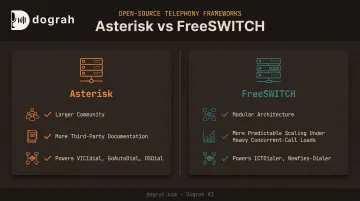
Most of the open source dialers worth considering in 2026 are built on one of two telephony frameworks:
- Asterisk — older, widely deployed open source PBX behind VICIdial, GoAutoDial, and OSDial
- FreeSWITCH — newer, modular telephony engine behind ICTDialer and Newfies-Dialer
Neither framework is inherently better. Asterisk has a larger community and more third-party documentation. FreeSWITCH tends to scale more predictably under heavy concurrent-call loads. Below are the five most actively maintained and widely adopted platforms across both stacks.
Top Open Source Predictive Dialer Software (2026)
We evaluated each platform on five criteria: telephony architecture, active development, compliance tooling, agent capacity, and community adoption. Here's how the five leading open source predictive dialers stack up.
VICIdial
VICIdial is the name most people think of first when they hear "open source predictive dialer." Creator Matt Florell started the project in 2003 as a simple list dialer, and it has since grown into one of the most widely deployed contact center suites in the open source world, with production installs across more than 100 countries.
Built entirely on Asterisk, VICIdial requires an Asterisk server to function. Its predictive and adaptive dialing algorithms sit on top of that PBX layer. The interface looks like it belongs to an earlier era of web design, and standing up a working instance typically demands real Asterisk expertise.
The dialing engine underneath is mature and reliable at scale.
Agents traditionally connect through SIP softphones, though VICIdial's maintainers introduced ViciPhone, a separately deployable WebRTC phone built on SIP.js, giving teams a browser-based option if they're willing to set it up.
| Attribute | Details |
|---|---|
| Telephony Base | Asterisk-based; SIP softphones standard, with ViciPhone as an optional, separately deployed WebRTC add-on |
| Key Features | Predictive/adaptive dialing, agent scripting, broadcast dial, IVR surveys, list management |
| Best Fit | Large call centers with in-house Asterisk expertise and high-volume outbound dialing needs |
GoAutoDial
GoAutoDial takes VICIdial's dialing engine and wraps it in a friendlier setup process. The official v4 repository lists both VICIdial and Asterisk among its core components, alongside WebRTC and JSSIP libraries, so it's fair to call it VICIdial-based rather than a from-scratch rebuild.
What makes it worth a second look is the agent experience. Where raw VICIdial hands agents a SIP softphone and a dated web panel, GoAutoDial ships a native browser-based WebRTC agent interface out of the box, along with omnichannel and CRM-style features layered on top.
GitHub commits show ongoing activity into 2026, including bug fixes, though it hasn't published a formal tagged release—worth knowing if your team relies on versioned upgrades. Licensing runs under AGPLv2.
| Attribute | Details |
|---|---|
| Telephony Base | Asterisk-based with native WebRTC agent interface |
| Key Features | Predictive dialing with configurable pace levels, answering machine detection, lead loader, real-time reporting |
| Best Fit | Smaller teams wanting VICIdial-grade dialing without the friction of a raw VICIdial setup |
OSDial
OSDial split from VICIdial's version 1.2 codebase in 2009, after its team spent a couple of years working directly with VICIdial. It's stayed close to that Asterisk-based architecture ever since, while building out its own feature set under an AGPL license.
The standout feature is baked-in compliance tooling. OSDial's variable dropped-call percentage setting, available since version 2.1, lets operators configure abandonment rates to stay within FTC guidelines. That's a real advantage over dialers that leave compliance entirely to manual configuration.
OSDial also ships with preconfigured sample campaigns and agents, so a new install isn't a completely blank slate. Paid support plans are available for teams that want a safety net beyond community forums.
| Attribute | Details |
|---|---|
| Telephony Base | Asterisk-based, VICIdial-derived architecture |
| Key Features | Adaptive dialing, configurable drop-percentage controls, preconfigured campaign templates, optional paid support |
| Best Fit | Small-to-mid call centers wanting a VICIdial alternative with stronger compliance defaults |
ICTDialer
ICTDialer breaks from the VICIdial lineage entirely. It's built on FreeSWITCH paired with ICTCore, a communications framework from ICT Innovations. It is a distinct project from that company's commercial ICTBroadcast and ICTContact products.
Where ICTDialer differs most from the other platforms here is architecture. It's REST API-first and multi-tenant by design, which makes it a better fit for developers building a hosted service on top of it than for a contact center manager looking for an agent desktop out of the box. Its core strength lies in voice, SMS, and fax broadcast campaigns rather than live-agent predictive pacing.
Licensed under GPL-3.0, with source available on GitHub and documented build instructions.
| Attribute | Details |
|---|---|
| Telephony Base | FreeSWITCH-based with ICTCore communication framework |
| Key Features | Voice/SMS/fax broadcast, REST API, multi-tenant campaigns, contact group management |
| Best Fit | Developers and SaaS builders needing API-driven outbound campaigns without heavy agent routing |
Newfies-Dialer
Newfies-Dialer is another FreeSWITCH-based platform, and historically one of the strongest for large-scale voice broadcast and survey campaigns. It shipped with answering machine detection, DNC list management per campaign, and automatic speech recognition that could route contacts based on their spoken responses.
Here's the catch: the project's own maintainers state that open source development stopped in 2015, with subsequent work moving to a closed-source commercial spinoff. The last published open source release, version 2.8.4, dates to October 2013. That's not a dated interface problem; it's a maintenance problem, and it should factor heavily into any decision to build on it today.
| Attribute | Details |
|---|---|
| Telephony Base | FreeSWITCH-based |
| Key Features | Voice broadcasting, automatic speech recognition, voicemail detection, DNC management |
| Best Fit | Notification and survey campaigns, for technical teams comfortable maintaining an unmaintained codebase themselves |
Beyond Predictive Dialing: How AI Voice Agents Are Replacing the Traditional Dialer Model
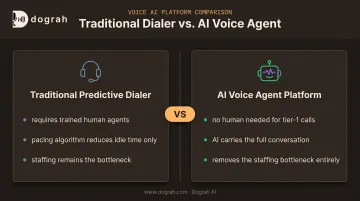
Every platform above solves the same narrow problem: getting a human agent connected to a live call faster. That's valuable, but it doesn't remove the actual bottleneck: staffing. You still need enough trained agents on shift to handle the calls a predictive dialer connects, and hiring, scheduling, and training people doesn't scale as fast as call volume does.
AI voice agent platforms take a different approach. Instead of optimizing how quickly a human picks up, they remove the human from tier-1 outbound volume entirely. The AI places the call, carries the conversation, and resolves it without needing an agent on the line at all.
An Open Source Alternative to Closed Voice AI Platforms
Dograh AI is an open-source, self-hostable voice AI platform, licensed under BSD 2-Clause, built as an alternative to closed platforms like Vapi and Retell. Think of it as n8n, but for voice agents: a visual, drag-and-drop workflow builder instead of one giant prompt or a fixed dialing script. Deploy it via Docker, and a working voice bot can be live in under 2 minutes.
Two details matter most for outbound calling performance:
- Speech-to-Speech orchestration (Gemini Flash Live, OpenAI GPT-Realtime-2, and similar models) roughly halves end-to-end latency versus a conventional STT-LLM-TTS pipeline
- Hybrid pre-recorded voice plus TTS blends real human clips with TTS fallback in the same cloned voice, cutting costs up to 3x and improving conversions 2x versus TTS-only calls
Every second of dead air on an outbound call raises hang-up rates, so that latency cut is not cosmetic.
For regulated outbound use cases such as collections, healthcare reminders, and financial outreach, the self-hosted deployment model has a specific advantage: call data stays on-premise. That removes a layer of vendor HIPAA, SOC 2, and GDPR compliance overhead from procurement, since there's no third-party processor to vet in the first place.
In practice, teams run AI voice agents on tier-1 outbound volume—reminders, qualification calls, and follow-ups—and reserve trained humans for tier-2 work that needs empathy, negotiation, or complex judgment. That split follows the same open source philosophy as the dialers above: full visibility into how the system works, without a vendor controlling the roadmap.
How We Chose the Best Open Source Predictive Dialers
The most common mistake teams make is picking a dialer based on name recognition alone. Many default to VICIdial because it's the platform everyone's heard of, without checking whether they have the Asterisk or FreeSWITCH expertise, hosting budget, and maintenance bandwidth to run it long-term.
We weighed each platform against five factors:
- Telephony architecture — Asterisk vs FreeSWITCH affects available documentation, community size, and how the system behaves under heavy concurrent load
- Active development — a platform with commits in 2026 gets security patches; one that stalled in 2015 does not
- Compliance tooling — built-in drop-percentage controls and DNC list management reduce regulatory exposure
- Agent interface modernity — WebRTC panels cut onboarding time versus SIP softphone setups requiring per-agent desktop configuration
- API/CRM integration depth — REST APIs and webhooks determine how much custom development you'll need to connect a dialer to your existing stack
Each factor ties directly to a business outcome. Weak compliance tooling creates real regulatory exposure. The FTC's Telemarketing Sales Rule caps abandoned calls at 3% of live-answered calls per campaign, and dialers without configurable abandonment controls make that limit harder to hit consistently.
A dated agent interface slows new-hire ramp time and drags down connect rates.
Conclusion
The right open source predictive dialer is the one that fits your operation, not the one that ranks first in a search. Match the platform to:
- Team size and in-house technical expertise
- Compliance exposure and data requirements
- Realistic monthly call volume
- Total cost of ownership beyond a free license
Before committing, pilot any platform against real campaign data, not a demo list. Hosting, SIP trunking, DID numbers, and the engineering hours to keep it patched all cost money, even when the license itself is free.
For teams ready to move past the agent-pacing model entirely, Dograh AI's open-source, self-hostable voice AI platform is worth evaluating alongside these five. It offers three paths: self-hosted OSS, managed cloud, or fully managed private cloud in your own infrastructure. You can start small without locking into a vendor's roadmap.
Frequently Asked Questions
What is the difference between a predictive dialer and an auto dialer?
An auto dialer simply dials numbers automatically, often to play a broadcast message. A predictive dialer is a specific type of auto dialer that uses pacing algorithms to dial ahead of agent availability and connects only answered calls to a live agent.
Is open source predictive dialer software really free?
The software license is free. Hosting, SIP trunking, DID numbers, and the maintenance hours needed to keep the system running are all real recurring costs you still have to budget for.
What are the risks of using open source predictive dialer software?
Risks include no vendor SLA, reliance on community forums for support, dated interfaces on older platforms, and a real need for technical expertise on setup and maintenance. Budget for in-house Asterisk or FreeSWITCH skills before committing.
Which open source predictive dialer is easiest to set up for a small team?
GoAutoDial and OSDial both offer simpler installation and friendlier agent panels than raw VICIdial. GoAutoDial's native WebRTC interface in particular cuts onboarding time for smaller teams.
Do open source predictive dialers comply with TCPA and DNC regulations?
Most include compliance features like calling-hour windows and DNC scrubbing. Legal responsibility for consent, list hygiene, and correct configuration still rests with the operator, not the software.
Can AI voice agents fully replace a traditional predictive dialer?
For many use cases, yes. AI voice agents can carry a full outbound conversation autonomously, removing the agent-pacing bottleneck entirely. Complex or highly sensitive calls still tend to route to a human.