Conversational IVR often gets described in abstract terms — "AI-powered," "natural language understanding," "next-generation self-service." But its real value shows up in numbers your team already tracks: handle time, containment rate, CSAT.
This article breaks down what conversational IVR actually is, why it matters operationally, and what businesses gain — or lose — by adopting it or ignoring it.
Key Takeaways
- Callers skip keypad menus and state issues in plain language, so intent is captured on the first turn
- Benefits compound as volume grows: faster resolution, lower cost, higher containment, better CSAT
- Escalations require full context handoff so complex issues reach a human without repetition
- Skipping conversational IVR drives more abandoned calls and higher staffing costs
- Modern voice AI platforms go live faster and cost less to run than legacy IVR builds
What Is Conversational IVR (Brief Context)
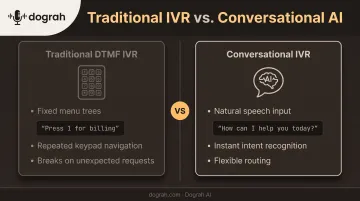
In plain terms: conversational IVR is a phone system that uses AI and natural language understanding so callers can speak naturally instead of pressing buttons or repeating rigid keyword phrases.
Instead of "Press 1 for billing, press 2 for support," the system asks, "How can I help you today?" and interprets whatever the caller says next.
Where it's typically used:
- Customer support triage and troubleshooting
- Billing inquiries and payment processing
- Appointment scheduling and rescheduling
- Order status and shipping updates
- After-hours call handling across healthcare, banking, insurance, and retail
Conversational IVR earns its place through outcomes: faster resolutions, lower operating costs, and a better customer experience. Legacy DTMF-based IVR (the "press or say a number" model) still handles simple routing fine. It just breaks down the moment a caller's request doesn't fit a predefined menu path.
Key Advantages of Conversational IVR
The advantages below tie to metrics your team is likely already reporting on, not theoretical claims. Each one gets more valuable as call volume scales, because automation costs stay flat while agent costs don't.
Faster Call Resolution and Reduced Handling Time
Conversational IVR identifies caller intent immediately through natural speech. There's no clicking through three or four menu layers to reach the right department. The caller says what they need, and the system routes accordingly.
This directly shortens average handle time (AHT). Instead of a caller navigating a menu tree, getting transferred once, then transferred again, the system either resolves the query outright or routes it correctly on the first attempt.
Why this matters:
- Cuts menu navigation and repeat transfers, so callers spend less effort getting help
- Fewer misrouted calls mean fewer agent-to-agent handoffs
- Forrester's TEI study on Amazon Connect modeled a 12% Year-1 AHT drop after moving to conversational self-service, plus stronger first-contact resolution from better intent recognition
KPIs impacted: average handle time, first-call resolution rate, call transfer rate
It pays off most on high-volume lines with repetitive, well-defined queries: billing questions, order status checks, and appointment scheduling. Intent on those calls is predictable enough for AI to recognize instantly.
Lower Operational Costs and On-Demand Scalability
Automating routine queries reduces how many agents you need to keep service running, without cutting availability. A conversational IVR doesn't take breaks, doesn't need overtime pay during a surge, and doesn't require weeks of hiring lead time before a seasonal spike hits.
That scalability is the bigger unlock. Conversational IVR platforms can absorb demand spikes (holiday order volume, a campaign that over-indexes) without the scramble to hire and train temporary staff.
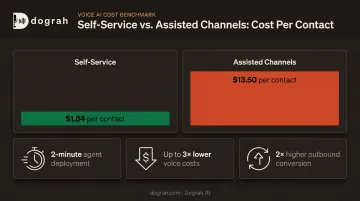
The cost gap is significant. Gartner's 2024 customer service benchmark put the median cost per contact at $1.84 for self-service versus $13.50 for assisted channels — a difference that compounds fast at scale.
Shifting routine volume to automation also frees your existing team for the calls that actually need a human: complex disputes, sales conversations, anything requiring judgment.
How platforms handle this in practice:
- Modern voice AI platforms like Dograh AI let teams deploy a production-ready conversational IVR agent in about 2 minutes using a plain-English description of the use case
- Multi-agent workflows auto-scale to handle large numbers of simultaneous calls as demand shifts, without manual overstaffing or understaffing decisions
- Hybrid pre-recorded + TTS in the same cloned voice can cut per-call voice costs by up to 3× vs. TTS-only systems and lift outbound conversion by 2×
KPIs impacted: cost per contact, staffing costs, agent utilization
Expect the largest gains during seasonal spikes, on 24/7 support lines, or anywhere call volume is growing faster than headcount can scale.
Higher Customer Satisfaction and Containment
Natural conversation reduces the friction of a rigid menu tree. Callers don't have to guess which numbered option matches their problem, and they don't have to repeat their account number three times because the system forgot it between transfers.
Successful containment (resolving a query without routing to a human) directly improves how fast and how competent the service feels. Callers don't care that no agent touched the call; they care that it got resolved quickly.
The same Forrester TEI study on Amazon Connect modeled containment climbing as conversational AI matured: calls reaching agents fell from 68% in Year 1 to 55% in Year 3 in the composite organization studied.
Containment without real resolution still fails. ContactBabel's Inner Circle Guide to Self-Service found that 71% of voice self-service abandonments happened because the available functionality didn't meet the caller's need.
Escalation quality matters just as much as containment rate. When a conversational IVR does need to hand a caller to a human, passing full conversation context prevents the single most common complaint in call centers: having to explain the problem all over again.
What a good handoff includes:
- A short summary of the conversation so far
- Extracted caller details: name, phone number, account info
- Caller intent and verification status
- Previous tool or lookup results already gathered
- A recommended next action for the agent
Dograh AI's multi-agent handoff, for example, can preserve full context across calls up to 45 minutes long, including transcripts and recording links where configured. Escalations for out-of-scope requests, compliance-sensitive issues, or high-emotion calls don't force the caller to start over.
KPIs impacted: CSAT score, containment rate, call abandonment rate
The stakes are highest in banking, healthcare, and e-commerce, where a bad phone experience directly damages loyalty and callers often already arrive stressed.
What Happens When Conversational IVR Is Missing or Ignored
Skipping conversational automation, or leaning entirely on legacy menu-based IVR, has predictable consequences as call volume grows:
- Longer wait times and higher abandonment: every added caller competes for the same finite agent pool
- Inconsistent experience: service quality swings with agent availability, skill level, and even time of day
- Rising costs that scale linearly: support headcount has to grow roughly in step with call volume, since there's no automation absorbing the routine load
- Missed calls and lost leads after hours: no one's picking up the phone at 9 PM, even though the customer is
- No structured interaction data: without consistent conversation logs, spotting recurring issues or systemic problems becomes guesswork
The functionality gap is the core issue. ContactBabel found 71% of voice self-service abandonments trace back to the system not meeting the caller's actual need. Legacy DTMF menus are the most common version of that gap: rigid trees that assume every caller's problem fits a pre-built option.
How to Get the Most Value from Conversational IVR
Conversational IVR delivers the most value when conversation flows come from real call transcripts and actual customer phrasing, not assumptions about how customers "should" describe their problem. If your flows are guesses, containment suffers no matter how good the underlying AI is.
Treat it as a living system, not a one-time setup.
- Monitor containment rate, CSAT, and handle time on an ongoing basis
- Refine conversation flows based on where callers actually get stuck or escalate
- Re-test flows against edge cases before rolling out changes
Automated QA tools make this easier to sustain. Dograh AI's post-call analysis, for instance, includes sentiment detection, miscommunication identification, and strict-adherence checks. That surfaces where a flow is failing without someone manually reviewing every recording.
When evaluating a platform, prioritize:
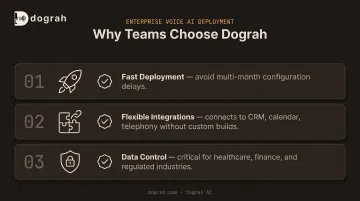
- Fast deployment: a platform that takes months to configure delays the ROI you're trying to capture
- Flexible integrations: your IVR needs to talk to your CRM, calendar, and telephony provider without custom engineering for each connection
- Data control: especially critical in healthcare, finance, and other regulated industries
Open-source, self-hostable platforms like Dograh AI let businesses deploy and customize voice agents quickly while keeping sensitive call data inside their own infrastructure. You can run fully self-hosted under a BSD 2-Clause license, or choose a fully managed private-cloud deployment where Dograh AI runs the infrastructure inside your own cloud environment.
For regulated teams, that can mean one fewer vendor in the data-flow diagram and fewer compliance agreements to negotiate.
Conclusion
Conversational IVR's value comes down to three things: faster resolutions, lower costs, and a better customer experience — and all three compound as call volume scales up.
None of that happens automatically after deployment, though. The gains depend on continuous monitoring and refinement of conversation flows, not a one-time install-and-forget setup.
Businesses evaluating conversational IVR should weigh flexibility, data control, and speed of deployment right alongside the cost savings.
The platform that deploys in minutes and keeps your call data under your own control will usually outperform one that takes months to configure and locks your data into someone else's infrastructure.
Frequently Asked Questions
What does IVR stand for?
IVR stands for Interactive Voice Response: an automated phone system that interacts with callers via voice or keypad input to gather information and route calls. Conversational IVR is its AI-powered successor.
What are the different types of IVR?
The main types are traditional DTMF (button-press) IVR, keyword-based voice recognition, menu-driven decision trees, and conversational IVR. Modern conversational systems use natural language understanding and large language models instead of fixed phrases.
What is the best IVR platform?
The right platform depends on your customization, compliance, and integration needs. Options range from managed enterprise platforms to open-source, self-hostable solutions like Dograh AI, which suits businesses prioritizing data control and fast deployment.
How does conversational IVR differ from traditional IVR?
Conversational IVR understands natural language and escalates with full conversation context. Traditional IVR relies on rigid button-press menus and blind transfers that often force callers to repeat themselves.
Is traditional IVR becoming obsolete?
Not entirely. Traditional IVR still handles simple, high-volume routing well, and most enterprises run hybrid systems that layer conversational AI on top of existing infrastructure rather than fully replacing it.
Does conversational IVR work for small businesses?
Yes. The underlying technology scales across business sizes. Enterprise deployments just carry heavier compliance and integration requirements than a typical small-business setup.