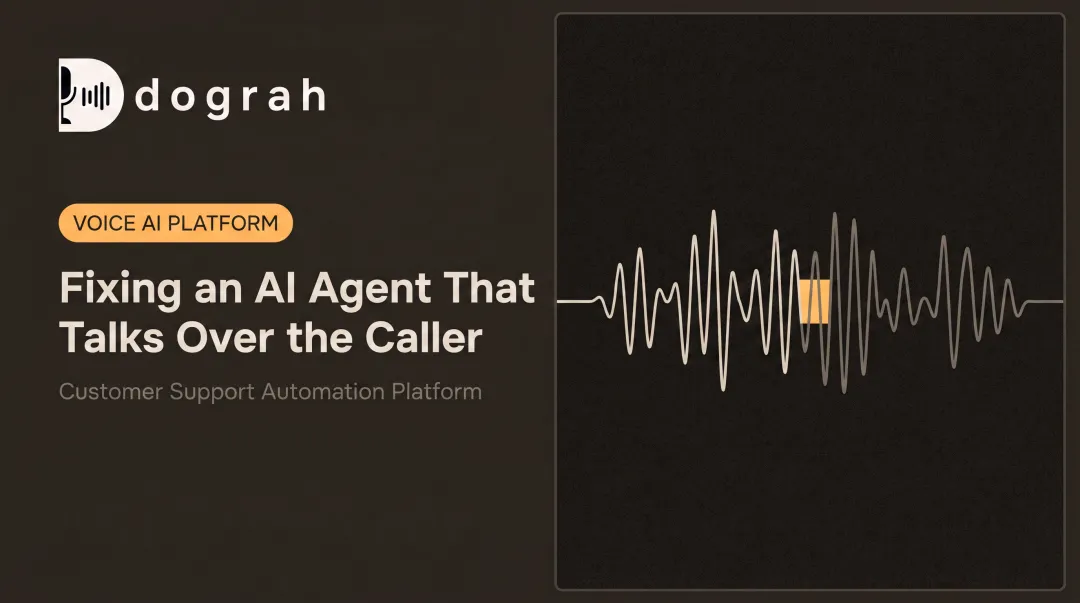
That's what barge-in solves: it lets a caller speak over a voice agent and have the system stop, listen, and respond. PolyAI's own deployment data pegs interruption at roughly 1 in 5 calls, with 15-20% of callers talking over the agent at some point. As voice AI scales into contact centers, that turn-taking moment has become a make-or-break detail.
Here's the catch: barge-in sounds simple, but most teams either disable it outright or misconfigure it badly. The result is false interruptions, missed corrections, and callers who stop trusting the system. This guide breaks down how barge-in actually works, the detection, decision, and recovery pipeline behind it, not just the surface-level idea of "letting people talk."
Key Takeaways
- Barge-in stops agent speech mid-utterance, processes the new input, and responds in real time
- Coordinated pipeline of VAD, echo cancellation, streaming ASR, and interruption policy runs in milliseconds
- Corrections, backchannels, background noise, and DTMF presses each need different handling logic
- Payment confirmations and legal disclosures often need conservative or non-interruptible policies
- Poorly tuned barge-in is one of the fastest ways to make an agent feel robotic
What Is Barge-In?
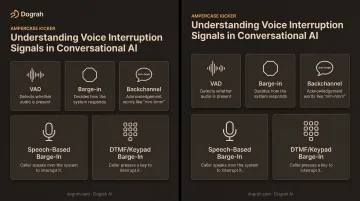
Barge-in is the capability that lets a caller speak while an AI voice agent is still talking, causing the system to halt its speech, process what the caller said, and respond accordingly. It's the difference between a caller waiting through an entire menu prompt and a caller cutting in halfway through to say "just transfer me to billing."
Older IVR and voice bot systems didn't allow this. They enforced rigid turn-taking: agent talks, caller waits, then caller talks. It worked, technically, but it felt slow and unnatural compared to how people actually communicate. Barge-in was built to close that gap.
Barge-in is not the same thing as voice activity detection (VAD). VAD simply detects that sound is present on the line. Barge-in is the broader behavior and policy layer that decides what to do once sound is detected: stop speaking, keep speaking, or ignore it entirely.
It's also distinct from backchannel handling. When a caller says "mm-hmm" or "right" while the agent talks, that's an acknowledgment, not an interruption. A well-tuned system recognizes the difference and keeps talking through it.
Even with modern LLM-based voice agents, turn-taking latency remains the biggest perceptible UX bottleneck. Callers judge how "smart" an agent feels largely by how gracefully it handles being interrupted, not by how good its answers are.
There are two broad categories:
- Speech-based barge-in: the caller interrupts by talking
- DTMF/keypad barge-in: the caller interrupts by pressing a key
Detection and decision logic differ slightly between the two, since DTMF is unambiguous (a keypress is a keypress) while speech requires classification.
How Does Barge-In Work?
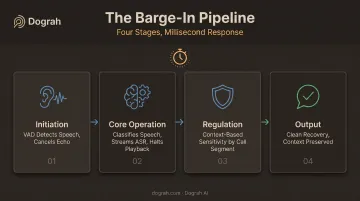
Barge-in isn't a single on/off toggle. It's a real-time pipeline with four distinct stages, and every stage has to complete in milliseconds for the interaction to feel natural.
Initiation: Detecting the Interruption
The moment barge-in begins is the instant voice activity detection (VAD) picks up speech energy on the caller's line while the agent's synthesized voice is still playing. This listening never stops. It's continuous and fully automated.
The common bottleneck here is echo. When the agent's outbound audio plays through a caller's speaker, it can leak right back into their microphone.
Without acoustic echo cancellation, the system would "hear" its own voice and treat that leak as caller speech. Stripping the leaked audio is what lets VAD react only to genuine interruptions.
Generic VAD models tuned on clean studio audio often fall apart on real telephony conditions: background noise, car environments, weak cellular connections. This mismatch is the leading cause of false interruption triggers in production deployments.
Core Operation: Classifying and Acting on the Interruption
Once speech is detected, the system has to classify it before deciding whether to actually stop talking. Is this:
- A true correction ("no, wait, I meant Tuesday")
- A backchannel ("okay," "right")
- Background noise (a TV, a passing car, a barking dog)
- A DTMF keypress
Mechanically, streaming speech recognition starts transcribing incrementally the moment the caller starts talking, instead of waiting for silence like older systems did. Agent playback gets halted or ducked, and the partial transcript flows straight to the dialogue engine for a response.
Speed matters enormously here. In natural human conversation, turn transitions typically land within 0-200 milliseconds, which is the bar callers unconsciously measure a voice agent against. Every extra hundred milliseconds between "caller interrupts" and "agent responds" is lag callers feel immediately.
That gap is why orchestration architecture matters. Dograh AI's Speech-to-Speech approach runs models like Gemini Flash Live and OpenAI's GPT-Realtime-2 across the full stack, roughly halving end-to-end latency versus a conventional STT-to-LLM-to-TTS chain. Tighter orchestration shrinks the exact pause callers notice between interrupting and being heard.
Regulation: Interruption Policy by Context
Barge-in sensitivity shouldn't be uniform across a call. Production systems apply different policies depending on where the conversation is:
- Greeting — moderate sensitivity, callers rarely interrupt here
- Data collection — responsive, since corrections happen constantly
- Confirmation — tighter, to avoid cutting off a "yes" partway through
- Payment or legal disclosure — conservative or non-interruptible
Teams tune three main levers to hit the right balance: VAD energy thresholds, minimum speech duration before something counts as "real" speech, and endpointing delay (how long the system waits for silence before deciding the caller is done).
Get this wrong in either direction and there's a cost. An over-sensitive policy cuts off legitimate caller speech constantly. An under-sensitive one lets callers talk over something they legally need to hear in full, like a payment confirmation, which creates a compliance risk rather than just a UX annoyance.
Output: Recovery and Response
When barge-in fires correctly, the agent stops speaking cleanly and remembers exactly where it left off. It doesn't repeat itself, and it doesn't lose the thread of what it was about to say. The caller's new input becomes a fresh conversational turn.
This requires the dialogue state to preserve context across the interruption. The model needs to know what it was interrupted mid-sentence about, so it can respond coherently instead of restarting the exchange from zero.
Clean recovery shows up in the metrics teams already watch. When barge-in success is tracked next to task completion and containment rate, interruption quality tends to move with those numbers.
A 2007 incremental dialogue study found that systems processing speech incrementally, rather than waiting for pauses, completed tasks roughly 20% faster and scored higher on predicted satisfaction.
Common Challenges and Best Practices for Tuning Barge-In
Every barge-in system runs into the same core tradeoff. Lower the detection threshold, and the agent feels more responsive, but false interruptions climb. Raise it, and false interruptions drop, but the agent starts feeling rigid and unresponsive.
These two failure modes aren't equally damaging. A false barge-in, stopping mid-sentence because of background noise, signals to the caller that the agent isn't really listening. That erodes trust faster than a missed interruption does. Both need to be measured separately, not lumped into one vague "barge-in accuracy" number.
Best practices that hold up across deployments:
- Set policy per message type, not globally. Keep legal disclosures and payment confirmations non-interruptible (or DTMF-only); allow full barge-in on open-ended support turns.
- Log every call. Record caller/agent speech state, the interruption decision, and recovery outcome so failures are diagnosed from evidence, not complaints.
- Test edge cases before launch. Include background noise, overlapping speech, and weak connections—not just clean studio audio.
Configuring context-specific rules like this used to mean custom pipeline code at every conversation step. That gap still shows up on open, self-hosted stacks like LiveKit or Pipecat, where turn-taking logic isn't exposed as a first-class control.
Visual low-code workflow builders, including Dograh AI's drag-and-drop agent builder, let teams set per-step barge-in behavior without touching pipeline internals.
Where Is Barge-In Used?
Barge-in matters most at specific points in a call, not uniformly throughout it:
- IVR-style menu navigation: Callers who already know what they want will talk over the menu
- Account or order data collection: Corrections happen constantly ("no, my zip code is...")
- Confirmation steps: Callers jump in to confirm or reject before the agent finishes
- Open-ended support conversations: Natural back-and-forth throughout
Environment strongly affects how well barge-in performs. A quiet office or home line gives VAD a clean signal to work with.
A caller driving on a highway, with wind noise, road noise, and a Bluetooth mic, is a much harder problem. Accented or multilingual speech typically needs extra tuning on top of that.
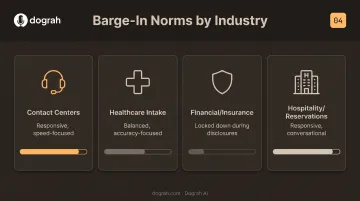
Those conditions also meet different industry norms for how aggressively barge-in gets applied:
- Contact centers generally favor responsive barge-in for speed
- Healthcare intake balances responsiveness against accurate, complete information capture
- Financial and insurance calls often lock down barge-in during disclosures and identity verification
- Hospitality and reservations lean toward responsive, conversational handling since urgency is lower
Conclusion
Barge-in is a coordinated pipeline—detection, classification, contextual policy, and recovery—running in real time. That pipeline is what separates a voice agent that feels natural from one that feels robotic.
Treat barge-in as a tunable, logged, per-context policy rather than a single on/off toggle. Teams that do ship agents that build caller trust instead of eroding it with every bad interrupt.
If you're building on an open stack, wire those controls into the agent workflow so you can tune thresholds, log decisions, and recover cleanly in production—the same approach platforms like Dograh AI take for self-hosted and private-cloud voice agents.
Frequently Asked Questions
What does "barge-in" mean in a voice AI context?
It refers to a caller interrupting an AI voice agent mid-speech, which prompts the system to stop talking, listen to the new input, and respond. It's the mechanism that makes voice AI feel like a real conversation instead of a scripted prompt tree.
Is barge-in the same as voice activity detection (VAD)?
No. VAD is just the detection layer that notices sound on the line. Barge-in is the broader behavior and policy that decides whether to stop speaking, keep speaking, or ignore the sound once it's detected.
Why do some voice agents disable barge-in entirely?
Disabling it is the safer, more predictable default because tuning it correctly is genuinely hard. Teams take that route to avoid false interruptions, but it makes the agent feel noticeably less natural to callers.
Can barge-in be turned off for specific parts of a call, like legal disclosures?
Yes. Most production systems apply non-interruptible or DTMF-only policies for compliance-sensitive segments, such as payment confirmations or required legal disclosures, while keeping full barge-in active elsewhere in the call.
What commonly causes false barge-in triggers?
The three biggest culprits are:
- Background noise on the line
- Echo from the agent's audio leaking into the caller's mic
- Backchannel words like "okay" or "right" misread as interruptions
Does enabling barge-in make a voice agent slower or less reliable?
Not inherently. But poor tuning, or high latency somewhere in the underlying detection-to-response pipeline, can make interruption handling feel delayed and clunky rather than instant and natural.