Many people use "IVR" and "DTMF" interchangeably, but they're not the same thing. IVR is the system. DTMF is the signal that makes the system respond.
This article breaks down what DTMF actually is, how the tones work at a technical level, how IVR depends on it, where it falls short, and how AI voice agents are now blending keypad tones with natural conversation.
Key Takeaways
- DTMF is the tone-based signaling method behind every telephone keypad press
- IVR menus use those tones to route calls, collect PINs, and run self-service without a live agent
- Numeric entry stays reliable; complex or open-ended requests need speech, not keypad paths
- AI voice agents pair DTMF capture with natural language understanding for hybrid call flows
What Is DTMF (Dual-Tone Multi-Frequency)?
DTMF stands for Dual-Tone Multi-Frequency. Press any key on a phone keypad, and the device generates two simultaneous audible tones: one low-frequency, one high-frequency. That specific pairing is what tells the receiving system exactly which key you pressed.
How DTMF Tones Work
The standard grid, defined by ETSI and ITU-T standards, uses four low frequencies and four high frequencies. Combined, they produce 16 possible signals:
| 1209 Hz | 1336 Hz | 1477 Hz | 1633 Hz | |
|---|---|---|---|---|
| 697 Hz | 1 | 2 | 3 | A |
| 770 Hz | 4 | 5 | 6 | B |
| 852 Hz | 7 | 8 | 9 | C |
| 941 Hz | * | 0 | # | D |
Regular consumer phones only expose 12 of these keys. The A through D column is reserved for specialized signaling equipment.
These tones travel over modern networks in two ways:
- In-band DTMF: tones ride inside the actual audio stream. This works fine on uncompressed calls, but low-bit-rate codecs can distort the tones enough that automated systems misread them.
- Out-of-band DTMF: the keypress is sent as separate signaling data (via RTP telephone-event packets, per IETF RFC 4733), bypassing the voice codec entirely.
Out-of-band is more reliable over VoIP because it doesn't ask a speech codec to faithfully reproduce a precise tone pattern.
A Brief History: From Pulse Dialing to Touch-Tone
Before DTMF, phones used pulse (rotary) dialing: clicking relays counted pulses to identify each digit. It was slow and prone to misreads on noisy lines.
The Bell System began introducing Touch-Tone service commercially in 1963, starting with just two exchanges before expanding nationwide. That shift enabled faster call setup and paved the way for the automated IVR routing systems used today.
What Is IVR and How Does DTMF Power It?
IVR stands for Interactive Voice Response: the automated phone system that greets callers and offers self-service through voice or keypad input, without needing a live agent on the line.
How DTMF Enables IVR Menu Navigation
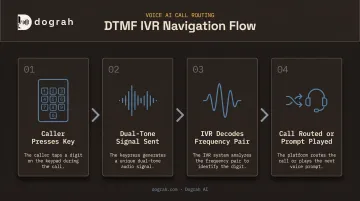
Here's the basic mechanic behind "Press 1 for Billing":
- Caller presses a key on their phone keypad
- That key sends a unique dual-tone signal to the IVR system
- The IVR decodes the frequency pair into the matching digit
- The system routes the call or plays the next prompt based on that digit
The same mechanism handles more than menu routing. Mid-call, DTMF is commonly used to capture sensitive numeric input (PINs, account numbers, order numbers, or dates of birth) before a call ever reaches a human agent. This keeps that data structured and unambiguous, so verification steps stay accurate and consistent.
Common Business Applications of DTMF-Based IVR
DTMF-driven IVR still runs a large share of routine phone interactions:
- Banking: balance checks, transaction history, card activation
- Healthcare: appointment confirmations, prescription refill requests, screening questionnaires
- Insurance: claims status checks, policy lookups
A 2024 industry survey found that 84% of small contact centers and 76% of medium and large centers still use touchtone IVR. DTMF remains a working backbone for high-volume, routine interactions.
Benefits of DTMF in IVR Systems
DTMF earned its staying power for practical reasons:
- Automates high-volume, repetitive interactions like balance checks and appointment confirmations without a live agent on every call
- Detects input with little ambiguity: a tone is either recognized correctly or it isn't, unlike speech recognition parsing a spoken account number in a noisy environment
- Works on any phone (landline, mobile, or old feature phone) with zero app downloads or smartphone requirements
That last point matters more than it might seem. Not every caller has a smartphone or a stable data connection, but nearly every phone can send a DTMF tone.
Limitations and Challenges of DTMF-Only IVR
DTMF's biggest weakness is rigidity. Linear menus frustrate callers when the options don't map to their actual problem.
That frustration shows up in the data. A 2024 ContactBabel contact-center survey found 59% of respondents cited "too many options" as a major reason customers sought a human agent.
The same report found 32% of self-service sessions ended by escalating to a live agent, up from 25% the prior year.
Technical issues compound the problem, particularly over VoIP:
- Low-bit-rate codecs can distort tones enough that automated detection fails
- Packet loss can corrupt or truncate a tone before the system reads it
- Transcoding between codecs can leave DTMF signals unrecognizable
DTMF also cannot handle open-ended, emotionally nuanced, or non-linear queries. A caller with an unusual problem often has no path forward except pressing "0" and waiting for a human.
Beyond DTMF: How Modern AI Voice Agents Handle Tones and Conversation
Today's AI voice agents carry a double burden. They need to hold a natural spoken conversation, but they also need to send and interpret DTMF tones when they run into legacy phone systems that don't understand speech at all.
Consider an outbound AI agent tasked with confirming an insurance claim. It might need to:
- Call a partner company
- Navigate that company's own "Press 1 for Claims" menu
- Enter a policy number via DTMF
- Only then start the conversational part of its task
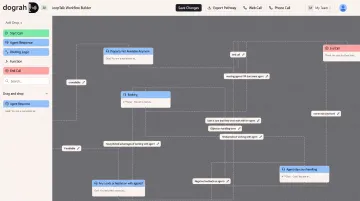
This is exactly the kind of hybrid call flow that voice AI platforms are being built around. Dograh AI's open-source workflow builder lets teams design agents visually, connecting Start Call, Agent Response, and routing nodes into a single flow.
Telephony integrations span Twilio, Vonage, Telnyx, and standard SIP trunks: the same rails that carry DTMF signaling across legacy IVR systems. For teams building agents that need to survive contact with someone else's decades-old phone tree, DTMF handling remains a documented requirement in that stack, not an optional extra.
Data sovereignty matters here too. Banking and healthcare workflows routinely involve keypad-entered PINs and account numbers, exactly the kind of sensitive data you don't want passing through a third-party vendor's cloud.
Dograh AI's self-hosted OSS deployment (BSD 2-Clause license) and fully managed private-cloud option keep that data inside a company's own infrastructure, with no external data transfer for the on-premises model. For regulated industries, that architecture choice can matter as much as the technology itself.
McKinsey found that seven in ten companies see IVR containment of 30% or less, meaning most calls still leave the automated system before resolution. Hybrid systems that pair DTMF's reliability with conversational understanding are the clearest path toward closing that gap.
Frequently Asked Questions
What does IVR stand for?
IVR stands for Interactive Voice Response — an automated phone system that greets callers and lets them self-serve through voice or keypad menus, without needing a live agent for every interaction.
What is DTMF and how is it used in telecom?
DTMF (Dual-Tone Multi-Frequency) is the dual-tone signaling method behind every keypad press. Telecom systems use it for call routing, dialing, and secure entry of numeric data like PINs or account numbers.
Is DTMF the same as touch-tone dialing?
Yes. "Touch-tone" is simply the consumer-facing name Bell System gave to DTMF technology when it launched commercially in 1963. They refer to the exact same underlying signaling method.
Can DTMF tones be used over VoIP calls?
Yes, DTMF works over VoIP but can travel in-band (inside the audio) or out-of-band (as separate signaling data). Out-of-band is generally more reliable against packet loss and codec distortion.
Do AI voice agents still need DTMF?
Often, yes. AI voice agents frequently need DTMF to navigate legacy IVR menus, dial extensions, or input PINs on other systems, even while handling the rest of the call through natural conversation.
What replaced DTMF in modern IVR systems?
Nothing has fully replaced it. Speech recognition and conversational AI have supplemented DTMF, and most modern systems now support both tone-based and voice-based input in the same call.