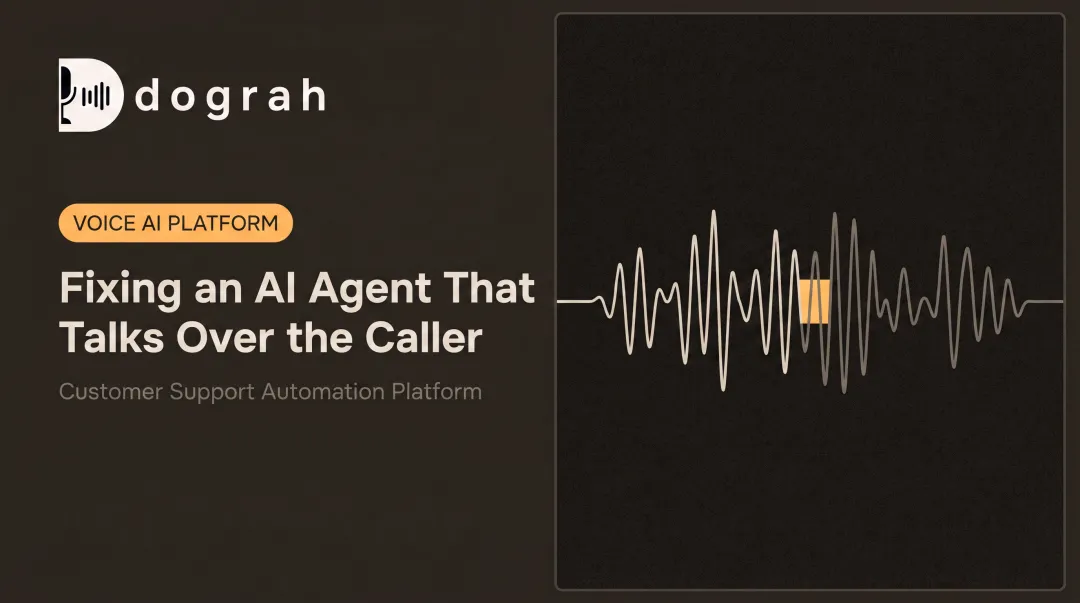
Get this wrong, and the conversation falls apart in seconds.
Voice AI adoption in customer support is accelerating fast. A 2024 Gartner survey of 187 customer-service leaders found 44% were exploring customer-facing generative AI voicebots, 11% piloting, and 5% had already deployed one. That's a lot of live calls now hinging on split-second timing decisions.
Most teams assume a simple silence timer solves this problem. It doesn't. Wait too short and you cut off callers mid-thought. Wait too long and dead air makes your agent feel robotic, and both quietly kill conversions.
This guide breaks down how end-of-turn detection actually works, the technical approaches available, and where the mechanics matter most on a live call.
TL;DR
- End-of-turn detection decides if a caller finished speaking or only paused—unlike basic VAD
- Modern systems fuse acoustic cues (pitch, rhythm, breathing) with semantic understanding in real time
- Wrong calls hurt both ways: premature cutoffs frustrate callers, slow detection feels robotic
- Approaches range from VAD-only to audio-native fused models, trading latency for accuracy
- Noisy phone audio, cross-talk, and language differences degrade accuracy vs. clean lab tests
What Is End-of-Turn Detection?
End-of-turn detection is the real-time process of deciding, at every pause in a caller's speech, whether that pause marks the end of their conversational turn. That signal tells the agent when it's safe to respond.
Fixed-duration silence timeouts fail because pause length varies by context. Picture a caller reciting a customer ID who stops for a second to check their notes.
A rigid timer set at 700 milliseconds can't tell "I'm done" from "I'm thinking." It fires anyway, and the agent talks over them.
Not the Same as VAD or Barge-In Handling
These three terms get used interchangeably, but they're separate stages of the same pipeline:
- Voice activity detection (VAD) only flags whether speech is present or absent in the audio
- End-of-turn detection interprets whether a detected silence actually means the turn is over
- Interruption or barge-in handling governs how the agent yields once it's already speaking
Still Relevant Even With Full-Duplex Models
Real-time speech-to-speech models are changing how conversations flow. Even so, most production voice pipelines built on STT, an LLM, and TTS still need a decisive turn-boundary signal before generating a reply. Skip this step and the agent either jumps the gun or leaves callers hanging.
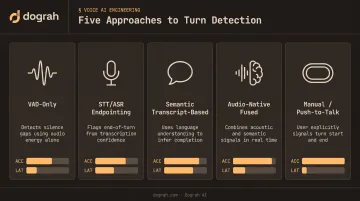
Five main approaches exist, and they differ depending on whether a transcript is required first:
- VAD-only — silence thresholds with no language understanding
- STT/ASR endpointing — the recognizer emits its own end-of-utterance signal
- Semantic, transcript-based models — judge completeness from the words said
- Audio-native models — fuse acoustic and semantic cues without waiting on a full transcript
- Manual or push-to-talk — the caller or agent marks the boundary explicitly
How Does End-of-Turn Detection Work?
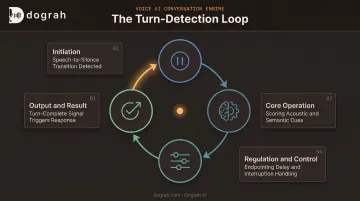
End-of-turn detection runs as a continuous evaluation loop. Every pause in a call becomes a candidate turn boundary that has to be resolved quickly and correctly, over and over, for the entire duration of the conversation.
Initiation
The process kicks off the instant voice activity detection (VAD) registers a transition from speech to silence in the live audio stream. It re-evaluates at every pause the caller takes, running silently in the background from the first word to the last.
Core Operation
At the center of the decision, a model scores how likely the pause is a true turn end. It weighs acoustic cues—intonation, rhythm, and pace—and often the semantic content of what was just said.
Text alone isn't enough to make this call reliably. Two callers can say the exact same words at the exact same pause point, "I'd like one large pizza…", and mean completely different things. One is finished ordering. The other is about to add toppings. The difference lives entirely in tone and delivery, not in the words themselves.
This matters for speed too. A model that waits for a finalized transcript can't start inference until speech-to-text finishes processing, which adds latency to every single pause. Acoustic-aware models skip that wait and start evaluating the moment audio arrives.
Regulation and Control
Systems stay balanced under real-world variability through endpointing delay controls—fixed minimum and maximum wait windows, or dynamic endpointing that tracks a caller's pause habits as the call progresses.
Callers who pause longer between sentences get more room. Callers who speak in short, quick bursts don't wait around unnecessarily.
This layer also handles interruptions. Systems must:
- Tell a genuine barge-in apart from backchanneling like "mm-hmm" or "right"
- Apply false-interruption recovery so the agent resumes if a flagged interruption was only silence
This is the layer most responsible for both false cutoffs and awkward dead air. Latency added here shows up immediately in how natural the agent feels.
Dograh AI's Speech-to-Speech orchestration—on models like Gemini Flash Live and OpenAI's GPT-Realtime-2—roughly halves end-to-end latency without sacrificing turn-detection accuracy. That shorter decision window is exactly what this layer needs.
Output and Result
The output is a "turn complete" signal that hands the finalized transcript and context to the response-generation stage.
That single signal triggers LLM reasoning, tool calls, and CRM logging. Get the timing wrong here, and the error cascades into every subsequent step of the conversation.
The stakes are measurable. A 2025 study with 54 participants in spoken conversations with an LLM-powered virtual agent tested response delays of 1.5, 4.0, and 6.5 seconds. Delay significantly affected perceived response time, engagement, impression of the agent, perceived competence, and willingness to interact again (all at p < 0.0001).
Conversational fillers helped perceptions of speed at the longer delays, but they didn't meaningfully fix the underlying discomfort.
Turn Detection Methods Compared
Not all turn detection works the same way. Here's how the main approaches stack up:
| Method | How It Works | Best For | Main Tradeoff |
|---|---|---|---|
| VAD-only | Pure silence detection, no language understanding | Lowest latency, any language | Frequent false cutoffs on thinking pauses |
| STT/ASR built-in endpointing | Turn detection bundled into transcription | Simplicity, single-vendor stacks | Locks conversational feel to that vendor's language coverage |
| Semantic/text-based | Small language model predicts end-of-turn probability from transcript | Genuine meaning understanding | Waits for finalized transcript, blind to tone |
| Audio-native/fused | Raw audio fed directly into a model combining acoustic and semantic signals | Speed and accuracy together | Newer, fewer providers |
| Hybrid two-stage | Lightweight always-on model flags a pause; heavier model classifies it | Balancing compute cost and accuracy | Added system complexity |
Audio-native models are pulling ahead on both fronts. Krisp benchmarked its raw-audio Turn Prediction v3 against a transcript-based detector using Deepgram Nova-3 transcripts and reported stronger results:
- Balanced accuracy: 88.05 vs. 82.70
- AUC: 94.58 vs. 88.70
- Turn-hold F1: 91.20 vs. 83.30
Per the Krisp turn-taking benchmark, those figures come from a vendor-run study—but the direction matches what most teams see in head-to-head comparisons.
Hybrid two-stage systems solve a different problem: compute cost. A lightweight model watches every pause; only when it flags something ambiguous does the heavier model activate. That cuts compute significantly while barely touching accuracy, because most pauses aren't ambiguous.
Choosing an approach means testing on real conditions, not clean lab recordings. Accuracy gaps widen sharply on actual phone calls with background noise and multiple languages in play.
Flexible stacks help you adapt. Dograh AI supports pluggable STT, turn-detection, and language models across 70+ languages, so teams can swap components for accuracy or coverage instead of inheriting one vendor's fixed turn-taking behavior.
Where End-of-Turn Detection Is Used
End-of-turn detection shows up anywhere a caller and an AI agent trade speaking turns. The stakes shift by workflow:
- Inbound support and IVR replacement, where callers explain issues in their own words and pace
- **Outbound sales and collections calls**, where dead air reads as disinterest and kills momentum fast
- Appointment scheduling and reminders, where exchanges stay short and predictable
- Healthcare or insurance intake triage, where accuracy and compliance outweigh raw speed
Clean Audio vs. Real Phone Lines
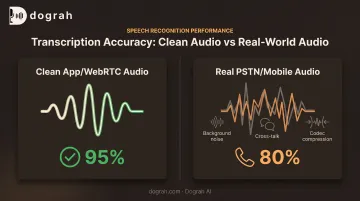
Those workflows also run on very different audio paths, and that changes how well detection holds up. Clean app-based or WebRTC audio gives models a clear signal. Real PSTN or mobile phone audio adds background noise, cross-talk, and codec compression, so accuracy drops versus lab conditions.
Industry context matters too. Outbound cold-calling needs tight, fast endpointing because dead air directly kills conversions on a call the prospect didn't ask for. Regulated intake calls, by contrast, can tolerate slightly longer pauses if it means better accuracy and cleaner compliance records.
Conclusion
End-of-turn detection is a layered, real-time decision. It fuses acoustic and semantic signals, and you tune it through endpointing and interruption controls. That decision ultimately triggers everything that happens next in the conversation.
With that model in mind, teams can stop defaulting to a generic silence timer. Pick and tune the approach—or the platform—that fits your caller demographics, languages, and call channel.
Frequently Asked Questions
What is the difference between end-of-turn detection and voice activity detection (VAD)?
VAD only detects whether speech is present or absent in the audio. End-of-turn detection goes further, interpreting whether a detected silence actually marks the end of the caller's turn.
How long should a voice AI agent wait before responding to a caller?
There's no universal fixed delay. Modern systems use dynamic endpointing that adapts the wait window based on the caller's own speech patterns and the model's confidence in that specific pause.
Can end-of-turn detection work reliably on noisy phone calls?
Accuracy drops on real PSTN and mobile audio compared to clean lab conditions, largely due to background noise and cross-talk. Noise cancellation and audio-native models help close much of that gap.
What happens when end-of-turn detection gets it wrong?
There are two failure modes: premature interruption, where the agent talks over the caller, and dead air, where the response comes too late. False-interruption recovery mitigates the former: if the agent starts too soon, it stops and yields when it hears the caller is still speaking.
Do multilingual voice agents need different turn detection models?
Yes. Speech rhythm and pause conventions vary by language, and models trained or evaluated only on English typically underperform elsewhere unless they're built with multilingual coverage from the start.
Is end-of-turn detection the same as interruption or barge-in handling?
They're related but distinct. End-of-turn detection decides when the caller has finished speaking, while interruption handling governs how the agent reacts if the caller speaks while it's still talking.