Introduction
The conversational AI market is projected to hit $49.80 billion by 2031, growing at a 19.6% CAGR from its current $17.05 billion valuation, according to MarketsandMarkets. Vapi has grown with that demand into a default choice for developers who want voice agents in production quickly.
But speed comes with tradeoffs. Usage-based pricing stacks platform fees on top of separate STT, LLM, and TTS costs, and the code stays closed—so teams struggle with rising bills, limited auditability, and little real control. That pressure is pushing engineering teams and data-sensitive businesses toward self-hostable, auditable alternatives.
This guide covers why teams leave closed platforms, the top open-source options to evaluate, and how to choose the right stack for cost, control, and deployment.
TL;DR
- Vapi is commercial, not open source — per-minute pricing plus pass-through provider costs
- Teams switch mainly for data sovereignty, unpredictable costs, and vendor lock-in
- Dograh AI, Pipecat, LiveKit Agents, Vocode, and Bolna AI lead the open-source field
- Judge options on license, self-hosting effort, telephony depth, and data control — not GitHub stars
- Dograh AI ships production-ready tooling; others are bare frameworks you assemble yourself
Is Vapi AI Open Source or Free?
Vapi is not open source. Its terms of service grant users only a limited, revocable license to access the platform. Vapi retains ownership of the underlying service.
Developer communities often describe it as sitting on the open-source Pipecat framework, though neither Vapi nor Pipecat's maintainer, Daily, has jointly confirmed that architecture.
What "bring your own model" actually means: you can plug in your own STT, LLM, and TTS provider keys. Vapi doesn't add markup to those costs directly, but you're still paying providers separately, plus Vapi's own platform fee for orchestration.
The Real Cost Structure
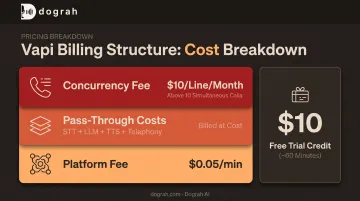
Vapi's documentation lists a $0.05 per minute platform fee, billed on top of at-cost transcription, model, voice, and telephony charges. New accounts get $10 in free credits, roughly 60 minutes of testing. Coverage can stretch to 150–200 minutes depending on the provider stack you choose.
Once you're in production, the bill breaks down into:
- Platform fee: $0.05/min
- STT + LLM + TTS + telephony: billed separately, at cost
- Concurrency above 10 simultaneous calls: $10 per line, per month
This multi-vendor billing model (one bill from Vapi, several more from your model providers) is why engineering teams and compliance-sensitive businesses look for platforms they can inspect, self-host, and run without a per-minute platform fee.
Why Businesses Are Moving to Open-Source Alternatives to Vapi
Three forces are driving the shift away from closed voice platforms like Vapi.
Data Sovereignty
Regulated industries — healthcare, finance, legal, and government — need call transcripts and audio to stay inside their own infrastructure.
HHS guidance confirms that HIPAA doesn't require self-hosting; cloud handling of protected health information is permitted with a signed Business Associate Agreement and proper risk management. Still, many compliance teams would rather remove the extra vendor layer than manage another BAA.
Cost at Scale
Vapi's $0.05/min fee compounds with pass-through STT, LLM, and TTS charges as call volume grows. LiveKit Cloud's own pricing documentation confirms managed voice-agent platforms typically meter usage across several separate categories: infrastructure, inference, and telephony. That metering unpredictability is what pushes teams toward flatter, self-hosted cost structures.
Vendor Lock-In and Compliance Overhead
Closed platforms restrict access to source code and block custom model swaps, which means your roadmap depends on someone else's release schedule. On top of that, vendor certification reviews for HIPAA, SOC 2, or GDPR add real procurement friction. Legal and healthcare buyers routinely run security questionnaires and due diligence cycles before signing anything.
Open-source frameworks skip much of that. They let teams:
- Read and modify the actual pipeline code
- Customize workflows without waiting on a vendor's feature queue
- Swap providers or models without renegotiating a contract
Top Open-Source Alternatives to Vapi
We evaluated each option on four criteria: genuine open-source licensing, self-hosting capability, active development, and production-readiness for real voice traffic, not just GitHub stars.
Dograh AI
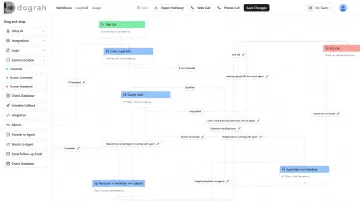
Dograh AI is an open-source, self-hostable voice AI platform under a BSD 2-Clause license. It works like a visual, n8n-style workflow builder—for voice agents and outbound calling.
Exited founders and Y Combinator alumni built it after hitting a familiar wall: bare frameworks needed too much custom code, and closed platforms carried data risk they wouldn't accept.
What sets it apart:
- Full data sovereignty: self-hosted OSS or managed private cloud—data stays on your infrastructure
- Speech-to-Speech orchestration with models like Gemini Flash Live and GPT-Realtime-2—roughly half the end-to-end latency
- Hybrid pre-recorded + TTS: real human clips with TTS fallback in the same cloned voice—up to 3× lower cost and 2× better outbound conversions (company benchmarks)
- MCP support so you can build and configure agents from Claude Code, OpenCode, Hermes, or Codex
- Local models: Whisper, Kokoro, Llama, Voxtral, Canary, Qwen, Chatterbox, Coqui, and more
| Feature | Details |
|---|---|
| Licensing & Hosting | BSD 2-Clause; self-host via Docker, managed cloud, or fully managed private cloud |
| Key Differentiators | Speech-to-Speech orchestration, hybrid pre-recorded/TTS, MCP support, 70+ languages |
| Best For | Data-sensitive teams (healthcare, fintech, legal) and anyone who wants a visual no-code/low-code builder |
Pipecat
Pipecat is an open-source Python framework maintained by Daily. Developers often cite it as the engine behind platforms like Vapi, though neither company has officially confirmed that link.
It is BSD 2-Clause licensed, actively maintained, and supports telephony through Daily, Twilio, Telnyx, Plivo, and Exotel.
Choosing Pipecat directly gets you the same pipeline engine without a platform markup, but you take on the cost of assembling, hosting, and maintaining the entire stack yourself.
| Feature | Details |
|---|---|
| Licensing & Hosting | BSD 2-Clause; fully self-managed hosting and infrastructure |
| Key Differentiators | Direct pipeline access, full customization, no platform fee |
| Best For | Developer teams ready to own integration, hosting, and maintenance |
LiveKit Agents
LiveKit Agents is an open-source, Apache 2.0-licensed framework built on LiveKit's WebRTC transport layer. It's built for teams that need low-latency, real-time voice in consumer-facing products.
You can self-host the entire stack or run it managed through LiveKit Cloud, which bundles SIP telephony. Self-hosting requires deploying SIP separately.
| Feature | Details |
|---|---|
| Licensing & Hosting | Apache 2.0; self-hosted or managed via LiveKit Cloud |
| Key Differentiators | Low-latency WebRTC transport, strong OSS ecosystem, custom model support |
| Best For | Engineering teams building real-time, consumer-facing voice products |
Vocode
Vocode is an MIT-licensed Python framework giving teams full control over their voice stack. It integrates multiple STT, LLM, and TTS providers with minimal code changes, so there's no dependency baked in at the infrastructure level.
The project supports telephony, web, and Zoom, and can be self-hosted end to end.
| Feature | Details |
|---|---|
| Licensing & Hosting | MIT; hosting and maintenance self-managed |
| Key Differentiators | Provider-agnostic architecture, active OSS community, no vendor lock-in |
| Best For | Engineering-heavy teams with strict compliance or customization needs |
Bolna AI
Bolna is an MIT-licensed voice agent platform built for fast telephony setup. Its Dockerized local stack ships with telephony server, Redis, and ngrok containers ready to go, and it supports Twilio, Plivo, Vobiz, Exotel, or your own SIP trunk out of the box.
It's a solid pick for developers who want an open, extensible starting point without Vapi's usage-based billing hanging over every test call.
| Feature | Details |
|---|---|
| Licensing & Hosting | MIT; self-hostable |
| Key Differentiators | Built-in telephony integrations, developer-friendly setup |
| Best For | Startups and developers prototyping without vendor cost overhead |
How to Choose the Right Open-Source Vapi Alternative
The most common mistake? Picking a framework by GitHub star count instead of testing it against your actual call flow.
Stars tell you a project is popular. They don't tell you how it holds up under real latency, how deep the telephony integrations go, or how much hosting effort it takes once live.
Key Evaluation Factors
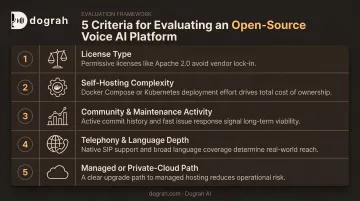
- License type: permissive (BSD, MIT, Apache) versus copyleft. All five platforms above use permissive licenses, meaning fewer restrictions on commercial use.
- Self-hosting complexity: a Docker-based setup with a visual builder takes far less engineering time than assembling a bare framework from scratch.
- Community and maintenance activity: check recent commits, not just total stars.
- Telephony and language depth: verify carrier support and language coverage against your actual markets before assuming broad claims apply.
- Managed or private-cloud path: useful if your team doesn't want to run infrastructure long-term, even if you start self-hosted.
Choose against these criteria and you get lower total cost of ownership, faster compliance sign-off, and engineers shipping features instead of babysitting infrastructure. Run your real call flow on the shortlist before you commit.
Conclusion
The right open-source Vapi alternative depends on one core question: do you want a bare framework to assemble, or a production-ready platform with the workflow tooling already built in?
Weigh long-term data control and total cost against short-term setup convenience. The framework that's fastest to a demo isn't always the cheapest to run at scale.
If you want a self-hostable, production-ready voice AI platform without building the orchestration layer from scratch, start with Dograh AI's open-source repository. Managed cloud and fully managed private-cloud options are available when you need production infrastructure without running it yourself.
Frequently Asked Questions
Is Vapi AI free or open source?
No. Vapi is a commercial orchestration platform, not open source. It offers a $10 free trial credit, but production usage is billed per minute plus separate STT, LLM, and TTS provider costs.
What are the best open-source alternatives to Vapi AI?
Dograh AI, Pipecat, LiveKit Agents, Vocode, and Bolna AI are the leading options, differing mainly in self-hosting effort and how much production tooling is built in.
Is Pipecat the same framework Vapi is built on?
Pipecat is often cited as the framework behind Vapi's orchestration layer, though neither company has officially confirmed that. Using Pipecat directly still gives you a comparable open-source pipeline engine.
Can I self-host an open-source Vapi alternative for free?
The frameworks themselves are free. You'll still pay for hosting, compute, and provider costs (STT/LLM/TTS) unless you choose a managed or private-cloud offering.
Which open-source voice AI platform is easiest to deploy?
Platforms with visual workflow builders and Docker-based self-hosting, like Dograh AI, typically deploy faster than bare frameworks that require custom integration work from scratch.
Do open-source Vapi alternatives support telephony and multiple languages?
Most support standard telephony providers and multiple languages, but depth varies significantly. Check each project's docs for your carrier and language needs before you commit.