Synthflow built its reputation as one of the easiest ways to answer that question. The no-code platform helped thousands of small and mid-sized teams stand up voice agents without hiring engineers, and its traction shows: Synthflow raised a $20M Series A in June 2025, led by Accel, bringing its total funding to $30M.
But easy-to-start doesn't always mean easy-to-scale. Many teams eventually hit walls with Synthflow's pricing opacity, rigid workflow logic, and limited control over where call data actually lives.
This guide breaks down the strongest Synthflow alternatives for 2026 — from open-source, self-hostable platforms to fully managed enterprise tools — so you can match a platform to your technical resources, compliance needs, and growth stage.
Key Takeaways
- Synthflow’s no-code builder is fine to start, but pricing opacity and rigid workflows limit scale
- Alternatives fall into three lanes: open-source/self-hosted, developer-first APIs, and managed enterprise platforms
- Compliance and data sovereignty (HIPAA, GDPR, SOC 2) matter as much as latency and voice quality
- Dograh AI is the only fully open-source, self-hostable option with full control over call data
- Pick by technical resources, industry, and call volume, not brand recognition
Overview of Synthflow and the Voice AI Alternatives Landscape
Synthflow is a no-code voice agent builder that lets teams automate calls, book appointments, and qualify leads without writing code. It found early traction among SMBs and non-technical teams who wanted a working phone agent fast, and its current positioning has since expanded toward broader enterprise call automation.
That growth mirrors the wider market. Grand View Research values the conversational AI market at $14.3 billion in 2025, projecting it to hit $17.7 billion in 2026 and climb toward $78.9 billion by 2033. Voice automation has moved from side experiment to core infrastructure.
Market expansion has also produced real fragmentation. Platforms now split along different priorities:
- Developer flexibility and API depth
- Enterprise polish and managed compliance
- Full ownership of your own voice stack, as with Dograh AI
The sections below evaluate the top contenders based on operational fit: deployment model, pricing clarity, and data control, rather than feature-list length alone.
Top Synthflow Alternatives for AI Voice Automation in 2026
This list weighs open-source flexibility, deployment model, pricing transparency, and data control as core criteria — not just how many features a platform can cram into a demo.
Dograh AI
Dograh AI is an open-source, self-hostable voice AI platform built by exited founders and Y Combinator alumni. Think of it as n8n, but for voice agents and AI calling — a genuine alternative to closed platforms like Synthflow, Vapi, and Retell.
What sets it apart:
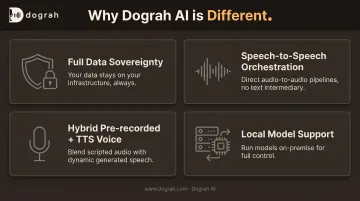
- Full data sovereignty. Self-host under a BSD 2-Clause license and audit the code yourself. Sensitive call data never has to leave your infrastructure.
- Speech-to-Speech orchestration. Built on models like Gemini Flash Live and OpenAI GPT-Realtime-2, this roughly halves end-to-end latency while improving conversational intelligence.
- Hybrid pre-recorded + TTS voice. Blends real human voice clips with a TTS fallback in the same cloned voice, cutting outbound calling costs by up to 3x while delivering 2x better conversions.
- Local model support. Connect your own LLM, STT, or TTS — including Voxtral, Whisper, Kokoro, Llama, Canary, Qwen, Chatterbox, and Coqui — for a fully on-premise voice stack.
| Aspect | Details |
|---|---|
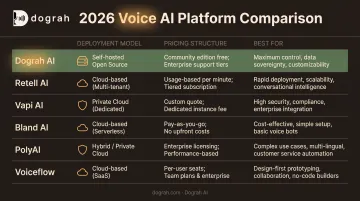
| Deployment | Self-hosted OSS via Docker, fully managed cloud, or fully managed private cloud inside your own infrastructure |
| Pricing | Free/open-source for self-hosting; usage-based cloud pricing (around $0.076/minute in a typical example) with no platform lock-in fees |
| Key Features | Visual no-code workflow builder, 70+ languages, MCP support for building agents from Claude Code, automated post-call QA and sentiment analysis |
| Best For | Teams that need data sovereignty, on-prem or private-cloud voice AI, and no vendor lock-in — especially healthcare, fintech, legal, and government |
For teams in healthcare, fintech, legal, or government work, this is the one alternative where you're not negotiating a vendor's compliance posture — you own the infrastructure outright.
Retell AI
Retell AI is a developer-friendly, pay-as-you-go voice agent platform known for fast response times and transparent per-minute billing.
Its differentiators:
- No-code builder paired with full API access for teams that want both
- Built-in post-call analytics and knowledge base retrieval from documents and URLs
- Custom LLM support via a websocket connection to your own model
- Warm transfer support, including agentic warm transfers to human staff
- Batch calling for scheduled outbound campaigns
| Aspect | Details |
|---|---|
| Pricing | Pay-as-you-go, $0.07–$0.31/minute depending on tier, plus telephony and LLM costs |
| Key Features | Sub-second latency (around 600ms per Retell's own benchmark), custom LLM/voice selection, knowledge base sync, warm transfer, batch calling |
| Best For | Startups and growth-stage teams wanting cost transparency and fast deployment |
Vapi AI
Vapi is built for engineering teams who want full control over their voice stack instead of a packaged, fixed-logic tool.
Its differentiators:
- Bring-your-own LLM, STT, and TTS through documented custom integrations
- Custom tool calling for API and function integrations mid-conversation
- Multilingual routing with automatic language detection
- Granular configurability that outpaces Synthflow's fixed workflow logic
| Aspect | Details |
|---|---|
| Pricing | $0.05/minute on the Build plan plus provider pass-through costs; 10 concurrent-call slots included, additional lines at $10/line/month |
| Key Features | API-first architecture, custom tool calling, multilingual routing, configurable concurrency |
| Best For | Developer-led teams wanting maximum infrastructure control |
Bland AI
Bland AI leans into enterprise-grade outbound calling and programmable voice logic for teams running high-volume campaigns.
Its differentiators:
- Infrastructure built to support thousands of concurrent calls
- Code-based integration examples in JavaScript, Python, and cURL
- Mid-call API actions for live CRM updates during a call
- Conversational Pathways for custom, branching call logic
| Aspect | Details |
|---|---|
| Pricing | Public tiers start at $0.14/minute (Start), dropping to $0.11/minute (Scale) with monthly platform fees; custom enterprise pricing above that |
| Key Features | High-volume outbound campaigns, native LLM flexibility, custom pathway builder |
| Best For | Large enterprises running high-volume outbound campaigns with dedicated technical teams |
PolyAI
PolyAI is an enterprise-managed voice AI provider focused on inbound customer service, built and refined alongside client teams to match brand tone.
Its differentiators:
- Proven deployments at scale in hospitality and retail — Golden Nugget's PolyAI deployment drove 3,000 reservations worth $600,000 in revenue in a single month at one property
- 45 languages offered as standard
- Strong handling of interruptions and natural barge-in during calls
- Both co-development support and a self-serve developer platform with CLI and API access
| Aspect | Details |
|---|---|
| Pricing | Custom enterprise quotes only |
| Key Features | Multilingual voice assistants, deep CRM/contact-center integrations, co-development support |
| Best For | Global enterprises needing a managed, white-glove inbound customer service solution |
Voiceflow
Voiceflow is a design-first, no-code platform for building conversational workflows across both voice and chat channels.
Its differentiators:
- Team collaboration tools, including version history on every publish
- Omnichannel deployment beyond just phone calls
- Enterprise governance features like SSO and private cloud hosting
| Aspect | Details |
|---|---|
| Pricing | Free tier available; paid plans require checking the current dashboard for exact rates |
| Key Features | Visual multi-channel builder, concurrent call support, private cloud deployment options |
| Best For | Startups and product teams prototyping conversational experiences across voice and chat |
How We Chose the Best Synthflow Alternatives
The most common mistake teams make? Picking a platform based on per-minute pricing or a slick demo, then discovering compliance gaps or workflow ceilings once call volume actually ramps up.
We weighted five factors, each tied to a real business outcome:
- Deployment flexibility: cloud vs. self-hosted vs. private cloud — how much control you need over where data lives
- Pricing transparency: published rates vs. custom quotes, for budget predictability as volume scales
- Data control and compliance readiness: audit readiness for HIPAA, GDPR, or SOC 2
- Integration depth: CRM, calendar, and telephony connections that cut manual work
- Proven performance at scale: concurrency limits and latency benchmarks under real load
Conclusion
There's no single "best" Synthflow alternative, only the one that matches your actual operational reality. A five-person startup testing outbound campaigns has different needs than a healthcare provider managing thousands of monthly patient calls.
Before committing long-term, pilot your shortlist against the scenarios that actually matter: peak call volume, data residency requirements, and integration depth with your existing CRM or scheduling tools.
If data control, fast deployment, and freedom from vendor lock-in top your list, Dograh AI fits that brief. As the only fully open-source, self-hostable option on this list, it puts your voice infrastructure and your data entirely in your own hands.
Frequently Asked Questions
What is Synthflow AI and why do businesses look for alternatives?
Synthflow is a no-code voice agent builder for handling calls, appointments, and lead qualification. Teams often outgrow it due to pricing opacity, rigid workflow logic, and limited analytics depth as call volume increases.
What should I look for in a Synthflow alternative?
Prioritize deployment flexibility, transparent pricing, compliance readiness for your industry, and integration depth with your existing CRM and telephony stack. These factors matter more than raw feature count.
Is there an open-source alternative to Synthflow?
Yes. Dograh AI is a self-hostable, open-source voice AI platform under a BSD 2-Clause license and an alternative to closed platforms like Synthflow, Vapi, and Retell.
How much do Synthflow alternatives cost compared to Synthflow?
Costs range widely: free for self-hosted open-source options, usage-based pricing around $0.05–$0.09 per minute for developer platforms, and custom enterprise contracts for white-glove providers like PolyAI or Bland AI.
Which Synthflow alternative is best for data-sensitive industries?
Self-hosted or private-cloud deployments, like Dograh AI, keep call data on your own infrastructure instead of routing it through third-party servers. This reduces vendor compliance overhead for regulated industries like healthcare and finance.
Can I self-host a voice AI platform instead of using a cloud-only tool like Synthflow?
Yes. Dograh AI supports self-hosting via Docker, giving you full infrastructure control instead of relying solely on a vendor's hosted cloud environment.