Capturing that DTMF (dual-tone multi-frequency) input looks straightforward on paper: caller presses a key, system reads a digit. In practice, reliability swings widely based on codec choice, telephony provider, signaling method, and how the platform's audio pipeline was built.
This article walks through when DTMF makes sense, the exact steps to implement capture, the technical factors that determine whether it actually works, and the mistakes that quietly break production call flows.
Key Takeaways
- DTMF lets voice agents take keypad input (0-9, *, #) for PINs, account numbers, and IVR-style menus
- Out-of-band signaling (RFC 4733, provider APIs) is far more reliable than in-band tone detection under compression and packet loss
- No single method guarantees success across every carrier — production systems need a hybrid, provider-aware approach
- Confirm your platform's telephony layer natively supports DTMF events before designing a call flow around it
- Reserve DTMF for sensitive or high-accuracy inputs; pair it with voice recognition for a smoother experience
How to Capture DTMF Keypad Input During an AI Call
Building reliable DTMF capture into an AI voice flow comes down to four steps. Skip any one of them and you'll likely find out in production, not testing.
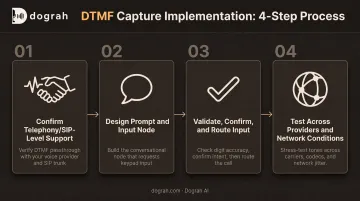
Step 1: Confirm Telephony/SIP-Level DTMF Support
Start by checking whether your voice AI platform's SIP or telephony integration supports out-of-band DTMF events (the telephone-event payload defined in RFC 4733), rather than only detecting tones in raw audio.
RFC 4733, published in December 2006, is the current IETF standard for sending DTMF as a separate signaling event rather than encoded speech, and it formally obsoletes the earlier RFC 2833. That distinction matters because event-based signaling doesn't depend on a codec faithfully reproducing a tone.
Check these early:
- Does your SIP trunk or telephony provider pass through DTMF signaling correctly, or does it strip/convert it somewhere in the path?
- Does your platform negotiate
telephone-eventsupport in the SDP handshake, or silently fall back to audio analysis? - Legacy IVR systems and older trunks sometimes don't support RFC 4733 at all. Confirm this before you build on top of them.
On a self-hostable platform like Dograh AI, this is where a visual workflow builder helps. Rather than writing SIP-handling code by hand, you configure DTMF behavior in the same drag-and-drop node structure as the rest of the call flow, then connect it to your existing Twilio, Vonage, or SIP trunk integration.
Step 2: Design the Prompt and Input Node
Once signaling is confirmed, design what the caller actually hears and how the system decides input is complete.
- Write an unambiguous prompt. "Please enter your 4-digit PIN, followed by the pound key" leaves no room for confusion. Vague prompts drive most abandoned entries.
- Set expected digit length. Configure either a fixed count (4 digits for a PIN) or a min-max range (10-16 digits for a card number).
- Define a termination signal. Use a terminating key (#) or a silence timeout so the system knows when to stop listening.
- Decide on a spoken fallback. Some VoIP apps and older handsets won't generate clean tones, so choose upfront whether spoken digits are accepted.
Step 3: Validate, Confirm, and Route the Captured Input
Never assume captured digits are correct. Read them back: "I heard 4-5-8-2. Is that right?" This single step catches most mis-keyed or misheard entries before they cause problems downstream.
From there:
- Map confirmed input into the correct variable for the next workflow step.
- Route the value to whatever system needs it (CRM, core banking, scheduling database) through a webhook or tool call.
- Build a re-prompt path. If input is invalid or incomplete, re-ask rather than letting the call fail silently or drop.
Step 4: Test Across Real Providers and Network Conditions Before Launch
This is the step teams skip most often, and it's usually where things go wrong. Run end-to-end tests across every telephony provider or SIP trunk used in production. DTMF implementation details differ meaningfully between them.
- Test under degraded network conditions, not just clean local calls. Packet loss and jitter are leading causes of dropped or misread digits.
- Use post-call logs to track DTMF failure rates once live, and adjust timing windows or retry logic based on what you see.
- Treat one provider's success as a starting point, not proof the flow works everywhere.
When to Use DTMF vs Voice Recognition During an AI Call
DTMF isn't the default choice for every input. It depends on how sensitive the data is, how noisy the environment is, and how structured the interaction needs to be.
DTMF works best for:
- PINs, account numbers, and card numbers, where accuracy and security outweigh conversational flow
- Confirmation-style menus ("press 1 for billing, press 2 for support")
- Situations where background noise would make speech recognition unreliable
Voice recognition works better for:
- Open-ended queries or multi-step conversations where forcing a keypad response feels clunky
- Calls from certain mobile or VoIP apps where tones don't transmit reliably
- Interactions where speed and natural flow matter more than exact numeric precision
Security is where DTMF has a real edge. The PCI Security Standards Council notes that call recordings can capture unmasked card data whether it's spoken or entered via keypad, but masking or suppressing DTMF tones can prevent that data from reaching the agent or recording system at all.
Keypad entry, when properly isolated, keeps sensitive digits out of speech-to-text pipelines entirely.
That's also why deployment architecture matters for regulated industries. On a self-hostable platform like Dograh AI, keypad input and call data stay inside your own infrastructure rather than passing through a third party's processing layer — a meaningful difference for banking, insurance, and healthcare teams handling PINs or account numbers under compliance obligations.
Key Technical Factors That Affect DTMF Capture Reliability
DTMF capture looks like simple event detection. Underneath, several variables determine whether it actually works on any given call.
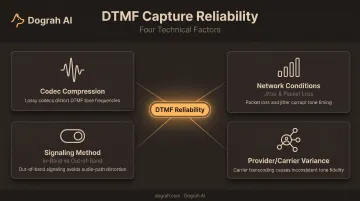
Codec Compression
Voice codecs are optimized for speech, not for preserving the precise dual-tone frequencies DTMF relies on. The IETF itself warns that low-rate codecs can't guarantee accurate tone reproduction, and Telnyx specifically flags G.729 and Opus as capable of degrading or destroying in-band tones.
- G.711, an uncompressed codec, generally preserves tones better on pass-through paths.
- Compressed codecs (G.729, Opus, G.723.1) can distort or drop tones, especially on low-bandwidth connections.
Network Conditions (Jitter & Packet Loss)
DTMF detection needs a clean signal for tens of milliseconds to register correctly. ITU-T Q.24 specifies a minimum operating duration of 40 ms across the administrations it references, with tolerated interruptions of only 10-20 ms. Jitter reorders packets; packet loss removes chunks of the tone outright.
- Garbled or missing digits (most common symptom)
- One keypress misread as a different digit
RFC 4733's event-repetition mechanism helps recovery: a receiver can reconstruct an event from periodic updates, and the final report is sent three times.
Signaling Method (In-Band vs Out-of-Band)
Out-of-band methods (RFC 4733 events, provider APIs, SIP INFO) bypass the audio stream entirely and avoid codec distortion. In-band tone generation depends on the audio path surviving intact, which compressed codecs and lossy networks routinely disrupt.
Platforms relying only on in-band detection see inconsistent results across calls. Hybrid systems that fall back between methods perform noticeably better in practice.
Provider/Carrier Variance
Not every provider implements DTMF signaling the same way:
| Provider | Documented DTMF behavior |
|---|---|
| Twilio Gather | Accepts RFC 2833/4733 only — doesn't detect in-band tones or SIP INFO |
| Telnyx | Supports RFC 2833, SIP INFO, and in-band, configurable per connection |
| Vonage | Sends RFC 4733 events via SIP and Voice API |
A setup that works flawlessly on one provider can silently fail on another. Cross-provider testing is the only reliable way to catch this before launch.
Common Mistakes & Troubleshooting DTMF Capture Issues
Most DTMF failures trace back to a handful of recurring mistakes:
- In-band-only tone detection with no out-of-band fallback fails as soon as a compressed codec or lossy network is involved
- Missing termination key or timeout leaves the system waiting indefinitely, or cuts off a valid multi-digit entry too early
- Skipping cross-provider testing assumes one carrier’s working setup will behave the same on another
When something still breaks in production, these two patterns show up most often.
Problem: caller presses keys, but the AI agent registers nothing.
Likely cause: the platform is listening only for in-band tones on a call where the provider or codec is mangling them. Confirm out-of-band signaling (RFC 4733) is enabled and supported end-to-end.
Problem: digits are captured but wrong (an "11" comes through as a "7").
Likely cause: network jitter or packet loss corrupting tone timing during detection. Review call logs for packet loss, then lengthen the detection window or switch to provider-API-based DTMF instead of raw audio analysis.
Conclusion
DTMF capture is essential for AI voice agents handling PINs, account numbers, and IVR-style menus , but reliability is not automatic. It hinges on signaling method, codec handling, and how fully your provider implements the standard.
Most capture failures share the same root cause: relying on a single method, usually in-band audio, instead of a resilient, provider-aware hybrid approach. Treat out-of-band signaling as the default and in-band tone detection as the fallback, not the plan.
For a reliable setup:
- Prefer out-of-band DTMF (SIP INFO or RFC 2833/4733) whenever the carrier path supports it
- Keep in-band detection only as backup when media is degraded or the provider is limited
- Validate end-to-end across providers, codecs, and the path sensitive digits take after capture
The right implementation balances security, accuracy, and cross-provider reliability. A self-hostable platform such as Dograh AI gives teams control over how DTMF is captured and where that data stays afterward.
Frequently Asked Questions
What is DTMF and why is it used in AI phone calls?
DTMF is the tone signaling generated when someone presses a phone keypad button. AI voice agents use it for PINs, account numbers, and IVR menu navigation where accuracy and security matter more than open conversation.
Can an AI voice agent accept both spoken numbers and keypad input in the same call?
Yes. Hybrid flows that accept either method are common. Letting callers choose whichever input works best for their phone or environment improves completion rates.
Why does DTMF sometimes fail to register during a call?
DTMF usually fails for one of three reasons:
- Codec distortion, especially with compressed codecs like Opus or G.729
- Network jitter or packet loss that corrupts tone timing
- Provider-specific differences in how DTMF signaling is implemented
Is DTMF more secure than voice recognition for sensitive information like PINs?
Yes. DTMF avoids speaking sensitive numbers aloud. When tones are masked or suppressed, that data can stay out of recordings and speech-to-text pipelines, which makes keypad entry preferable for PINs and card numbers.
What telephony standard is used to send DTMF tones reliably?
RFC 4733 (which obsoletes the earlier RFC 2833) defines out-of-band DTMF signaling as a separate event payload rather than encoded audio, making it the preferred standard over in-band tones.
Do all telephony providers support DTMF the same way?
No. Support and implementation details vary: some providers accept only out-of-band events, others allow multiple methods. That variance is why cross-provider testing matters before launch.