The right outbound calling platform won't fix every problem, but it closes the gap between effort and outcome — whether that means cutting dial-to-conversation time, automating post-call logging, or deploying AI agents that run campaigns without a human on every call.
This guide covers both traditional outbound dialers built for human SDRs and AI voice agent platforms — helping you choose based on your call volume, CRM stack, and whether you want to augment reps or automate entire call campaigns.
Key Takeaways
- Outbound calling platforms range from human-operated parallel dialers to AI voice agents. The right fit depends on call volume, workflow, and whether you're scaling people or scaling automation.
- Key features to evaluate: dialing mode, CRM integration depth, call analytics, compliance safeguards, and coaching capability
- Six platforms covered: Nooks, Orum, Kixie, Aircall, and JustCall for human-led dialing — plus Dograh AI for AI voice agents at scale
- AI voice agents are now viable for first-touch outreach and qualification — teams should evaluate both human and AI-led calling options
What Makes an Outbound Calling Platform Right for SDR Teams
An outbound calling platform is software that automates, manages, or augments the process of reaching prospects at scale — whether through human reps dialing lists or AI agents running autonomous campaigns.
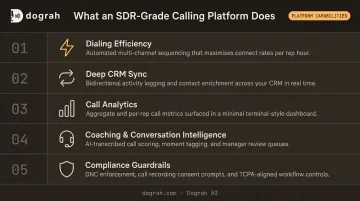
A basic phone tool gets calls out the door. An SDR-grade platform does five things that matter:
- Dialing efficiency — power, parallel, or predictive modes that reduce dead time between conversations
- Deep CRM sync — bidirectional integration that logs outcomes, triggers workflows, and keeps data clean without manual entry
- Call analytics — connect rate, talk time, and conversion metrics at the rep and campaign level
- Coaching or conversation intelligence — whether that's call whisper, post-call scoring, or AI-driven pattern analysis
- Compliance guardrails — DNC list scrubbing, TCPA consent handling, and GDPR controls baked in, not bolted on
The Landscape Is Shifting
Traditional dialers are adding AI features. Gartner predicts 40% of enterprise apps will include task-specific AI agents by end-2026, up from less than 5% in 2025. AI voice agent platforms like Dograh AI now let teams run outbound campaigns without a human SDR on every call — which means the decision isn't just about dialer features anymore. It's about whether the platform can handle AI-generated voice within the bounds of tightening regulation.
A critical compliance note: The FCC's 24-17 ruling (February 2024) classifies AI-generated voices under TCPA restrictions. The FTC requires DNC list scrubbing every 31 days. Any platform you deploy — human-operated or AI-powered — needs controls for these before you scale.
Best Outbound Calling Platforms for SDR Teams
These platforms were selected for SDR workflow fit, dialing performance, integration quality, and ability to scale outbound activity without proportional headcount growth.
Nooks
Nooks is an AI-powered sales platform combining an outbound dialer, prospect prioritization, and call coaching in a single workspace — built specifically for SDR teams that want higher call volume and better conversation quality.
What separates Nooks from standalone dialers is its coaching engine. It analyzes real outbound conversations, surfaces patterns in openers and objection handling, then feeds those insights back into rep practice before the next call block. That feedback loop is what most dialers skip entirely.
| Feature | Detail |
|---|---|
| Key Features | Parallel and power dialing, AI prospect prioritization, in-platform coaching insights, call recording and analytics, virtual salesfloor |
| Best For | SDR and BDR teams that want dialing, prospecting, and coaching unified in one environment |
| Pricing | Quote/demo pricing — no public per-seat rate; contact Nooks directly |
| G2 Rating | 4.8 stars from 1,446 verified reviews |
Smartlead
Smartlead is a multi-channel outbound platform where the power dialer runs as a native step inside the email sequence engine. Unlike standalone dialers that require bridging to a separate email tool, SmartDialer's Phone Call step type sits in the same Sequence Builder as email and LinkedIn steps.
Post-call dispositions branch the sequence forward automatically: a no-answer advances to email follow-up, an interested reply routes to meeting booking. Parallel dialing, voicemail drop, AI call summaries, and SmartCoach real-time coaching are included in the base plan.
The Unified Global Block List covers both email and phone channels, closing the cross-channel TCPA compliance gap that most standalone dialers leave open. Flat monthly pricing (not per seat) makes the economics work significantly better than per-seat dialer alternatives for teams of 10 or more.
| Feature | Detail |
|---|---|
| Key Features | Power dialer with parallel dialing, native PHONE_CALL sequence step, SmartCoach real-time coaching, voicemail drop, AI call summaries, Unified Global Block List, Smart Prospect enrichment |
| Best For | SDR teams running coordinated email plus calling outbound who want both channels in one sequence engine without managing two separate tools |
| Pricing | Flat pricing from $39/month (not per seat); power dialer and parallel dialing included; 14-day free trial, no credit card required |
| G2 Rating | 4.5 stars from 350+ verified reviews |
Orum
Orum is built for speed. Its parallel dialing lets reps dial up to 10 lines simultaneously, with AI that detects live answers and skips voicemails in real time — so reps spend nearly all their calling time in actual conversations rather than waiting for connections.
Orum's own 2023 benchmark across 60 million calls shows a 5.35% average connection rate — a useful baseline when evaluating dialer ROI. The platform supports international calling across 160+ countries and regions.
| Feature | Detail |
|---|---|
| Key Features | AI-assisted parallel dialing (up to 10 lines), live answer detection, voicemail skip, call analytics, Salesfloor |
| Best For | High-volume SDR teams focused on maximizing daily conversation attempts and pipeline velocity |
| Pricing | Launch and Ascend tiers; 3-seat minimum; free trial capped at 500 dials — verify current rates at orum.com |
| G2 Rating | 4.6 stars from 785 verified reviews |

Kixie
Kixie is a CRM-native sales dialer with deep bidirectional integration into HubSpot, Salesforce, and Pipedrive. Reps can launch calls, log outcomes, and trigger follow-up workflows without leaving their CRM — which reduces context-switching and admin overhead.
Its local presence dialing feature displays a local area code to prospects. Whether that lifts answer rates depends on your market and number health — treat it as a testable variable rather than a guaranteed boost.
| Feature | Detail |
|---|---|
| Key Features | Power dialer, local presence dialing, bidirectional CRM sync, SMS outreach, voicemail drop, 7-day free trial |
| Best For | SMB and mid-market SDR teams that operate primarily inside HubSpot or Salesforce |
| Pricing | Professional, Single-Line PowerDialer, and Multi-Line PowerDialer tiers; AI Human Detection add-on $30/month — verify at kixie.com |
| Capterra Rating | 4.7/5 |
Aircall
Aircall is a cloud-based phone platform built for distributed and international SDR teams. Its call whispering and real-time monitoring features stand out for SDR managers — they can coach reps mid-call without the prospect hearing, which accelerates onboarding for new hires.
The platform supports 250+ integrations and includes AI Assist features for call summarization and analysis. Note: Essentials and Professional tiers require a 3-license minimum; Custom requires 25.
| Feature | Detail |
|---|---|
| Key Features | Power dialer, call whisper and barge, warm transfers, call tagging, CRM integrations, global number coverage |
| Best For | Remote or globally distributed SDR teams that need reliable call quality across regions with manager coaching tools |
| Pricing | Essentials, Professional, Custom — Essentials from approximately $30/license; verify current rates at aircall.io |
| G2 Rating | 4.4 stars from 1,582 verified reviews |
JustCall
JustCall combines calling and SMS in the same workflow, letting SDR teams sequence voice calls and text follow-ups from a single interface. Its AI post-call summaries and call scoring reduce manual QA time — a practical gain for managers reviewing rep performance at scale.
The published pricing is among the most transparent in this category, and a 14-day free trial makes evaluation low-friction.
| Feature | Detail |
|---|---|
| Key Features | Power, predictive, and dynamic dialing, SMS + voice sequencing, AI post-call summaries, live call monitoring, 100+ CRM integrations |
| Best For | SDR teams running multi-touch outbound combining calls and SMS, particularly in SaaS and mid-market B2B |
| Pricing | Team $29/user/month, Pro $49, Pro Plus $89 (annually); 14-day free trial |
| G2 Rating | 2,383 reviews on G2 — verify star rating at justcall.io; also listed on Gartner Peer Insights |
Dograh AI
Dograh AI is an open-source, self-hostable Voice AI platform that enables SDR teams to deploy AI calling agents for outbound campaigns — handling cold calls, qualification conversations, and meeting booking autonomously, at a scale no human team can match.
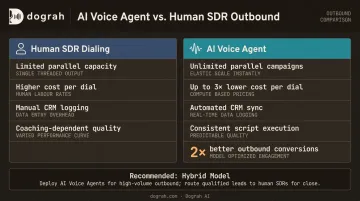
Unlike traditional dialers where every call still requires a human rep, Dograh AI lets teams run parallel outbound campaigns with AI agents that respond to objections, follow scripts dynamically, and hand off warm leads to human reps. Its hybrid pre-recorded + TTS voice model delivers 2× better outbound conversions at up to 3× lower cost than fully synthetic voice. Speech-to-Speech orchestration — using Gemini Flash Live, OpenAI GPT-Realtime-2, and other S2S models — halves end-to-end call latency, targeting under 600ms consistently.
Built by Y Combinator alumni, Dograh AI emerged from direct builder frustration: the founders needed a voice agent for the visa industry and hit a dead end with frameworks that required heavy custom code and closed platforms that carried real data risk. The result is the open-source alternative to Vapi and Retell.
Key differentiators for SDR teams:
- Full data sovereignty — self-hosted under BSD 2-Clause license, or deployed as a fully managed private cloud within your own infrastructure
- 70+ language support for global SDR teams
- MCP support — build, configure, and iterate voice agents directly from Claude Code, OpenCode, or any agent platform
- Post-call analysis — call playback, transcripts, outcome tracking, and disposition codes written back to CRM
- Automated CRM sync — native integrations with Salesforce, HubSpot, and Zendesk; call logs, outcomes, and notes sync automatically
- Fast setup — go from zero to a working voice bot in under 2 minutes via the drag-and-drop workflow builder
| Feature | Detail |
|---|---|
| Key Features | AI voice agents for outbound, hybrid pre-recorded + TTS voice, Speech-to-Speech orchestration, self-hosted or cloud deployment, MCP support, 70+ languages, automated post-call analysis |
| Best For | SDR teams and growth-stage companies that want to scale outbound calling without scaling headcount, and enterprises requiring full data sovereignty |
| Pricing | Open-source (free, self-hostable under BSD 2-Clause license); cloud and fully managed private cloud plans available — verify current pricing at dograh.com |
How We Chose These Platforms
Platforms were assessed across five dimensions:
- Dialing performance — connect rate optimization, parallel dialing capability, answer detection accuracy
- CRM and sales tool integration — bidirectional sync quality, workflow trigger support, data hygiene
- Coaching and analytics depth — whether the platform helps reps improve, not just dial faster
- Compliance and data handling — DNC controls, consent management, GDPR/TCPA posture
- Scalability — can the platform grow with team size and outreach volume without linear cost increases?
The most common mistake teams make: optimizing for raw dial speed while ignoring conversation quality, CRM data hygiene, and workflow fit. High activity numbers with stagnant pipeline outcomes are exactly what happens when a team picks a dialer based on speed alone.
Both human-operated dialers and AI voice agent platforms are covered here, because modern SDR teams need to evaluate both categories. AI agents are a practical option for first-touch outreach and qualification right now — not a future consideration.
Conclusion
There's no single best platform here. The right choice depends on what you're actually trying to fix:
- Maximize human rep productivity → Nooks, Orum, Kixie
- Support distributed or remote teams → Aircall, JustCall
- Scale outbound without scaling headcount → Dograh AI
Evaluate against your CRM stack, compliance requirements, team size, and whether you're optimizing for call volume, conversation quality, or both. Trial before committing — onboarding friction and rep adoption matter as much as feature depth.
For teams in data-sensitive industries or GDPR regions who want to run AI-powered outbound without handing call data to a closed vendor, Dograh AI's open-source platform is worth a close look. You can review the codebase on GitHub or book a demo with the founders to see how AI voice agents perform on live outbound campaigns.
Frequently Asked Questions
What is the best option for tracking outbound calls?
Look for platforms with native CRM sync, automatic call outcome logging, and analytics dashboards that surface connect rates, talk time, and conversion metrics at the rep and campaign level. Nooks, JustCall, and Aircall all include these natively — the key is whether the data writes back to your CRM without manual cleanup.
How do you make successful outbound calls?
The first 15 seconds determine most calls. Lead with relevance, handle interruptions without losing the thread, and match the prospect's pacing rather than running a scripted monologue. Pairing calls with timely SMS or email follow-up improves response rates, and AI coaching tools surface patterns that help reps improve faster than standard call reviews.
Which CRM is best for call centers?
Salesforce and HubSpot are the most widely deployed CRMs for outbound teams — both carry 4.4 stars on Gartner Peer Insights, with Salesforce drawing from a larger review pool. Integration depth matters more than brand — most tools in this guide offer native sync with both.
What voice AI works best for outbound sales calls?
Purpose-built platforms outperform generic voice AI — look for sub-second response latency, natural-sounding hybrid voice, objection handling, and clean CRM handoff for warm leads. Dograh AI's hybrid pre-recorded + TTS model and Speech-to-Speech orchestration target under 600ms latency for exactly this use case.
What is the difference between a power dialer and a parallel dialer?
A power dialer dials one number at a time sequentially — reps finish a call, it immediately dials the next. A parallel dialer calls multiple numbers simultaneously and connects the rep only when a live person answers, maximizing conversation volume. Orum supports up to 10 parallel lines. The tradeoff: parallel dialing increases volume but reduces per-call preparation time.
Can AI voice agents replace SDR cold calling entirely?
Not entirely — not yet for complex deals. AI agents handle first-touch cold calls, qualification, and meeting booking at scale, but multi-stakeholder enterprise deals still benefit from human involvement where relationship and judgment matter. The most effective model pairs AI for high-volume first-touch outreach with human SDRs on warm handoffs.