That's not an exaggeration. A 2019 Vonage survey of 2,010 US adults found 51% had abandoned a business after hitting a frustrating phone menu, costing companies an estimated $262 per lost customer per year. Worse, 89% of that abandoned spending went straight to a competitor.
Here's the confusion, though: "IVR bot" and "voice bot" get thrown around like synonyms. They're not. One follows a fixed script. The other holds an actual conversation.
This article breaks down what each technology really is, where they differ, and how to figure out which one — or which combination — fits your business.
Key Takeaways
- Traditional IVR is rule-based with no AI; voice bots hold real conversations via speech recognition and language models.
- 61% of callers rate traditional IVR menus a poor experience (Vonage, 2019).
- IVR wins on cost and simplicity; voice bots win on volume, multilingual support, and complex or revenue-driving calls.
- Most businesses land on a hybrid setup, not an all-or-nothing choice.
- Data-sensitive industries benefit most from open-source, self-hostable voice bot platforms.
What Is an IVR Bot?
An IVR (interactive voice response) bot is an automated phone system that plays pre-recorded prompts and lets callers navigate using keypad presses (DTMF tones) or basic voice commands. Think "press 1 for billing, press 2 for support."
The flow is almost always the same:
- Greeting — a scripted welcome message plays.
- Menu options — the system lists choices ("For sales, press 1...").
- Caller selection — the caller presses a key or says a short phrase.
- Routing or queuing — the call moves to a department, a self-service task, or an agent queue.
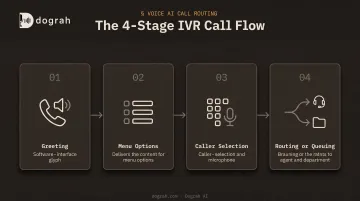
Every branch is predetermined. There's no free-form conversation, just a fixed decision tree the caller has to follow.
Is an IVR Bot Actually AI?
No, not in the traditional sense. Twilio's own definition describes IVR as an automated telephony system that maps keypresses or recognized responses to predefined prompts. That's deterministic logic, not machine learning.
Modern conversational IVR muddies this a bit. It bolts basic speech recognition or NLU onto the same menu structure, so callers can say "billing" instead of pressing 2. But the underlying system still walks a scripted tree—it just recognizes speech instead of key tones.
Common IVR use cases:
- After-hours call routing
- Appointment reminder confirmations
- Bill payment lines
- Simple triage before agent handoff
The catch: Vonage research found 61% of callers rate IVR a poor experience, and 47% specifically cite frustration. The top complaints:
- Menus that never ask why the caller called (65%)
- Irrelevant options (63%)
- Menus that block access to a human (54%)
What Is a Voice Bot?
A voice bot is an AI-powered conversational agent. It uses speech-to-text, natural language understanding, and text-to-speech to hold open-ended, human-like conversations. No fixed menu tree required.
The technical pipeline works like this:
- Caller speech gets transcribed in real time
- An LLM or NLU engine interprets intent and drafts a response
- Speech synthesis converts that response back into natural-sounding voice
- Function calls fire in the background: checking order status, booking an appointment, pulling account data
The core advantage over IVR: callers say what they need in their own words. No menu-hunting. In a SINTEF-observed test covered by Boost.ai, all ten bank customers preferred the voice bot over the IVR menu. Opinions were more split when compared against a human agent.
The Shift Toward Speech-to-Speech
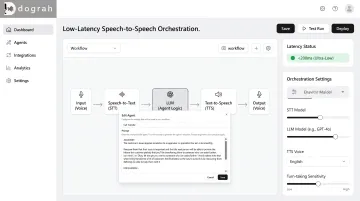
Older voice bot architectures had to transcribe speech to text, run it through an LLM, then synthesize a reply. That is three separate steps, each adding delay. Newer Speech-to-Speech (S2S) orchestration skips the transcription step entirely and works more directly on audio in and audio out.
Dograh AI ships full-stack S2S orchestration with models like Gemini Flash Live and GPT-Realtime, roughly halving end-to-end latency so conversation feels more natural. The same open-source builder can stand up a testable voice bot in under two minutes.
Common voice bot use cases:
- 24/7 inbound support
- Outbound appointment reminders and collections calls
- Lead qualification
- CRM-connected order tracking
The limitations are real, though. Voice bots need quality training and ongoing prompt tuning. Heavy accents, background noise, and ambiguous intent can still trip them up. One documented deployment struggled with a British accent until the team swapped in a better-suited speech recognition model.
IVR Bot vs Voice Bot: Key Differences
Here's how the two stack up side by side:
| Factor | IVR Bot | Voice Bot |
|---|---|---|
| Technology | Rule-based menus, DTMF/keyword matching | AI/NLP-driven conversation |
| Interaction Style | Linear, scripted decision tree | Natural, non-linear language |
| Setup Time & Cost | Fast and low-cost | Higher upfront, more configuration |
| Personalization | Generic, same for every caller | CRM-personalized, dynamic per caller |
| Human Handoff | Fixed transfer rules | Context-aware, triggered by confidence or complexity |
Conversational IVR sits in between. It adds an NLU layer to the same menu system so callers can speak their request instead of pressing keys, without becoming a fully open-ended AI agent.
In a SINTEF-linked bank study, callers preferred the voice bot over IVR almost unanimously, while willingness to skip a human agent was more mixed. Voice bots win by beating rigid menus, not by replacing skilled agents.
The practical rule: IVR excels at predictable, low-complexity routing. Voice bots excel at high-volume, multilingual, or higher-value conversations where the caller's need doesn't fit neatly into "press 1 or 2."
Neither is built to replace human agents outright. Both filter and resolve simpler queries so people can focus on the complex ones.
Pros and Cons: Which Wins for Customer Experience?
IVR Bot
Pros:
- Fast to deploy, low maintenance
- Predictable, auditable call paths
- Works without internet or an app
Cons:
- Rigid menus frustrate callers with non-standard requests
- Poor handling of edge cases or urgent issues
Voice Bot
Pros:
- Natural conversation, no menus to memorize
- Handles high volume and multiple languages simultaneously
- Available 24/7, reduces tier-1 agent workload
Cons:
- Higher setup investment
- Occasional misunderstanding on unclear speech
- Needs ongoing tuning as call patterns shift
Simple routing favors IVR. Complex or revenue-driving conversations favor voice bots, or a hybrid of both: IVR handles the basics, and a voice bot (or human) takes anything more nuanced.
How to Choose Between IVR and Voice Bot for Your Business
Choose IVR if you're budget-conscious with simple needs:
- Office-hours and location info
- Basic department routing
- Payment status lookups with no follow-up questions
Choose a voice bot if you handle:
- High call volumes that spike unpredictably
- Multilingual or accented callers
- Outbound campaigns where conversion rate matters
When those needs show up, platforms like Dograh AI let teams go from testing to a working voice bot in minutes without an in-house AI engineering team. Support for 70+ languages and accents out of the box helps if your customer base isn't monolingual.
For data-sensitive industries (healthcare, finance, legal, government), the deployment model matters as much as the AI itself. An open-source, self-hostable voice bot platform keeps call data inside your own infrastructure instead of routing it through a closed vendor.
Fewer third parties touching PII means less dependence on a vendor's HIPAA, GDPR, or SOC 2 certifications, and often faster procurement with one less compliance review to run.
How Much Does an IVR Bot or Voice Bot Cost?
IVR costs are lower and more predictable, since you're paying for telephony minutes and setup, not AI processing.
Published rates give a sense of scale: Twilio charges roughly $0.0085 per minute to receive calls plus $0.0025 per workflow execution, while Plivo's US voice rates run about $0.0115 per minute with numbers around $0.50 per month.
Voice bot pricing is less predictable because it depends on call volume and which speech-to-text, language model, and text-to-speech providers you choose. Published AI voice platform rates range from roughly $0.05 to $0.31 per minute, often with concurrency limits and add-on fees for features like guardrails or QA.
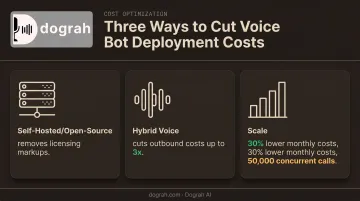
A few things move the needle on total cost:
- Open-source, self-hosted platforms remove licensing markups so you pay only for telephony, STT, TTS, and LLM usage
- Hybrid voice (pre-recorded human clips plus TTS fallback in the same cloned voice) can cut outbound voice AI costs up to 3x and lift conversions, per Dograh AI product data
- Scale changes the math: Computer Weekly reported one deployment cut monthly service costs by roughly 30% and handled 50,000 concurrent callers in a surge no IVR-only setup could match
The right comparison isn't headline per-minute price. It's total cost per resolved call, including how many calls each system actually closes without a human.
Frequently Asked Questions
What is an IVR bot?
An IVR bot is a rule-based automated phone system that routes calls using pre-recorded menus and keypad presses or basic voice input. It follows a fixed decision tree rather than open-ended conversation.
Is an IVR bot considered AI?
Traditional IVR is scripted logic that matches keys or keywords to preset branches, not AI. Modern conversational IVR variants add limited speech recognition, but the underlying menu structure stays fixed.
How much does an IVR bot cost?
IVR costs are lower and mostly setup-based, covering telephony minutes and workflow execution fees. See the cost section above for specific provider pricing ranges.
Can a voice bot replace an IVR system entirely?
Voice bots can replace most IVR functions, handling free-form requests that IVR menus can't. Many businesses still keep a lightweight IVR layer for the simplest, highest-volume routing tasks alongside it.
What's the difference between a voice bot and a chatbot?
A voice bot operates over phone calls using speech input and output. A chatbot operates via text, typically in a website chat window or messaging app, with no voice component involved.
Do voice bots work with existing CRM and telephony systems?
Yes. Modern voice bots integrate with CRMs like Salesforce and HubSpot, plus telephony providers like Twilio, to personalize calls with caller data and automatically log outcomes after each interaction.