This matters most for engineering teams building production voice agents: support lines, outbound sales dialers, scheduling bots, healthcare intake systems. In a chat interface, a slow response is an annoyance. In a phone call, it's dead air the caller hears within a second.
"Add a fallback model" shows up on a lot of architecture diagrams as a single checkbox. In practice, it's one of the least understood pieces of voice infrastructure. The hard part isn't keeping something responding — it's keeping the conversation behaving the same way it did before the switch.
This article breaks down how multi-provider failover actually works, what makes it reliable in production, and when it's genuinely worth building versus when it's premature.
Key Takeaways
- Voice failover must preserve latency SLAs and conversational behavior, not just uptime
- Pair a per-task model router with a provider congestion controller to prevent oscillation
- Mid-stream model switches without a safety rule are the top cause of failovers that still ruin calls
- Benchmark fallback models on latency and instruction-following before go-live, not during incidents
- Open-source platforms expose routing logic that closed platforms hide as a black box
What Is Multi-Provider LLM Failover for Voice Agents?
Multi-provider LLM failover keeps a voice agent's LLM inference running across multiple providers or deployments when the primary path gets disrupted. That can mean OpenAI direct versus Azure-hosted OpenAI, or a primary model backed by a secondary model.
The goal is zero dead air and maintained tool-calling accuracy through an infrastructure hiccup the caller never perceives.
That differs from two things it often gets confused with:
- Load balancing distributes traffic across providers for cost or throughput under normal conditions. It's optimizing, not reacting.
- Simple API retries resend the same request to the same endpoint. They don't help when a provider is rate-limiting you or has a regional capacity problem; you'll just get another 429.
Failover triggers specifically on degradation. It's reactive by design, and it needs a different provider or model path to actually resolve the problem, not just a second attempt at the same one.
Why Voice Agents Need Multi-Provider LLM Failover
Voice is synchronous in a way chat simply isn't. A chat user tolerates a few seconds of typing indicator. A phone caller hears silence, and silence reads as broken.
Human conversation itself runs on a tight clock. Natural turn-taking gaps have a median around 100 milliseconds across languages.
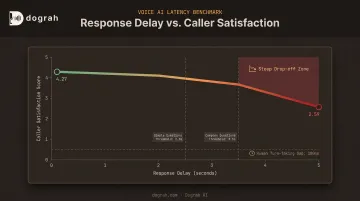
Controlled testing on spoken-agent delay found that satisfaction holds up until roughly 2.5 seconds for simple questions and 3.5 seconds for complex ones, then drops sharply. A 2025 Oregon State University study on response delay and perceived naturalness measured scores falling from 4.27 at zero delay to 2.59 at five seconds. Cross that line and callers disengage.
A voice agent needs two things at once: consistent sub-second responses and accurate tool calling for CRM updates, appointment booking, and payment lookups. A single provider hiccup can stall a turn and derail the whole call flow mid-transaction.
What goes wrong without it
Without failover, teams see:
- Dropped calls when a provider returns hard errors mid-conversation
- Silent hallucinations when a provider quietly degrades without throwing an error at all
- Lost revenue on outbound campaigns that stall at scale during peak dialing hours
Provider incidents aren't hypothetical, either. OpenAI's own March 2025 incident write-up describes an internal state error that triggered incorrect rate-limiting protections, spiking 429 responses across customers who'd done nothing wrong on their end.
Common real-world triggers
- Rate-limit errors during high-volume outbound campaigns
- Regional capacity constraints during peak hours
- Concurrency caps tied to a single API key
- Providers quietly changing inference stacks or model weights without renaming the model
Multi-model, multi-provider serving is baseline architecture for enterprise-grade voice agents — not a bolt-on after launch.
How Multi-Provider LLM Failover Works (Conceptual Flow)
Two decision layers run continuously in parallel:
- A task-level model router picks the preferred model per inference task, based on a defined priority order and live health signals.
- A provider-level selector manages traffic and admission for whichever provider is currently serving that model.
Each layer needs its own inputs. The router needs an ordered list of models per task. A "generate response" task might use a different fallback chain than a "call the CRM tool" task, since not every fallback model supports the same function-calling schema.
The provider layer needs real-time latency and error-rate telemetry to tell when a provider is actually struggling versus one slow request.
When the primary model shows strain, the router doesn't switch blindly. It checks whether a switch is even safe right now: does the alternate model support the required tool schema, and has a response already started streaming to the caller? Switching after audio has begun playing is riskier than switching before the turn starts.
Controlling how much traffic moves matters just as much as deciding whether to move it. An additive-increase/multiplicative-decrease (AIMD) approach uses the same congestion-control logic that underpins TCP networking, formalized in RFC 4341.
A provider's traffic allowance shrinks sharply on rate-limiting and grows back gradually on success. That keeps two constrained providers from oscillating traffic back and forth every few seconds.
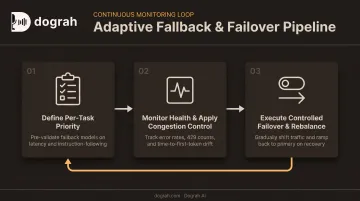
Step 1: Define per-task model priority and pre-validate fallback candidates
Each inference task — greeting, tool call, response generation — should carry its own ordered fallback list. Every candidate model on that list needs latency and instruction-following benchmarks before it's trusted, not added reactively while an incident is already in progress.
Step 2: Monitor provider health and apply congestion control in real time
Health signals — error rates, 429 counts, time-to-first-token drift — feed the admission controller continuously. Gradual traffic shifting means the backup provider doesn't get slammed with 100% of load the instant the primary shows the first sign of strain.
Step 3: Execute controlled failover and rebalance as providers recover
Recovery should ramp traffic back to the primary gradually rather than flipping an instant full switch-back. A sudden full return can re-trigger the exact instability that caused the failover in the first place.
Key Factors That Determine Failover Reliability
Getting the conceptual flow right is one thing. Making it hold up under real call volume depends on a handful of specifics teams frequently skip.
Six factors decide whether failover stays reliable in production:
- Model behavioral consistency across providers
- Task-specific fallback design
- Streaming and mid-response constraints
- Provider and API key diversity
- Latency budget parity
- Observability after the switch
Model behavioral consistency across providers. The same model name served through different infrastructure (OpenAI direct versus a cloud-hosted deployment) can differ in both latency and subtle output behavior. Parity should be tested, never assumed.
Task-specific fallback design. Classification, tool-calling, and response-generation tasks often need different fallback chains. One blanket "backup model" for the entire system breaks down the first time a fallback handles tool calls differently than the primary.
Streaming and mid-response constraints. Switching models after a response has already started streaming can create a jarring tone break mid-sentence. Failover logic needs an explicit rule: switching is safe before a turn starts, risky once audio is already playing.
Provider and API key diversity. Relying on a single API key can create concurrency bottlenecks even when multiple providers are technically configured.
Platform architecture matters here. Dograh AI's open-source voice AI platform supports rotating API keys across LLM, STT, and TTS providers to work around per-key concurrency limits. Teams can also plug in locally hosted models like Llama and Voxtral as an extra fallback tier, cutting dependency on any single cloud vendor.
Latency budget parity. A fallback model has to hit roughly the same response-time target as the primary, or the failover mechanism becomes the delay problem it was supposed to solve.
Time-to-first-token is often the deciding factor. Cresta's engineering guidance on voice agent latency puts TTFT anywhere from roughly 250 milliseconds for smaller local models to over a second for larger third-party ones. A model that scores well on a general leaderboard can still be too slow for a live call.
Observability requirements. Failover events, provider health history, and post-switch conversation quality all need logging and review. A fallback model can degrade call outcomes for weeks without throwing a hard error. The only way to catch that is by watching what happens after the switch, not just whether the switch succeeded.
Common Pitfalls, Misconceptions, and When Failover May Not Be Necessary
A handful of misconceptions and setup mistakes cause most of the failover failures teams actually hit in production.
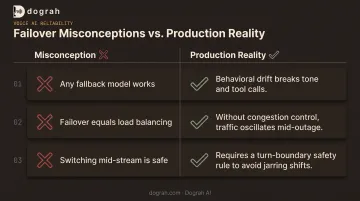
"Any fallback model is good enough." It isn't. Behavioral drift in tone, formatting, or tool-call structure is a common reason calls degrade after a technically successful switch. The session stays up, but the agent no longer sounds or acts the same.
"Failover is the same as load balancing." Conflating cost-based routing with reliability-based routing, without congestion control on top, is what sends traffic oscillating between two providers mid-outage.
Switching mid-stream without a safety rule. This is less a belief problem than an implementation one. Without a boundary (turn end, tool boundary, or similar), callers hear a tone or personality shift mid-sentence — one of the more jarring modes, because the call technically kept running.
Failover also isn't always the right investment yet. Skip it for now if you're dealing with:
- Low-volume prototypes still validating product-market fit
- Internal tools where a dropped call has no business cost
- Workloads already covered by a single provider's enterprise SLA and dedicated capacity
The over-engineering signal to watch for: investing in complex multi-provider routing before you've validated basic latency and reliability on your primary stack. Start simple. Add failover complexity once call volume or business criticality actually justifies the engineering cost.
Frequently Asked Questions
What's the difference between LLM failover and load balancing for voice agents?
Load balancing distributes traffic for cost or throughput under normal conditions. Failover activates specifically when a provider degrades. Voice agents typically need both working together, without one causing the other to oscillate.
Which LLM providers should be included in a fallback chain?
Include at least one alternate hosting path for the same model, plus a benchmarked backup model. Choose based on matching latency and instruction-following performance to your primary, not just whichever provider has availability.
Does switching to a fallback model mid-call affect conversation quality?
It can, especially mid-stream. Failover logic should avoid switching once a response has started unless the primary connection has fully failed, since a mid-sentence switch is far more noticeable than one between turns.
How much extra latency does multi-provider failover add to a voice agent?
Well-designed failover adds negligible latency on the healthy path. It only affects the specific turn during which a switch occurs, provided health checks and admission control run continuously rather than reacting after the fact.
How do I test whether a fallback model is production-ready for voice?
Run candidates through multi-turn, tool-calling, and latency benchmarks that mirror your actual call flows, not just general-purpose LLM leaderboards, which don't measure time-to-first-token under real conversational load.
Can I build multi-provider LLM failover on an open-source voice AI platform?
Yes. Self-hostable platforms like Dograh AI expose full routing and provider configuration, including bring-your-own-key setups across LLM, STT, and TTS and support for locally hosted models. Closed platforms typically don't offer that level of visibility.