Many teams starting out don't realize this decision determines more than syntax preference. It decides how much infrastructure you own, how fast you ship a working prototype, and how much branching logic your conversation can support before you hit a wall.
This article compares Pipecat and LiveKit Agents across architecture, transport handling, licensing, and real use cases, then looks at what neither framework solves once you actually reach production: latency, memory, and observability.
Key Takeaways
- Pipecat: Python conversation orchestration that runs on Daily, WebSockets, Twilio, or LiveKit
- LiveKit Agents: WebRTC media platform plus a native runtime built on Rooms and Participants
- Control and provider swapping favor Pipecat; global scale and speed-to-ship favor LiveKit
- Both are free and open-source—neither ships end-to-end latency, long-term memory, or observability alone
- Choose by transport ownership, conversation complexity, and how much infra you want to run
Pipecat vs LiveKit Agents: Quick Comparison
Before going deep, here's how the two frameworks stack up on the dimensions that actually affect a build:
| Dimension | Pipecat | LiveKit Agents |
|---|---|---|
| Mental model | Pipeline of composable "Frame" processors handling audio, text, and control signals | Rooms and Participants model — the agent joins as a headless participant reacting to events |
| Transport | Transport-agnostic: Daily, WebSockets, Twilio, or LiveKit's audio-only mode | Native WebRTC SFU with built-in NAT traversal, jitter buffering, and SIP telephony |
| Flow control | High control: parallel processing, one-line provider swaps | More opinionated: built-in workflows, task groups, multi-agent handoffs |
| License | BSD 2-Clause, Python-only | Apache 2.0, Python and Node.js SDKs |
| Ecosystem | Larger catalog of pre-built AI service integrations | Stronger native multi-language and global infra support |
Mental model: pipelines vs. rooms
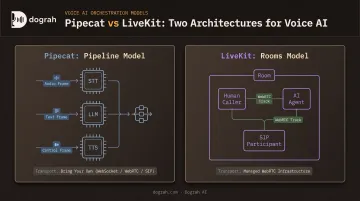
Pipecat treats audio, transcribed text, and control signals as Frames flowing through a pipeline of processors. Each processor can transform, forward, or discard a frame, and several can run on the same frame in parallel.
That's why a Pipecat pipeline can transcribe, run sentiment analysis, and generate a response simultaneously without one step blocking the next.
LiveKit flips that model. Instead of a pipeline, you get a Room populated with Participants. The agent is just another participant, one that happens to be headless and reacts to events like a track being subscribed or a caller connecting.
Transport and flow control
Pipecat doesn't care what carries the audio. Swap Daily for Twilio or a raw WebSocket, and the pipeline logic doesn't change. LiveKit owns the transport outright: a Go-based WebRTC SFU handling NAT traversal, jitter buffers, and codec negotiation, plus SIP trunking for phone connectivity.
That ownership cuts both ways. Pipecat gives granular control and parallel task execution at the cost of assembling your own transport stack. LiveKit gives a maintained, opinionated stack with built-in multi-agent handoffs, but you trade some branching flexibility for that convenience.
What is Pipecat?
Pipecat is Daily's open-source Python framework for orchestrating AI services, transports, and audio processing into a single pipeline. Rather than hard-wiring a call flow, you compose a Pipeline from processors, each handling a discrete job: speech-to-text, LLM inference, text-to-speech, or a custom function.
Data moves through that pipeline as Frames, typed containers carrying audio chunks, transcribed text, or control signals. A processor inspects a frame, does its work, and pushes a new frame downstream. Because processors can run in parallel, a call can be transcribed, sentiment-scored, and responded to at the same time, which cuts the response latency callers actually notice.
Pipecat's transport-agnostic design means the same pipeline logic runs on Daily, raw WebSockets, Twilio, or LiveKit's audio-only mode. Switching providers, say, from Deepgram to Cartesia for TTS, is typically a one-line change since every integration follows the same processor interface.
Pipecat Flows for deterministic conversations
For conversations that need a predictable path—structured intake forms or qualification scripts—Pipecat Flows adds a graph layer on top of the base pipeline. Flows defines conversation nodes, manages context and tool availability as state, and transitions between nodes by rewriting what the LLM can see and call next.
Where Pipecat fits best
Pipecat makes sense for teams that:
- Already own a transport layer (Daily, Twilio, or a custom WebSocket setup) and don't want to adopt a new one
- Need branching, multi-step conversation logic a linear script can't express
- Want parallel AI tasks, like live sentiment analysis during outbound sales calls, without blocking the response
- Deploy on constrained environments like edge or IoT devices, where every dependency matters
Real examples back this up. NVIDIA uses Pipecat to build digital humans, Superdial automates healthcare phone calls with it, and Tavus uses it for human-AI video interaction. On GitHub, Pipecat has crossed 14,200 stars with over 300 contributors.
What is LiveKit Agents?
LiveKit is an open-source, Go-based real-time media platform, a WebRTC Selective Forwarding Unit, with a built-in Agents framework layered on top. Instead of assembling your own transport, you get a Room: a virtual space where human callers, AI agents, SIP participants, and services connect as Participants publishing and subscribing to audio and video Tracks.
An agent in this model is a Python or Node.js program that joins a Room as a full participant. LiveKit's agent server handles job dispatch, spinning up a subprocess that connects the moment a call starts.
Why native integration matters
Because the media server and agent framework come from the same vendor, timing and synchronization issues that plague bolted-together stacks mostly disappear. Audio arrives, gets routed, and reaches the agent through one integrated path. LiveKit's edge network also routes calls to the nearest region automatically, which matters once you're running high-concurrency deployments across continents.
SDKs, turn detection, and SIP
- Language support: Python and Node.js agent SDKs, unlike Pipecat's Python-only approach
- Turn detection: an open-weight, CPU-optimized model bundled directly into the SDK, alongside a hosted version evaluated across 14 languages
- Telephony: native SIP trunking, inbound and outbound, connects an agent to a phone number with no additional code
Where LiveKit Agents fits best
LiveKit earns its keep when the product needs stable, multi-user, high-concurrency calls at global scale. Think telecom platforms, telehealth visits, or financial infrastructure where thousands of concurrent sessions can't afford to wobble.
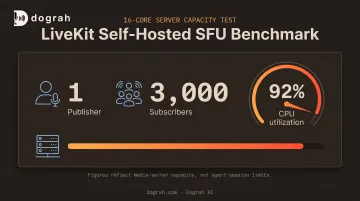
LiveKit's own benchmark on a single 16-core server shows the SFU handling a livestream scenario with 1 publisher and 3,000 subscribers at 92% CPU. Those numbers describe media-server capacity rather than agent-session limits, but they still show why teams reach for LiveKit when raw concurrency is the bottleneck.
LiveKit also states that OpenAI uses it to deliver voice to millions of ChatGPT users, a clear public proof point for real-world scale.
Pipecat vs LiveKit: Which Should You Build On?
The decision comes down to three questions: who owns your transport layer, how much custom branching your conversation logic needs, and how much infrastructure your team wants to manage.
Choose Pipecat if
- You already run Daily, Twilio, or a custom WebSocket transport and don't want to migrate
- Your conversation logic needs deep branching, parallel AI tasks, or frequent provider swaps
- Your team is comfortable owning more of the stack in exchange for control
Choose LiveKit if
- Speed-to-production and global call stability matter more than granular control
- You need native multi-participant rooms, not just single-caller voice bots
- You'd rather lean on managed Cloud infrastructure than run your own servers
The production ceiling
Neither framework fully solves what happens after launch. Pipecat and LiveKit both handle transport and orchestration well, but engineering teams are still left to build, on their own:
- End-to-end latency tuning across STT, LLM, and TTS calls
- Long-term memory and state management across sessions
- Cost and quality observability once call volume climbs
Those gaps show up as soon as a prototype takes real call volume.
Pipecat and LiveKit also aren't mutually exclusive. Some teams run Pipecat's pipeline logic directly on top of LiveKit's transport using its audio-only mode, combining LiveKit's media infrastructure with Pipecat's orchestration flexibility.
There's a third path, too. Open-source platforms like Dograh AI add a visual workflow layer so teams aren't hand-coding orchestration from scratch.
You can self-host the OSS stack, use managed cloud, or run a fully managed private cloud in your own environment—then focus on latency, memory, and observability instead of rebuilding the agent layer.
Real-World Example: Why Builders Outgrow Both Frameworks
Dograh AI's founding story is a useful data point. Its founders lived this exact tradeoff before building a solution.
Pritesh Kumar and Abhishek Kumar were originally building a voice agent for the visa industry. They tried the two paths most teams try first:
- Code-first frameworks like LiveKit and Pipecat: heavy custom code for sessions, state management, variable extraction, and turn detection made iteration slow
- Closed platforms like Vapi and Retell: convenient, but they restricted customization, limited LLM and voice-activity-detection choices, and routed sensitive applicant data through another vendor
Neither option worked for a regulated, data-sensitive use case.
Instead of patching around framework limits, they built a self-hostable visual workflow layer on the same transport and orchestration problems Pipecat and LiveKit solve—without hand-coding every conversation path.
What that unlocked
Those results became core product milestones, not one-off fixes:
- Speech-to-Speech orchestration with Gemini Flash Live and OpenAI's GPT-Realtime-2 roughly halved end-to-end latency versus a conventional STT-LLM-TTS pipeline
- Hybrid pre-recorded + TTS blends real human voice clips with synthesized fallback in the same cloned voice, cutting costs up to 3x and driving 2x better outbound conversions
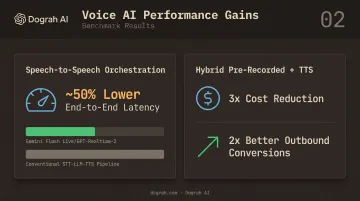
Both outcomes map directly to the production-ceiling gaps above: latency and cost/quality observability that Pipecat and LiveKit leave for engineering teams to solve on their own.
If your team keeps rebuilding the same latency, state, or observability layer on top of Pipecat or LiveKit, that is usually the signal. Evaluate an open-source workflow platform like Dograh AI instead of custom-coding that layer yourself.
Conclusion
Neither Pipecat nor LiveKit Agents wins in every setup — the right choice depends on your constraints. Pick Pipecat when you need architectural control, parallel processing, and provider flexibility, and you're willing to own more of the infrastructure. Pick LiveKit when global call stability, native multi-participant rooms, and speed-to-ship matter more than granular branching control.
Both choices carry the same downstream reality: latency tuning, state management, and observability remain your team's responsibility once real users show up. That's not a flaw in either framework; it's simply outside their scope.
Whichever you choose, treat it as a starting point rather than a final architecture. Some production stacks combine these frameworks; others replace the orchestration layer with a platform that covers the gaps they leave open. Dograh AI sits in that second path — an open-source, self-hostable voice layer aimed at the latency, state, and ops work your team still owns after the framework choice.
Frequently Asked Questions
Does LiveKit use WebRTC?
Yes. LiveKit is built as a WebRTC-native SFU that handles NAT traversal, jitter buffering, and codec negotiation natively — a core reason teams pick it for low-latency global voice and video.
What's the main difference between Pipecat and LiveKit?
Pipecat is a pipeline-based orchestration framework focused on conversation logic. LiveKit is a Rooms-based media platform with its own built-in agent framework layered on top.
Can I use Pipecat and LiveKit together?
Yes. Pipecat's LiveKit transport lets its pipeline logic run on top of LiveKit's audio-only mode, combining LiveKit's media infrastructure with Pipecat's orchestration.
Which framework is better for connecting voice agents to phone numbers via SIP?
LiveKit has native SIP trunking built in for inbound and outbound calls. Pipecat relies on transports like Twilio for telephony, so telephony takes more manual setup.
Is Pipecat or LiveKit better for a team without a dedicated DevOps team?
LiveKit's managed Cloud and integrated stack reduce infrastructure work considerably. Pipecat needs more hands-on server and transport management, so teams without DevOps usually prefer LiveKit or another managed platform.
Do Pipecat and LiveKit support multiple LLM, STT, and TTS providers?
Both support swapping providers like OpenAI, Deepgram, and Cartesia. Pipecat generally offers simpler one-line provider swaps thanks to its modular processor design.