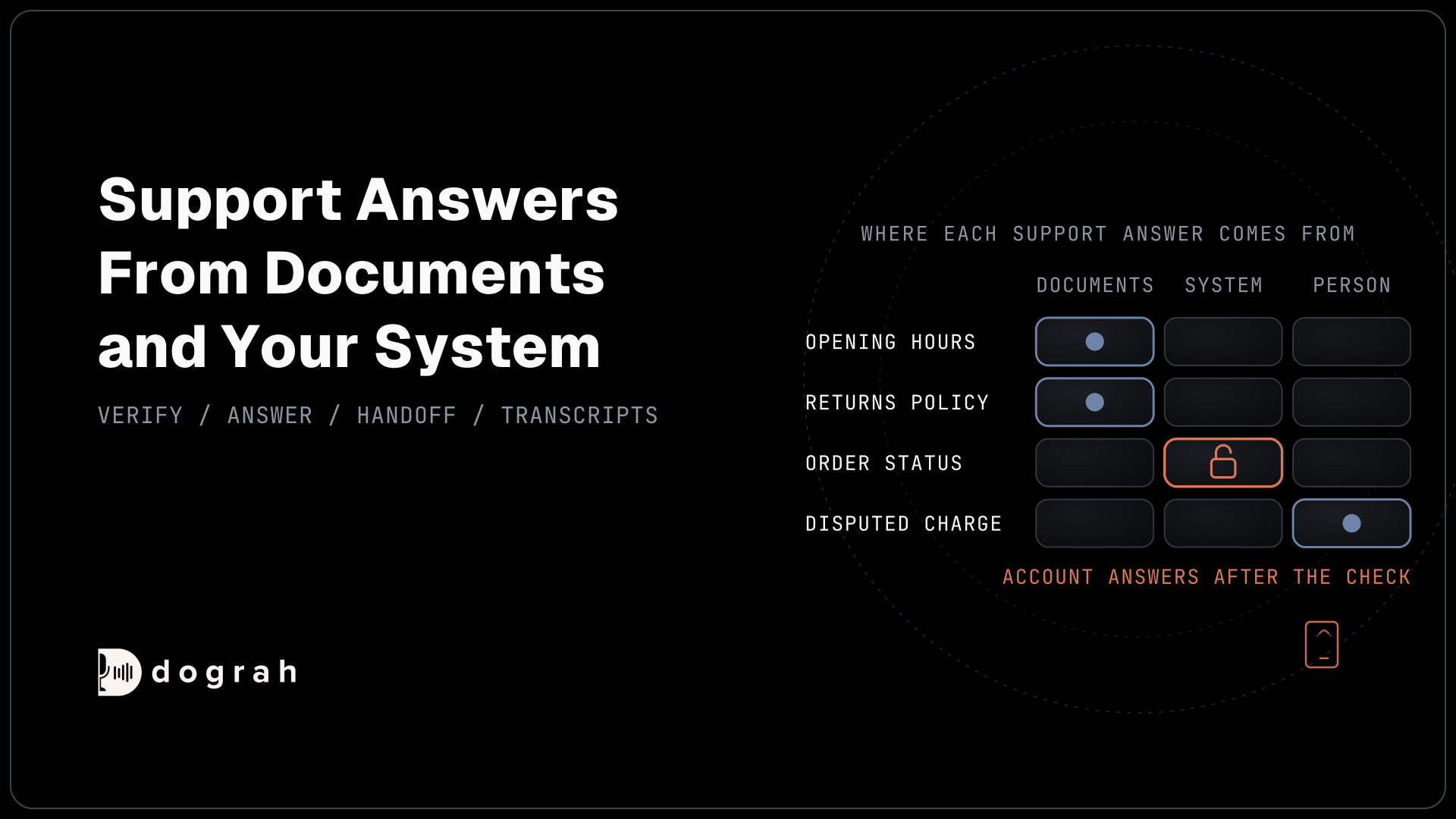

AI voice agents for inbound customer support pick up every call, check who is calling, and answer from two sources: fixed answers from your own documents and live answers from your systems, such as an order status or a balance. Disputes, refunds and anything that needs judgement go to a person, with the details written to your system first.
Key Takeaways
- Fixed answers come from your documents, and account answers come from your system.
- A phone number finds the account, but only an approved check proves who is calling.
- Write the details to your system before any transfer to a person.
This post is part of our guide to AI voice agents by use case. The guide's section "Inbound calls: support, booking and new leads" says inbound customer support runs on two answer sources: your own documents for fixed answers, and your system for live ones, read only after the caller passes the verify step. Here is that call for any business, run in Dograh, an open-source, self-hostable voice agent platform.
Two answer sources: your documents and your system
A support line's first job is to pick up. In CallRail's survey of 1,000 US consumers, 78% said they have abandoned a business after an unanswered call. An agent answers every ring, at any hour. What it says next depends on where each answer comes from.
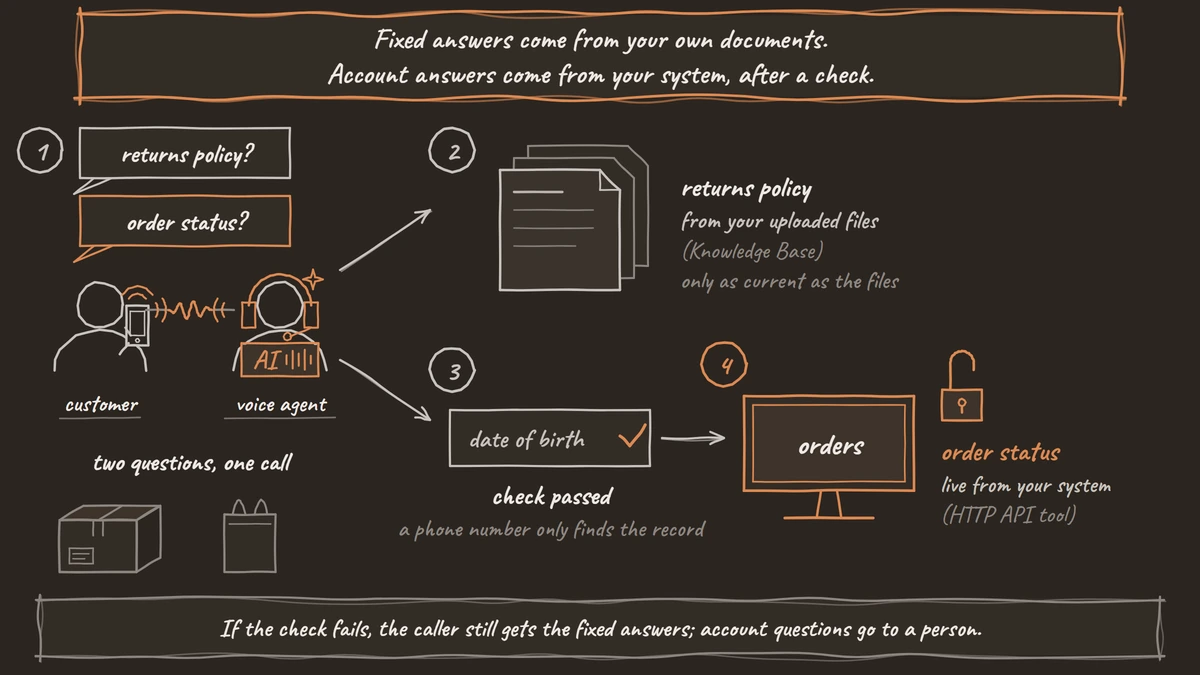
Fixed answers, such as opening hours or a returns policy, come from your own documents. You upload them to the Knowledge Base under "Files", as PDF, DOCX, DOC, TXT, JSON or MD, up to 5 MB each, and select them on the agent's node under "Knowledge Base Documents". Chunked Search needs an embedding key, while Full Document does not. The agent is only as current as those files, so tell it in the prompt to say when the documents do not cover a question and to offer a person.
Live answers, such as an order status or a balance, come from your system. An HTTP API tool asks for them during the call, and only after the verify step in the next section. If one agent serves several brands or lines, point each phone number at it through that number's "Inbound workflow" setting. The dialled number reaches your lookup as to_number, so the agent knows which line was called.
If an IVR menu answers today, our comparison of AI voice agents and IVR shows what changes. When a support call turns into a booking, the steps are in AI voice agents for appointment scheduling.
Verify the caller before reading an account
The call runs greet, verify, disclose. The Greeting Text is fixed text the agent speaks word for word as the call connects, so it carries the business name exactly. If you want to tell callers they're speaking with an automated assistant, or your location requires it by law, write it in the Greeting Text along with the business's name.
Pre-Call Data Fetch, in its "Inbound calls only" mode, sends the caller's and the called number to your system as the call connects. The greeting waits for it, and the caller hears ringing meanwhile. That lookup finds the likely record. It does not prove who is calling, because families and teams share phones.
So tell the agent in the prompt to ask for an approved check, such as date of birth or the last four digits of the account number, before it reads anything from the account. If the check fails, the caller still gets the fixed answers from your documents, and anything about the account goes to a person. A failed check never earns a weaker question.
Recordings and transcripts keep whatever is said, so the call never asks for a full account, card or Social Security number; use a short check such as the last four digits, and send payment links by text or email from your own system. It never asks for a password or a PIN either.

Open Source Alternative to Vapi / Retell
Self-hosted voice agent platform — no per-minute fees
dograh-hq/dograh
Star on GitHub
What the agent should hand to a person
Some calls belong with your team from the start: a disputed charge, a refund, a complaint, an exception to policy, or any decision that needs judgement. List them in the prompt, and tell the agent to offer a person the moment a caller asks for one. Callers expect that option. In a Gartner survey of 3,566 customers, 87% said it is essential for companies using generative AI to provide an option to reach a human agent.
Emergencies get fixed text, never words the AI writes. Draw a pathway to an emergency step whose Transition Speech says, for a medical emergency, "hang up and call 911" (999 in the UK), and for a hazard such as a gas leak or a fire, "get to safety and call 911".
Transfer Call works on Twilio, Telnyx and Asterisk ARI. It passes no summary by default; on Twilio it can play a short spoken introduction to both people. Write the details to your system with an HTTP API tool before the transfer: who called, whether they passed the check, what they asked and what the agent already tried. Dograh calls your team first and connects the caller only when someone answers. If nobody answers within the 30-second default, the caller stays with the agent; tell it in the prompt to offer a callback. Web calls cannot transfer, so test every transfer on a real phone line.
Answering rules: recording consent and call limits
Answering a call generally needs no robocall consent. The FCC's February 2024 ruling says its AI-voice requirements apply to "any AI technology that initiates any outbound telephone call", so a call the customer places to you is generally outside them. Recording is a separate matter. Dograh starts recording as the call connects, so a recording notice belongs in the Greeting Text, the first thing the caller hears. Call-recording consent laws differ by state and country, and our post on call-recording consent laws covers how to set up the agent for them. This is general information, not legal advice; confirm your position with counsel.
Capacity is the other limit. Self-hosted Dograh runs 10 concurrent calls by default, adjustable with DEFAULT_ORG_CONCURRENCY_LIMIT. Your servers and phone provider set the practical ceiling. Dograh Cloud's Pay as you go plan includes 10 concurrent calls, and higher limits come through Dograh. Over the limit, a new inbound call is rejected, not queued, so size the limit for your busiest hour.
Measuring the line once it is live
A support agent is never finished, because customers keep asking new things. Dograh's QA node reviews calls, both test calls from the editor and live calls of the published agent. Its Sample Rate sets the share of calls it reviews, picked at random. It scores each step of the call separately, with its own tags, a 1-10 score, sentiment and a summary. There is no single call score.
Read the transcripts of calls that ended in a transfer. They show which questions your documents do not answer yet, and each fix is a new paragraph in a Knowledge Base file. After each call, a Webhook node can send the outcome and the transcript link to your helpdesk. If your main inbound job is the front desk rather than support, our guide to AI receptionists covers that role.
Self-hosted Dograh has no per-minute platform fee (servers, model keys and phone minutes still cost); Dograh Cloud has a 1¢-a-minute platform fee.
By industry: support lines with their own rules
Each industry adds its own rules to the support call. These posts cover them:
- AI Voice Agents for Customer Support in E-commerce: store questions and orders.
- AI Voice Agents for Order Status and Updates in E-commerce: where is my order.
- AI Voice Agents for Telecom Support Lines: faults and line tests.
- AI Voice Agents for Utility Customer Support: explaining the bill.
- AI Voice Agents for Patient Support Lines: health questions answered from your own documents.
- AI Voice Agents for Healthcare Call Centers: patient calls at health-system scale.
- AI Voice Agents for Resident Support: tenants and property rules.
- AI Voice Agents for Student Support: student records.
- AI Voice Agents for Citizen Helplines: government helplines.
- AI Voice Agents for After-Hours Coverage: nights and weekends.
- AI Voice Agents for Customer Support in Insurance: policyholder calls.
- AI Voice Agents for Coverage Questions: what a policy covers.
- AI Voice Agents for Account and Billing Support in SaaS: subscription accounts.
- AI Voice Agents for Gym Member Support Calls: gym members.
- AI Voice Agents for Pharmacy Patient Support: pharmacy questions.
- AI Voice Agents for Pharmacy Order Status: prescription orders.
- AI Voice Agents for Tax-Season Call Overflow: accounting firms at peak.
- AI Voice Agents for Tier-1 Call Deflection: contact centers, first-line calls.
- AI Voice Agents for Overflow Call Handling: contact centers, peaks.
- AI Voice Agents for Human Handoff Routing: contact centers, routing rules.
- AI Voice Agents for Multilingual Support Lines in BPOs: several languages on one line.
Join the Dograh Community
Dograh is an OSS alternative to Vapi. Join our Slack community for queries, releases, best practices & community interactions.
Glossary
- Knowledge Base
- The documents you upload to Dograh, such as policies and FAQs, that the agent answers fixed questions from during a call. Files can be PDF, DOCX, DOC, TXT, JSON or MD, up to 5 MB each.
- Verify step
- The check that proves who is on the line, such as date of birth or the last four digits of an account number. A phone number only finds the record; nothing from the account is read out until the check passes.
- Pre-Call Data Fetch
- A Dograh setting at the bottom of the Start Call node that sends the caller's and the called number to your system as the call connects. On inbound calls the greeting waits for it, and the result is a likely record, not proof of identity.
- Sample Rate
- The share of calls Dograh's QA node reviews, picked at random. Each reviewed call gets scores and tags for every step, not a single call score.