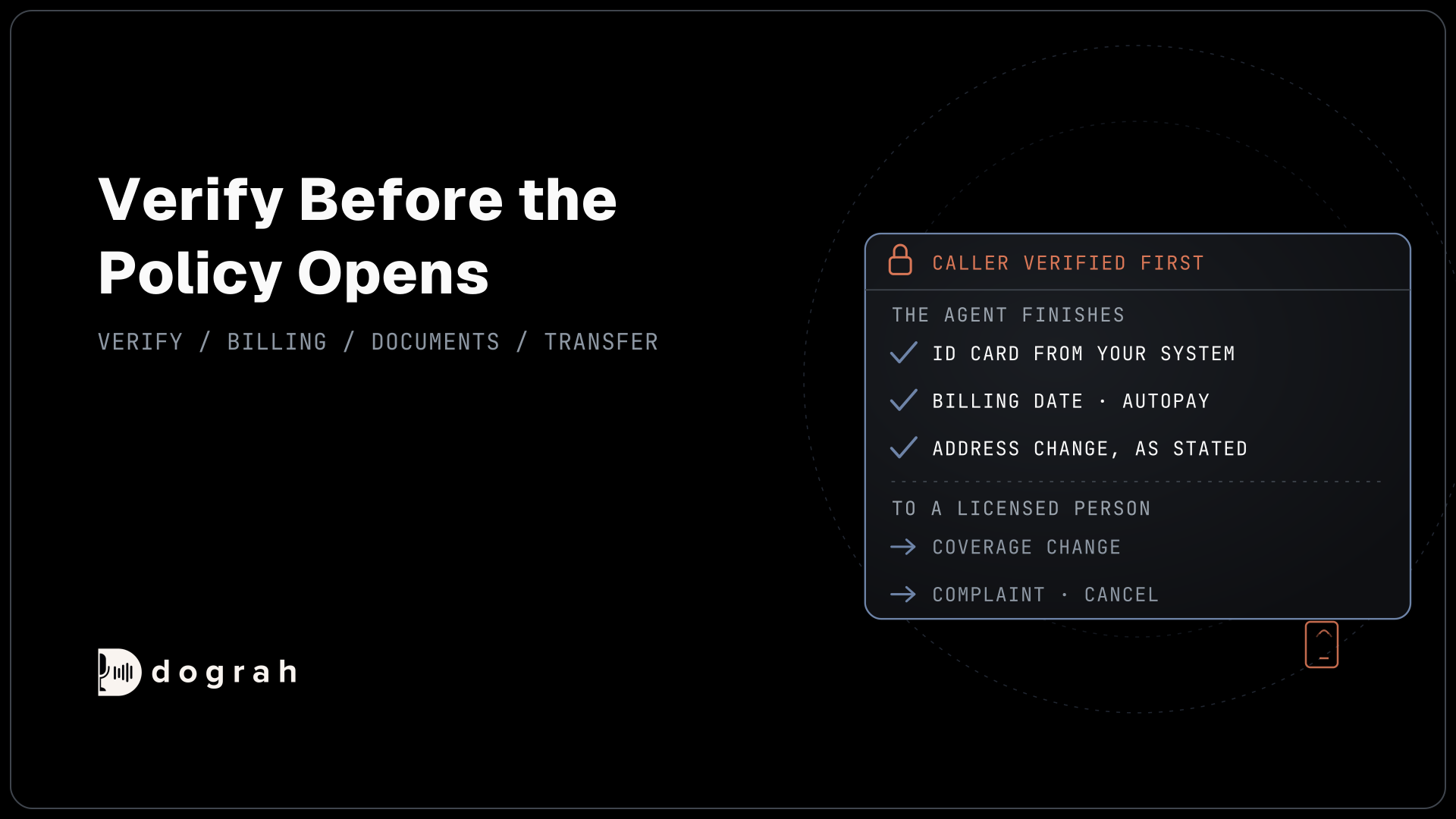

AI voice agents for customer support in insurance answer policy service calls. After verifying the caller, they finish clerical requests such as ID cards, billing dates and document copies, and write each one to the policy system. The insurer's own system sends documents and payment links, while coverage changes, complaints and disputes go to a licensed person.
Key Takeaways
- Verify the caller before reading any policy detail, since a phone number only finds records.
- The agent finishes clerical requests, and coverage changes go to a licensed person.
- Payment links and documents come from your own system, never card numbers.
This post is part of our guide to AI voice agents for insurance. The guide's section "Serving policyholders: support and coverage questions" splits service calls into requests the agent can complete and questions about cover, where it reads but never rules. This post covers the first kind, run in Dograh, an open-source, self-hostable voice agent platform.
Insurance support calls the agent can finish
Most calls to a policy service line are clerical: a new ID card or proof of insurance, the next billing date, whether autopay is on, a copy of the declarations page, a new mailing address. An agent can finish those end to end, because none of them sells or advises.
The licence rules explain why. The NAIC Producer Licensing Model Act, which each state enacts in its own version, says: "A person shall not sell, solicit or negotiate insurance in this state for any class or classes of insurance unless the person is licensed for that line of authority in accordance with this Act." It exempts employees whose work is "executive, administrative, managerial, clerical or a combination of these, and are only indirectly related to the sale, solicitation or negotiation of insurance."
That exception was written for people, so whether an agent's script fits it is a question for counsel. The working rule stays simple. Selling, advising on or binding a policy generally needs a state producer licence, so the agent qualifies, reads the record and hands the caller to a licensed person; confirm your own position with counsel.
Two kinds of call leave this line straight away. A caller reporting a loss goes to your claims line, covered in AI Voice Agents for Insurance Claims. A caller asking "am I covered for this?" needs the read-back rules in AI voice agents for coverage questions.
Verify before the policy opens
The agent knows nothing about the policy until the caller passes a check, so a wrong person on the line hears nothing they could misuse. The call opens with Greeting Text, the fixed line Dograh plays word for word, with the agency's or carrier's name. If you want to tell callers they're speaking with an automated assistant, or your location requires it by law, say that there too.
If Pre-Call Data Fetch is on, the greeting waits for it and the caller hears ringing meanwhile. Set it to Inbound calls only and have your endpoint return just a match flag and a first name for the calling number, so the prompt holds no policy data before the check. Several phone numbers can point at the same agent, and the dialled number arrives as to_number, so one agent can serve each carrier or office line.
A phone number finds a record, but it does not prove who is calling, so the agent asks for an approved check, such as date of birth plus the last digits of the policy number. An HTTP API tool sends those answers to your policy system, which says whether they match, and the agent reads the record only when the check passes. If it fails twice, tell the agent in the prompt to stop and offer a callback to the number on file, without saying whether a policy exists.

Open Source Alternative to Vapi / Retell
Self-hosted voice agent platform — no per-minute fees
dograh-hq/dograh
Star on GitHub
Completing the request and writing it back
After the check, the agent reads the answer from the record or records the request, and an HTTP API tool writes it back to the policy or agency system.
An ID card or a declarations page goes out from your own system. An HTTP API tool asks it to email or text the document to the contact details on file, since Dograh sends no texts or emails itself. Billing dates, the amount due and autopay status are read straight from the record.
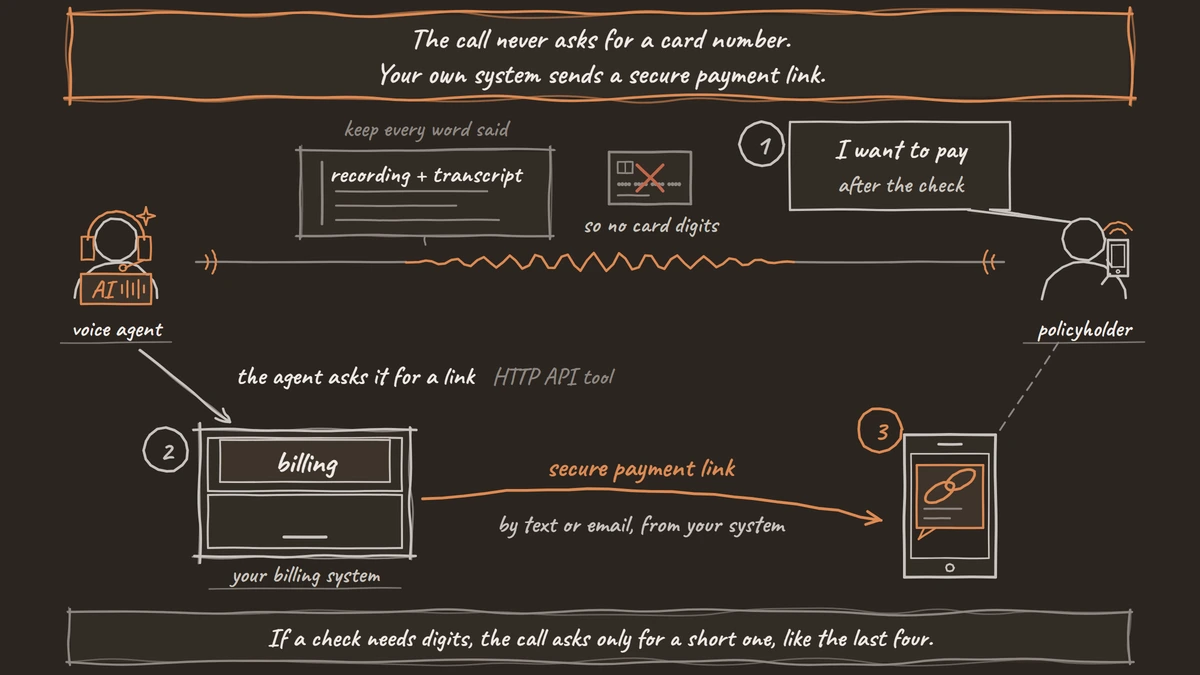
If the caller wants to pay, an HTTP API tool asks your system to send its secure payment link. Recordings and transcripts keep whatever is said, so the call never asks for a full account, card or Social Security number; use a short check such as the last four digits, and send payment links by text or email from your own system.
An address or vehicle change can move the premium or the cover. The agent records the request as the caller stated it and writes it to your system, and your system or a licensed person confirms any effect. It never quotes a new premium.
Lookups take a moment. The HTTP API tool's Custom Message (text or a recorded clip) plays once, just before the tool runs, so a line such as "Let me pull up your policy" covers the pause. The tool waits 5 seconds by default and does not retry, so tell the agent in the prompt to offer a callback when a lookup fails.
General answers, such as office hours or how to send a document, can come from the Knowledge Base (PDF, DOCX, DOC, TXT, JSON or MD, up to 5 MB a file). The caller's own figures always come from the record. Outbound reminders about money due are a separate call, covered in AI voice agents for premium reminders.
What goes to a person
Anything that changes what the policy covers, or how much it costs, is a licensed conversation. So are complaints, disputes about a charge and requests to cancel, which need someone who can act on them.
Transfer Call works on Twilio, Telnyx and Asterisk ARI. It passes no summary by default; on Twilio it can play a short spoken introduction to both people. So an HTTP API tool writes the request and the reason to your system before the transfer, and the person who picks up sees it there. If nobody answers within the 30-second default, the caller stays with the agent; tell it in the prompt to offer a callback and write the request to your system. Out of hours, the same callback request is the whole job.
Some callers are in trouble right now. Give these calls their own pathway and put one fixed line in its Transition Speech, so the model never improvises it (on a speech-to-speech model, use a recorded clip there). Someone hurt after a crash is told to hang up and call 911; someone reporting a fire or a gas leak is told to get to safety and call 911. Everything else about a loss goes to your claims line.
Showing the agent stayed in its lane
Regulators expect insurers to watch what their AI says. The NAIC model bulletin on insurers' use of AI says AI can "improve consumer interface and service" but "can present unique risks to consumers, including the potential for inaccuracy, unfair discrimination, data vulnerability, and lack of transparency and explainability." On a service line, the inaccuracy risk is the one to design against, so the agent answers only from the record.
Transcripts and recordings are how you show it did. Run QA on a random 5 to 10% sample of live calls. Dograh's QA scores each step of the call separately, so a coverage question that slipped into the service step shows up there. Because you self-host Dograh inside your existing compliance perimeter, you don't need a separate vendor review for Dograh. The speech and language model providers you choose may still need their own review, unless those models run on your servers too.
Self-hosting keeps the recordings and transcripts on your servers. Dograh is the orchestration layer: it runs the call flow, tools and telephony, and the speech and language models are a separate layer you choose. Dograh starts every account on its own managed models. To keep call audio away from Dograh, open Models, switch the Organization default to BYOK with your own speech and language providers (or local models), and check that no agent has its own model override. The call audio stays in-house only when the speech and language models run on your own servers too.
Plan for busy mornings. Self-hosted Dograh runs 10 concurrent calls by default, adjustable with DEFAULT_ORG_CONCURRENCY_LIMIT, and a call over the limit is rejected, not queued. Self-hosted Dograh has no per-minute platform fee (servers, model keys and phone minutes still cost); Dograh Cloud has a 1¢-a-minute platform fee. Our playbook on inbound customer support covers the same line across industries.
Join the Dograh Community
Dograh is an OSS alternative to Vapi. Join our Slack community for queries, releases, best practices & community interactions.
Glossary
- Clerical exception
- The part of the NAIC Producer Licensing Model Act that exempts employees whose work is clerical and only indirectly related to selling insurance. It was written for people, so whether a voice agent's script fits it is a question for counsel.
- Proof of insurance
- A document, usually an ID card or declarations page, showing a policy is in force. The agent records the request after verification, and the insurer's own system sends it to the contact details on file.
- Pre-Call Data Fetch
- A Dograh setting at the bottom of the Start Call node that asks your system for data as an inbound call connects. On a service line it returns only a match flag and a first name, so nothing about the policy is known before the check.
- Knowledge Base
- Documents uploaded to Dograh that the agent searches for general answers, such as office hours or how to send a document. The caller's own figures always come from the policy system instead.