
Spanish AI voice agents for insurance answer policyholders in Spanish, or in Spanish and English on one line, with the same checks as English calls. They verify the caller before reading any policy detail and hand questions about what to buy to a licensed producer, ideally one who speaks Spanish. Use speech providers whose own pages list Spanish.
Key Takeaways
- Greet in both languages, because the greeting plays before Dograh hears the caller.
- Verify first, then read policy facts. Licensed producers answer buying questions.
- Name a speech provider for Spanish only when its own page lists Spanish.
This post is part of our guide to AI voice agents for insurance. The guide's section "Calling rules: US, UK and Spanish-speaking callers" sets the rule in one line: Spanish-speaking policyholders get the same two lines in Spanish, verification first and a licensed producer for anything about buying. Here is how that line runs in Dograh, an open-source, self-hostable voice agent platform.
Why a Spanish line matters to insurers
Many policyholders are more at ease in Spanish, and some cannot follow a policy conversation in English. The Census Bureau's American Community Survey counted about 44.9 million people in the US who speak Spanish at home, and about 18.4 million of them speak English less than "very well".
Coverage shows a gap as well. LIMRA reports from its 2025 Insurance Barometer Study that life insurance coverage among Hispanic Americans "dropped eleven percentage points from 51% in 2021 to just 40% today". LIMRA's advice is to make "resources available in Spanish" and to provide "access to bilingual advisors".
A voice agent covers the first half of that advice on every call, at any hour, because it can verify callers and handle their service requests in Spanish. The second half, the bilingual advisor, stays a person, and the agent's job is to reach one.
Greeting, language and speech settings
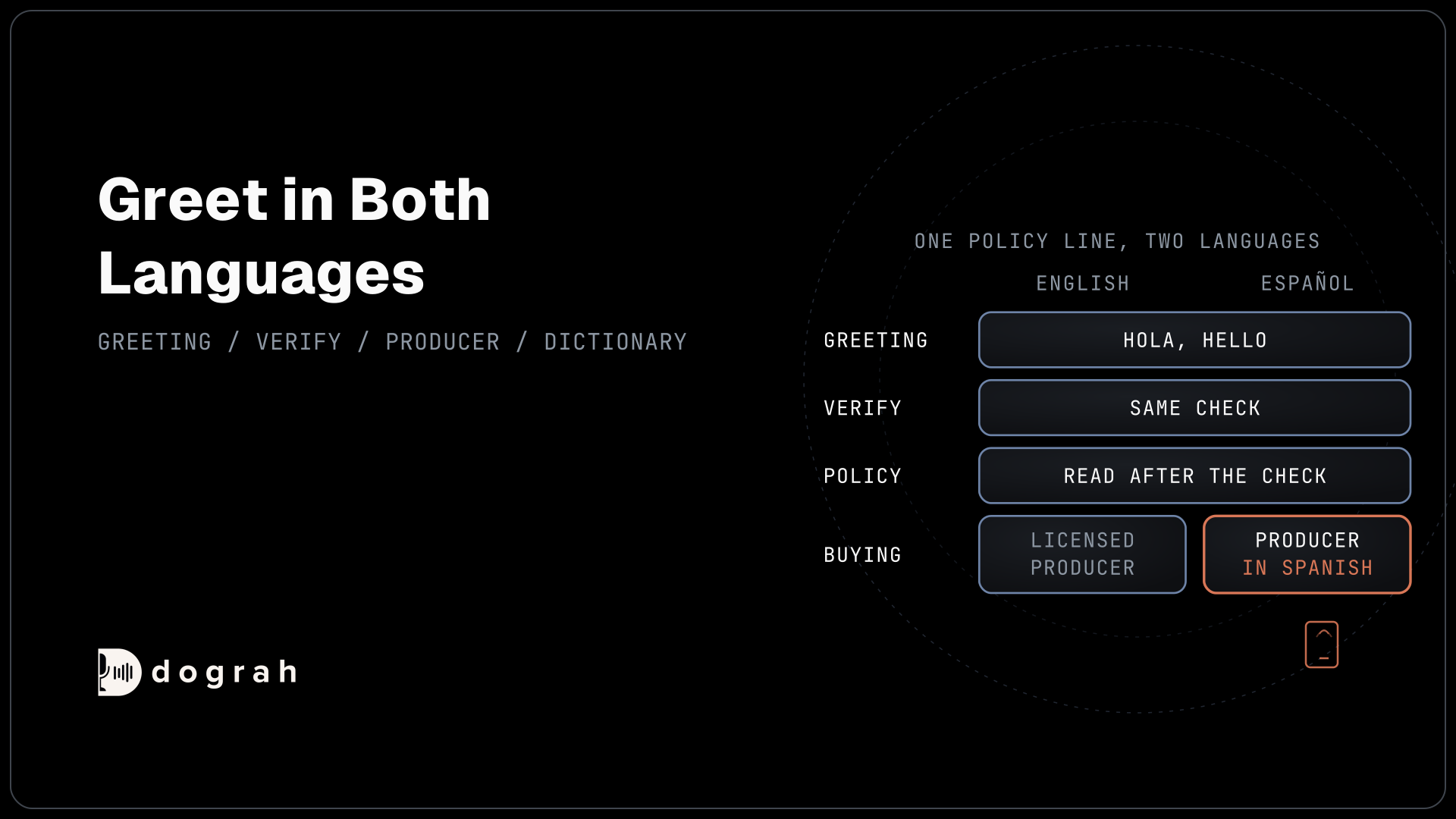
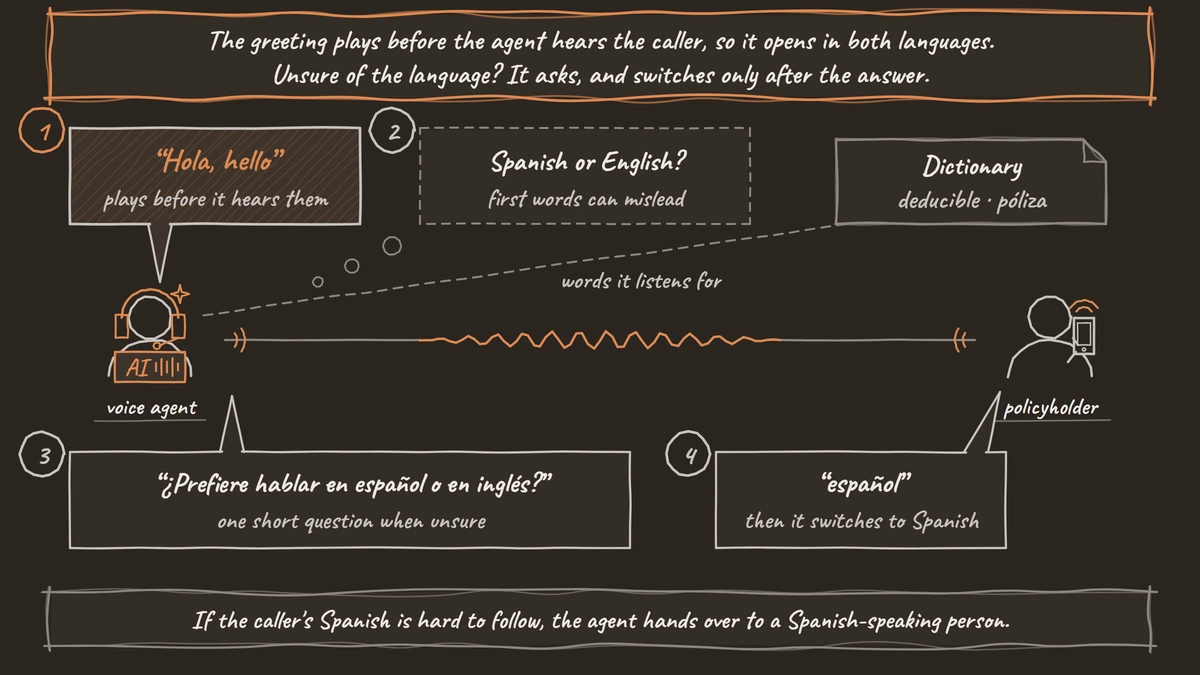
The first seconds decide whether a Spanish speaker stays on the line. Greeting Text is the fixed line Dograh speaks word for word as the call connects. It plays before Dograh can hear the caller's language, so write it in both, for example "Hola, hello". Put the agency's name in it.
Then set how the agent listens. In the agent's Model tab, set speech-to-text to Multilingual (Auto-detect) and tick Spanish and English under Language Hints. Language Hints work only with Dograh's own models or Deepgram Flux, and Spanish is one of the languages Flux supports. Deepgram's language page lists Spanish for its Flux multilingual model and lists es and es-419 for Nova-3.
The voice must speak Spanish too. ElevenLabs lists "Spanish (Spain, Mexico)" among the 29 languages of its Multilingual v2 model. For a self-hosted stack, NVIDIA's Parakeet TDT 0.6B v3 is an open-weight speech-to-text model under the CC-BY-4.0 licence, and it lists Spanish among its 25 languages.
Detection can be wrong, especially in the first words. Tell the agent in the prompt that when it is unsure, it asks one short question, "¿Prefiere hablar en español o en inglés?", and switches only after the caller answers. If the caller's Spanish is hard to follow or key facts cannot be confirmed, it hands the call to a Spanish-speaking person. Add carrier names, Spanish surnames and policy terms such as "deducible" and "póliza" to the Dictionary in the agent's Settings, so speech-to-text listens for them. The same settings run a clinic line in Spanish AI voice agents for healthcare.

Open Source Alternative to Vapi / Retell
Self-hosted voice agent platform — no per-minute fees
dograh-hq/dograh
Star on GitHub
Verify first, in Spanish too
A Spanish call runs in the same order as any policy call: greet, verify, then disclose. A phone number finds the record, and asking for the policyholder by name finds the right person, but neither proves who is speaking.
So the agent asks for an approved check, such as date of birth plus the last digits of the policy number, and an HTTP API tool sends the answers to your policy system. Only when the check passes does the agent read the premium, the due date or the limits on the record. Many Spanish speakers use two surnames, so tell the agent in the prompt to ask for both and to spell back any name it is unsure of before the lookup.
Recordings and transcripts keep whatever is said, so the call never asks for a full account, card or Social Security number; use a short check such as the last four digits, and send payment links by text or email from your own system.
Buying questions go to a licensed producer
A Spanish speaker asking which policy to buy needs a licensed producer, exactly as an English speaker does. In most states, selling, soliciting or negotiating a policy generally needs a producer licence for that line, so the agent collects facts and hands the caller to a licensed producer; confirm your own position with counsel. AI voice agents for insurance in the US covers that rule and the consent rules for outbound calls.
The hand-off line must be exact, so it goes in a pathway's Transition Speech, fixed text Dograh plays word for word, written in Spanish: "Esa pregunta la responde uno de nuestros agentes con licencia. Le comunico ahora." A prompt alone cannot guarantee that wording.
Transfer Call works on Twilio, Telnyx and Asterisk ARI. It passes no summary by default; on Twilio it can play a short spoken introduction to both people. Write the details to your agency system with an HTTP API tool before the transfer. Its Context Mapping can pick the number from the language the agent recorded, such as a preferred_language variable, so Spanish speakers reach a Spanish-speaking producer. Set a Fallback Destination for when no rule matches. If nobody answers within the 30-second default, the caller stays with the agent; tell it in the prompt to offer a callback in Spanish and write the request, language included, to your system.
Outbound calls, Spain and the data
Outbound Spanish calls follow the same US consent rules as English ones, with any offer generally needing prior express written consent. Insurers serving customers in Spain have a different rulebook. Ley 10/2025 generally lets a customer with a query or complaint ask to be attended by a person, and companies have until 28 December 2026 to adapt; financial firms, which generally include insurers, follow their own sector rules first, with this law filling the gaps. Spanish AI voice agents for e-commerce covers the law in more detail. Confirm your position with counsel.
Review Spanish calls as closely as English ones. QA summaries are in English, so a reviewer reads the Spanish transcript for anything flagged.
Self-hosting Dograh keeps Spanish recordings and transcripts on your own servers. Dograh is the orchestration layer: it runs the call flow, tools and telephony, and the speech and language models are a separate layer you choose. Dograh starts every account on its own managed models. To keep call audio away from Dograh, open Models, switch the Organization default to BYOK with your own speech and language providers (or local models), and check that no agent has its own model override. The call audio stays in-house only when the speech and language models run on your own servers too.
Self-hosted Dograh has no per-minute platform fee (servers, model keys and phone minutes still cost); Dograh Cloud has a 1¢-a-minute platform fee. How to build a voice agent for insurance walks through the full build, step by step.
Join the Dograh Community
Dograh is an OSS alternative to Vapi. Join our Slack community for queries, releases, best practices & community interactions.
Glossary
- Multilingual (Auto-detect)
- The speech-to-text setting in a Dograh agent's Model tab that detects the caller's language, so one agent can follow Spanish and English on the same line.
- Language Hints
- Checkboxes under Multilingual (Auto-detect), such as Spanish and English, that steer detection toward the languages you expect. They work only with Dograh's own models or Deepgram Flux.
- Producer licence
- The state licence a person needs to sell, solicit or negotiate insurance for a line. The voice agent holds none, so a licensed producer answers buying questions in either language.
- Context Mapping
- A Transfer Call setting that picks the destination from a value the agent recorded, such as the caller's preferred language, so Spanish speakers reach a Spanish-speaking producer.