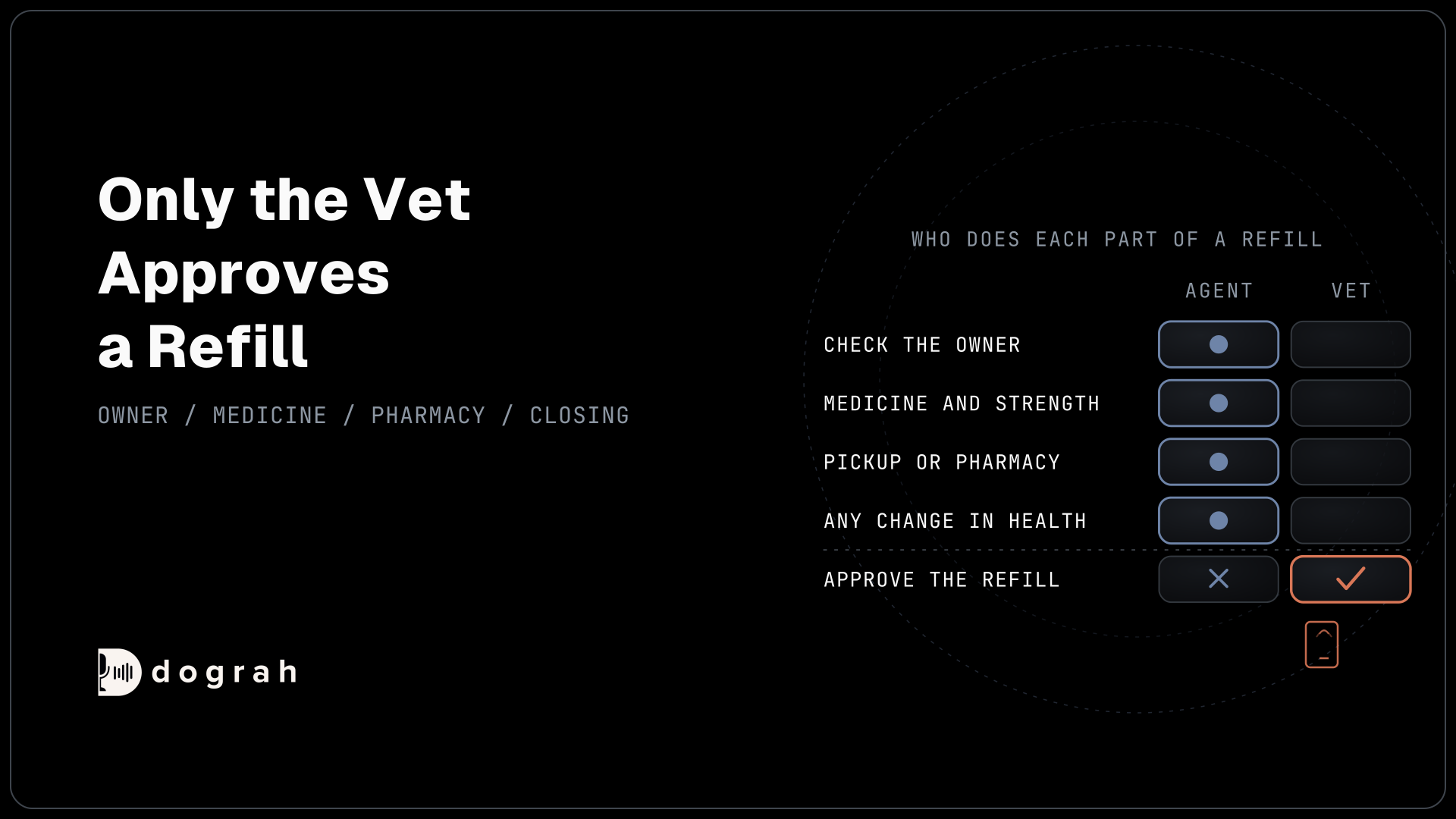

AI voice agents for vet prescription refill requests take the owner's request and write it to the practice system for the vet. After checking the owner, the agent records the pet, the medicine and strength, the pickup or pharmacy choice and any change in health. Only the vet approves a refill, and the call ends on a fixed line.
Key Takeaways
- The agent takes the request; only the vet approves or declines a refill.
- A fixed closing line ends the call, and the prompt rules out "approved".
- A reaction or sudden illness moves the call to the emergency line.
This post is part of our guide to AI voice agents for veterinary clinics. The guide's section "Prescription refill requests: the vet decides" sets the rule in one line: "The refill call takes the request and writes it to the practice system; only the vet approves a refill, and the agent never confirms one." Here is that call in full, run in Dograh, an open-source, self-hostable voice agent platform.
Why the vet, not the agent, decides on a refill
A refill is a medical decision about one animal, so it belongs to the vet who knows that animal.
The federal definition of a veterinarian-client-patient relationship starts with a vet who "has assumed the responsibility for making medical judgments regarding the health of (an) animal(s) and the need for medical treatment". It adds that such a relationship "can exist only when the veterinarian has recently seen and is personally acquainted with the keeping and care of the animal(s)". Whether a pet needs an exam before its next refill is part of that judgment.
The medicine's own label says the same. The federal label rule for veterinary prescription drugs requires the legend "Caution: Federal law restricts this drug to use by or on the order of a licensed veterinarian". State veterinary practice acts set their own rules on top. This is general information, not legal advice; confirm your position with counsel.
So the agent has nothing to decide. It never proposes a refill because one looks due, and it never sends one to a pharmacy. Its job is to take the owner's request down accurately and hand it to the vet.
What the agent collects after the owner check
The agent checks the owner first, then collects the few details the vet needs to decide. A phone number can find a client record, but it does not prove who is calling. Before naming any pet or medicine, the agent asks for an approved check, such as the postcode on file or the last digits of the account number. If the check fails, it offers a callback from the clinic and says nothing about the pet's medicines.
After the check, an HTTP API tool can read the pet's current medicines from the practice management system (PMS). That way, an owner who asks for "the one for her joints" hears the medicine named as the record has it, and the request names the right drug and strength. Then the agent asks for the rest: which pet, how much is left, the clinic pickup or the pharmacy the owner uses, and whether anything about the pet's health has changed.
Each answer is recorded as the owner said it, and the transcript and recording keep the exact words. A change in health is written down, never judged. Medicine names that speech-to-text tends to miss can go in the agent's Dictionary.
Some pet medicines are controlled drugs, with federal refill limits for controlled drugs on top of the vet's own judgment. The agent takes those requests the same way and promises nothing different. Our post on prescription refill reminders in pharmacy covers the outbound call a pharmacy makes once a prescription exists.
Writing the refill request to the practice system
The request goes into the PMS during the call, so it is in the vet's queue before the owner hangs up. An HTTP API tool writes the request to the PMS, as a task, a note or a refill request, depending on your system. ezyVet, Vetspire and Provet Cloud publish their own developer docs. If your system is not one of these, ask its vendor what API access it offers. Dograh has no built-in practice software integration.
Add a Preset Parameter named workflow_run_id with the value {{initial_context.workflow_run_id}}, so the PMS can ignore a repeat of the same request. HTTP API tools wait 5 seconds by default and do not retry. Tell the agent in the prompt never to say the request is recorded unless the tool returned success, and otherwise to say the clinic will call back.
As a backup, a Webhook node sends the request again after the call, and it retries on a temporary failure. The same workflow_run_id lets the PMS ignore the copy. A request taken after hours is written the same way and waits for the morning.

Open Source Alternative to Vapi / Retell
Self-hosted voice agent platform — no per-minute fees
dograh-hq/dograh
Star on GitHub
The closing line that never says "approved"
The call ends on a fixed line, because a generated closing cannot promise that the agent never says "approved".
Write the closing with your vets, for example: "Thank you. The vet will review this request, and the clinic will contact you." Put that line in Transition Speech, the fixed text or recorded clip Dograh speaks when the call moves into the closing step. Text Transition Speech does not play on speech-to-speech models, so use a cascade agent or a recording there.
Tell the agent in the prompt never to say approved, ready or a pickup time, and to answer "will it be ready tomorrow?" with the same line. When the vet approves, your PMS or pharmacy sends the ready message by its own text or email. Dograh sends no texts.
If the vet wants to see the pet first, the clinic books a recheck from live slots. That booking call is covered in AI voice agents for vet appointment booking and vaccination reminders.
When a refill call is really an emergency
A refill call that mentions a reaction or sudden illness is no longer a refill call, and the agent moves it to the emergency path.
The clinic writes the list, such as vomiting after a dose, facial swelling, collapse or a seizure. Moving to the emergency pathway is the language model reading that written condition, and a model can misread it. The pathway plays the clinic's fixed line: "If your pet is having an emergency, please call your nearest emergency vet now." The full after-hours path is in AI voice agents for after-hours vet triage calls.
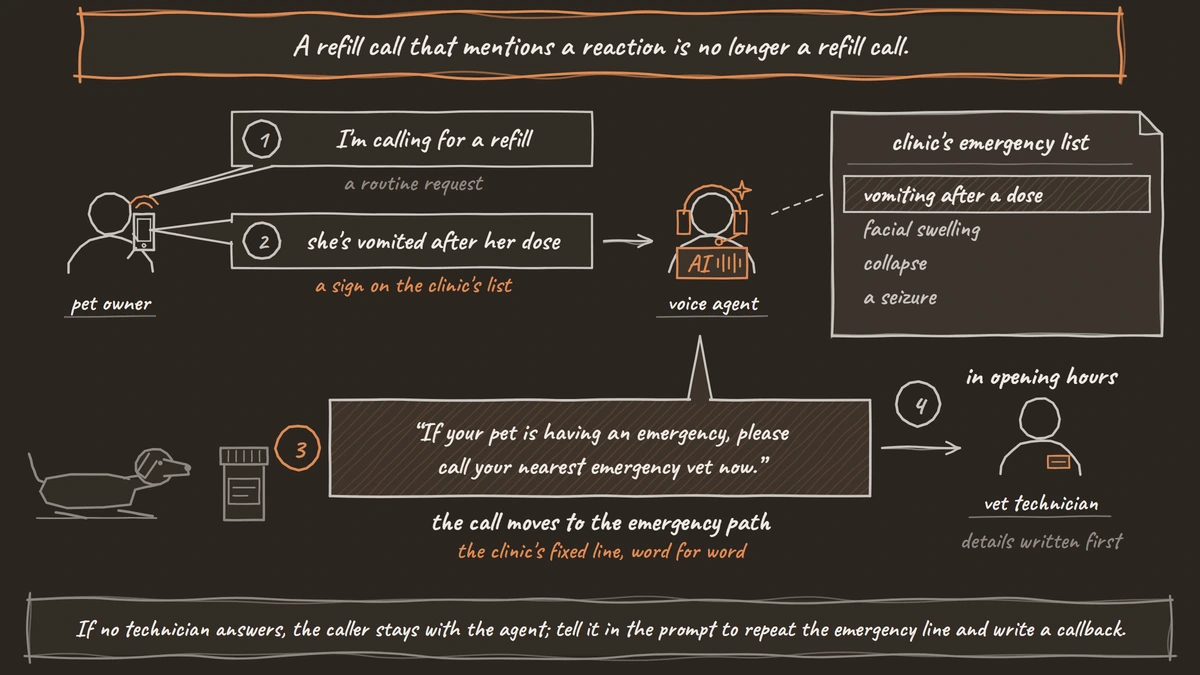
In opening hours, a technician can take the call. Transfer Call works on Twilio, Telnyx and Asterisk ARI. It passes no summary by default; on Twilio it can play a short spoken introduction to both people. Write the details to your system with an HTTP API tool before the transfer. If nobody answers, the caller stays with the agent; tell it in the prompt to offer a callback. Tell it also to repeat the emergency line and write the callback request to the PMS.
Self-hosting keeps owner details, recordings and transcripts on servers the clinic runs. Dograh is the orchestration layer: it runs the call flow, tools and telephony, and the speech and language models are a separate layer you choose. The call audio stays in-house only when the speech and language models run on your own servers too. Self-hosted Dograh has no per-minute platform fee (servers, model keys and phone minutes still cost); Dograh Cloud has a 1¢-a-minute platform fee.
Join the Dograh Community
Dograh is an OSS alternative to Vapi. Join our Slack community for queries, releases, best practices & community interactions.
Glossary
- Veterinarian-client-patient relationship (VCPR)
- The federal standard in 21 CFR 530.3(i) for when a vet knows an animal well enough to make medical decisions about it, including a recent exam. It is why every refill decision is the vet's.
- Refill request
- What the agent creates: the owner's ask, with the pet, medicine, strength, pickup or pharmacy and any change in health, written to the practice system. It is not an approval and starts nothing at a pharmacy.
- Controlled substance
- A drug on the DEA schedules, which some pet medicines are. Federal rules limit how often and for how long its prescriptions can be refilled, on top of the vet's judgment.
- Transition Speech
- Fixed text or a recorded clip Dograh plays when a call moves along a pathway. It carries the closing line and the emergency line, so neither is ever reworded.