
AI voice agents for veterinary clinics answer and place routine calls: bookings, vaccination reminders, after-hours calls, refill requests, post-surgery check-ins and grooming or boarding bookings. They read and write the practice management system during the call. They never diagnose: emergencies get a fixed line to call the nearest emergency vet, and only the vet approves a refill.
Key Takeaways
- Every answer comes from the practice system, read during the call and written back.
- The agent never diagnoses; emergencies hear a fixed line to call an emergency vet.
- Verify the owner before naming any pet's records, and get consent before outbound calls.
This guide follows a vet clinic's calls from the first booking to the boarding stay, then sets out the rules for every call and how each one runs in Dograh, an open-source voice agent platform. You can self-host it or run it on Dograh Cloud.
What a veterinary clinic's phone line hears
A vet clinic's phone line carries routine requests and frightened owners on the same number, so an agent has to handle both without mixing them up.
The pool of callers is large. The American Pet Products Association reports that 95 million US households own a pet, from its 2025 National Pet Owners Survey, and that vet care and product sales reached $41.0 billion in 2025.
Owners book visits, often for several pets in one call, and ask for refills. The clinic calls owners about due vaccines and checks in after surgery. At night, worried owners call about a pet that is unwell, and many clinics also take grooming and boarding bookings.
An agent earns its place on calls whose answer lives in your systems: an open slot, a due vaccine, a recorded refill request, a kennel date. It never judges an animal's health, and it never gives first-aid advice, even when an owner asks for it.
Every call in this guide reads from the practice management system (PMS) and writes back to it. During the call, an HTTP API tool asks the PMS for what the call needs, such as open slots or a pet's due vaccines, and the agent offers only what comes back. When the owner agrees to something, a second HTTP API tool writes it, whether that is a booking or a refill request.
Booking visits and vaccination reminders
On an inbound call, the owner says which pets need what. The agent finds the client record, checks who is calling, then reads each pet's open slots and books them one by one. The agent never promises a time the system did not return, and it books several pets in one call when the slots allow.
Vaccination reminders run the other way. Your practice system sends its own text or email first, because Dograh has no SMS tool and sends no texts. The call goes to owners who did not respond. Upload them as a list to Campaigns, or start each call from your own system. A campaign dials inside calling hours set in one time zone, so a group with clinics in two time zones runs two campaigns. Retries run from 0 to 10, with 2 by default.
The reminder names no pet and no vaccine until the owner passes the verify step. After that, it reads the due item, such as a rabies booster, and offers the open slots. AI voice agents for vet appointment booking and vaccination reminders covers both calls in full, including consent.
After-hours calls and pet emergencies
The after-hours call never diagnoses. It plays the clinic's approved emergency line as fixed text, then puts the owner through to the on-call vet or points them to the emergency clinic.
The emergency line comes first. Write it with your vets, for example: "If your pet is having an emergency, please call your nearest emergency vet now." Never tell an owner to call 911 about a pet. If the clinic sends owners to one emergency hospital, name it in the line. The after-hours agent's Greeting Text says it first, to every caller, before the agent tries to work out what is wrong. Greeting Text is spoken word for word on agents with separate speech and language models, so the line never drifts.
That order matters because the agent cannot be trusted to spot every emergency. In Dograh, moving to the emergency pathway is the language model reading a written condition, such as the clinic's list of emergency signs, and a model can misread that. So the line plays to everyone, and the pathway plays it again as Transition Speech, the fixed text or recorded clip spoken when the call moves into that part of the flow. Tell the agent in the prompt to ask no questions beyond the clinic's written list.
Next, the owner reaches a person. Transfer Call works on Twilio, Telnyx and Asterisk ARI. It passes no summary by default; on Twilio it can play a short spoken introduction to both people. Write the details to your system with an HTTP API tool before the transfer. The Transfer Call tool's Dynamic HTTP Resolver asks the clinic's system who is on call and dials that number. Have the system always return a number, falling back to a fixed one when no one is on the rota.
If nobody answers, the caller stays with the agent; tell it in the prompt to offer a callback. The owner has already heard the emergency line, so tell the agent to repeat it too and write the callback request to your system. Our post on after-hours coverage covers that moment in more depth.
Poisonings are common enough to plan for. ASPCA says its Animal Poison Control staff helped more than 334,000 animals with toxic substance exposures in 2025. Give the agent the poison line your clinic approves, as fixed text. Everything that is not urgent, such as a question about tomorrow's visit, is written up and booked for the morning. AI voice agents for after-hours vet triage calls covers the three outcomes and the poison lines.

Open Source Alternative to Vapi / Retell
Self-hosted voice agent platform — no per-minute fees
dograh-hq/dograh
Star on GitHub
Prescription refill requests: the vet decides
After the verify step, the agent takes the pet, the medicine and its strength as the owner states them, the pharmacy or pickup choice, and whether anything about the pet's health has changed. An HTTP API tool writes that request to the PMS for the vet's queue. A refill call after hours is taken the same way and waits for the morning.
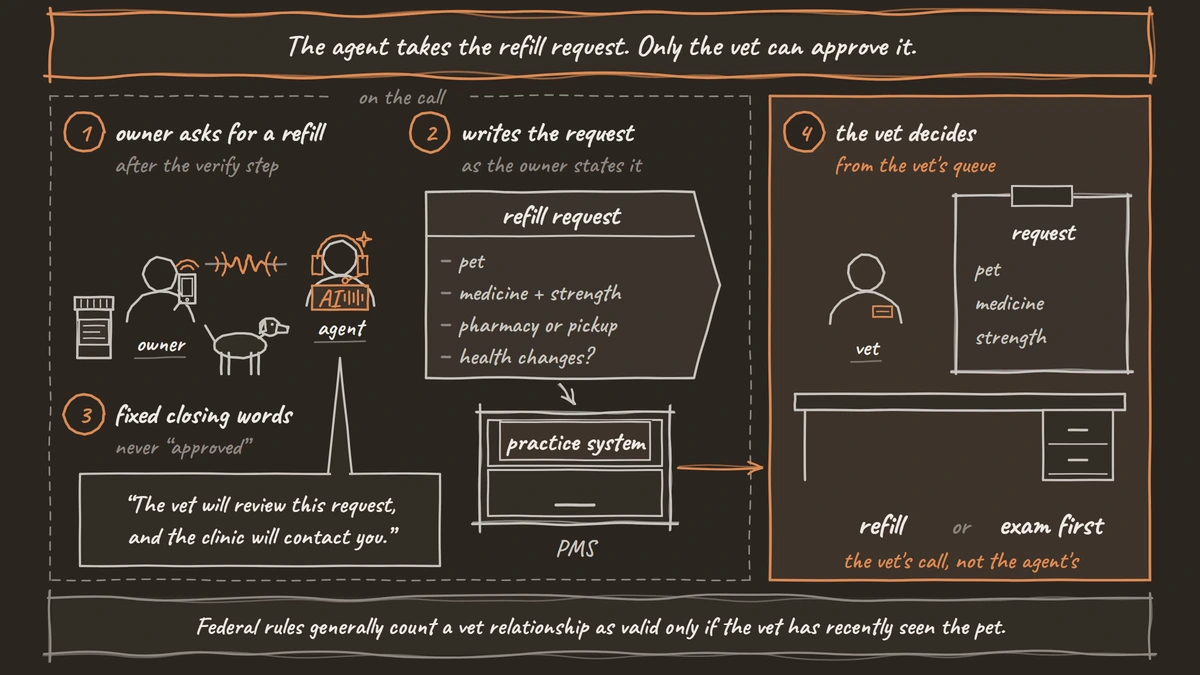
The reason sits in federal law. The federal definition of a veterinarian-client-patient relationship says a valid one exists only when "the veterinarian has recently seen and is personally acquainted with the keeping and care of the animal(s)". Whether a pet needs an exam before its next refill is the vet's call, so the agent has nothing to decide.
The closing words are fixed too: "The vet will review this request, and the clinic will contact you." Put that line in Transition Speech or a recorded clip, and tell the agent in the prompt never to say "approved". If the owner mentions a reaction to the medicine, the call moves to the emergency path instead. AI voice agents for vet prescription refill requests covers the request and the extra limits on controlled drugs.
Post-surgery follow-up: fixed questions
The post-surgery call asks the clinic's fixed check-in questions, and any worrying answer goes to a vet technician, with no medical advice from the agent.
Calls start from the practice system's discharge list, through a campaign or from your own system with the API Trigger. The agent confirms it is speaking with the owner before it names the pet or the surgery. Then it asks the clinic's questions, such as whether the pet is eating and drinking, how the incision looks, and whether the pain medicine was given. Each answer is recorded as the owner said it, and the transcript keeps the exact words.
Exact wording holds only where Dograh speaks fixed text. Put the opening in the Greeting Text. Write each question word for word in the node prompt, knowing the agent may phrase it slightly differently, and let a QA node check that every question was asked.
An answer on the clinic's worry list, such as a swollen incision, goes to a vet technician by Transfer Call, with the answers written to the PMS first. If nobody answers, tell the agent in the prompt to write a callback request. Emergency signs get the same fixed emergency line as the after-hours call. AI voice agents for post-surgery follow-up calls in vet clinics covers timing and the question list.
Grooming and boarding bookings
The same APPA figures put other pet services, which include boarding and grooming, at $14.3 billion in 2025. Many clinics run them alongside medical care, and many owners book them by phone.
The agent books from the grooming or kennel calendar through an HTTP API tool, never from memory. Grooming prices depend on breed, size and coat, so the agent quotes the range in your price list, uploaded to the Knowledge Base, and the groomer confirms the price at check-in. Boarding needs the business's vaccine policy, which the agent reads from the same files. It never grants an exception, and a missing vaccine record goes to staff.
A deposit goes through a payment link your own system sends by text or email. Notes about medication, behaviour or a matted coat are written down for staff. Breed names that speech-to-text tends to miss can go in the agent's Dictionary. AI voice agents for pet grooming and boarding bookings covers both services.
Join the Dograh Community
Dograh is an OSS alternative to Vapi. Join our Slack community for queries, releases, best practices & community interactions.
Rules for every call at a vet clinic
Four rules hold on every call above. This section is general information, not legal advice.
The agent never diagnoses or advises. The federal VCPR definition requires "sufficient knowledge of the animal(s) by the veterinarian to initiate at least a general or preliminary diagnosis". A voice agent has no such knowledge, so it never says what might be wrong or suggests a home remedy or first aid. Tell it in the prompt to answer any such question with the clinic's fixed line and an offer of a person. State veterinary practice acts set their own rules on top of the federal one.
On every call with an owner, the agent verifies the caller before it discloses anything. A phone number can find a client record, but it does not prove who is calling. Before the agent names a pet, a vaccine, a medicine or a surgery, it asks for an approved check, such as the postcode on file or the last digits of the account number. Recordings and transcripts keep whatever is said, so the call never asks for a full account, card or Social Security number; use a short check such as the last four digits, and send payment links by text or email from your own system.
Outbound calls generally need consent. The FCC's calling rule bars calls to a mobile number made "using an automatic telephone dialing system or an artificial or prerecorded voice" without "the prior express consent of the called party". In February 2024 the Federal Communications Commission (FCC) ruled that AI-generated voices count as artificial voices. The rule's exception for "a call that delivers a 'health care' message made by, or on behalf of, a 'covered entity'" refers to HIPAA covered entities, and a vet clinic is generally not one. So capture consent for reminder and follow-up calls at registration or discharge.
Dograh keeps no do-not-call list. When a caller opts out, an HTTP API tool writes it to your own list, and you remove those numbers before the next campaign upload. The do_not_call call tag records the request but never blocks a later call.
Pet records generally fall outside HIPAA. HIPAA's definitions say "Individual means the person who is the subject of protected health information", and the animal is not a person. The owner's name, number and payment details are still personal data, and many states have their own rules on veterinary records. Confirm your position with counsel before the first call.
Connecting your practice management software
Dograh has no built-in practice software, CRM or calendar integration, so each connection is an HTTP API tool, the Webhook node, Pre-Call Data Fetch or the API Trigger pointed at your system. Our guide to Integrating Voice Agents With Your Stack covers those routes.
Three vet systems publish their own developer docs. ezyVet's booking guide covers checking availability and creating a booking. Vetspire offers a GraphQL API that covers appointments. Provet Cloud runs a developer hub with REST API pages. If your system is not one of these, ask its vendor what API access it offers before you plan the build.
Writes need care. HTTP API tools wait 5 seconds by default and do not retry, so tell the agent in the prompt what to say if a write fails, and send the call's workflow_run_id as a Preset Parameter, so the PMS can ignore a repeated booking.
A group with several clinics can run one agent. Several phone numbers can point at the same agent, and Pre-Call Data Fetch, at the bottom of the Start Call node, receives the dialled number as to_number. Your endpoint returns that clinic's name, hours and emergency clinic, so the agent answers for the right location. How to build a voice agent for veterinary clinics walks through one front-desk agent step by step.
Which call to hand over first
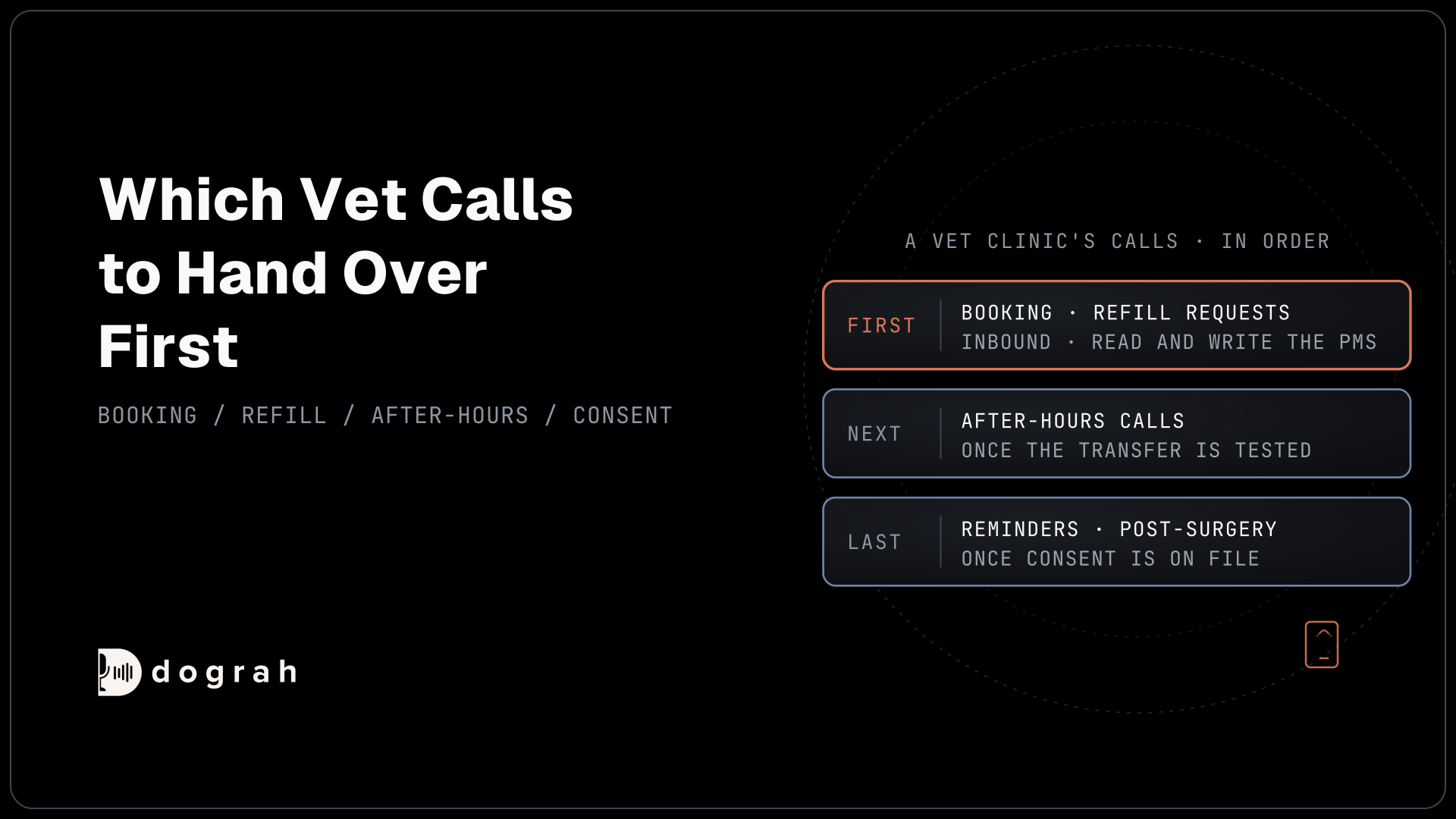
Start with inbound booking and refill requests, because they read and write the PMS and raise no outbound consent questions. After-hours calls come next, once the emergency line, the on-call resolver and the unanswered-transfer path are tested. Reminder and post-surgery campaigns come last, once consent is on record.
Test on a real phone number before any owner hears the agent. Web calls cannot transfer, and most phone calls reach the agent as 8 kHz audio, while a browser test runs at 16 kHz. Testing Voice Agents Before You Go Live sets the order. Once live, run QA on a random 5 to 10% sample of calls and fix what the transcripts show. For one agent answering the whole front desk, The Ultimate Guide to AI Receptionists is the wider view.
Self-hosting keeps owner data, recordings and transcripts on servers the clinic or group runs. Dograh is the orchestration layer: it runs the call flow, tools and telephony, and the speech and language models are a separate layer you choose, so the audio stays in-house only when those models run there too. Self-hosted Dograh has no per-minute platform fee (servers, model keys and phone minutes still cost); Dograh Cloud has a 1¢-a-minute platform fee.
Each call above has its own deep dive:
- AI Voice Agents for Vet Appointment Booking and Vaccination Reminders
- AI Voice Agents for After-Hours Vet Triage Calls
- AI Voice Agents for Vet Prescription Refill Requests
- AI Voice Agents for Post-Surgery Follow-up Calls in Vet Clinics
- AI Voice Agents for Pet Grooming and Boarding Bookings
- How to Build a Voice Agent for Veterinary Clinics
Glossary
- Practice management system (PMS)
- The clinic's main software for clients, pets, appointments, medical records and billing, such as ezyVet, Vetspire or Provet Cloud. The voice agent reads every slot and due item from it and writes every booking and request back.
- Veterinarian-client-patient relationship (VCPR)
- The federal standard in 21 CFR 530.3(i) for when a vet knows an animal well enough to make medical decisions about it, including a recent exam. It is why a refill or a diagnosis is always the vet's decision, never the agent's.
- Dynamic HTTP Resolver
- A Transfer Call setting in Dograh that asks your own system, at the moment of transfer, which number to dial. A clinic uses it to reach whoever is on the on-call rota, with a fixed fallback number returned by the clinic's system.
- Transition Speech
- Fixed text or a recorded clip that Dograh plays word for word when a call moves along a pathway. It carries lines that must never change, such as the emergency vet line or the refill closing line.