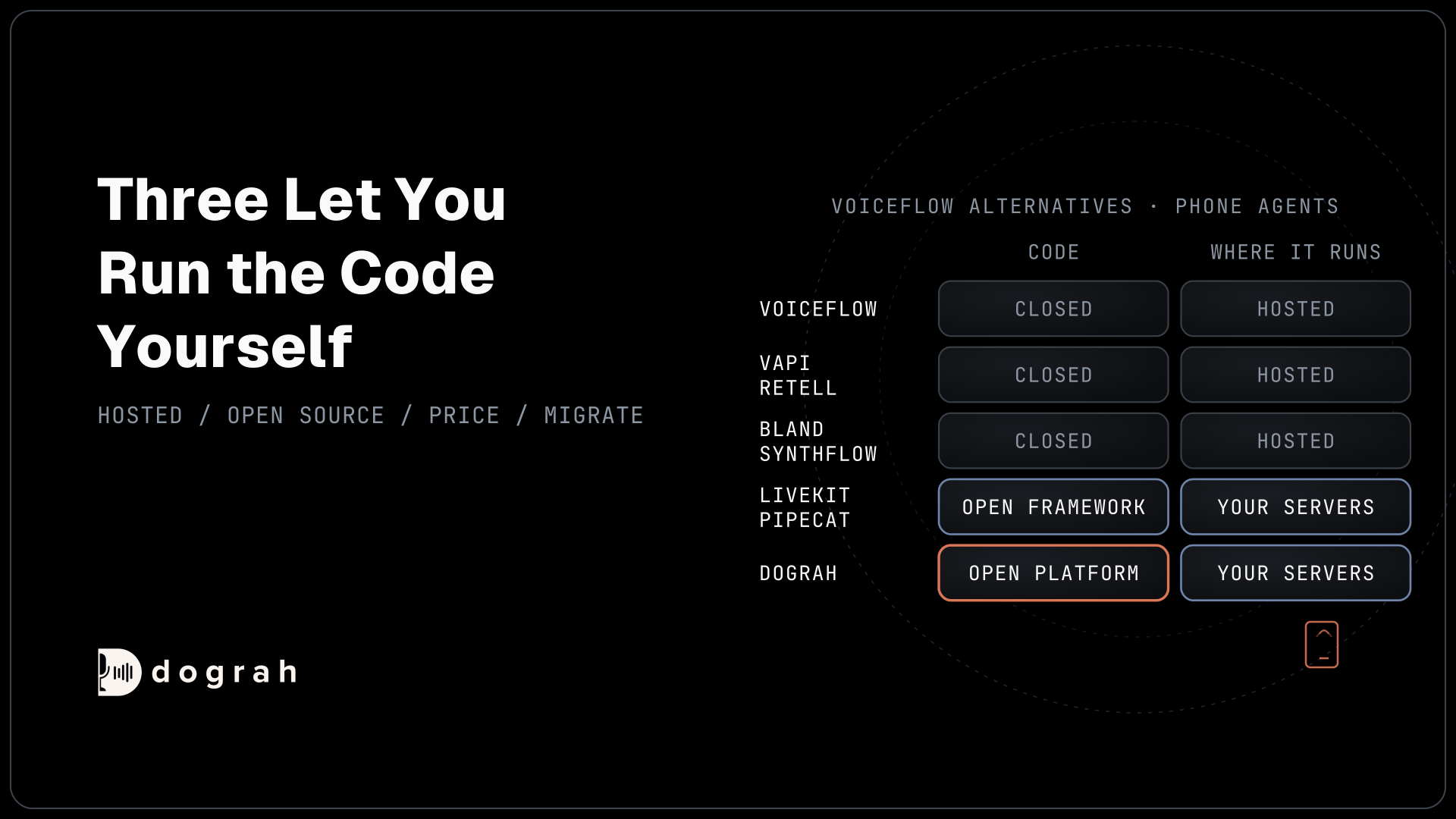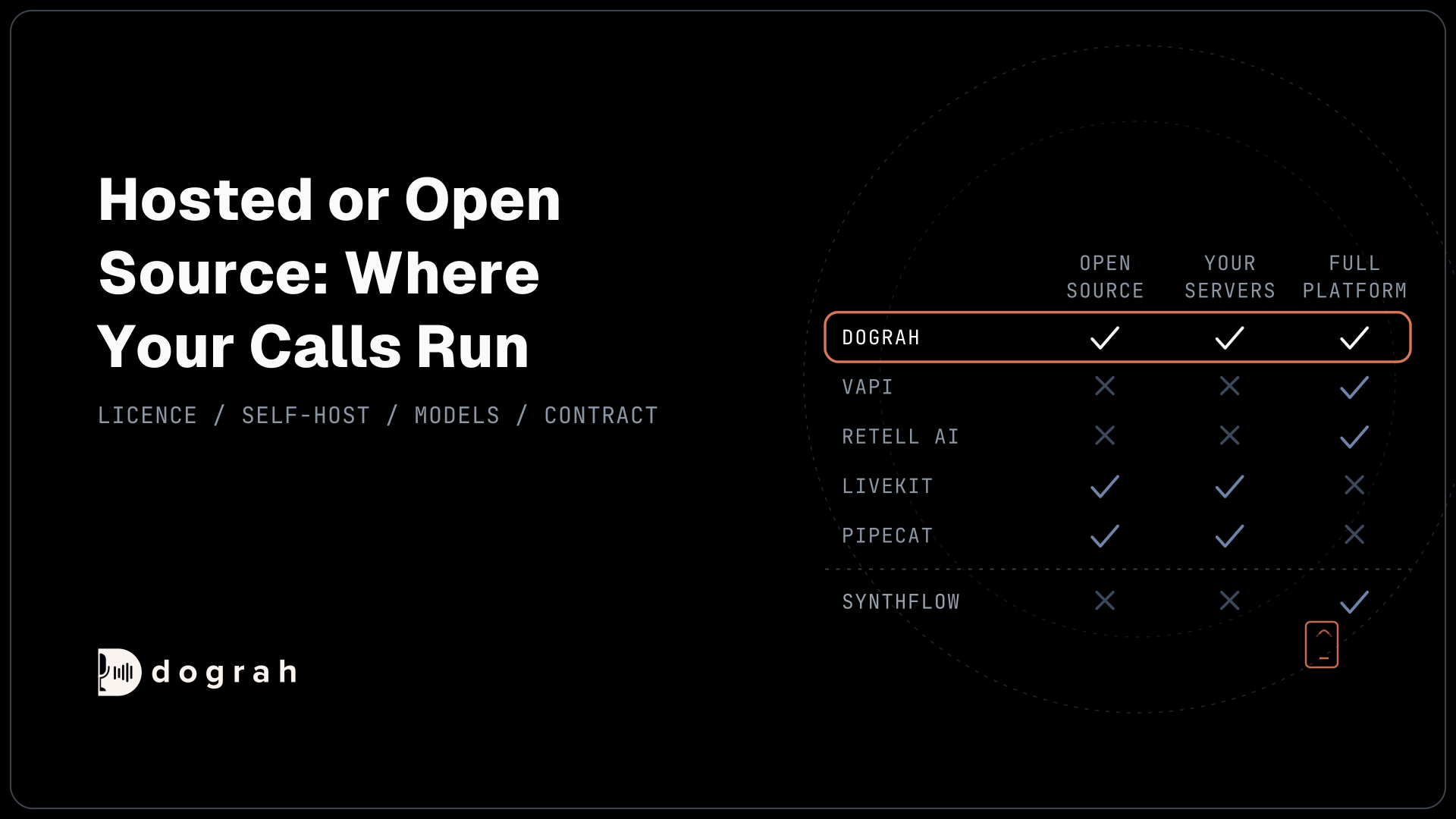

Synthflow alternatives split by who runs the platform. Dograh, an open-source, self-hostable voice agent platform, runs on your own servers with a visual builder and any model you choose. Vapi, Retell AI, Bland AI, ElevenLabs Agents and Voiceflow are hosted and closed source, like Synthflow. LiveKit Agents and Pipecat are open-source frameworks you build on.
Key Takeaways
- Synthflow now sells only Enterprise contracts, from $30,000 a year.
- Dograh is open source under BSD-2-Clause and can run on your own servers.
- Rebuild one agent, test it on a real phone line, then move numbers.
This guide sets eight Synthflow alternatives against Synthflow on licence, where each can run, list price and model choice, and says when staying on Synthflow is the better call. One of them is Dograh, an open-source voice agent platform that reads and writes your CRM during the call. You can self-host it or run it on Dograh Cloud.
Why teams look for a Synthflow alternative
Most searches for an alternative to Synthflow start with its June 2026 move to annual contracts, or a feature now behind Enterprise. Synthflow is a hosted voice agent platform. You build each agent with a single prompt or in its visual Flow Designer.
The first trigger is price. In early June 2026 Synthflow's public pricing page still listed a pay-as-you-go rate, according to dated captures of that page. By 24 June it read "Enterprise contracts start at $30,000 annually". Synthflow's pricing page now lists that one plan, with the final price "scoped around call volume, concurrency, telephony setup, integrations, security needs, and launch support."
The second is the older plans. Pro, Growth and Agency "are no longer sold", and workspaces still on them keep their old limits. On those workspaces, Synthflow's model settings say "Synthflow LLM is the only model available to non-enterprise customers". Connecting your own SIP trunk or phone system (PBX) and the Workflows automation tool need Enterprise too.
The third hits agencies. Synthflow removed in-product reselling through Stripe on 15 September 2026, so agencies now bill clients through their own Stripe account or another billing system.
The fourth is hosting. Synthflow runs on its own cloud, with region-based hosting in the US and EU, and it is retiring its legacy Global cluster during Q4 2026. Teams on that cluster face a region change anyway, which makes it a natural time to compare.
How we compared the alternatives
The licence decides whether you can read the code and keep running it if the vendor changes course. Where it runs means your own servers without a sales contract, or the vendor's cloud only. List prices come from each vendor's own pricing page. Model choice covers bringing your own key (BYOK) or hosting open-weight models. Last, a full platform ships the builder, telephony, call history and QA, while a framework leaves the product to your developers. Latency is left out, because it depends on your models and phone path far more than on the platform. Measure it on your own calls.
Other names come up on Synthflow shortlists. PolyAI, Thoughtly, Leaping AI and Smallest AI are hosted voice agent platforms too. Air AI also appears. The US Federal Trade Commission sued it in August 2025 over its marketing claims. The table keeps to the eight products teams weigh most often.
Synthflow alternatives in one table
| Product | Open source | Self-host or on-prem | List price | What you get, and what's missing |
|---|---|---|---|---|
| Dograh | Yes, BSD-2-Clause | Yes, with Docker Compose; on-prem or private cloud on Enterprise; or Dograh Cloud | Self-hosted: no per-minute platform fee. Dograh Cloud: 1¢/min platform fee, 10 concurrent calls. Models and phone extra | Full platform: visual builder, your own carrier, call traces, per-step QA and any models, including open-weight ones you host. Your team runs the servers |
| Vapi | No | Runs on Vapi's cloud | $0.05/min hosting, plus models and phone. Core $29/mo, Pro $999/mo minimum. HIPAA add-on $2,000/mo | Developer platform with your own model keys, built as Assistants and Squads. Visual Workflows retired in August 2026 |
| Retell AI | No | Runs on Retell's cloud; a dedicated stable server is an Enterprise add-on | $0.07 to $0.31/min, from $0.055/min voice infrastructure. 20 concurrent calls free, then $8/mo each | Visual Conversation Flow builder, a choice of language models and a self-serve BAA. Retell says it does not operate services in the EU |
| Bland AI | No | On-prem or VPC on Enterprise | Start $0.14/min, 100 calls a day; Build $0.12/min plus $299/mo. Phone extra | One rate covers Bland's own models, which Bland picks on self-serve plans. The BAA needs Enterprise |
| ElevenLabs Agents | No | Runs on ElevenLabs' cloud | Free 15 min/month; paid $6 to $990/mo; extra minutes $0.08. Language model extra | Workflow builder from a text-to-speech company. BAAs on Enterprise |
| Voiceflow | No | Hosted on Voiceflow; private cloud on Enterprise | Phone $0.05/min self-serve, plus credits and a plan fee | One agent for chat and phone. Outbound needs your own Twilio, Vonage or Telnyx number |
| LiveKit Agents | Yes, Apache-2.0 | Yes, or LiveKit Cloud | Free to self-host. Cloud: Build free with 1,000 min, Ship $50/mo, Scale $500/mo, then $0.01/min | Framework with telephony and any model. Your developers build the product around it |
| Pipecat | Yes, BSD-2-Clause | Yes, or Pipecat Cloud | Free to self-host. Cloud $0.01/min per active agent | Python framework from Daily. Phone wiring, call history and QA are yours to build |
| Synthflow (for reference) | No | Its own cloud, with region-based hosting in the US and EU | Enterprise contracts from $30,000 a year | Flow Designer, native telephony and launch support in an annual contract; SOC 2 Type 2 and ISO 27001 listed |
Of the three you can run yourself, only Dograh ships as a full platform. LiveKit Agents and Pipecat are frameworks.
Dograh: run the platform yourself
Dograh's code is open, so anyone can read and change it, and self-host it for free.
Its GitHub repository, with more than 5,900 stars, holds the whole platform: telephony, Transfer Call, Campaigns for outbound lists, call traces and automatic QA. A team used to the Flow Designer will find the visual workflow builder familiar: nodes joined by pathways, each with a condition the AI reads.
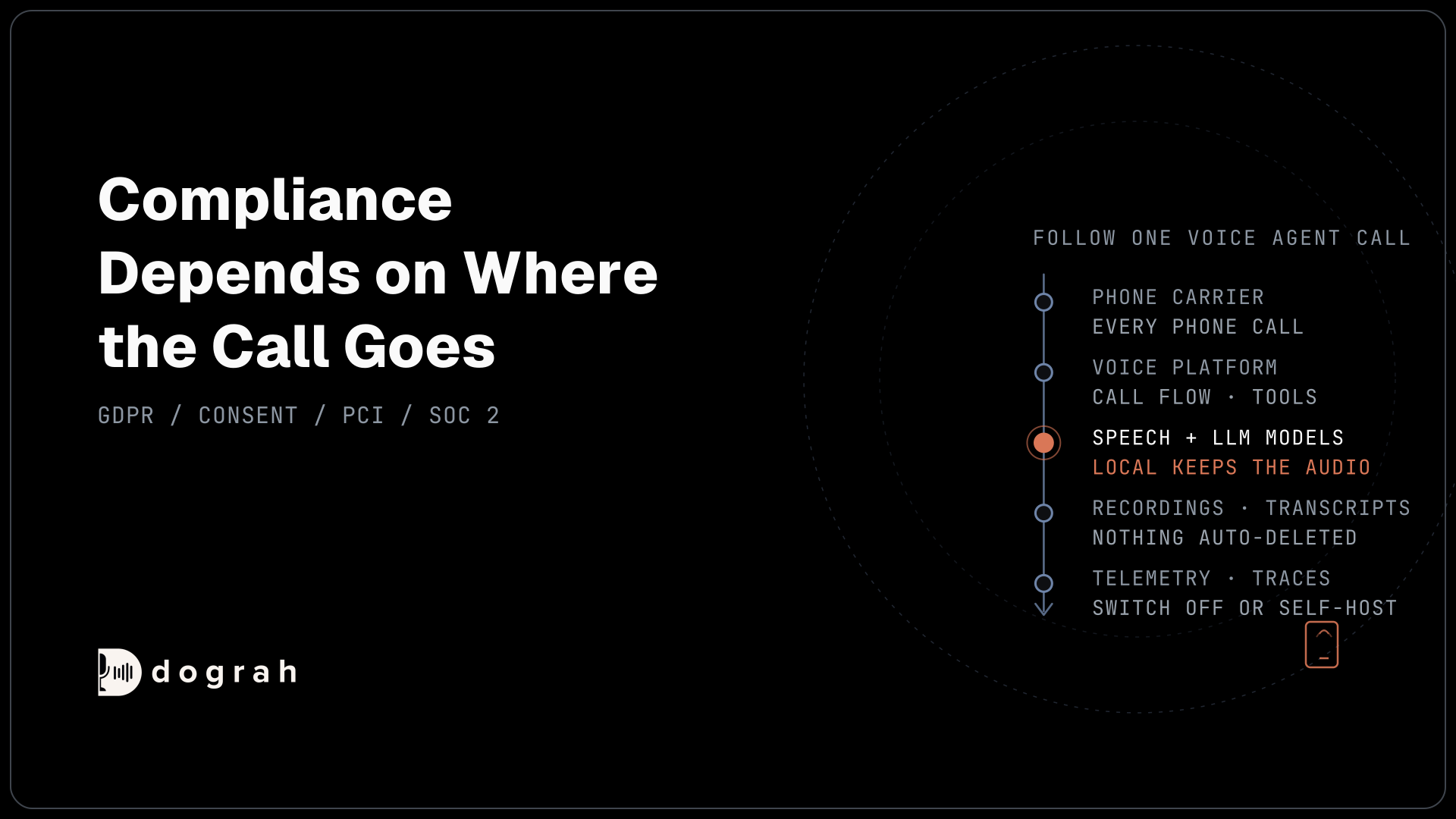
The biggest change from Synthflow is the model layer. Dograh is the orchestration layer: it runs the call flow, tools and telephony, and the speech and language models are a separate layer you choose. That can be Dograh's own models, a provider on your own key, or open-weight models you host. The call audio stays in-house only when the speech and language models run on your own servers too. Our guide to running voice AI on local, self-hosted models covers that stack.
Dograh runs on your own phone setup: Twilio, Vonage, Plivo, Telnyx, Cloudonix, Exotel, Vobiz or Asterisk ARI, and on Dograh Cloud, Dograh Managed SIP connects your own SIP trunk or PBX. Transfer Call works on Twilio, Telnyx and Asterisk ARI. It passes no summary by default; on Twilio it can play a short spoken introduction to both people. Write the details to your system with an HTTP API tool before the transfer.
For patient calls, self-host Dograh. No BAA with Dograh is needed, because Dograh never sees the data. Your speech and language providers may need their own BAA, and your phone carrier may too. Dograh starts every account on its own managed models. To keep call audio away from Dograh, open Models, switch the Organization default to BYOK with your own speech and language providers (or local models), and check that no agent has its own model override.
For agencies, Dograh connects to Paygent, which tracks each call's usage and invoices clients at your own rates.
Self-hosting uses Docker Compose and runs 10 calls at once by default, a limit you can raise. Self-hosted Dograh has no per-minute platform fee (servers, model keys and phone minutes still cost); Dograh Cloud has a 1¢-a-minute platform fee. Cloud includes 10 concurrent calls, with more on request. Our Dograh vs Synthflow comparison sets the two side by side.

Open Source Alternative to Vapi / Retell
Self-hosted voice agent platform — no per-minute fees
dograh-hq/dograh
Star on GitHub
Hosted alternatives to Synthflow
Five hosted Synthflow competitors come up most often, and each sells a self-serve plan.
Vapi
Vapi is a self-serve developer platform, where Synthflow is a sales-led one. Models pass through at the provider's price, or you bring your own keys or a custom LLM. Vapi retired its visual Workflows on 18 August 2026, so a team that wants to draw calls as nodes will miss the Flow Designer there. See Vapi vs Synthflow, and Vapi alternatives for Vapi's side of the field.
Retell AI
Retell bills each part of a minute separately, from $0.055 for voice infrastructure up to $0.31 in total. It has a visual Conversation Flow builder, a choice of language models including OpenAI's realtime speech-to-speech models, and a BAA that pay-as-you-go customers sign themselves. Retell also says it does not operate services within the European Union, where Synthflow has an EU cluster. See Retell AI vs Synthflow, and Retell AI alternatives for Retell's side of the field.
Bland AI
Bland runs entirely on its own speech and language models, and one per-minute rate covers them. Start allows 100 calls a day and Build 2,000, so a busy day can hit a cap. Bland picks every model on its self-serve plans, while Synthflow's older workspaces get only Synthflow LLM. See Bland AI vs Synthflow, and Bland AI alternatives for Bland's side of the field.
ElevenLabs Agents and Voiceflow
ElevenLabs Agents comes from a text-to-speech company, with the easiest free start and the language model billed on top. Voiceflow builds one support agent for chat and phone, with private cloud hosting on Enterprise. Its own numbers can't place outbound calls, so outbound runs on your Twilio, Vonage or Telnyx number. Our Synthflow vs Voiceflow comparison puts the two side by side.
Open-source routes: LiveKit Agents and Pipecat
Bland sells on-prem deployment on Enterprise, but only open source lets you read, change and run the code without a contract. Neither alone keeps call audio in-house. That also needs self-hosted models.
Pipecat is a Python framework from Daily, and Dograh itself is built on a fork of it. In our experience it is an excellent base, but production adds phone integrations, call history, QA on live calls and the call lifecycle. LiveKit Agents runs on the LiveKit media server, and both have managed clouds.
If open source is your main reason for leaving, our post on the open-source alternative to Synthflow covers what changes when you own the platform.
What Synthflow costs, and what the contract covers
Synthflow sells one plan, Enterprise, with contracts from $30,000 a year, and the contract buys more than minutes.
It covers Synthflow's own telephony or approved enterprise telephony, integrations with your CRM, calendar and contact-centre stack, security review, and implementation through launch. Usage is counted per second, and your exact rates come from your agreement. Against that floor, Vapi, Retell AI, Bland AI and ElevenLabs Agents all start on self-serve plans. Our breakdown of Synthflow pricing works out what that floor means each month.
When staying on Synthflow makes sense
If you want the vendor to scope, build and launch the agent under one contract, Synthflow sells exactly that. Implementation, testing and launch support sit inside the price, and its native telephony covers Twilio, Telnyx, RingCentral RingCX, Vonage, 8x8, Zoom and Five9.
If your buyers need certificates on the vendor, Synthflow's trust center lists SOC 2 Type 2, ISO/IEC 27001 and PCI DSS v4.0.1. Its EU cluster keeps all data and processing in the European Union, and it offers a toggle that deletes transcripts, recordings and caller IDs after 30 days, plus PII redaction for transcripts, webhooks and logs.
Because you self-host Dograh inside your existing compliance perimeter, you don't need a separate vendor review for Dograh, though your model providers may still need their own review unless they run on your servers. Self-hosting does put uptime in your team's hands.
What moving off Synthflow takes
Moving can happen one number at a time, so Synthflow keeps answering calls until each rebuilt agent passes its tests. Plan for more work than it looks: in a Zapier survey of US enterprise executives published in April 2026, 58% of those who had tried to switch AI vendors said the move failed or took far more effort than expected. A written spec for each agent and a fallback on Synthflow keep that risk small.
Synthflow's Export to JSON downloads an agent version's settings, but it leaves out actions and knowledge bases, so list those by hand. Dograh has no one-click Synthflow import, so treat the export as a spec and rebuild the flow, by hand in the builder or with an AI assistant that reads the JSON and builds the agent through Dograh's MCP (Model Context Protocol) server.
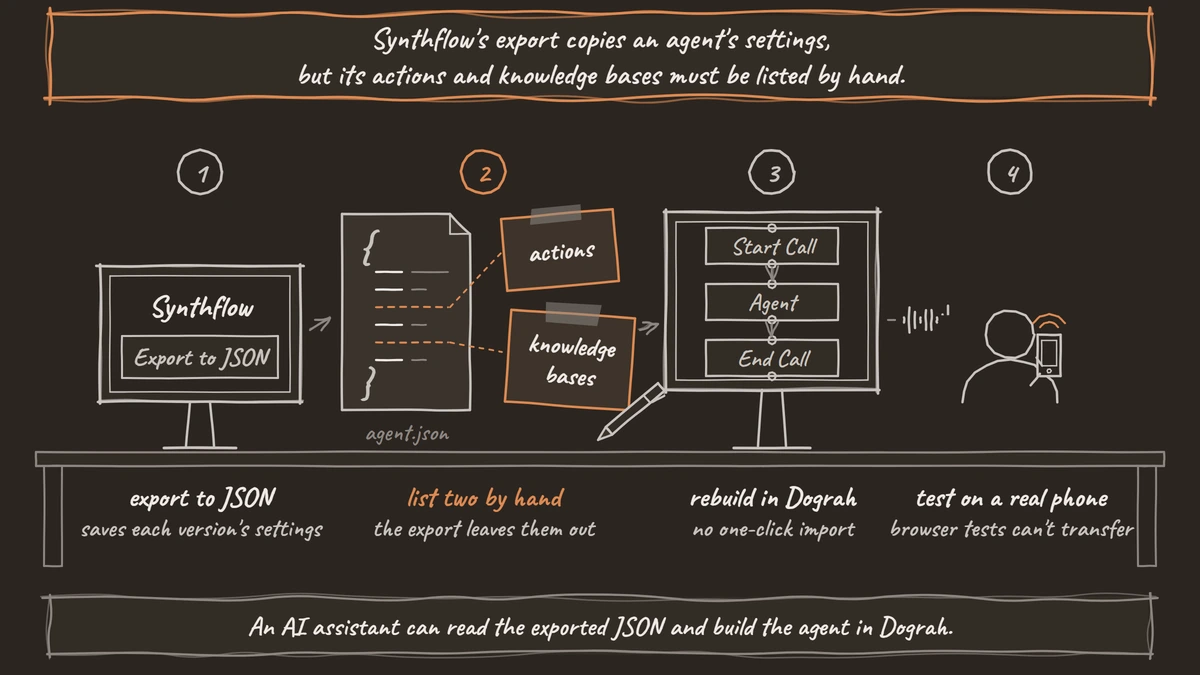
A Prompt Builder agent becomes one prompt in a Dograh node, and a Flow Designer agent becomes nodes and pathways. Synthflow's Trigger Subflow hands the call to a sub-agent and comes back. In Dograh you draw one pathway into that part of the workflow and one back to the next step. The return is not automatic.
For numbers in your own Twilio account, connect the account to Dograh and set each number's inbound workflow. Numbers on your own carrier or PBX connect through Dograh Managed SIP on Cloud, or Asterisk ARI when self-hosted. For numbers bought through Synthflow, ask Synthflow about porting them. Test each rebuilt agent on a real phone line before any number moves, because browser test calls cannot transfer. The full walk-through is in how to migrate from Synthflow to open-source voice AI.
Join the Dograh Community
Dograh is an OSS alternative to Vapi. Join our Slack community for queries, releases, best practices & community interactions.
Picking your Synthflow alternative
Teams that would rather write the agent in code can start with LiveKit Agents or Pipecat. On a hosted self-serve plan, Vapi suits developers who want an API, Retell AI teams that want a BAA without a contract, and Bland AI teams happy for the vendor to pick every model. ElevenLabs Agents is the easiest free start, and Voiceflow fits one agent across chat and phone. Stay on Synthflow if you want the vendor to build and launch the agent under one contract.
If call data has to stay on your own servers, Dograh answers the gaps that start most of these searches. It is open source under BSD-2-Clause, so you can self-host it without an annual contract and with no per-minute platform fee. You choose every model, from your own provider keys to open-weight models on your own servers, and your numbers stay with your carrier. On-prem support comes on Enterprise if you want a contract. To try it, run it from GitHub with Docker Compose, or start on Dograh Cloud.
Whichever you shortlist, run the same call script on a real phone line, because most phone calls reach the agent as 8 kHz audio, while a browser demo runs at 16 kHz.
Each part of this guide has its own deep dive:
- Dograh vs Synthflow
- Open-Source Alternative to Synthflow
- Synthflow Pricing Explained
- How to Migrate From Synthflow to Open-Source Voice AI
- Vapi vs Synthflow
- Retell AI vs Synthflow
- Bland AI vs Synthflow
Glossary
- Flow Designer
- Synthflow's visual call builder, where each node handles one part of the call and branches decide where it goes next. Each Synthflow agent uses either the Flow Designer or a single prompt, never both.
- Concurrency
- How many calls a platform runs at the same time. Synthflow scopes it in the Enterprise contract; self-hosted Dograh runs 10 by default, a limit you can raise.
- Platform fee
- What a voice AI vendor charges for running the call itself, separate from the models and the phone line. Self-hosted Dograh has no per-minute platform fee.
- Bring your own key (BYOK)
- Using your own account with a model provider instead of the platform's. You hold the contract and the bill, but the call audio still goes to that provider.