
Bland AI and Synthflow are both hosted and closed source. Bland is self-serve, and one rate covers its own models: $0.14 a minute on Start, or $0.12 on Build plus $299 a month. Synthflow sells one plan, Enterprise, with contracts from $30,000 a year. For code you can run yourself, there is Dograh, an open-source, self-hostable voice agent platform.
Key Takeaways
- Bland starts self-serve with daily call caps; Synthflow contracts start at $30,000 a year.
- Bland runs only its own models on self-serve plans; Synthflow's model list depends on plan.
- To choose every model and self-host without a contract, run Dograh, which is open source.
This post is part of our guide to Synthflow alternatives. The guide's section "Hosted alternatives to Synthflow" puts the Bland comparison in one line: "Both vendors narrow model choice below the top tier, in different ways." Here are the two side by side, on that point and every other one that changes a buying decision. The last section covers Dograh, an open-source, self-hostable voice agent platform.
Self-serve plans against an annual contract
Bland sells plans you can start on today, while Synthflow sells a contract you scope with its sales team.
| Row | Bland AI | Synthflow |
|---|---|---|
| How you buy | Self-serve: Start $0.14/min with no platform fee; Build $0.12/min plus $299/mo; Enterprise contracted to your volume | One plan, Enterprise, with contracts from $30,000 a year, scoped by volume, concurrency, telephony and integrations. But every contract goes through sales |
| What a minute covers | Bland's own speech, language and voice models, with no token charges. But phone time is billed separately | Rates set in your agreement, counted per second |
| Calls at once and per day | 10 at once and 100 a day on Start; 50 at once and 2,000 a day on Build. But a busy day can hit a cap | Scoped with Synthflow in the contract; calls over the limit get an error or wait briefly in a queue |
| Models | Bland's own models only, on Start and Build | GPT models from GPT-4o to GPT-6-Luna, plus Synthflow LLM, on Enterprise |
| Builder | Bland Agents, the successor to Conversational Pathways, and Norm, an AI assistant that builds from a prompt | Prompt Builder or the visual Flow Designer, one per agent, plus Workflows for the steps around a call |
| Phone | Numbers at $15/mo in the US and Canada, or your own Twilio account; SIP through an entitlement support enables for Enterprise organisations | Synthflow's native telephony, your Twilio account, or your SIP trunk or PBX; bought numbers cover the US, Canada and Australia |
| HIPAA | BAA on Enterprise only | A BAA signed with the contract for the HIPAA Setting, which is off by default |
| Where it runs | Bland's cloud on Start and Build; on-prem or VPC deployment on Enterprise | Synthflow's own cloud, with region-based hosting in the US and EU |
| Certificates listed | SOC 2 Type I and Type II, HIPAA, GDPR, PCI DSS (self-attested), ISO 27001, FedRAMP 20x Class A | SOC 2 Type 2, ISO/IEC 27001, PCI DSS v4.0.1, HIPAA, GDPR |
The Bland figures come from Bland's pricing page, which lists a 99.9% uptime SLA on every plan.
What each one costs at your volume
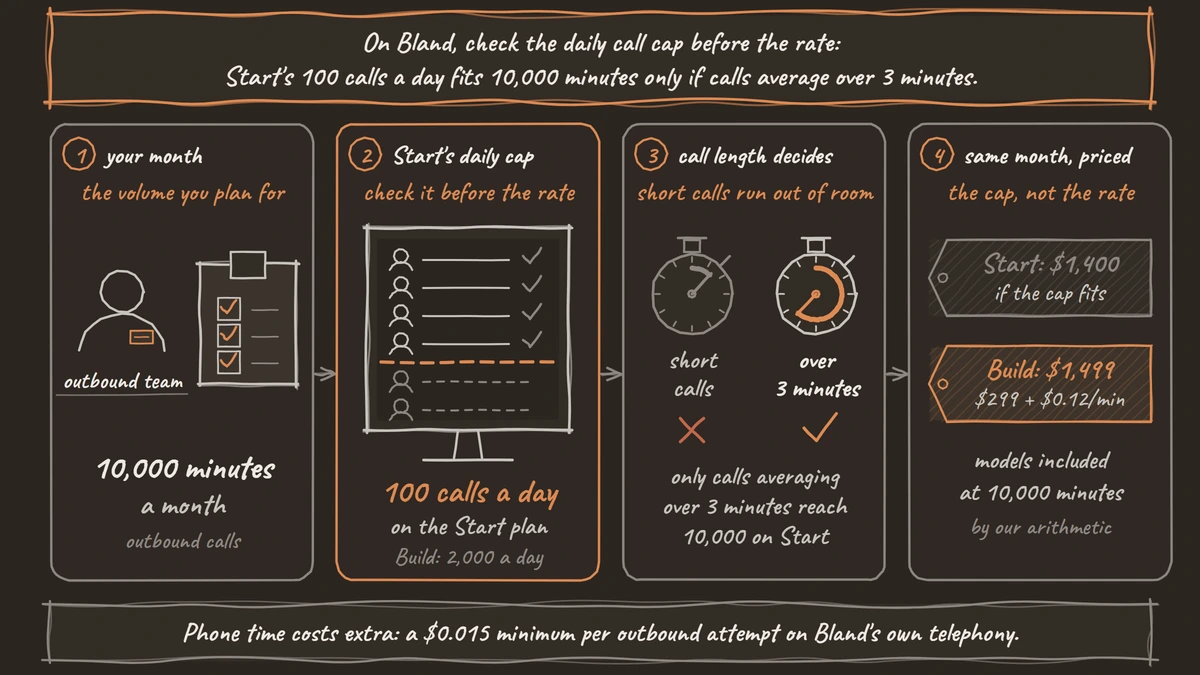
Bland's bill is easy to work out from its rate and caps, while Synthflow's starts at a fixed annual floor. On Bland, by our arithmetic from its list prices, 10,000 minutes a month costs $1,499 on Build ($299 plus $0.12 a minute), with the models included. Start would come to $1,400, but its cap of 100 calls a day only fits 10,000 minutes if calls average more than three minutes. Phone time sits on top, and Bland's billing page adds a $0.015 minimum for each outbound attempt and each failed call on Bland's own telephony. Our breakdown of Bland AI pricing prices every line.
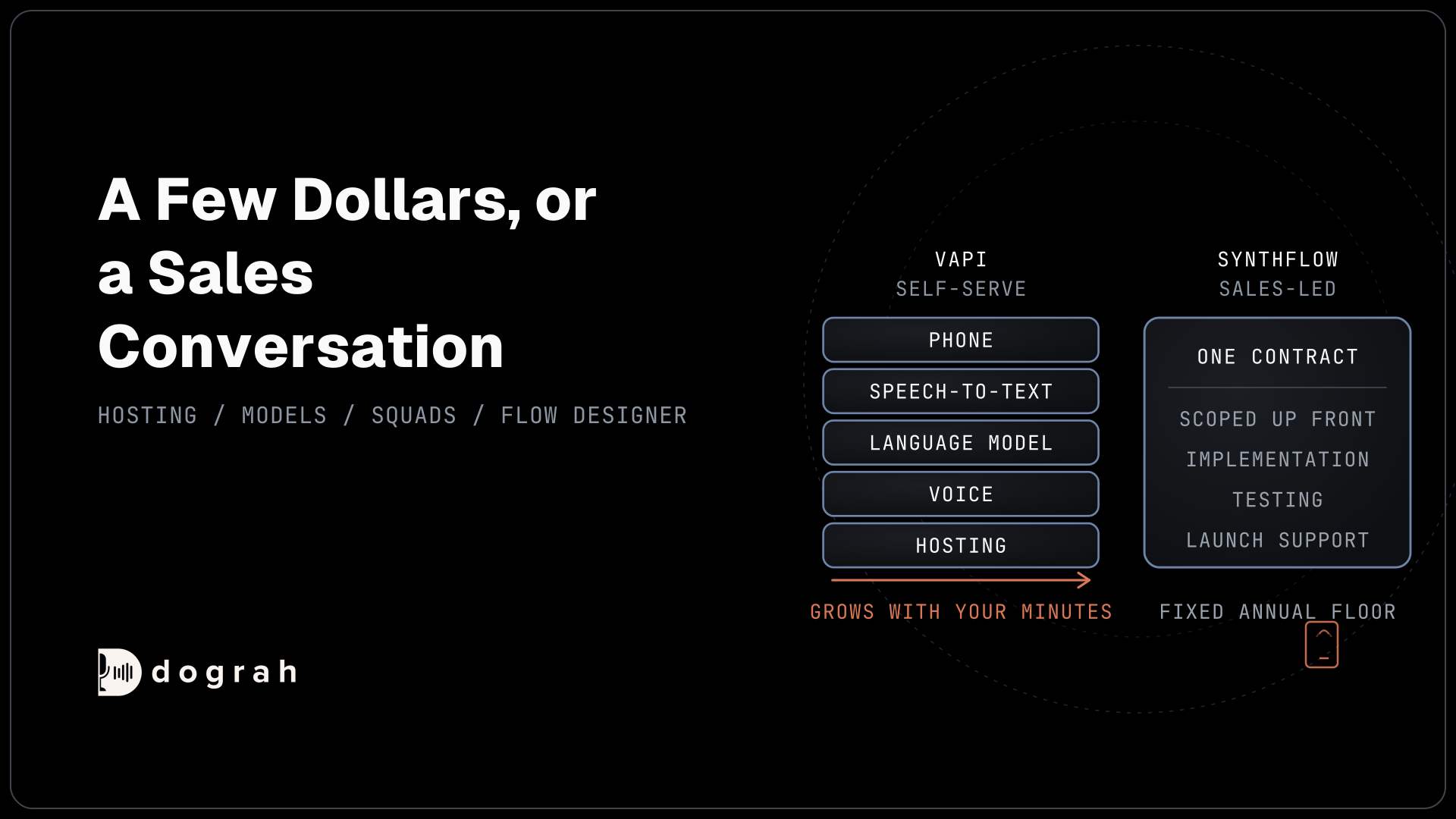
On Synthflow, the pricing page says "Enterprise contracts start at $30,000 annually," with the final price "scoped around call volume, concurrency, telephony setup, integrations, security needs, and launch support." The contract also buys implementation, testing, training and launch support, work Bland leaves to you.
So a pilot costs a few dollars on Bland, while on Synthflow it starts with a sales conversation. Our post on Synthflow pricing explains what the contract covers and how the floor works out each month.
Who picks the models
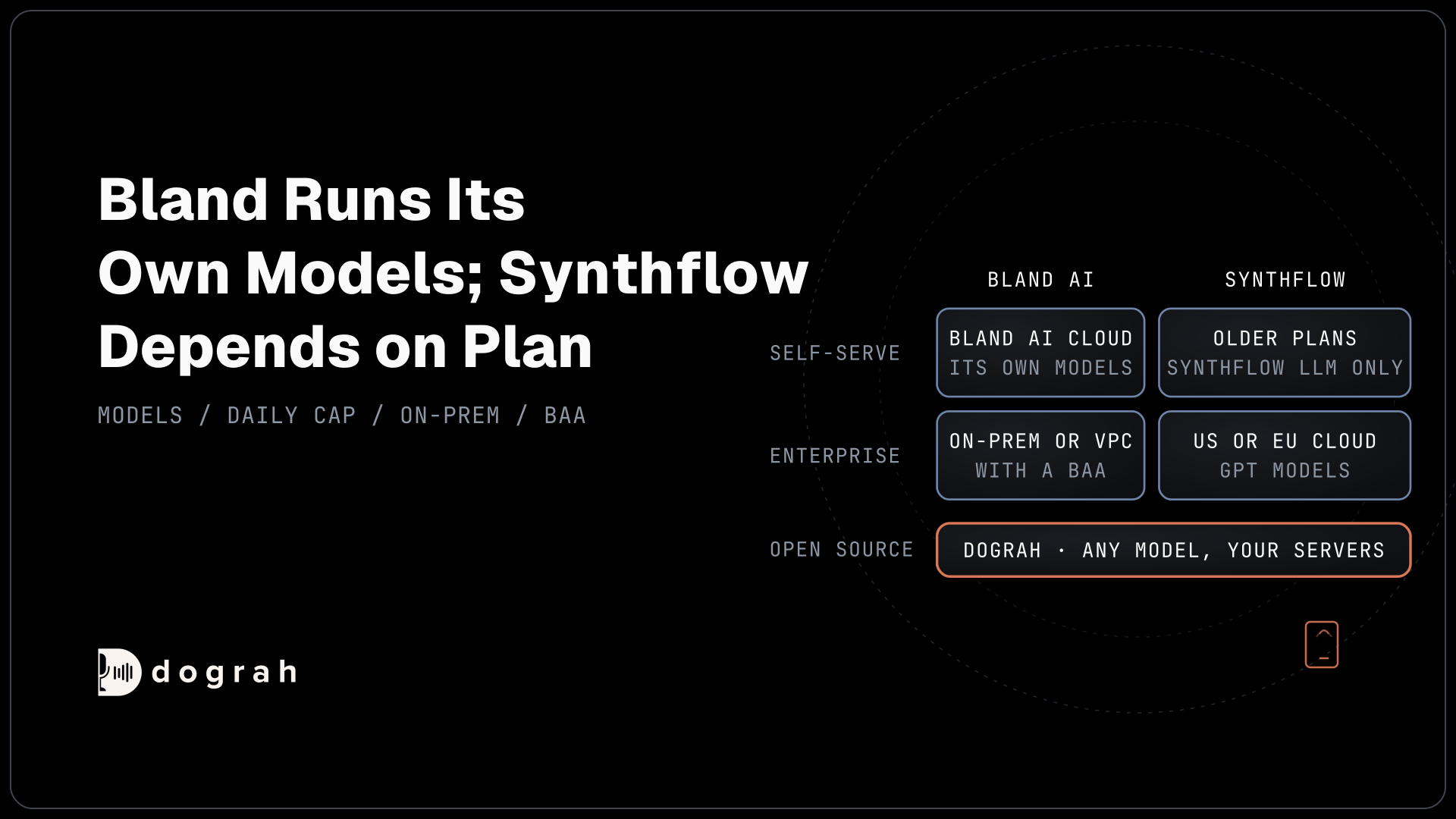
Both vendors keep model choice narrow below their top tier, each in its own way. Bland calls itself "the only voice AI that runs entirely on its own models." Its rate covers the speech, language and voice models in one number, with "No token charges. No model-provider pass-throughs." You get one team to call when a model misbehaves, and no third-party AI provider hears the call. In exchange, on Start and Build you cannot move to another provider's model.
Synthflow's model settings list OpenAI models from GPT-4o to GPT-6-Luna, plus Synthflow LLM and Advanced Synthflow LLM, and say "GPT and other third-party models are only available on Enterprise plans." Every plan on sale is Enterprise, so the line that Synthflow LLM is the only model below Enterprise applies to workspaces on the older Pro, Growth and Agency plans. Your own OpenAI key appears only when BYOK access is enabled for your account.
Building an agent: Bland Agents or the Flow Designer
Both platforms draw a call as connected steps, and Bland is partway through moving to a new builder. Bland's original builder, Conversational Pathways, is being replaced by Bland Agents. Bland's migration guide says "All production agents need to be migrated to the new agent architecture by November 15." A pathway's node graph becomes a pathway inside an agent, and agents add environments and versioned snapshots. Norm, Bland's AI assistant, builds, edits and tests agents from a prompt.
On Synthflow, each agent uses either Prompt Builder, where one prompt defines the agent, or the Flow Designer, with nodes for conversation steps, branches, call transfer and real-time booking. A Trigger Subflow node hands the call to a sub-agent and returns to the main flow when it finishes. Every publish saves a new version, and each version can be exported to JSON, without its actions or knowledge bases. Teams already on Bland have to move each production agent to Bland Agents anyway, which makes the rebuild a natural point to compare.

Open Source Alternative to Vapi / Retell
Self-hosted voice agent platform — no per-minute fees
dograh-hq/dograh
Star on GitHub
HIPAA, private hosting and certificates
Both keep their BAA inside an Enterprise contract, and they offer different kinds of private hosting. Bland signs a business associate agreement on Enterprise only, along with single sign-on and data residency. Synthflow signs its BAA at contract signing for customers using the HIPAA Setting, which is off by default. Generally, whichever vendor signs, a BAA hands it obligations while your own HIPAA duties stay with you; confirm your position with counsel.
For private hosting, Bland lists on-prem or VPC (virtual private cloud) deployment on Enterprise, and the software stays closed source. Synthflow runs on its own cloud, with region-based hosting in the US and EU. Its EU cluster keeps all data and processing in the European Union, and it is retiring its older Global cluster during Q4 2026.
On certificates, Bland lists SOC 2 Type I and Type II, ISO 27001, PCI DSS (self-attested) and FedRAMP 20x Class A. Synthflow's trust center lists SOC 2 Type 2, ISO/IEC 27001 and PCI DSS v4.0.1.
Picking between them
Pick Bland if you want to start today on one rate that includes the models, and your daily volume fits its caps. Pick Synthflow if you want the vendor to build and launch the agent under one contract, with a drawn flow and US or EU hosting.
High-volume outbound teams should check Bland's caps before its rate: Start allows 100 calls a day and Build 2,000. Teams weighing a third hosted option can read Vapi vs Synthflow and Retell AI vs Synthflow.
Run the same call script on both over a real phone line before you sign. Most phone calls still reach the agent as 8 kHz audio, while a browser demo runs at 16 kHz, so a demo that sounds sharp can mishear callers on the phone.
Where an open-source platform fits
Both are hosted and closed source, and both keep model choice and private hosting behind their top tier. Neither gives you code you can run without a contract, and that is where Dograh fits.
| Question | Bland AI | Synthflow | Dograh |
|---|---|---|---|
| Open source | No | No | Yes, BSD-2-Clause |
| Run it on your own servers | On Enterprise only | Runs on Synthflow's cloud, US or EU | Yes, self-host for free |
| Choose the models | Not on self-serve plans | GPT list on Enterprise | Yes, including open-weight models you host |
| Daily call cap | 100 on Start, 2,000 on Build | Set in the contract | None self-hosted; your servers and phone provider set the limit |
Dograh is open source under BSD-2-Clause, and its GitHub repository, with more than 5,900 stars, holds the whole platform. Its visual workflow builder joins nodes with pathways, each with a written condition the AI reads, so a team used to Bland's pathways or the Flow Designer will find it familiar. Campaigns run outbound lists, and self-hosted Dograh runs 10 calls at once by default, a limit you can raise.
Dograh is the orchestration layer: it runs the call flow, tools and telephony, and the speech and language models are a separate layer you choose, from Dograh's own models to a provider on your own key or open-weight models you host. The call audio stays in-house only when the speech and language models run on your own servers too. Your numbers stay with your carrier, such as Twilio, Vonage, Plivo or Telnyx. Transfer Call works on Twilio, Telnyx and Asterisk ARI. It passes no summary by default; on Twilio it can play a short spoken introduction to both people. Write the details to your system with an HTTP API tool before the transfer.
Self-hosted Dograh has no per-minute platform fee (servers, model keys and phone minutes still cost); Dograh Cloud has a 1¢-a-minute platform fee. Cloud includes 10 concurrent calls. Self-hosting puts uptime in your team's hands, and since there is no one-click import from Bland or Synthflow, each agent is rebuilt.
Dograh is the strongest fit when you want to choose every model and run the platform yourself without an Enterprise contract, because the code is yours to run. To try it, self-host it with Docker Compose, or start on Dograh Cloud.
Join the Dograh Community
Dograh is an OSS alternative to Vapi. Join our Slack community for queries, releases, best practices & community interactions.
Glossary
- Daily cap
- The most calls a Bland plan can place in a day: 100 on Start and 2,000 on Build; on Enterprise, Bland lists daily calls as unlimited.
- Bland Agents
- Bland's current builder and the successor to Conversational Pathways. A pathway's node graph becomes a pathway inside an agent, and production agents must move to it by 15 November 2026.
- Flow Designer
- Synthflow's visual call builder, where each node handles one part of the call and branches decide where it goes next. Each Synthflow agent uses either the Flow Designer or a single prompt.
- Attempt minimum
- Bland's $0.015 charge on each outbound dial and each failed call placed on its own telephony, on top of the per-minute rate.